


- ABSTRACT:
- 1. INTRODUCTION
- 2. LITERATURE REVIEW
- 3. METHODOLOGY
- 4. RESULTS
- 5. DISCUSSION
- IMPLICATIONS
- CONCLUSION
- LIST OF ABBREVIATIONS
- AUTHORS' CONTRIBUTIONS
- ETHICAL APPROVAL & INFORMED CONSENT
- AVAILABILITY OF DATA AND MATERIALS
- FUNDING
- CONFLICT OF INTEREST
- ACKNOWLEDGEMENTS
- DECLARATION OF AI
- APPENDIX A-QUESTIONNAIRE
- REFERENCES
Article ID: PDT2601203001
Views: 425The Relation Between Perceived Staffing Adequacy, Customer Experience Strategy and Customer Loyalty: The Moderating Role of Perceived PVCEA
 Article DOI
10.67887/PDT2601203001
 PDF
⬇ Downloads: 22
1Imam Abdulrahman Bin Faisal University, Dammam, Saudi Arabia
Received: 25 April, 2026
Accepted: 24 May, 2026
Revised: 21 May, 2026
Published: 29 May, 2026
ABSTRACT:
Introduction: This study aimed to explore the association between perceived staffing adequacy, Customer Experience Strategy (CES), and customer loyalty in the Saudi Arabian retail sector and evaluate the moderating influence of the Perceived Vision 2030 Consumer Economic Agenda (PVCEA). This study uses the Social Exchange Theory (SET) and Institutional Theory as its theoretical framework.
Methodology: A structured survey questionnaire using a five-point Likert scale and purposive sampling method were used to collect data from 488 retail customers in Saudi Arabia, using purposive sampling approach. Partial Least Squares Structural Equation Modelling (PLS-SEM) was used to determine the relationships.
Results: The results showed a positive and significant association between customer loyalty, perceived staffing adequacy, and Customer Experience Strategy in Saudi Arabia’s retail industry. Customer Experience Strategy showed a relatively strong association with customer loyalty. Moreover, the Perceived Vision 2030 Consumer Economic Agenda (PVCEA) significantly moderated the association between perceived staffing adequacy, Consumer Experience Strategy (CES), and customer loyalty.
Conclusion: This study’s novelty lies in its focus on the role of consumer perception of macro-level policy reform (PVCEA) as a boundary condition in determining the association between staffing adequacy, Customer Experience Strategy and customer loyalty. It combines social exchange and institutional theories to provide a basis for understanding how perceptions of institutional reforms affect consumer judgments of service inputs and differentiate between strategic service signals and generic measures of service quality in the changing environment of the Saudi Arabian retail sector.
Keywords: Customer loyalty, perceived staffing adequacy, CES, Vision 2030, Saudi retail sector, institutional theory.
1. INTRODUCTION
Saudi Arabia’s retail industry is at the crossroads of radical economic change and consumer market development in the Middle East. In the last ten years, Saudi Arabia has grown to be the biggest retail economy in the Gulf Cooperation Council, with both online and offline consumer spending skyrocketing as the country is urbanising, income levels are increasing, and the population of young techno-savvy people alters the consumption trend (Arab News, 2026; Consultancy Middle East, 2025). As reported by Knight Frank (2025), Saudi retail expenditure reached SAR 1.41 trillion in 2024, and e-commerce transaction volume is rapidly increasing and is projected to account for almost 50% of the overall retail transactions by 2030 as part of the digital economy push of the Vision 2030 agenda.
This accelerated market growth is part of the larger PVCEA, which aims to diversify the Saudi Arabian economy by focusing on developing the non-oil private sector, consumer empowerment, and diversifying into a vibrant service economy, as indicated by Kayani and Alzaid (2025). As suggested by Saied et al., (2024), Vision 2030 includes a clear intention to reinforce the Consumer Economy Programme, become more competitive in the market, and offer enhanced services in critical sectors such as retail. In the context of these radical structural changes, there are critical underexplored concerns regarding how the adequacy of staffing and the Consumer Experience Strategy (CES) result in customer loyalty within this dynamic environment, and to what extent customer relationships depend on the perception of Saudi consumers of PVCEA.
Although the literature, such as Mutambik (2023) and Sun and Pan (2023) on service quality, agrees that the interaction between workers has a profound impact on the degree of customer satisfaction and loyalty, empirical support for the topic of staffing adequacy in the Middle Eastern retail sector is scarce and disjointed. Similarly, the Consumer Economy Agenda of Vision 2030, as a perceived moderating variable in consumer loyalty relations, has not been given significant scholarly coverage, even though it has been central to the policy of retail and consumer expectations, as Saied et al., (2024) highlighted.
In addition, although the relationship between service quality and customer loyalty has been extensively studied, there are several conceptual and theoretical gaps. Studies such as Zaid and Patwayati (2021) generally focused on staffing as a component of overall service quality measures, such as SERVQUAL, rather than conceptualising perceived staffing levels as a separate consumer perception that reflects the sufficiency, availability, and competence of the front line. Existing studies, such as Mutambik (2023) and Sun and Pan (2023), have tended to consider staffing as one component of broader service quality measures without conceptualising it as an independent consumer perception that reflects the sufficiency, availability, and competence of the front line. Similarly, research such as Makudza (2021) and Pappas et al., (2023) on customer experience has analysed it as a consumption outcome and not a deliberate organisational ability called Customer Experience Strategy (CES) that involves how the organisation’s interactions and experiences are designed with the customer throughout multiple customer touchpoints. Hence, the unique value of strategic experience management in customer loyalty is unclear. In addition, while some studies have started to consider Vision 2030 as an emerging theme in policy and economic development literature (Saied et al., 2024), prior investigations have not used consumers perceptions of macro-level institutional reforms as a contextual mechanism impacting the evaluation of firm-level service practices in the customer loyalty model. Thus, the main gap in the literature addressed in this research is conceptual, focusing on explaining the effect of strategic service signals and consumer-perceived institutional environments on customer loyalty in the Saudi retail sector.
In this study, we assume that staffing adequacy is a distinct construct which is not fully captured in broader service quality frameworks. In the field of traditional service quality models, the focus is mainly on consumers’ overall assessment of service performance in terms of reliability, responsiveness, assurance, empathy, and tangibles. In comparison, perceived staffing adequacy is a measure of consumers’ ratings of the number of available, competent, and sufficient employees in the front-line service area of a retailer. Therefore, staffing adequacy is not a judgement on the quality of service but a separate signal of the capability and operational resources of the organisation. Moreover, retailers could evaluate their service quality similarly, even though the degree to which they felt they had an adequate workforce was significantly different. Therefore, the independent analysis of staffing adequacy allows for a more detailed understanding of consumer perceptions of the level of investment by the retailer in the frontline service capacity and how these perceptions impact customer loyalty beyond the focus of traditional service quality dimensions.
This study addresses these gaps by assessing the effects of perceived staffing adequacy and Customer Experience Strategy on customer loyalty among Saudi retail consumers and the moderating effect of PVCEA on these relationships. This study contributes to the body of research by reconfiguring the construction of customer loyalty by providing a consumer interpretation of macro-level policy reform as a conditioning factor. By doing so, this study brings Institutional Theory out of its conventional emphasis on organisational adherence to regulatory and normative forces to a consumer-oriented approach, whereby institutional reforms serve as interpretive frames according to which customers make judgments and respond behaviourally. Moreover, the conceptualisation of the two strategic service signals, staffing adequacy and Customer Experience Strategy, in the present study contrasts with traditional service quality research, which regards service attributes as generic SERVQUAL-type dimensions.
The remaining sections of the article are analysed as follows: This section outlines the theoretical background, conceptualisation of the constructs, and hypotheses formulation for the proposed research model. Next, the methodology section presents the research design, research methodology, measurement instruments, sample, and analysis method. The empirical results are reported in the next section and discussed in terms of the other literature and theories that are relevant. Finally, this paper presents a summary of the main results, theoretical and practical implications, limitations of the study, and directions for future research.
2. LITERATURE REVIEW
2.1. Theoretical Framework
The theoretical basis of this study combines Social Exchange Theory (SET) with Institutional Theory to illustrate the process and situational dynamics that determine customer loyalty. SET articulates the relationship between positive service inputs and loyalty results because it is based on mutual interactions between customers and companies. Customers consider service encounters and base their choices on perceived benefits and costs, as proposed by Liu et al., (2026), indicating that they develop relational commitments when they realise that the benefits are positive. Personal perceptions of staffing sufficiency and Customer Experience Strategy are strategic service inputs in retail settings that indicate organisational investment in service quality. These inputs are perceived by customers as valuable benefits, and they respond with loyalty behaviours, as observed by Liu et al., (2026) and PhamThi and Ho (2024). Similarly, Hsiao et al., (2023) highlighted that frontline service interactions are an important exchange mechanism that may affect customer loyalty.
However, SET cannot answer the question of when these service inputs are perceived more favourably. In response to this limitation, Institutional Theory was developed, where the evaluations of stakeholders are influenced by the regulatory and normative environments suggested by Buallay et al., (2022). The PVCEA is the conceptual framework of this study in terms of the consumer-perceived institutional frame. Hsiao et al., (2023) argue that national reform agendas are salient institutional forces that condition consumer that condition consumer and Alqahtani et al., (2024) propose that alignment with socioeconomic goals is important for evaluating services. Therefore, favourable attitudes toward Vision 2030 reinforce the ways customers perceive the adequacy and experience strategies in staffing and increase their correlation with loyalty.
Institutional theory implies that not only does organisational behaviour change due to institutional environments, but perceptions of organisational actions are also highlighted in PhamThi and Ho (2024). In this study, as signified by Galleli and Amaral (2026) regarding institutional policies and frameworks, the PVCEA is viewed as a sub-institutional context at the consumer level that influences perceptions of retail service. From this perspective, Saied et al., (2024) also articulate that consumers who are positive regarding their perceptions of Vision 2030 have shown higher levels of optimism towards the reforms of the country, trust in institutions, and confidence in the modernisation of the retail sector. They assume that staffing levels prove that retailers are working to deliver good service, as required by the goals of national development. Likewise, strategies for improving customer experience could be interpreted as trustworthy indications of the company’s dedication to the consumer-centred change desired in Vision 2030. This psychological mechanism, in terms of institutional trust and positive evaluative framing, legitimises service initiatives and enhances their perceived value. Based on this, Institutional Theory suggests that the moderating effect can be attributed to people’s different perceptions of the overall institutional context in which they are engaged.
The moderating role of PVCEA is theoretically justified by the assumption that institutional environments affect not only organisational behaviour but also the cognitive frames that enable stakeholders to understand the behaviour of the organisation. The PVCEA among consumers could lead to greater confidence in the path of retail modernisation, trust in institutional reforms, and expectations of better levels of service for customers (Saied et al., 2024). This also makes them more likely to consider adequate staffing and strategically designed customer experiences as indicators of a retailer’s commitment to broader national reform objectives and not just a series of operational activities.
While the central theoretical perspective in this research is that PVCEA should condition the relationships between retailers’ service practices and customer loyalty, Institutional Theory also offers a justification for a direct link between PVCEA and loyalty. Due to the expected positive portrayal of Vision 2030, consumers’ confidence in the entire retail environment is likely to increase, meaning that this change will support improvements in service standards, market competitiveness, and consumer protection (Saied et al., 2024). Consumers’ trust in individual service events can also positively impact their general trust in retailers’ institutions in the altered market environment. In this context, customer loyalty is a function of the assessment of staffing levels and customer experience practices, but also an indicator of general trust and confidence in the sector’s future and its trustworthiness. Therefore, the moderating role of PVCEA is considered an institutional spillover effect, whereas the direct effect is a consumer’s evaluative framing of retailer service efforts. Complementing Institutional Theory, these roles are extended to help explain the development and contextual reinforcement of customer loyalty.
However, customers with fewer positive perceptions of Vision 2030 are more inclined to assess similar service practices in terms of their primary functional qualities, as found by Suriansha et al., (2024). Therefore, institutional theory predicts the moderating role not only that it does not predict the absence of service investment but also that the perception of the institution together with its perception of the services will influence the interpretation of the service investment, not whether it exists or not, as suggested by Dam and Dam (2021). This study gives Institutional Theory a new aspect beyond organisational compliance and establishes consumer-perceived institutional environments as evaluative frames that affect the effectiveness of firm-level service initiatives.
2.2. Conceptualisation of Key Constructs
In this study, the constructs were conceptualised as separate consumer perceptions that occur at various points in the service evaluation process. Perceived Staffing Adequacy is the consumer’s evaluation of the retailer’s staffing level, availability, and competency as a means of providing timely and effective service, as suggested by Fisher et al., (2021). According to Zaid and Patwayati (2021), staffing is hidden in the context of service quality and a broader strategic capacity. Staffing is part of a larger service quality measure, but it is overlooked in this broader context because it serves as a signal of resource capacity. In this perspective, Makudza (2021) argues that staffing adequacy is a measure of the adequacy of staff that captures consumers’ evaluation of the availability of staff and staff performance in service encounters, compared to general service quality which reflects the overall evaluation of the quality of the staff performing the services. Consequently, it can be considered a structural service input rather than a service output, in line with the arguments presented by Haque et al., (2024).
Perceived Staffing Adequacy can be conceptually separated from the overall concept of service quality. Traditional service quality measurement systems, such as SERVQUAL, measure customer perceptions of overall service quality based on five dimensions: reliability, responsiveness, assurance, empathy, and tangibility (Mutambik, 2023; Sun & Pan, 2023). In contrast, consumers’ perception of staffing adequacy is limited to their assessment of the availability, number, and competency of the store’s frontline employees to provide adequate and effective service in a timely manner (Suriansha et al., 2024). This construct does not assess the quality of the service received but rather reflects the customer’s perception of an organisational capability that can be used in the provision of service. As a result, it can be said that staffing is a strategic operational capability that relates to customers’ confidence in the retailer to provide services that satisfy customers’ expectations at all times. By separating the construct of service quality from customer loyalty, an important contribution of this study lies in its ability to isolate the distinct contribution of the front line in terms of their perceptions of the resources they have on the job to the customer’s loyalty towards the organisation.
Customer Experience Strategy is the consumer consciousness of how a retailer deliberately designs and coordinates a consistent, engaging, and seamless experience across points of contact the customer touchpoints throughout the experience, as specified by Bruckberger et al., (2023). Unlike service quality, this construct looks at the conscious management of interactions, not just the service performance, nonetheless, before, during, and after the purchase. According to Hsiao et al., (2023), Customer Experience is a strategic process that results from several interactions and channels.
Customer Experience Strategy (CES) is closely related to customer experience but should not be used as an interchangeable term. Customer experience is the consumer’s full cognitive and emotional appraisal formed upon the completion of a retailer’s service encounter, which is considered a result of the service encounter (Hsiao et al., 2023). However, the Customer Experience Strategy (CES) is true for retailers’ deliberate organisational ability to design, coordinate, and proactively manage customer interactions before they are evaluated in a multi-contacting manner (Pappas et al., 2023). It is not about consumer responses but about strategic decisions related to the journeys themselves, the uniformity of the service offered, and the involvement of physical and digital channels. Thus, Customer Experience Strategy (CES) is a managerial capability that leads to customer experience rather than the experience itself. By separating Customer Experience Strategy from customer experience, this study allowed for a focus on the impact of planned service initiatives on customer loyalty through more strategic organisational action than evaluation after the customer consumption of the product, thereby moving beyond the outcome-oriented approaches of consumer-centric customer experience research.
Finally, PVCEA reflects consumers’ perceptions that the national reform movement has raised the quality of retail, customer orientation, and service standards (Suriansha et al., 2024). This variable is an institutional frame, as opposed to the previous constructs developed at the firm level, that is, a macro-level definition that consumers use to define their retail experience. Staffing adequacy is considered a measure of service capacity, Customer Experience Strategy is a measure of service design, and Vision 2030 perceptions are considered a measure of institutional context and are independent within the proposed model.
2.3. Hypotheses Development
2.3.1. Perceived Staffing Adequacy and Customer Loyalty
The relationship between staffing adequacy in retail settings and customer loyalty has become increasingly important in retail and service management studies. Frontline employees have been the focus of service experiences in retail environments; hence, the display of availability, responsiveness, and competence of employees strongly influences how consumers rate service quality and consequent loyalty behaviour (Alqahtani et al., 2024). Dam and Dam (2021) explored the connections between staffing adequacy, customer satisfaction, and customer loyalty using survey data from 299 customers of a supermarket in Vietnam, which was analysed using PLS-SEM. Their results show that the quality of services is a major boost to customer loyalty and simultaneously reinforces brand image and customer satisfaction. Although the study conceptualises service quality as a multidimensional construct, the authors focus on employee responsiveness and reliability, which are strongly linked to staffing adequacy as a determinant of loyalty development. Nevertheless, the application of convenience sampling and the emphasis on a single urban retail setting restrict the extrapolation of the results to other markets where consumers and industries are undergoing radical changes.
Similar emphasis is placed in the operational research on the significance of staffing capacity to ensure the effective delivery of retail services. Diaz et al., (2025) examined the problem of operational constraints of 24-hour retail stores in the Philippines by qualitatively interviewing store owners and employees in the Philippines. The results indicate that staffing deficits, especially during peak times or night shifts, interfere with service provision and compromise customer experiences because they have to wait to be served and have inaccessible service experiences, which eventually negates their retention. However, the qualitative case study design is mainly indicative of managerial and operational views as opposed to consumer reviews and hence incapable of empirically estimating the direct impact of staffing adequacy on loyalty outcomes. These results are consistent with the Social Exchange Theory, which assumes that loyalty is a relational consequence of positive interactions with customers in terms of service, as reflected in the arguments of Suriansha et al., (2024). However, perceived staffing adequacy as a predictor of consumer-based loyalty has been investigated in previous studies. To address this gap, this study proposes the following hypothesis:
H1: There is a statistically significant and positive relationship between Perceived Staffing Adequacy and Customer Loyalty in the retail sector of Saudi Arabia.
2.3.2. Customer Experience Strategy and Customer Loyalty
The strategy of customer experience has been identified as an important factor in customer loyalty, especially in service-oriented industries, where value generation is realised at many points of interaction. Makudza (2021) proves that customer loyalty in the banking industry is largely determined by customer experience management, which involves virtual, physical, and service interaction. These observations are consistent with the Social Exchange Theory, which states that such positive experiential benefits are returned by customers in loyalty behaviours, as indicated by Dam and Dam (2021). However, the research is more operationalised to the dimensions of interaction instead of focusing on the experience as the wider strategic organisational potential. In addition, the industry-specific focus and cross-sectional survey design restrict the applicability of the results to different retail settings, where the elements of experience are more diverse.
Likewise, evidence is emerging in the e-retailing literature. Zaid and Patwayati (2021) concluded that customer experience has a positive effect on loyalty, both directly and indirectly, via engagement and satisfaction processes, using PLS-SEM with 512 participants. Although their results support the relational exchange perspective, the study uses a student sample and deals with digital retail environments; therefore, the findings can be questionable in terms of their applicability to the real-life retail world, where face-to-face service interactions are still at the centre. Specific information related to the retail sector is presented by Pappas et al., (2023), who also affirm that customer retention is greatly boosted when customer experience is improved in the contemporary retail setting.
However, the authors’ conceptualisation of customer experience is mostly a moderating product and not a strategic initiative planned by organisations to influence loyalty. To expand on this point of view, Kumar and Mokha (2021) state that technological programmes such as E-CRM can improve customer experiences and loyalty results. However, their review also found conceptual vagueness in the integration of customer experience and strategic relationship management in organisations. Taken together, these studies argue the significance of experience in influencing loyalty, though they lack empirical emphasis on the issue of customer experience as a unified strategic capability in retail markets. To fill this gap, this study hypothesises the following:
H2: There is a statistically significant and positive association between Customer Experience Strategy and Customer Loyalty in the retail sector of Saudi Arabia.
2.3.3. Moderating Role of Perceived Consumer Economic Agenda
Emerging markets are characterised by greater consumer expectations and relationships between firms and customers, as increased by national economic agendas and institutional reforms. According to Institutional Theory, macro-level policies establish regulatory and normative pressures which impact the way consumers judge organisational practices and service quality (Olaopa & Alsuhaibany, 2023). The PVCEA within the framework of Saudi Arabia is a significant institutional change that helps enhance consumer markets, boost the level of services, and promote competition in the private sector. Kumar and Mokha (2021) claimed that Vision 2030 changes have transformed consumer expectations in the Saudi retail industry, especially regarding service quality and customer-focused innovation. This research mainly utilises policy analysis and secondary economic information; thus, empirical knowledge of consumers’ perceptions of these institutional alterations relative to loyalty patterns is restricted.
Similarly, Ha (2021) explored the overall economic transformation in relation to Vision 2030 and found that institutional changes in favour of service excellence and workforce development prompt firms to enhance their operational and customer engagement strategies. Although the strategy of institutional alignment is emphasised in the study, its macroeconomic approach does not consider the dimension of consumer perception that accounts for behavioural responses such as loyalty. At the organisational level, Shibeika (2025) discovered that Vision 2030 efforts have compelled Saudi service organisations to enhance customer experience strategies and employee competence building to keep them competitive. Nevertheless, the qualitative design that considers managerial views limits the capacity to study the direct impact of such institutional initiatives on customers’ perceptions.
Similar arguments are made by Kumar and Venkatesan (2021), who propose that consumer trust and service expectations can be moulded by national transformation programs and have an indirect influence on loyalty results. However, they did not explicitly assess the moderating effects within the given service interactions in their cross-national comparative analysis.
Studies such as Ha (2021), Manyanga et al., (2022), and Shibeika (2025) have consistently shown that Vision 2030 has brought about innovation in services, work skills, and customer-centric transformation in retail services. However, most of these studies focus on organisational reactions to reform agendas and not on consumer surveys of their assessment. Similarly, Kumar and Venkatesan (2021) claim that national transformation programs impact service expectations and trust, but the impact of these perceptions on service outcomes depends on firm-level service practices. Based on the above, it can be concluded that while the literature reviewed shows that institutional reforms impact organisations and markets, their impact on the influence of perceived staffing levels and the Customer Experience Strategy (CES) on customer loyalty is limited.
Similarly, Manyanga et al., (2022) note that the consumer-based reforms of Vision 2030 stimulate retail organisations to promote workforce capacity and innovation in services, although there is no empirical validation based on consumer data. These studies show that institutional reforms affect the strategies of organisations and consumer expectations; however, few of them investigate how consumer perceptions of such reforms moderate the relationship between service practices and loyalty results. To fill this research gap, the following hypotheses are proposed. The conceptual framework of this study is shown in Fig. (1).
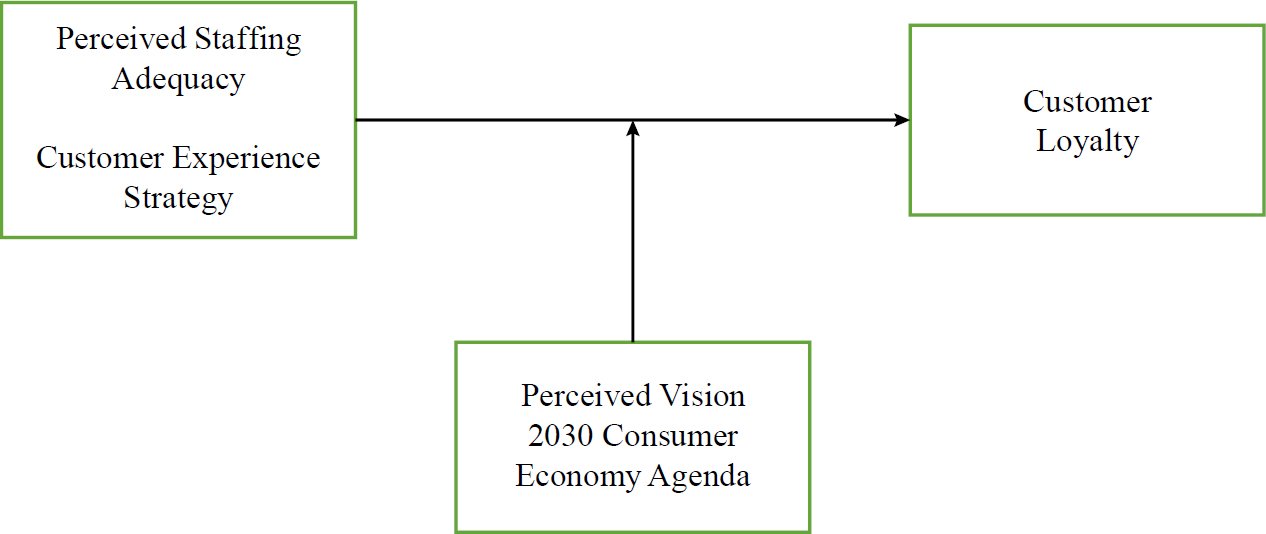
Fig. (1). Conceptual framework.
H3a: PVCEA positively moderates the relationship between perceived staffing adequacy and customer loyalty.
H3b: PVCEA positively moderates the relationship between Customer Experience Strategy and customer loyalty.
3. METHODOLOGY
3.1. Research Design and data Collection Instrument
This study followed a primary quantitative research design to empirically investigate the interrelationships between perceived staffing adequacy, Customer Experience Strategy, and customer loyalty, and the moderating effect of PVCEA. A survey questionnaire based on structured and closed-ended questions was used to collect data based on measurement items that obtained validity in the examination of the retail setting. The measurement scale was based on a five-point Likert scale ranging from 1 (strongly disagree) to 5 (strongly agree), which is generally suggested to yield perceptions and behavioural intentions in consumer research, as suggested by Abdallah et al., (2021). The questionnaire was segmented into four parts that stated the constructs of the study: PVCEA, Customer Loyalty, Perceived Staffing Adequacy, and Customer Experience Strategy.
3.2. Variable Construction and Operationalisation
The questionnaire comprised both adapted and newly developed measures. Items related to Customer Experience Strategy were adapted from Garg et al., (2014), and Customer Loyalty items were adapted from Bobâlcă et al., (2012). In contrast, PSA and PVCEA were developed for this study based on the conceptual definition and vision of the study. Specifically, a comprehensive literature review of Institutional Theory, consumer-driven economic reforms, modernisation of the service sector, and Vision 2030 policy initiatives contributed to the development of PVCEA items. Academic research, policy documents from the government, and reports on retail transformation, service levels, consumer empowerment, and competitiveness in the private sector in the context of Vision 2030 were analysed to find common themes. These themes served as a basis for drawing up an initial item pool to assess consumer perceptions of the impact of Vision 2030 on enhancing the standards in retail, customer orientation, and the overall environment of the consumer economy in Saudi Arabia.
Moreover, the instrument underwent content validation by a panel of three scholars who were knowledgeable and experienced in the field of consumer behaviour and retail management, which resulted in some minor changes to the wording and context of the items. Moreover, when the items were being evaluated by experts for consistency, items that showed some overlap in content and ambiguity or poor correspondence to the construct definition were either dropped or rewritten to ensure that the remaining items would reflect a coherent institutional perception of the attitude of the users and not a general policy attitude. To test item clarity, reliability, and preliminary validity, a pilot study was conducted with 75 retail consumers. The full measurement instrument is provided in Appendix A.
Four criteria were used to evaluate construct validity and reliability: Cronbach’s alpha, composite reliability, Average Variance Extracted (AVE), and discriminant validity. The values of Cronbach’s alpha and composite reliability were higher than 0.7 which showed stronger reliability of the construct. Further, the AVE values were higher than 0.5 which showed robust convergent validity.
3.3. Participants and Sampling
The target population was retail customers in Saudi Arabia with recent experience shopping at retail outlets. Participants were contacted on social media platforms such as Instagram, X (formerly known as Twitter), and Facebook, as this allowed us to reach a wider range of digitally active consumers. The sampling method used in this study was purposive sampling, which, as Ahmad and Wilkins (2025) explain, entails selecting respondents based on specific criteria relevant to the research purpose. This was deemed to be the right approach, as only customers with experience in retail purchasing and an understanding of service interactions can make significant assessments of perceived staffing adequacy and customer experience approaches. Purposive sampling is often used in similar consumer-focused research to guarantee that the participants are knowledgeable about the required experience, as suggested by Bouncken et al., (2026).
As recommended by Tilahun et al., (2023) the estimation of the required minimum sample size was done by G*Power whereby the sample size was estimated based on the statistical power (0.80), level of significance (0.05) and the expected medium effect size (0.15) when using multiple regression models, according to the recommendation. The analysis showed that the sample size should be above 200 respondents; thus, a larger sample was used to enhance the statistical strength. The number of consumers who received the questionnaire was approximately 800, with 540 of them completing the questionnaire, which is equal to a 67.5% response rate. After examining the missing answers and possible outliers, 52 questionnaires were eliminated, and the final sample comprised 488 respondents.
3.4. Addressing Selection Bias, Non-Response Bias and Common Method Bias
The issue of potential selection bias was reduced by dispersing the survey on various social media platforms to represent different population segments. As indicated by Wei et al., (2023), independent t-tests were used to compare early (n1 = 100) and late respondents (n2 = 100) to examine non-response bias. In addition, multicollinearity was tested based on the Variance Inflation Factor (VIF) method, in which lower values than the criterion of 3.3 indicate that there is no significant issue of multicollinearity, as suggested by Gaskin et al., (2025). In addition, the issue of Common Method Bias (CMB) was tested through Harman’s Single Factor Test, in which the total variance explained was found to be below 50% for the first factor, that is, 46.31%. This indicates that there is no CMB issue in the model. A full collinearity VIF was also used to assess common method bias, where a VIF below 3.3 indicated no CMB issue in the study (Table 5).
To reduce the likely impact of Common Method Bias (CMB), certain procedural remedies were applied throughout the questionnaire design and data collection process. Evaluation apprehension and socially desirable responses were minimised by guaranteeing that the respondents would not be personally identified and that their participation was anonymous and confidential. The questionnaire was clear and concise to ensure comprehension and reduce the chances of misunderstanding. Moreover, it was assessed by three academic experts and pilot-tested with 75 store consumers to enhance the clarity of the items and their context. The constructs were introduced separately to minimise the respondents’ responses to the study hypotheses. In addition to these procedural remedies, common method bias was statistically examined using the full-collinearity approach Variance Inflation Factor (VIF) results, which showed no significant common method problems, since all VIFs were below the recommended values.
3.5. Data Analysis
Partial Least Squares Structural Equation Modelling (PLS-SEM) with SmartPLS software was used for data analysis because it is appropriate for predictive models and complex relationships with moderating effects (Haji-Othman & Yusuff, 2022). The measurement model was analysed by initially testing the internal consistency reliability using Cronbach’s alpha and composite reliability, and convergent validity using Average Variance Extracted (AVE). This was followed by a path coefficient analysis to validate the hypothetical relationships and moderating relationship between the constructs.
4. RESULTS
4.1. Demographic Profile Analysis
The statistics shown in Table 1 portray the demographic profiles of the study participants. It is found that out of (N=488) respondents, 56.35% were males, and 35.86% were female, while 7.79% preferred not to answer. Among these participants, 30.74% were below 25 years of age, 24.59% fell in the age category of 25-34 years, 18.03% 35-44 years, and 14.34% were 45-54 years. In addition, most of the participants, that is, 27.66% and 25.61%, held bachelor’s and master’s degrees, respectively. On the other hand, 35.86% of the respondents do retail shopping 3-5 times per month, and 25.20% do it more than 5 times a month. Finally, regarding the preferred retail shopping platform, 46.11% preferred online shopping platforms, and 35.45% preferred omnichannel shopping.
Table 1. Demographics profile analysis.
| Demographic Category | Frequency (n) | Percentage (%) | |
| Gender | Male | 275 | 56.35% |
| Female | 175 | 35.86% | |
| Prefer not to say | 38 | 7.79% | |
| Age Range | Below 25 | 150 | 30.74% |
| 25–34 | 120 | 24.59% | |
| 35–44 | 88 | 18.03% | |
| 45–54 | 70 | 14.34% | |
| 55 and above | 60 | 12.30% | |
| Educational Qualification | Secondary | 118 | 24.18% |
| Diploma | 90 | 18.44% | |
| Bachelor’s | 135 | 27.66% | |
| Master’s | 125 | 25.61% | |
| Doctorate | 20 | 4.10% | |
| Frequency of Retail Shopping | 1–2 times per month | 90 | 18.44% |
| 3–5 times per month | 175 | 35.86% | |
| More than 5 times per month | 123 | 25.20% | |
| Preferred Retail Shopping Platform | Physical retail stores | 90 | 18.44% |
| Online retail platforms | 225 | 46.11% | |
| Omnichannel | 173 | 35.45% | |
4.2. Measurement Model Assessment
The measurement model of the study was assessed for internal consistency and reliability using Cronbach’s Alpha, Composite Reliability, and convergent validity using the Average Variance Extracted (AVE) method, as recommended by Cheung et al., (2024). The results are presented in Table 2.
Table 2. Measurement model assessment.
| Latent Variables | Indicators | Factor Loadings | Loading Significance | Cronbach’s Alpha | Composite Reliability (rho_c) | Average Variance Extracted (AVE) |
| Customer Experience Strategy | CES1 | 0.788 | 0.000 | 0.874 | 0.889 | 0.799 |
| CES2 | 0.894 | 0.000 | ||||
| CES3 | 0.874 | 0.000 | ||||
| Customer Loyalty | CL1 | 0.906 | 0.000 | 0.813 | 0.937 | 0.727 |
| CL2 | 0.923 | 0.000 | ||||
| CL3 | 0.908 | 0.000 | ||||
| Perceived Staffing Adequacy | PSA1 | 0.880 | 0.000 | 0.899 | 0.915 | 0.833 |
| PSA2 | 0.907 | 0.000 | ||||
| PSA3 | 0.863 | 0.000 | ||||
| Perceived Vision 2030 Consumer Economy Agenda | PV1 | 0.893 | 0.000 | 0.860 | 0.922 | 0.781 |
| PV2 | 0.925 | 0.000 | ||||
| PV3 | 0.862 | 0.000 |
The results presented in Table 2 indicate that the factor loadings of the measurement items ranged between 0.788 and 0.925, which is higher than the generally accepted 0.70, thus indicating strong indicators of latent constructs. All indicator loadings in the bootstrapping results were significant at p = 0.000 (0.05 level). This shows that each measurement item is an important component of its latent construct and that there is strong evidence of indicator reliability. This means that the measurement model accurately measures the latent constructs of the observed items, which strengthens it. Cronbach’s alpha and composite reliability were also higher than the suggested threshold of 0.7, indicating satisfactory internal consistency. In addition, the Average Variance Extracted (AVE) values were greater than 0.50, which is a sign of convergent validity.
4.3. Discriminant Validity
The separability among study variables and the issue of conceptual overlap were examined through discriminant validity using the HTMT ratio within the threshold of 0.85, as suggested by Haji-Othman and Yusuff (2022).
As shown in Table 3, it can be observed that all the HTMT values in the case of all the constructs are found to be lower than the threshold value of 0.85. This indicates that the study constructs were separated and distinguished from each other with no conceptual overlap.
Table 3. Discriminant validity.
| – | Customer Experience Strategy | Customer Loyalty | Perceived Staffing Adequacy |
| Customer loyalty | 0.435 | – | – |
| Perceived staffing adequacy | 0.532 | 0.500 | – |
| PVCEA | 0.331 | 0.478 | 0.367 |
Discriminant validity was further examined with respect to the study constructs using bootstrapped HTMT Confidence Intervals (CIs), as presented in Table 4. All confidence intervals excluded the value of 1.00, which is the standard for discriminant validity, thus providing sufficient evidence of discriminant validity for all construct pairs. The HTMTs ranged from 0.500 to 0.751, which is less than the recommended value of 0.85, and the 95% confidence intervals were clearly separated between constructs. Perceived Vision 2030 and Customer Loyalty had the highest HTMT value (0.751), but were still seen as being within acceptable limits. In general, the study results offer strong support for the separation of latent constructs and their conceptual independence.
Table 4. Confidence intervals.
| – | Original Sample (O) | Sample Mean (M) | 2.5% | 97.5% |
| Customer Loyalty <-> Customer Experience Strategy | 0.500 | 0.501 | 0.392 | 0.607 |
| Perceived Vision 2030 <-> Customer Experience Strategy | 0.600 | 0.601 | 0.502 | 0.692 |
| Perceived Vision 2030 <-> Customer Loyalty | 0.751 | 0.751 | 0.683 | 0.813 |
| Perceived Staffing Adequacy <-> Customer Experience Strategy | 0.649 | 0.650 | 0.564 | 0.733 |
| Perceived Staffing Adequacy <-> Customer Loyalty | 0.623 | 0.623 | 0.547 | 0.690 |
| Perceived Staffing Adequacy <-> Perceived Vision 2030 | 0.725 | 0.725 | 0.660 | 0.787 |
4.4. Cross Loadings
The cross-loading matrix used to evaluate discriminant validity is shown in Table 5. All items had high item-total reliabilities, with each item being more correlated with the construct it was being used to measure than the other constructs. More specifically, it was established that the items related to Customer Experience Strategy (CES) loaded between 0.788 and 0.894 on the construct, the items related to Customer Loyalty loaded between 0.906 and 0.923, the items related to Perceived Staffing Adequacy loaded between 0.863 and 0.907, and the Perceived Vision 2030 loaded between 0.862 and 0.925 on the corresponding constructs. There were several cross-loadings that were moderately correlated with the primary loadings but consistently lower than the primary loadings. These results further support the satisfactory discriminant validity and verify the empirical separation of all latent constructs from the measurement model.
Table 5. Cross loadings.
| – | Customer Experience Strategy | Customer Loyalty | Perceived Staffing Adequacy | Perceived Vision 2030 |
| CES1 | 0.788 | 0.335 | 0.390 | 0.346 |
| CES2 | 0.894 | 0.369 | 0.453 | 0.434 |
| CES3 | 0.874 | 0.392 | 0.546 | 0.514 |
| CL1 | 0.410 | 0.906 | 0.515 | 0.590 |
| CL2 | 0.387 | 0.923 | 0.461 | 0.595 |
| CL3 | 0.380 | 0.908 | 0.524 | 0.641 |
| PSA1 | 0.480 | 0.505 | 0.880 | 0.571 |
| PSA2 | 0.477 | 0.469 | 0.907 | 0.576 |
| PSA3 | 0.501 | 0.480 | 0.863 | 0.531 |
| PV1 | 0.459 | 0.612 | 0.628 | 0.893 |
| PV2 | 0.458 | 0.615 | 0.603 | 0.925 |
| PV3 | 0.460 | 0.561 | 0.454 | 0.862 |
4.5. Multicollinearity and Common Method Bias Using VIF
The issue of multicollinearity and CMB was addressed by examining the values of the VIF, which are specified in Table 6.
Table 6. Variance inflation factor.
| – | VIF |
| Customer Experience Strategy-> Customer loyalty | 2.547 |
| Perceived staffing adequacy -> Customer loyalty | 2.263 |
| PVCEA -> Customer loyalty | 1.798 |
| PVCEA x Customer Experience Strategy -> Customer loyalty | 2.076 |
| PVCEA x Perceived staffing adequacy -> Customer loyalty | 2.151 |
As depicted in the results, the values are below the standard threshold of 3.3, which rules out the issues of common CMB and multicollinearity in the model.
4.6. Path Coefficient
The results of the structural model (Table 7) show substantial relationships between the variables of this study. On the one hand, Customer Experience Strategy and customer loyalty have a direct positive statistically significant relationship (β = 0.270, p < 0.001), indicating that successful customer experience strategies can significantly contribute to increasing consumer loyalty within the retail industry. This observation confirms that managed service interactions and experience touchpoints motivate customers to have long-term relationships with retailers, supporting H2’s hypothesis.
Table 7. Path coefficients analysis.
| – | Path Coefficients | T-statistics | P-values | F-Square |
| Customer Experience Strategy -> Customer loyalty | 0.270 | 4.102 | 0.000 | 0.162 |
| Perceived staffing adequacy -> Customer loyalty | 0.100 | 2.098 | 0.026 | 0.035 |
| PVCEA -> Customer loyalty | 0.395 | 7.411 | 0.000 | 0.339 |
| PVCEA x Customer Experience Strategy -> Customer loyalty | 0.105 | 2.032 | 0.042 | – |
| PVCEA x Perceived staffing adequacy -> Customer loyalty | 0.057 | 2.051 | 0.032 | – |
Similarly, staffing adequacy had a positive but modest relationship with consumer loyalty (β = 0.100, p = 0.026). The magnitude of the effect is relatively smaller, but the outcome shows that customers who believe that the retail staff is adequate, responsive, and able to show higher chances of engaging in loyalty behaviours, which validates the acceptance of H1. Moreover, PVCEA has a direct and significant effect on customer loyalty (β = 0.395, p < 0.001), which means that it shows a notable direct association but requires careful and theoretical interpretation.
In terms of moderation, PVCEA was a modest significant moderator in the predictive relationship between Customer Experience Strategy and customer loyalty (β = 0.105, p = 0.042), and perceived staffing adequacy and customer loyalty (β = 0.057, p = 0.032). These results confirm that H3a and H3b are supported, indicating that perceptions of Vision 2030 support such associations. The practical significance of these predictors of customer loyalty varies, as shown in the f-square results. Based on the results, the effects of the Customer Experience Strategy (CES) and perceived staffing adequacy were moderate and small, respectively (f² = 0.162 and f² = 0.035). PVCEA had the highest level of influence (f² = 0.339) and was just over the threshold of a large effect on the model, indicating high practical relevance.
4.7. Moderation Plots
As shown in Fig. (2), there is a consistently positive connection between Perceived Staff Adequacy and Customer Loyalty for all conditions. PVCEA had a significant and strong direct relationship with Customer Loyalty, greatly moving the baseline when moving from low (-1 SD, red line) to high (+1 SD, green line). Nevertheless, the slopes of the three lines are still very close to parallel, meaning that the moderating role of vision is limited, and thus the relationship between staff adequacy and loyalty does not differ much across the PVCEA.
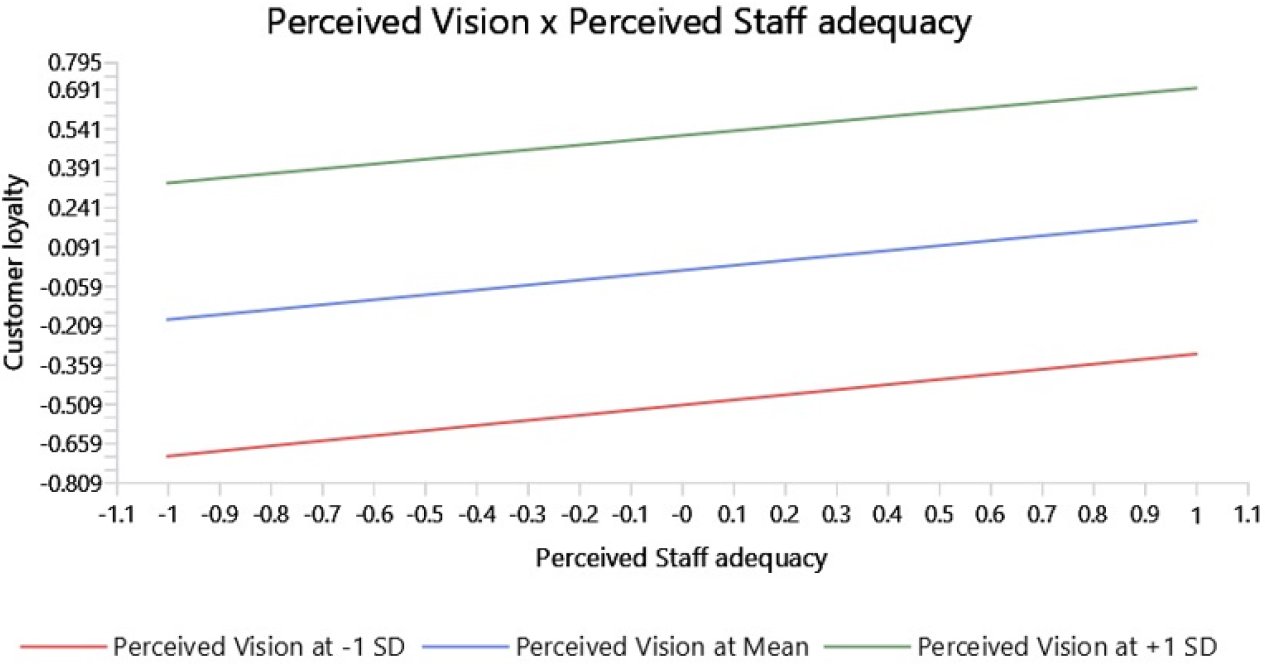
Fig. (2). Perceived staff adequacy and customer loyalty with moderation of PVCEA.
All the lines in the scatter plot rise from the lowest level of PVCEA to the highest, as shown in Fig. (3), which shows that the Customer Experience Strategy is positively related to Customer Loyalty at all levels of PVCEA. However, PVCEA played a modest role in moderating. At higher levels (+1 SD, green line), the baseline loyalty of customers is significantly greater than the mean (blue line) and low levels (-1 SD, red line). The relative role of the loyalty of Customer Experience Strategy is weak as the three lines are nearly parallel and the effect is not so different, and the effect of Customer Experience Strategy on loyalty is similar regardless of PVCEA.
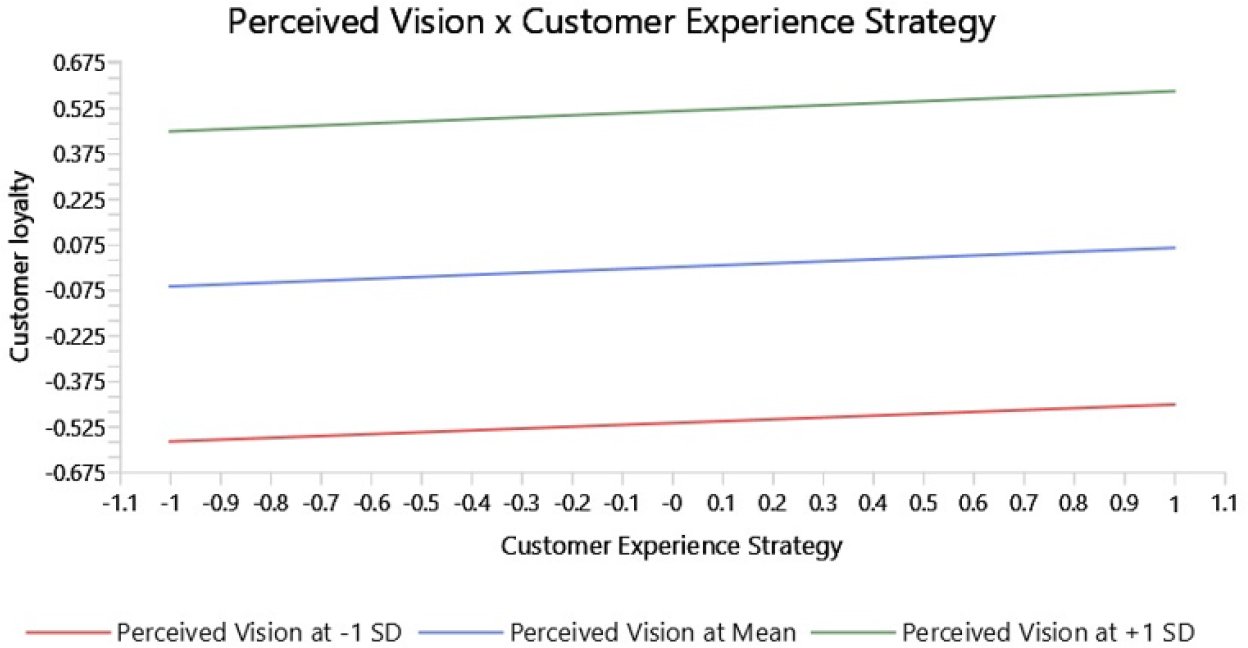
Fig. (3). Customer experience strategy and customer loyalty with moderation of PVCEA.
The robustness of the estimated relationships in Table 8 is further confirmed by bootstrapping results. All three relationships were statistically significant, as indicated by the 95% confidence intervals for Customer Experience Strategy → Customer Loyalty [0.140, 0.400], PVCEA → Customer Loyalty [0.288, 0.498], and PVCEA × Customer Experience Strategy → Customer Loyalty [0.005, 0.208], which did not contain zero null values. The confidence intervals for Perceived Staffing Adequacy → Customer Loyalty [0.017, 0.193] and PVCEA × Perceived Staffing Adequacy → Customer Loyalty [0.054, 0.171] do not contain zero which also shows that the results are significant.
Table 8. Bootstrapping 95% confidence interval.
| – | Original Sample (O) | Sample Mean (M) | 2.5% | 97.5% |
| Customer Experience Strategy -> Customer loyalty | 0.270 | 0.268 | 0.140 | 0.400 |
| Perceived staffing adequacy -> Customer loyalty | 0.100 | 0.102 | 0.017 | 0.193 |
| PVCEA -> Customer loyalty | 0.395 | 0.397 | 0.288 | 0.498 |
| PVCEA x Customer Experience Strategy -> Customer loyalty | 0.105 | 0.104 | 0.005 | 0.208 |
| PVCEA x Perceived staffing adequacy -> Customer loyalty | 0.057 | 0.057 | 0.054 | 0.171 |
4.8. Model Explanatory Power, Predictive Relevance, and Fitness
The model results in Table 9 show moderate predictive power, as they illustrate 37.7% of the variance in customer loyalty (R² = 0.377; adjusted R² = 0.371) through its predictors. Furthermore, the Q² predict value of 0.342 indicates an acceptable predictive relevance. Finally, the comparatively low RMSE (0.814) and MAE (0.605) values indicate a better model fit.
Table 9. Predictive power and relevance.
| – | R-square | R-square Adjusted | Q²predict | RMSE | MAE |
| Customer loyalty | 0.377 | 0.371 | 0.342 | 0.814 | 0.605 |
5. DISCUSSION
The findings of this study affirm H1 that customer loyalty in the Saudi retail industry is positively and significantly predicted by perceived staffing adequacy. However, this relationship was found to be modest. This finding is consistent with the general service management literature on the significance of frontline employees in influencing customer perceptions and relationship results. For example, according to the research conducted by Dam and Dam (2021), customer loyalty in a retail setting is greatly boosted by the quality of the services provided, which underscores the fact that both responsiveness and reliability in customer communication matter a great deal. Similarly, Alqahtani et al., (2024) cited staffing shortages as a major issue in operations that influenced the delivery of services and customer satisfaction in retail. These revelations are expanded in the current research because they prove that customers’ perceptions of sufficient staffing directly influence their loyalty.
The relationship between Perceived Staffing Adequacy and Customer Loyalty was statistically significant, but the effect size analysis indicated that the relationship did not have a severe impact. This suggests that as consumers rate the staffing of retailers as a crucial factor in assessing how adequate and competent they are, Staffing Adequacy alone may not be a key factor in explaining the retail loyalty behaviour of consumers. Instead, it is one of several other service-related factors that influence consumer retention. Thus, the results should be considered as indicating that it has made some contribution towards loyalty formation, albeit modest. The level of significance of the relationship should be considered, together with its relatively low practical importance when making managerial decisions, as recommended by contemporary SEM.
Nevertheless, the size of the relationship witnessed in this study is relatively small compared to the more significant service quality impacts witnessed in some earlier studies, such as Dam and Dam (2021). The first reason could be the brisk modernisation and digitalisation of Saudi retail, as automated service provision and omnichannel solutions partially lessen the dependency on human relations, as in the traditional retail environment. Nonetheless, human service encounters are essential for improving trust, solving problems, and personalising experiences in the hospitality industry.
The results are also in line with the Social Exchange Theory (SET), according to which customers respond to positive service experiences with a positive behavioural response, including loyalty (Alqahtani et al., 2024). As indicated by Makudza (2021), consumers who find that retail stores have provided them with enough attentive staff who are able to deliver perceive this as an investment in the quality of service by a given organisation, thus creating reciprocal commitment. Hence, based on these arguments, it can be said that adequate staffing is likely to fortify customer-retailer relationships and increase the resultant loyalty in the Saudi retail environment, where economic reforms and global competition in the retail sector have shifted the expectations of customers towards high service levels. Thus, retail managers should focus on workforce planning, staff training, and service responsiveness to ensure that staffing levels are appropriate for improving customer satisfaction and retention in the long run.
The findings also show that Customer Experience Strategy is positively related to customer loyalty at significant levels, validating H2, which means that properly developed experiential strategies contribute significantly to the increase in consumer commitment in the Saudi retail market. In terms of the structural effect on loyalty, Customer Experience Strategy outperforms the perceived staffing level, highlighting the importance of retailers’ deliberate design and management of customer experiences over staff. These results are in line with those of earlier studies by Makudza (2021), who found that the dimensions of customer experience management significantly influence customer loyalty, and earlier study by Zaid and Patwayati (2021), who reported that customer experience is an important factor which can influence customer loyalty in an e-retailing environment. Likewise, Suriansha et al., (2024) argued that Customer Experience is one of the factors that helps an organisation retain customers within the contemporary retail environment.
While Customer Experience Strategy was a more effective measure than the staffing adequacy measure, the effect size suggests a moderate practical significance of Customer Experience Strategy on the process of forming loyalty. This means that Customer Experience Strategy is a critical element of the process of building loyalty, but it is in addition to other organisational and contextual factors. The findings thus add to previous studies by showing that strategic customer experiences continue to play a significant role in the Saudi retail market despite swift digitalisation and market transformation. As in modern times, customers are increasingly choosing retailers based on the quality, consistency, and coordination of their shopping experience. As a result, investments in customer journey management and experience design are more likely to explain loyalty results than discrete operational service inputs.
The current results support these inferences, although they generalise them to the case of a fast-developing retail industry in Saudi Arabia, where experiential differentiation is the key competitive approach. In contrast to conventional retail markets, where the variety of products is the key determinant of consumer behaviour, Saudi retailers compete with an increasingly high rate of immersive stores, customised services, and online platforms (Suriansha et al., 2024). These changes can be used to justify why Customer Experience Strategy is among the impacts that are stronger relative to staffing adequacy in this study. Similarities with past studies can also be attributed to cultural and industrial factors. Most of the emerging markets studied by Makudza (2021) also have similar retail trends of rapid digitalisation and growing consumer demands for convenience and customisation. Nevertheless, the socio-economic changes peculiar to Saudi Arabia, which are based on Vision 2030, have spurred the pace of retail innovation and pushed organisations to invest in customer-oriented service paradigms.
PVCEA has a comparatively strong relationship with customer loyalty, which proves that consumers do not respond only to firms ‘service interactions at the micro-level but also to the macro-level institutional perception. This association can be explained in terms of institutional spillover effects when national reform efforts increase the level of confidence in market regimes and service providers. The greater direct impact of PVCEA than that of staffing adequacy indicates that the consumer’s restaurant experience could be judged based on how the industry as a whole evolves as a result of the impact of Vision 2030”. Therefore, positive retail sector perceptions can independently influence loyalty, regardless of specific retailer interactions.
Furthermore, the comparatively stronger influence of PVCEA than that of staffing adequacy is that macro-level confidence could be superior to micro-level customer service assessments through adequate staffing, especially in fast-changing economies, as supported by Makudza (2021). With the active encouragement of service excellence, modernisation, and consumer empowerment promoted by Vision 2030 in the Saudi context, retailers can use legitimacy spillover, whereby alignment with national transformation increases their perceived credibility and appeal. This means that customer loyalty can also be inspired by direct service encounters and encompass more confidence in the retail ecosystem, which can, in turn, support the significance of the institutional context in consumer behaviour formation.
The results are aligned with the Social Exchange Theory because improved customer experiences generate a perception of relational values, which leads to consumer loyalty behaviours. Consequently, the findings imply that when retailers streamline both physical and digital interactions, customers feel the greater advantages of the relationship between the retailer and customer. Therefore, they are likely to make repeat purchases and spread positive word of mouth. These findings have strategic implications for Saudi retailers, who must invest in experiential innovation, omnichannel integration, and customised services to remain competitive in a fast-paced consumer economy.
The results reveal that PVCEA significantly moderates the relationships between perceived Staffing Adequacy, Customer Experience Strategy, And Customer Loyalty, supporting H3a and H3b. However, the magnitude of these Moderation Effects is rather small, which implies that national reform initiatives, as perceived by consumers, affect the formation of loyalty, but in practice, they have a relatively small effect. The small moderation coefficients indicate that Vision 2030 does not significantly affect consumer loyalty formation. Rather, such perceptions seem to slightly validate their current assessment of retailers’ service levels. This discovery suggests that loyalty is still largely a result of retail experiences and no longer the overall perception of the policy itself.
This is consistent with previous research suggesting that national transformation programs influence consumer expectations and market actions. Similarly, Olaopa and Alsuhaibany (2023) established that economic diversification policies lead to greater operational efficiency and engagement. However, the results of the present study indicate that the impact of such reforms on loyalty is indirect and relatively moderate compared to the firm’s service factors. Broader regulatory and normative contexts can influence stakeholder understanding of organisational practices, as suggested by the Institutional Theory (Suriansha et al., 2024). However, the low levels of moderation coefficients suggest that retailer-specific service experiences and perceptions of reform at the macro level have a major influence on loyalty. Thus, Vision 2030 is an additional contextual stimulus that enhances, rather than significantly changing, consumers’ reactions to retail service practices.
IMPLICATIONS
The findings have practical implications for policymakers, retail managers, and researchers in Saudi Arabia. PVCEA is positively correlated with customer loyalty which means that consumer confidence in continuous reforms in the retail sector could complement firms’ stronger customer relations efforts. The findings suggest that Customer Experience Strategy plays a greater role in customer loyalty for retail managers, but perceived staffing adequacy is also an important predictor of customer loyalty. Therefore, retailers should focus on providing uniform and properly managed customer experiences and ensure that the store is sufficiently staffed to provide the service. Managers should consider a positive perception of national reforms as a positive contextual factor, not a replacement for good service practices, given that the moderating effects of the PVCEA were statistically significant but relatively small. From a theoretical perspective, the results provide a theoretical extension of social exchange and institutional theories, as they provide evidence for various factors that work to shape customer loyalty, not only based on assessment of service experiences but also on perceptions of the general institutional setting in which services are realised.
CONCLUSION
This study provides empirical evidence that customer loyalty in the Saudi retail industry is not determined solely by traditional service factors, although it is formed in the environment of interaction of organisational service practices with institutional changes. The results indicate that although perceived staffing adequacy is relevant to loyalty, as it enables the presence of responsive and reliable service experiences, it has stronger effects when combined with strategically designed customer experiences that can create value at multiple service touchpoints. To this end, the establishment of loyalty in modern retail settings seems to be more experiential than it is transactional. In addition, the moderating role of PVCEA suggests that macro-level economic reforms can be used to change how consumers interpret and analyse organisational service initiatives. This shows that consumer loyalty in Saudi Arabia is part of a broader socio-economic discourse in which institutional changes and reform rest on the expectations of the quality of services, innovation, and the capacity of workforces. Therefore, retailers who align their operational practices with the Vision 2030 goals can build consumer loyalty more efficiently.
Although these contributions exist, several limitations must be considered. First, purposive sampling and self-reported survey data were used in the study, which limits the generalisability of the results and may cause bias in perception. Second, a cross-sectional design does not allow for attention to changes in customer perception in the long run. Future studies can take the form of longitudinal or mixed methods to reflect the changing attitudes of consumers over time due to changes in Vision 2030 reforms. Moreover, considering other moderating factors, such as service innovation or digital transformation, may help unravel the nature of loyalty in the new retail market. Finally, as data were collected through social media platforms, the sample mostly represents digitally accessible retail consumers in Saudi Arabia, which does not capture less digitally active groups in the population. This could result in reduced representativeness and generalisation of the overall findings to the entire retail population. Therefore, further studies should consider stratified sampling methods that will make the sample much more balanced in its demographic composition and provide a comparison between the sample features and national retail consumer profiles to increase generalisability.
LIST OF ABBREVIATIONS
AVE | = | Average Variance Extracted |
CIs | = | Confidence Intervals |
CES | = | Customer Experience Strategy |
CMB | = | Common Method Bias |
PVCEA | = | Perceived Vision 2030 Consumer Economic Agenda |
PLS-SEM | = | Partial Least Squares Structural Equation Modelling |
SET | = | Social Exchange Theory |
VIF | = | Variance Inflation Factor |
AUTHORS’ CONTRIBUTIONS
A.A. contributed to the study conception, design, and writing of the manuscript. R.A. contributed to the study conception, design, and writing of the manuscript. F.A.G. contributed to data collection and writing of the manuscript. S.A. contributed to data collection, review, and editing of the manuscript. M.A. contributed to data analysis, review, and editing of the manuscript. All authors reviewed and approved the final version of the manuscript.
ETHICAL APPROVAL & INFORMED CONSENT
The research procedures adhered to established ethical guidelines for survey-based studies. Participation was entirely voluntary, with explicit informed consent secured from all participants before survey initiation. To uphold data protection and confidentiality standards, all personally identifiable information was removed, and responses were aggregated and anonymised.
AVAILABILITY OF DATA AND MATERIALS
The data supporting the findings of this study are available from the corresponding author upon reasonable request [A.A.].
FUNDING
The authors declare that no financial support or funding was received for the conduct of the research, authorship, or publication of this article.
CONFLICT OF INTEREST
The authors declare that they have no competing interests that could have influenced the conduct or findings of this study.
ACKNOWLEDGEMENTS
Declared none.
DECLARATION OF AI
The authors declare that no artificial intelligence tools or technologies were used in the preparation, analysis, or writing of this study. The authors take full responsibility for the content and originality of the work.
APPENDIX A-QUESTIONNAIRE
- What is your gender?
- Male
- Female
- Prefer not to say
- What is your age group?
- Below 25
- 25–34
- 35–44
- 45–54
- 55 and above
- What is your highest educational qualification?
- Secondary
- Diploma
- Bachelor’s
- Master’s
- Doctorate
- Frequency of Retail Shopping
- 1–2 times per month
- 3–5 times per month
- More than 5 times per month
- Preferred Retail Shopping Format
- Physical retail stores
- Online retail platforms
- Omnichannel
| Variable | Question Statement | Strongly Disagree (1) | Disagree (2) | Neutral (3) | Agree (4) | Strongly Agree (5) |
| Staffing Adequacy | 1. You feel that your particular retail brand has adequate staffing to meet customer service needs effectively. | ☐ | ☐ | ☐ | ☐ | ☐ |
| 2. You perceive that staffing levels at your particular retail brand are regularly reviewed to ensure optimal customer service. | ☐ | ☐ | ☐ | ☐ | ☐ | |
| 3. You perceive that adequate staffing allows retail brands to focus on delivering exceptional customer experiences to their customers. | ☐ | ☐ | ☐ | ☐ | ☐ | |
| Customer Experience Strategy. Adapted from Garg et al., (2014) | 1. The retailer deliberately designs its services and interactions to create a positive shopping experience for customers. | ☐ | ☐ | ☐ | ☐ | ☐ |
| 2. The retailer provides a consistent experience across different customer touchpoints, including physical stores, websites, mobile applications, and social media platforms. | ☐ | ☐ | ☐ | ☐ | ☐ | |
| 3. The retailer effectively manages the customer journey by providing personalised support and seamless transitions throughout the shopping process. | ☐ | ☐ | ☐ | ☐ | ☐ | |
| Perceived Vision 2030 Consumer Economy | 1. Vision 2030’s consumer economy agenda positively influences customer service practices within the company. | ☐ | ☐ | ☐ | ☐ | ☐ |
| 2. The Vision 2030 agenda provides clear guidelines for employees to improve customer loyalty. | ☐ | ☐ | ☐ | ☐ | ☐ | |
| 3. Employees are motivated to enhance customer loyalty due to the Vision 2030 consumer economy focus. | ☐ | ☐ | ☐ | ☐ | ☐ | |
| Customer Loyalty. Adapted from Bobâlcă et al., (2012) | 1. I think this company has the best offers in the present. | ☐ | ☐ | ☐ | ☐ | ☐ |
| 2. I am pleased to buy from this retail brand instead of other retail stores. | ☐ | ☐ | ☐ | ☐ | ☐ | |
| 3. I will recommend this retail store those who ask my advice. | ☐ | ☐ | ☐ | ☐ | ☐ |
REFERENCES
Abdallah, N., Alyafai, H., & Ibrahim, A. (2021). Customer satisfaction towards online shopping. International Journal of Current Science Research and Review, 4(7), 692-696. https://doi.org/10.47191/ijcsrr/V4-i7-11
Ahmad, M., & Wilkins, S. (2025). Purposive sampling in qualitative research: A framework for the entire journey. Quality & Quantity, 59(2), 1461-1479. https://doi.org/10.1007/s11135-024-02022-5
Alqahtani, F., Alshehri, A., Mulyata, J., & Cranfield, D. (2024). Assessing the potential effects of disruptive technologies on business models: a case of Saudi Arabia. Open Journal of Business and Management, 12(5), 3417-3445. https://doi.org/10.4236/ojbm.2024.125171
Arab News (2026). Saudi retail sector ‘booming,’ industry experts confirm at RLC Global Forum. Available from: https://www.arabnews.com/node/2631624/business-economy
Bobâlcă, C., Gătej, C., & Ciobanu, O. (2012). Developing a scale to measure customer loyalty. Procedia Economics and Finance, 3, 623-628. https://doi.org/10.1016/S2212-5671(12)00205-5
Bouncken, R. B., Czakon, W., & Schmitt, F. (2026). Purposeful sampling and saturation in qualitative research methodologies: recommendations and review. Review of Managerial Science, 20(2), 579-615. https://doi.org/10.1007/s11846-025-00881-2
Bruckberger, G., Fuchs, C., Schreier, M., & Van Osselaer, S. M. (2023). Retailing Groundedness: How to improve customer experience, brand perceptions, and customer loyalty through feelings of groundedness. Journal of Retailing, 99(4), 594-604. https://doi.org/10.1016/j.jretai.2023.11.004
Buallay, A. (2022). Sustainability reporting and retail sector performance: worldwide evidence. The International Review of Retail, Distribution and Consumer Research, 32(3), 311-330. https://doi.org/10.1080/09593969.2022.2048410
Cheung, G. W., Cooper-Thomas, H. D., Lau, R. S., & Wang, L. C. (2024). Reporting reliability, convergent and discriminant validity with structural equation modeling: A review and best-practice recommendations. Asia Pacific Journal of Management, 41(2), 745-783. https://doi.org/10.1007/s10490-023-09871-y
Consultancy Middle East. (2025). Emerging trends in the GCC’s fast-growing retail sector. Available from: https://www.consultancy-me.com/news/10770/emerging-trends-in-the-gccs-fast-growing-retail-sector
Dam, S. M., & Dam, T. C. (2021). Relationships between service quality, brand image, customer satisfaction, and customer loyalty. The Journal of Asian Finance, Economics and Business, 8(3), 585-593. https://doi.org/10.13106/jafeb.2021.vol8.no3.0585
Diaz, R. D., Vasquez, C. N. B., Villano, M. C., Didal, M. A. D., Manggabon, J. A., Ramos, C. V., & Mangarin, J. A. (2025). Challenges and Opportunities Encountered of 24–Hour Operating Stores. Guild of Educators in Tesol international research journal, 3(1), 320–368. https://doi.org/10.5281/zenodo.15038801
Fisher, M., Gallino, S., & Netessine, S. (2020). Setting retail staffing levels: A methodology validated with implementation. Manufacturing & Service Operations Management, 23(6), 1562-1579. https://doi.org/10.1287/msom.2020.0917
Galleli, B., & Amaral, L. (2026). Bridging institutional theory and social and environmental efforts in management: A review and research agenda. Journal of Management, 52(1), 42-93. https://doi.org/10.1177/01492063251322429
Garg, R., Rahman, Z., & Qureshi, M. N. (2014). Measuring customer experience in banks: scale development and validation. Journal of Modelling in Management, 9(1), 87-117. https://doi.org/10.1108/JM2-07-2012-0023
Gaskin, J. E., Lowry, P. B., Rosengren, W., & Fife, P. T. (2025). Essential validation criteria for rigorous covariance‐based structural equation modelling. Information Systems Journal, 35(6), 1630-1661. https://doi.org/10.1111/isj.12598
Ha, M. T. (2021). The impact of customer experience on customer satisfaction and customer loyalty. Turkish Journal of Computer and Mathematics Education, 12(14), 10247-10388. https://doi.org/10.17762/turcomat.v12i14.10388
Haji-Othman, Y., & Yusuff, M. S. S. (2022). Assessing reliability and validity of attitude construct using partial least squares structural equation modelling. International Journal of Academic Research in Business and Social Sciences, 12(5), 378-385. http://dx.doi.org/10.6007/IJARBSS/v12-i5/13289
Haque, A. A., Chowdhury, N. A., Maulan, S., Islam, M. A., & Sarker, M. A. (2024). Configuring the effect of multidimensional retail service quality and perceived value on customer loyalty towards retailers in Malaysia: mediated by customer satisfaction and trust. International Journal of Services and Operations Management, 46(4), 492-519. https://doi.org/10.1504/IJSOM.2023.136121
Hsiao, A., Ma, E., Manfreda, A., Baker, M., & Xu, J. (2023). A social exchange perspective on boosting customer loyalty through culturally competent servers. Journal of Hospitality Marketing & Management, 32(4), 555-577. https://doi.org/10.1080/19368623.2023.2184439
Kayani, F. N., & Alzaid, O. I. (2025). Small and medium-sized enterprises under the transformative Vision 2030 of Saudi Arabia. International Review of Management and Marketing, 15(3), 46-52. https://doi.org/10.32479/irmm.18797
Knight Frank (2025). Riyadh leads Saudi retail rebound as consumer spending surges to SAR 1.41 trillion: Knight Frank UAE. (.2025). Available from: https://www.knightfrank.ae/newsroom/article/2025/6/ksa-retail-market-review-spring-2025
Kumar, P., & Mokha, A. K. (2021). Relationship between E-CRM, customer experience, customer satisfaction and customer loyalty in banking industry: a review of literature. Research Review. International Journal of Multidisciplinary, 6(2), 127-137. https://doi.org/10.31305/rrijm.2020.v06.i02.022
Kumar, V., & Venkatesan, R. (2021). Transformation of metrics and analytics in retailing: The way forward. Journal of Retailing, 97(4), 496-506. https://doi.org/10.1016/j.jretai.2021.11.004
Liu, D., Son, S., & Zhu, Y. (2026). From perceived value to customer loyalty behavioural intentions: a social exchange theory perspective on value-based selling. Journal of Business & Industrial Marketing, 41(3), 413-428. https://doi.org/10.1108/JBIM-01-2025-0007
Makudza, F. (2021). Augmenting customer loyalty through customer experience management in the banking industry. Journal of Asian Business and Economic Studies, 28(3), 191-203. https://doi.org/10.1108/JABES-01-2020-0007
Manyanga, W., Makanyeza, C., & Muranda, Z. (2022). The effect of customer experience, customer satisfaction and word of mouth intention on customer loyalty: The moderating role of consumer demographics. Cogent Business & Management, 9(1), 2082015. https://doi.org/10.1080/23311975.2022.2082015
Mutambik, I. (2023). Customer experience in open banking and how it affects loyalty intention: a study from Saudi Arabia. Sustainability, 15(14), 10867. https://doi.org/10.3390/su151410867
Olaopa, O. R., & Alsuhaibany, Y. M. (2023). Economic diversification in Saudi Arabia: the role of information communication technology and e-commerce in achieving Vision 2030 and beyond. International Journal of Technological Learning, Innovation and Development, 15(2), 137-161. https://doi.org/10.1504/IJTLID.2023.135347
Pappas, A., Fumagalli, E., Rouziou, M., & Bolander, W. (2023). More than machines: The role of the future retail salesperson in enhancing the customer experience. Journal of Retailing, 99(4), 518-531. https://doi.org/10.1016/j.jretai.2023.10.004
PhamThi, H., & Ho, T. N. (2024). Understanding customer experience over time and customer citizenship behaviour in retail environment: The mediating role of customer brand relationship strength. Cogent Business & Management, 11(1), 2292487. https://doi.org/10.1080/23311975.2023.2292487
Roy, S. K., Gruner, R. L., & Guo, J. (2022). Exploring customer experience, commitment, and engagement behaviours. Journal of Strategic Marketing, 30(1), 45-68. https://doi.org/10.1080/0965254X.2019.1642937
Saied, A. H. (2024). The growth of digital marketing for e-commerce in Saudi Arabia: e-Marketing strategies of electronic commerce companies in KSA. International Journal of Business Marketing and Management, 9(6), 11-22. Available from: https://www.ijbmm.com/paper/Nov2024/8340436664.pdf
Shibeika, A. (2025). The Effect of Employee Service Quality on Customer Loyalty in the Saudi Retail Sector. Journal of Service Science and Management, 18(5), 350-372. https://doi.org/10.4236/jssm.2025.185023
Sun, S., & Pan, Y. (2023). Effects of service quality and service convenience on customer satisfaction and loyalty in self-service fitness centres: Differences between staffed and unstaffed services. Sustainability, 15(19), 14099. https://doi.org/10.3390/su151914099
Suriansha, R., Diposumarto, N. S., & Muharam, H. (2024). Optimizing Customer Retention in Modern Retail: The Role of Customer Experience and Relationship Quality. The Eastasouth Journal of Social Science and Humanities, 1(03), 189-195. https://doi.org/10.58812/esssh.v1i03.271
Tilahun, M., Berhan, E., & Tesfaye, G. (2023). Determinants of consumers’ purchase intention on digital business model platform: evidence from Ethiopia using partial least square structural equation model (PLS-SEM) technique. Journal of Innovation and Entrepreneurship, 12(1), 50. https://doi.org/10.1186/s13731-023-00323-x
Wei, S., Chen, X., & Rice, R. E. (2023). We can work it out: A multilevel examination of relationships among group and individual technology workarounds, and performance. Journal of Operations Management, 69(6), 1008-1038. https://doi.org/10.1002/joom.1267
Zaid, S., & Patwayati, P. (2021). Impact of customer experience and customer engagement on satisfaction and loyalty: A case study in Indonesia. The Journal of Asian Finance, Economics and Business, 8(4), 983-992. https://doi.org/10.13106/jafeb.2021.vol8.no4.0983