


- ABSTRACT:
- 1. INTRODUCTION
- 2. LITERATURE REVIEW
- 3. METHODOLOGY
- 4. RESULTS
- 5. DISCUSSION
- THEORETICAL CONTRIBUTION
- CONCLUSION
- LIMITATIONS AND SUGGESTIONS FOR FUTURE RESEARCH
- LIST OF ABBREVIATIONS
- AUTHORS' CONTRIBUTION
- ETHICAL APPROVAL & INFORMED CONSENT
- AVAILABILITY OF DATA AND MATERIALS
- FUNDING
- CONFLICT OF INTEREST
- ACKNOWLEDGEMENTS
- DECLARATION OF AI
- REFERENCES
Article ID: PDT2601203006
Views: 47Association Between Job Satisfaction and Perceived Organisational Innovation: Testing the Moderating Impact of Alignment with Vision 2030 in Saudi Retail Firms
 Article DOI
10.67887/PDT2601203006
 PDF
⬇ Downloads: 1
1EMAAN Institute of Management and Sciences (EIMS), Karachi, Pakistan
Revised: 05 August, 2026
ABSTRACT:
Introduction: This study investigated the connection between job satisfaction and perceived organisational innovation levels in Saudi retail companies and tested its alignment with Vision 2030 as a moderating variable.
Methodology: The study used a quantitative design and purposive sampling technique to obtain 400 employees and supervisors who were administered a structured questionnaire. Partial least Squares Structural Equation Modelling (PLS-SEM) was used to analyse the data.
Results: Employees perceived organisational innovation was positively associated with their satisfaction (β = 0.384, p < 0.001), meaning that the more satisfied employees are, the more willing they are to engage in innovative work. The association between perceived organisational innovation and Vision 2030 support was also modest and statistically significant (β = 0.276, p < 0.001). The relationship between job satisfaction and perceived organisational innovation was significantly moderated and positively by alignment with Vision 2030 (β = 0.248, p = 0.004), indicating that the positive association between job satisfaction and perceived organisational innovation is greater when employees feel more aligned with Vision 2030.
Conclusion: The results demonstrate that the positive influence of job satisfaction on innovation is stronger in organisations that are focused on the Vision 2030 objectives, contributing to creating an organisational environment conducive to innovative behaviour of employees’ IB. This study contributes to the literature on empirical studies on the transformative influence of national transformation efforts on employee-led innovation processes in Saudi Arabia’s retail industry.
Keywords: Job satisfaction, perceived organisational innovation, social exchange theory, institutional theory, Vision 2030, retail, Saudi Arabia.
1. INTRODUCTION
The Kingdom of Saudi Arabia is currently undergoing an economic reorientation process as a result of the national reform agenda called Vision 2030, which focuses on reducing dependence on oil and promoting the growth of non-oil segments of the economy, such as retail, tourism, and services (Alam et al., 2023). Regulatory changes, the arrival of foreign investors, and changes in consumer behaviour have made the retail industry a significant source of economic diversification during this transition (Statista, 2026). A young and digitally active generation, as well as an increasing workforce, particularly women, also contributes to this growth, changing consumption patterns, and the composition of the workforce (PwC, 2024). This changing environment has made innovation a strategic focus at the organisational level. Business executives in Saudi Arabia are beginning to view innovation as a driver of growth, and approximately 65% of them have mentioned it as one of the main drivers of competition (PwC, 2026). The pro-innovation influence of macro-level policies is strong; however, the mechanism through which innovation is introduced in firms, particularly at the worker level, remains unclear.
Moreover, innovation among employees is of particular importance in service-intensive sectors such as retail, where frontline employees directly deal with customers and operations. Theoretically, Social Exchange Theory can explain the relationship between job satisfaction and organisational innovation, which states that employees respond favourably to their workplace environment with favourable behaviours such as creativity and innovation (Ahmad et al., 2023; Wu & Lv, 2024). This relationship is substantiated by empirical studies which show that job satisfaction is a determinant of employees’ involvement in the generation and implementation of ideas (Amoah-Mensah & Okorley, 2024; Daneshmandi et al., 2023). Nevertheless, most available literature is context-dependent and considers job satisfaction an indirect or secondary predictor of innovation outcomes rather than a direct predictor.
Meanwhile, Institutional Theory offers a more complementary approach as it focuses on the influence of external forces, including national policy and strategic frameworks, on organisational behaviour (Kauppi, 2022). Vision 2030 is a powerful institutional driver of organisational focus in Saudi Arabia, including innovation, digitalisation, and competition. According to the literature, these institutional pressures may prompt firms to implement new practices to remain legitimate and align with national expectations (Zhu et al., 2024).
However, gaps remain in the existing literature. First, minimal research has explored the direct relationship between job satisfaction and perceived organisational innovation in the retail economy, particularly in transforming economies. Second, although Vision 2030 has been widely studied as a policy framework, it is often treated as a contextual backdrop rather than an empirical construct that can be measured and tested. Third, the possible moderating (interaction) role of alignment with Vision 2030 in the formation of relationships at the employee level has received little empirical attention. This is especially important in the retail sector in Saudi Arabia, where the internal work relations and external institutional needs of an organisation impact organisational practices.
Therefore, this study aims to determine the relationship between job satisfaction and perceived organisational innovation and whether this relationship is moderated (interacted) by alignment with Vision 2030 in Saudi retail firms. This study offers a micro-level perspective of innovation processes in a macro-level transformation context by concentrating on employees and supervisors in retail organisations. This study adds to the+ existing literature by providing a study of perceived organisational innovation in an under-researched field, namely, Saudi retail organisations, in the context of the national transformation. It also contributes to the literature by examining empirical data on whether Vision 2030 can be aligned with a perceived state of affairs in the workplace, as opposed to a policy background.
Furthermore, this study addresses whether institutional alignment intensifies the positive association between job satisfaction and innovation, which can help reveal the impact of external transformation initiatives on internal employee perceptions, leading to organisational performance. Moreover, instead of merely integrating Social Exchange Theory and Institutional Theory, this study suggests that institutional alignment enhances the mechanism of reciprocity. In particular, organisational alignment with Vision 2030 provides a favourable strategic environment in which satisfied employees are more likely to transform their positive work attitudes into innovative behaviour. Therefore, institutional alignment enhances the behavioural process described by the Social Exchange Theory.
2. LITERATURE REVIEW
2.1. Key Constructs
Job satisfaction can be described as a positive emotional state that appears due to personal evaluation of job and work experiences (Lee et al., 2022). It reflects employees’ feelings toward various job aspects, such as the work environment, supervision, rewards, and growth opportunities. Recent empirical data support the study of this construct. (Daneshmandi et al., 2023) discussed job satisfaction and personal innovation using structured survey instruments to evaluate job satisfaction and its influence on generating and realising ideas among workers. The study concluded that job satisfaction heightens innovative behaviour and creativity. Organisational innovation is the process of introducing new concepts, processes, practices, and systems to an organisation to improve its performance and competition (Chuang & Lee, 2023). It is the process of idea creation and implementation and is shaped by organisational culture, leadership, and employee engagement.
The three dimensions of perceived organisational innovation used in this study were: (1) organisational support of employee ideas, (2) perceived capacity of employees to think creatively because of work satisfaction, and (3) formal mechanisms for implementing innovative ideas. Both perceived organisational innovation ideas and perceived organisational capacity to think creatively because of job satisfaction were operationalised in the form of perceived organisational support of ideas, while the formal mechanisms of implementing innovative ideas were operationalised as perceived OSI mechanisms. The construct includes employees’ perception of the organisational climate of innovation and support for innovation behaviours rather than the results of organisational innovation itself. This means that the innovation climate (support and encouragement) and innovation capability (implementation structures) are given two important dimensions.
(Nasir et al., 2022) examined employees’ behaviours regarding organisational innovation, leadership, and creativity in SMEs. They identified organisational innovation as one of the major drivers of employee performance, which is closely linked to creativity and leadership practices. Moreover, (Amamou, 2025) found that innovation practices, including employee engagement, learning systems, and collaborative culture, are key determinants of organisational success in Saudi Arabia’s digital companies. They discovered that a culture of innovation has great benefits for firms’ performance and competitiveness. These studies prove that employee perceptions of support, creativity, and implementation are reliable measures of innovation and are consistent with the recent literature.
Saudi Vision 2030 is a national strategic plan that seeks to diversify the Saudi economy and improve government efficiency and growth through innovation (Al-Rasheed, 2026). It focuses on the main pillars of digital transformation, strengthening the private sector, empowering employees, and fostering a culture of innovation. However, Vision 2030 is an overarching vision. In this study, Vision 2030 alignment is operationalised at the perceptual employee level as “Perceived organisational alignment with Vision 2030.” This is aligned with previous micro-institutional studies that define institutional forces in terms of individual-level perceptions of organisational practices and enable macro-level institutional structures to be empirically tested at the behavioural level. The aligning effect of Vision 2030 is theoretically described in three ways: (1) resource prioritisation, in which organisations aligned with Vision 2030 devote more resources to innovation initiatives; (2) strategic emphasis, in which innovation becomes a formal organisational priority; and (3) innovation climate reinforcement, in which institutional alignment reinforces supportive norms for generating ideas. Nevertheless, this study empirically determines the presence or absence of these mechanisms in the form of an enhanced employee-level satisfaction-innovation association. Although the indicators are various practices within organisations, they have been combined to reflect the overall perception of employees regarding whether the organisation is aligned with Vision 2030. Therefore, this construct was modelled as a higher-level perception of strategic alignment and not as distinct dimensions.
2.2. Theoretical Framework
Social Exchange Theory presupposes that mutual exchanges are the principle of the relationship between employees and organisations (Ahmad et al., 2023). Employees are more likely to return the favour when treated well in positive environments and job satisfaction, which will be expressed through positive behaviour, including innovation and creativity.
In this study, job satisfaction is defined as a favourable employee assessment of work experiences and not organisational support per se. According to Social Exchange Theory, positive experiences at work lead to a feeling of reciprocity, which drives workers to perform discretionary actions, such as creativity and innovative work behaviour. Therefore, job satisfaction is the psychological result of positive interactions, which in turn promotes employees to offer creative ideas and suggestions. According to a recent meta-analysis that examined the correlations between social exchange and workforce innovation, team-member exchange and leader-member exchange are significantly related to innovative behaviour; thus, mutual support and reciprocity play a role in innovative behaviour formation (Wu & Lv, 2024). A second study on employee innovation established that the more satisfied employees are, the more likely they are to participate in generating and implementing ideas (Daneshmandi et al., 2023).
Moreover, Institutional Theory is rooted in the model of DiMaggio and Powell 1983, cited in (Kauppi, 2022) and presupposes that organisations are situated in the institutional environment, which exerts coercive, normative, and mimetic pressure. These pressures force firms to align their internal behaviours and strategies with the requirements of the external environment to attain legitimacy. Vision 2030 is a strong institutional driver that influences organisational behaviour and expectations in the Kingdom of Saudi Arabia.
The literature on organisational adaptation highlights the significance of external institutional factors in defining the innovation strategy and behaviour of firms, which leads them to implement new systems, processes, and innovative practices to remain legitimate and competitive (Franco & Franco, 2022; Martinez et al., 2020; Zhu et al., 2024). Therefore, Institutional Theory justifies how alignment with Vision 2030 can affect organisational behaviour and moderate internal relations, including job satisfaction and innovation. Although Social Exchange Theory describes innovation as a reciprocity-based employee reaction to job satisfaction and Institutional Theory describes external legitimacy pressures, both theories work at varying analytical levels. In this study, they are combined complementarily, as opposed to being interactive, with internal motivational processes (SET) tested against the external institutional setting Vision 2030 and without direct theoretical interaction between the two.
2.3. Hypotheses Development
(Amoah-Mensah & Okorley, 2024), drawing on Social Exchange Theory and data from 723 employees in small retail stores in Ghana, found that job satisfaction positively influences employees’ IWB. The study also established that job satisfaction is a significant psychological process in which participatory decision-making improves innovation. Despite its methodological soundness by the application of PLS-SEM, the study has a limitation in its limited scope of one industry in a developing economy. This limits the applicability of the findings to other organisational and cultural contexts.
In a more technologically savvy method, (Yao et al., 2024) used deep learning algorithms, such as Autoencoders and Restricted Boltzmann Machines, to investigate the association between employee satisfaction and innovative behaviour. Their results demonstrated a moderate positive relationship, where satisfaction played a significant role in innovation and indirectly in corporate performance. Nevertheless, methodological sophistication does not imply that the study is mainly data-driven and has not been well-grounded in existing organisational behaviour theories, making it difficult to confidently interpret the causal mechanisms. In addition, their research on the Turkish retail grocery market, (Üçok & Torlak, 2024) determined that job satisfaction as a moderator contributes to the interdependence between innovation performance and managerial style. Interestingly, this reinforces the impact of integrating and compromising leadership styles and undermines the impact of dominating and avoiding them. A limitation on generalisability in the retail sector is that although this study offers important information on conditional effects, it operationalises job satisfaction as a moderating variable and not a direct predictor of innovation, and its sample size of 322 supermarket employees is relatively small.
From a theoretical perspective, (Nguon, 2022) strengthens the direct relationship between job satisfaction and innovation by stating that when employees are satisfied, they are more inclined to utilise their creativity and productivity at work, which increases the organisation’s innovation potential. This theoretical construct supports the claim that satisfaction serves as a psychological motivator for innovation. Complementing this, (Tung, 2025) indicates that job dissatisfaction (poor compensation, poor leadership, and poor career progression) negatively impacts employee productivity and organisational effectiveness in the Malaysian retail context. This indirectly suggests that a lack of satisfaction limits the development of innovative behaviour.
Taken together, these studies provide uniform evidence of a positive correlation between job satisfaction and innovation, although they have significant limitations. Most studies are context-specific, methodologically narrow, and include indirect or moderating relationships but not direct ones. Furthermore, insufficient focus has been placed on retail companies operating in transformation-based economies, where innovation is a strategic factor. As such, even though there are some limitations related to the existing data, it can be concluded that the evidence suggests that the theoretical assumption of a positive correlation between job satisfaction and innovation holds true. Thus, H1 is proposed:
H1: Job Satisfaction has a positive and significant impact on employees’ perception of organisational innovation in Saudi retail firms.
The moderating influence of strategic alignment with the national vision on organisational outcomes is a relatively unexplored area in the literature. Institutional Theory describes the reaction of organisations to external forces, including regulations, norms, and national policies. This theoretical school of thought forms the core of explaining why congruence with a national strategic plan, such as Vision 2030, can influence innovation-based results in organisations. In a study focused on eco-innovation in Chinese companies, (Zhu et al., 2024) revealed that the effect of regulatory pressure exerted by government institutions significantly impacts enterprises’ innovation behaviour. In response to institutional requirements, organisations consider innovation a strategic tool that ensures their survival in terms of legitimacy and competition. Although this study was dedicated to environmental innovation, the rationale that perceived organisational innovation behaviour is influenced by external institutional pressures can be applied to the Vision 2030 context, whereby national transformation objectives serve as a powerful institutional force in the Kingdom.
More specifically, recent empirical research on Saudi SMEs showed that alignment with Vision 2030 plays a significant moderating role in the relationship between quality management implementation and corporate excellence. (Alhawwashi & Khatibi, 2026), operationalised the alignment of Vision 2030 based on indicators that measured strategic fit with national transformation objectives, institutional expectations, and modernisation-oriented performance indicators. This research is especially significant because it defines alignment towards Vision 2030 as a construct and not a contextual environment. Nevertheless, the author also warn that the effects of national strategic visions do not always contribute to organisational performance because they are influenced by the relationship between them and certain organisational variables. This justifies the conceptualisation of Vision 2030 alignment as a moderating but not direct effect.
Additionally, (Zhang et al., 2024) studied 483 listed Chinese firms and observed that institutional forces, including regulatory, normative, and mimetic forces, positively affect green innovation. Nevertheless, it was also found that institutional pressures have varying responses based on the capabilities of the firm and its strategic orientation. This implies that institutional effects do not exist in a homogeneous manner but are influenced by organisational preparedness, which justifies the need to study the moderating effects of boundary conditions.
Taken together, these studies point to the value of institutional alignment in determining innovation outcomes, but they do not give much attention to how institutional alignment interacts with employee-level variables such as job satisfaction. This gap is especially critical in the Saudi retail industry, where national transformation efforts and frontline employee attitudes intersect to determine the outcomes of innovation. Therefore, H2 is proposed as follows:
H2: Alignment with Vision 2030 positively moderates the relationship between job satisfaction and perceived organisational innovation, such that the positive relationship becomes stronger when the perceived organisational alignment with Vision 2030 is high.
2.4. Literature Gap
While the literature review has shown that the existing literature provides evidence of a positive correlation between job satisfaction and innovation, there are also significant gaps in the current literature. Most studies have been conducted in non-retail or single-industry settings, such as the Ghana-based retail study by (Amoah-Mensah & Okorley, 2024), which restricts cross-cultural and cross-sectoral generalisation. Moreover, technologically advanced methods, such as those of (Yao et al., 2024), are still theoretically ungrounded; hence, causal interpretations are challenging. Importantly, most of the available literature on this topic focuses on job satisfaction as a moderating or indirect predictor of perceived organisational innovation rather than a direct predictor. No research has found the predisposition of national strategic alignment towards the relationship between the attitude of employees and perceived organisational innovation within the retail industry in Saudi Arabia. This study directly addresses this gap by testing a moderated model in the context of Saudi retail firms.
2.5. Conceptual Framework
The conceptual framework is illustrated in Fig. (1), placing job satisfaction as the independent variable that directly affects perceived organisational innovation (H1), while alignment with Vision 2030 acts as a moderator of this relationship (H2). Social exchange and institutional theories form the theoretical foundation of this research design.
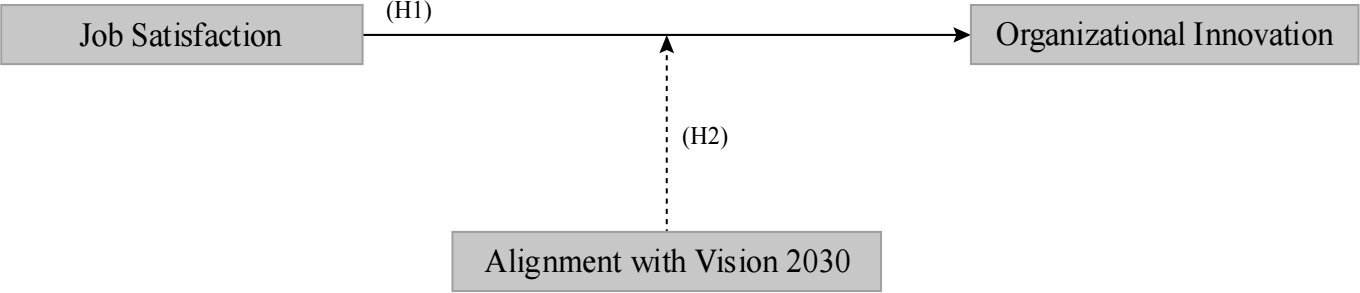
Fig. (1). Conceptual framework.
3. METHODOLOGY
3.1. Research Design
This study used a quantitative research design to investigate the relationship between job satisfaction and perceived organisational innovation and the moderating role of Vision 2030 alignment in Saudi retail companies. According to (Kandel, 2020), quantitative methodology can be defined as a method of study that uses statistical procedures and numerical data to test a hypothesis and make a connection among variables. This design was appropriate because the study involved measurable constructs and structured data, with H1 and H2 being predefined hypotheses.
3.2. Data Collection Tool
This study used a questionnaire as a data collection tool for data collection, which was administered using Google Forms. The questionnaire was split into two broad sections: demographic information and items measuring the study constructs. The demographic section included questions related to gender, age, educational level, job position, and work experience to collect the profile of the respondents working in retail companies in Saudi Arabia. The second part comprised closed-ended statements that were meant to measure the key research variables using three items for each. Shortened three-item scales were chosen based on prior validated research practices in structural equation modelling, where the reduction of items is a common practice to enhance model parsimony and maintain construct validity, assuming that reliability and Average Variance Extracted (AVE) thresholds are achieved (Goetz et al., 2013; Yang et al.,2010). Items were chosen based on their conceptual relatedness, and adaptability to the Saudi retail environment. Items were selected to best represent the core dimensions of each construct without sacrificing the clarity of the questionnaire or the effectiveness of the respondent’s completion. The last item selection was also checked to prevent conceptual overlap between independent and dependent constructs. Items were adapted rather than directly adopted to suit the Saudi retail context (Table 1).
Table 1. Summary of item sources.
| Construct | Original Scale | Adaptation |
| Job Satisfaction | (Weiss et al., 1967) MSQ | Three adapted items |
| Perceived Organisational Innovation | (Hurley & Hult 1998) | Three adapted employee perception items |
| Vision 2030 Alignment | (Alhawwashi & Khatibi 2026; Zhu et al., 2024) | Contextualized items |
Three key constructs were included in the survey section: Job Satisfaction, Perceived Organisational Innovation, and Vision 2030 Alignment, and each construct was measured using three items. The well-known Minnesota Satisfaction Questionnaire, designed by (Weiss et al., 1967), was adjusted to current satisfaction items, which are highly recognized for measuring intrinsic and extrinsic employee satisfaction. The items for measuring Perceived Organisational Innovation were based on the validated scale created by (Hurley & Hult, 1998), which is often used to measure organisational innovation capability and employee-led innovativeness in organisations. Prior literature on strategic alignment and national transformation frameworks was adapted and contextualised to make the Vision 2030 Alignment construct relevant to the Saudi retail context. Minor wording modifications were made to suit the retail environment while preserving the conceptual integrity and validity of the original scales.
All latent constructs were specified as reflective because the observed indicators were conceptualised as expressions of the underlying latent variables and not defining. It is presumed that changes in employees’ overall job satisfaction, perceived organisational climate of innovation, or perceived organisational alignment with Vision 2030 will manifest consistently across the indicators. This specification is in line with the recommendations of attitude and perception constructs in PLS-SEM. Furthermore, the dataset was pre-processed for missing data, outliers, and normality before the analysis. Datasets that contained large numbers of missing data points were eliminated, and there were no missing data points requiring imputation in the final dataset. The Mahalanobis distance was used to evaluate multivariate outliers, with no influential observations above the critical value. Skewness and kurtosis were used to assess data normality. Some of the variables were not normally distributed, but this did not affect the analysis, as PLS-SEM does not require multivariate normal variables.
3.3. Sampling Method and Sample Size
This study used purposive sampling. Purposive sampling is a non-probability sampling technique in which respondents are chosen based on particular traits pertinent to the study objectives (Nyimbili & Nyimbili, 2024). This is especially helpful when research is conducted with participants who have direct knowledge or experience of the phenomenon being studied. Employees and supervisors working in Saudi retail firms (frontline workers, team leaders, and managerial workers) constituted the sample population of this study. These people were selected because they were directly engaged in daily operations, decision-making, and activities related to innovation and were thus in a good position to provide information about job satisfaction and innovation in the organisation. Nonetheless, owing to purposive sampling, the findings cannot be statistically generalised to the entire Saudi retail population. Rather, they represent the contextual information of employees and supervisors in the sampled firms.
Professional and organisational networks were used to recruit respondents to ensure that relevant participants in the Saudi retail industry were reached. The questionnaire was shared on Google Forms in LinkedIn and WhatsApp professional groups specifically related to retail workers in Saudi Arabia. In addition, the survey link was sent directly to store managers and supervisors, who forwarded it to their teams. Retail employees operating in shopping malls and retail chains were also involved by distributing the survey link electronically to involve more people in different positions and organisational levels. The survey was voluntary, and only respondents who agreed that they were working in the Saudi retail industry at the time of the survey were allowed to complete the survey.
This study used a sample of 400 respondents in total. G*Power was used to confirm the sufficiency of the sample size. G * Power is a statistical analysis program that computes the minimum acceptable sample size based on the effect size, level of significance, and statistical power (Kang, 2021). This ensured that the study was sufficiently powerful to identify meaningful associations. A medium effect size (f2 = 0.15), significance level of 0.05, statistical power of 0.95, and two-predictor model were used to determine the minimum required sample size of approximately 107 participants. Therefore, the sample size of 400 respondents exceeded the minimum, implying that the study had a high statistical power and strength.
3.4. Data Analysis Technique
The data were analysed using Partial Least Squares Structural Equation Modelling (PLS-SEM). PLS-SEM is a form of structural equation modelling based on variance. It can test complex connections between latent constructs when the study model comprises mediation and moderation impacts and does not require strict normality criteria (Memon et al., 2021). PLS-SEM was selected as the data analysis technique because of its suitability for this study’s objectives. It is particularly appropriate for predictive and exploratory research and is effective in handling moderation analysis, which is central to this study, with Vision 2030 as the moderating variable. In addition, PLS-SEM can support large and small research models with small sample sizes. It also allows for the simultaneous evaluation of the measurement model, reliability, and validity, and the structural model to test hypotheses, which makes it a holistic method of analysis.
3.5. Common Method Bias (CMB) and Non-Response Bias
Common Method Bias is the variance that can be attributed to the method of measurement and not the constructs that the measures capture. This can occur when data for all variables are collected from the same source (Podsakoff et al., 2024). Harman’s single-factor test was conducted to determine the presence of common method bias. It was found that there was no individual factor that accounted for most of the variance, which meant that the problem of common method bias was not significant in this study. In addition, the CMB was analysed using the Variance Inflation Factor (VIF) method. If the value of the VIF coefficient is lower than 3.3, then common method bias is not an issue. The findings indicated that all full collinearity VIFs were less than the threshold, which proved that there was no significant CMB (Table 2). Non-response bias is a distortion when respondents are considerably different from non-respondents. To evaluate non-response bias, early and late responses were compared for the key variables. There were no major differences, indicating that nonresponse bias was unlikely to affect the results.
Table 2. Full collinearity statistics (VIF).
| – | VIF |
| Alignment with Vision 2030 | 1.784 |
| Job Satisfaction | 1.629 |
| Alignment with Vision 2030 x Job Satisfaction | 1.276 |
3.6. Ethical Considerations
This study adhered to the ethical principles. Involvement was voluntary, and informed consent was obtained electronically prior to completing the questionnaire. No personally identifiable information was collected, and the respondents remained anonymous throughout the study. Since the research was conducted by way of anonymous survey answers with no clinical intervention, formal ethical approval of the institution was not necessary according to the existing university research ethics.
4. RESULTS
4.1. Descriptive Analyses
Table 3 presents the demographic data of the 400 employees working in Saudi retail companies. The sample is mostly male (65%), with females comprising 30%, which is a moderate female participation in the retail labour force, as labour diversification trends are ongoing.
Table 3. Demographic profile of 400 respondents.
| Variable | Category | Frequency (n) | Percentage (%) |
| Gender | Male | 260 | 65.0% |
| Female | 120 | 30.0% | |
| Prefer not to say | 20 | 5.0% | |
| Age Group | Below 25 | 60 | 15.0% |
| 25–34 | 150 | 37.5% | |
| 35–44 | 100 | 25.0% | |
| 45–54 | 60 | 15.0% | |
| 55 and above | 30 | 7.5% | |
| Education Level | Secondary | 70 | 17.5% |
| Diploma | 90 | 22.5% | |
| Bachelor’s | 170 | 42.5% | |
| Master’s | 55 | 13.8% | |
| Doctorate | 15 | 3.8% | |
| Job Role (Retail-Specific) | Sales Associate / Customer Service Representative | 110 | 27.5% |
| Cashier / Store Assistant | 70 | 17.5% | |
| Visual Merchandiser / Inventory Coordinator | 50 | 12.5% | |
| Team Leader / Shift Supervisor | 65 | 16.3% | |
| Store Manager / Branch Manager | 55 | 13.8% | |
| Regional Manager / Area Manager | 30 | 7.5% | |
| Corporate / Head Office Staff (HR, Marketing, Innovation Units) | 20 | 5.0% | |
| Work Experience | Less than 3 years | 90 | 22.5% |
| 3–5 years | 110 | 27.5% | |
| 6–10 years | 120 | 30.0% | |
| More than 10 years | 80 | 20.0% |
The highest age category was 25-34 years (37.5%) then 35-44 (25%), indicating that most of the respondents were in the early to mid-career age. Education-wise, the majority of the respondents had a bachelor’s degree (42.5%), indicating a fairly educated workforce that can participate in organisational processes such as innovation. The distribution of job roles was adequate, comprising operational (sales associates and cashiers), supervisory (team leaders), and managerial levels; therefore, the responses represented various organisational perspectives. Work experience is relatively balanced as well, with the highest percentage in the 6-10 years category (30%), which means that the majority of respondents have enough exposure to the industry to provide valid feedback. Generally, the sample selection can be regarded as appropriate for job satisfaction and Perceived Organisational Innovation analysis in the retail context.
4.2. Measurement Model
The results concerning the reliability and validity of the measurement models are presented in Table 4. The factor loadings ranged between 0.809 and 0.926, all of which were greater than the item reliability level of 0.70. Good internal consistency was supported by Cronbach’s alpha values exceeding 0.80 (0.832-0.890) for all constructs. Construct reliability is further supported by composite reliability values (0.899-0.931). Convergent validity was achieved because all the AVE values were greater than 0.50 and ranged between 0.748 and 0.819, meaning that all constructs accounted for over 50% of the variance in their indicators. In general, the measurement model has high reliability and validity, which proves that the constructs can be further analysed in terms of their structures.
Table 4. Measurement model.
| Latent Construct | Indicators | Factor Loading | Cronbach’s Alpha | Composite Reliability | Average Variance Extracted (AVE) |
| Alignment with Vision 2030 | AV1 | 0.889 | 0.890 | 0.931 | 0.819 |
| AV2 | 0.926 | ||||
| AV3 | 0.900 | ||||
| Job Satisfaction | JS1 | 0.865 | 0.840 | 0.904 | 0.758 |
| JS2 | 0.898 | ||||
| JS3 | 0.848 | ||||
| Perceived Organisational Innovation | OI1 | 0.809 | 0.832 | 0.899 | 0.748 |
| OI2 | 0.913 | ||||
| OI3 | 0.870 |
Note: Factor Loadings ≥ 0.70; Cronbach’s alpha ≥ 0.70; CR ≥ 0.70; AVE ≥ 0.50 (Haji-Othman & Yusuff, 2022).
4.3. Discriminant Validity
Table 5 presents the discriminant validity based on the HTMT criterion. All values were less than the recommended value of 0.85, indicating satisfactory discriminant validity. This proves that the constructs of Job Satisfaction, Perceived Organisational Innovation, and Vision 2030 alignment are different concepts that measure different theoretical concepts. Thus, multicollinearity among the constructs was not an issue at the measurement level.
Table 5. Discriminant validity.
| – | Alignment with Vision 2030 | Job Satcisfaction |
| Job Satisfaction | 0.713 | – |
| Perceived Organisational Innovation | 0.521 | 0.602 |
Note: HTMT threshold < 0.85, (Rasoolimanesh, 2022).
4.4. Model Fit
Table 6 shows the values for the standardised root mean square residual (SRMR), which was used to determine the overall fit of the models. The SRMR value of 0.064 is below the threshold of 0.08, which is recommended, implying that the proposed model shows a satisfactory fit to the observed data.
Table 6. Model fit indices.
| – | Saturated Model | Estimated Model |
| SRMR | 0.064 | 0.064 |
4.5. Path Coefficient
The results of the structural model are presented in Table 7. Job Satisfaction and Perceived Organisational Innovation showed a significant positive association (β = 0.384, t = 6.397, p < 0.001) with a small-to-medium effect (f2 = 0.130). This supports H1, which states that the higher the job satisfaction, the higher the Perceived Organisational Innovation. Although the effect size is almost medium, it falls within the thresholds of small to medium. In addition, Perceived Organisational Innovation, which was not hypothesised as part of the model but was associated with Alignment with Vision 2030, was statistically significant (β = 0.276, t = 3.958, p < 0.001), with the association being of a small effect size (f2 = 0.061). This means that alignment with Vision 2030 helps support or enhance innovation outcomes. This was not one of the preliminary hypotheses and was thus considered a control or additional explanatory variable.
Table 7. Path coefficient.
| – | Path Coefficient | T Statistics | P Values | F-Square |
| Alignment with Vision 2030 -> Perceived Organisational Innovation | 0.276 | ***3.958 | 0.001 | 0.061 |
| Alignment with Vision 2030 x Job Satisfaction -> Perceived Organisational Innovation | 0.248 | 2.874 | 0.004 | 0.168 |
| Job Satisfaction -> Perceived Organisational Innovation | 0.384 | ***6.397 | 0.001 | 0.130 |
Note: *** p < 0.001; f² ≥ 0.35 is large, ≥ 0.15 is medium, and ≥ 0.02 is small (Changalima & Chuwa, 2026).
The interaction effect of Job Satisfaction and Vision 2030 on Perceived Organisational Innovation was significantly positive (β = 0.248, p = 0.004) at the 0.05 significance level, with a moderate effect size (f2 = 0.168). This indicates that Vision 2030 acts as a moderator in this sample in relation to the association between job satisfaction and perceived Organisational Innovation, supporting H2.
4.6. Explanatory Power and Predictive Relevance
Table 8 shows that the R² value for Perceived Organisational Innovation is 0.303 (adjusted R² = 0.297), indicating that approximately 30.3% of the variance in Perceived Organisational Innovation is explained by this model. Based on the classification rules, the explanatory power was moderate. Furthermore, the Q2 of 0.277 represents small to medium predictive relevance because it is not less than zero and is near the 0.25 threshold value. This validates that the model is acceptable in terms of its predictive abilities, but not with a strong predictive ability. In general, the model shows fair explanatory and predictive validity for Perceived Organisational Innovation within Saudi retail companies.
Table 8. R2 and Q2 values.
| – | R-square | R-square adjusted | Q2 |
| Perceived Organisational Innovation | 0.303 | 0.297 | 0.277 |
Note: R2 values are substantial, moderate, and weak when they are ≥ 0.75, ≥ 0.50, and ≥ 0.25, respectively, and Q2 values of 0, 0.25, and 0.50 represent small, medium, and large predictive accuracies, respectively (Changalima & Chuwa, 2026).
5. DISCUSSION
The findings of this study provide nuanced details about the connection between job satisfaction, alignment with Vision 2030, and perceived organisational innovation in Saudi Arabia’s retail businesses. In general, it can be stated that institutional fit and internal individual-level psychological variables have different associations with the innovative outcome variable. It is important to note that these results should be interpreted within the methodological limitations of purposive sampling; that is, the results should be contextualised observations of the sampled organisations and not the extrapolation of the entire population.
H1 is supported, as there is a significantly positive relationship between job satisfaction and perceived organisational innovation. This suggests that the more satisfied people are with their work, the more innovative they are, and they are more willing to create and execute more ideas. This finding is consistent with other empirical studies (Amoah-Mensah & Okorley, 2024; Daneshmandi et al., 2023) that similarly determined that satisfied employees demonstrate more innovative work behaviour. Within the context of Social Exchange Theory, this relationship is arguably the outcome of employees repaying positive workplace experiences with discretionary behaviours that are beneficial to the organisation in the form of creativity and innovation.
However, the effect size demonstrates that the relationship is small-to-moderate and not strong, which means that job satisfaction alone does not fully explain innovation results. The refinement is considerable in that it points out that innovation in the retail setting is preconditioned by a range of organisational variables other than employee satisfaction. For example, structural support, leadership behaviour, and opportunity structure are likely to complement satisfaction in the formation of innovative behaviour. This interpretation is consistent with (Tung, 2025), who emphasised that organisational systems, such as leadership support and career development opportunities, influence innovation in retail settings. Thus, the findings suggest that job satisfaction is a necessary, but not the sole, condition for innovation.
The direct impact of alignment with Vision 2030 on perceived organisational innovation, which was not initially hypothesised, was found to be statistically significant. This implies that organisations closer to the objectives of national transformation are more likely to show slightly more innovation. This finding aligns with Institutional Theory (Kauppi, 2022), according to which organisations react to the external pressure of institutions to obtain legitimacy and remain competitive. Vision 2030 is a strong institutional system in Saudi Arabia that encourages digitalisation, modernisation, and an innovation-focused approach. However, its effect size is weak, indicating that institutional alignment is a weak indicator of innovation at the employee level. This suggests that coordination with Vision 2030 may be more evident at the strategic or policy level rather than directly affecting employees’ day-to-day behaviours. In other words, organisations’ formal orientation to the goals of Vision 2030 does not necessarily support significant behaviour changes among employees. This understanding aligns with (Alam, 2026), who found that institutional forces tend to be more structural than behavioural.
Moreover, the moderating role of Vision 2030 alignment in the relationship between job satisfaction and perceived organisational innovation was statistically significant and had a medium effect size. Consequently, H2 is supported. This suggests that the positive relationship between job satisfaction and innovation can increase when employees perceive that their organisations are committed to achieving the goals of Vision 2030. One possible explanation is that institutional alignment provides a more definite strategic direction that legitimises innovation-related behaviour in organisations. If organisational commitment is expressed in terms of modernisation, digital transformation, and innovation initiatives related to Vision 2030, employees might feel more supported and more relevant in bringing new ideas to the table. Consequently, satisfied staff members are more inclined to express positive attitudes toward their workplace through creative activities. This interpretation is consistent with emerging AI-adoption evidence showing that visible AI investment can function as a strategic capability signal for stakeholders, while organisational responses to AI-driven workforce transformation shape employee attitudes through support, usability, and anxiety-related mechanisms (Patel et al., 2026a, 2026b).
This finding conforms to Institutional Theory (Kauppi, 2022), which proposes that external institutional pressure shapes organisational behaviour and priorities. This result also supports the outcomes of (Zhu et al., 2024; and Zhang et al., 2024), who proposed that if an organisation possesses a favourable internal environment and is strategically prepared, institutional forces assist in enhancing innovation results. Finally, it is necessary to note that the purposive sampling method used in this study restricts statistical generalisation. The findings thus reflect context-specific observations of a few Saudi retail companies and do not reflect the behavioural tendencies of the entire retail industry sample.
THEORETICAL CONTRIBUTION
This research makes a theoretical contribution by showing that institutional alignment enhances the reciprocity mechanism suggested by Social Exchange Theory and not just integrating Social Exchange Theory and the Institutional Theory. In particular, the results indicate that employees who are more satisfied with their jobs tend to act more innovatively when they believe that their company is strategically aligned with the goals of the Saudi Vision 2030. Thus, perceived organisational alignment acts as a contextual amplifier, allowing positive employee attitudes to be more effectively converted into innovative behaviour.
This view builds on Institutional Theory by showing that institutional pressures alone cannot stimulate employee innovation. Conversely, they can have more power when there are positive internal psychological processes, such as job satisfaction. The results connect macro-level institutional effects with micro-level employee behaviour by demonstrating that organisational identification with national transformation goals strengthens, but does not substitute, reciprocity dynamics underlying innovative work behaviour. This study further empirically explains how national transformation efforts can influence innovation by employing employee-level behavioural processes within Saudi retail companies and conceptualising Vision 2030 alignment as an empirically quantifiable employee perception rather than as a strategic or policy context.
CONCLUSION
In terms of empirical results, it can be stated that job satisfaction is positively related to perceived organisational innovation in Saudi retail firms. It can be suggested that Saudi retail firms should focus on improving the job satisfaction of their employees by implementing certain approaches, such as tying reward programs to idea generation and providing systematic feedback. In addition, it has been found out that alignment with Vision 2030 positively influences the level of innovation and strengthens the positive relationship between job satisfaction and innovation behaviour. The findings suggest that innovation can only be built on positive experiences at work, which can be encouraged by supportive institutional and strategic environments.
Thus, retail managers should emphasise formalised idea management programs which help capture employee recommendations systematically, as opposed to informal feedback. Digital suggestion platforms and in-store innovation kiosks are frontline innovation channels that can produce actionable ideas based on employee satisfaction. Moreover, supervisors need to be trained to promote innovation-supportive practices at the store level, which would translate employee satisfaction into operational improvements, including service efficiency, customer experience, and process optimisation. This study combines employee- and institutional-level aspects, which helps to gain an understanding of innovation in the context of a transforming economy such as Saudi Arabia. Thus, from a policymaking perspective, organisations aligned with Vision 2030 must translate strategic objectives into concrete workplace activities, including training on innovations and engaging employees in transformation processes. This may help operationalise national-level strategies at the employee level, where innovation behaviour originates. At the broader digital-transformation level, recent applied AI studies also demonstrate how automated analysis of heterogeneous information, predictive learning from historical and contextual variables, and explainability mechanisms can support more transparent and auditable organisational decision processes (Patel, 2026a, 2026b, 2026c).
In HR terms, retail companies are encouraged to incorporate innovation-based behaviour into performance appraisal models, establish formal employee suggestion channels, and create innovation-oriented KPIs aligned with the goals of Vision 2030. Training and incentives should also be provided to managers to identify, gauge, and implement employees’ ideas so that employee satisfaction can be converted into quantifiable innovation outputs.
LIMITATIONS AND SUGGESTIONS FOR FUTURE RESEARCH
This study had a few limitations. First, the cross-sectional design does not allow for inferring causality between variables. Second, purposive sampling limits the extrapolation of the findings to other retail settings in Saudi Arabia. Third, the use of self-reported data can lead to response bias, even though attempts were made to remove common method bias. Furthermore, the study depended on the perception of employees in relation to organisational innovation and not the objective evidence of innovation, which should be considered when interpreting the obtained results.
A longitudinal research design and probability sampling can be used in future studies to address changes over time and a broader sample population. Furthermore, factors such as leadership style, organisational culture, and digital transformation can provide a much fuller picture of the drivers of innovation. Other industries or countries can be analysed in detail for further information.
LIST OF ABBREVIATIONS
| AVE | = | Average Variance Extracted |
| IB | = | Innovative Behaviour |
| MSQ | = | Minnesota Satisfaction Questionnaire |
| OSI | = | Organisational Support for Innovation |
| PLS-SEM | = | Partial least Squares Structural Equation Modelling |
| SMEs | = | Small and Medium-sized Enterprises |
| SRMR | = | Standardised Root Mean Square Residual |
AUTHORS’ CONTRIBUTION
E.R. contributed to the conceptualization, research design, methodology, data collection, data analysis using PLS-SEM, interpretation of results, manuscript preparation and revision, and approval of the final manuscript.
ETHICAL APPROVAL & INFORMED CONSENT
The study followed established ethical guidelines for survey-based research. Participation was voluntary, and informed consent was obtained from all participants before completing the questionnaire. To protect participants’ privacy and confidentiality, personally identifiable information was excluded, and all responses were anonymised and analysed in aggregate.
AVAILABILITY OF DATA AND MATERIALS
The data generated and analysed during this study are available from the corresponding author upon reasonable request, subject to applicable ethical and confidentiality requirements.
FUNDING
This research received no external funding.
CONFLICT OF INTEREST
The author declares no conflicts of interest.
ACKNOWLEDGEMENTS
None.
DECLARATION OF AI
ChatGPT was used to assist with language refinement, editing, and improving the clarity of the manuscript. It was not used for literature searching, data extraction, analysis, synthesis, or interpretation of the findings. The author reviewed and verified all AI-assisted content and takes full responsibility for the accuracy and integrity of the manuscript.
REFERENCES
Ahmad, R., Nawaz, M. R., Ishaq, M. I., Khan, M. M., & Ashraf, H. A. (2023). Social exchange theory: Systematic review and future directions. Frontiers in psychology, 13, 1015921.
https://doi.org/10.3389/fpsyg.2022.1015921
Alam, F., Alam, S., Asif, M., Hani, U., & Khan, M. N. (2023). An Investigation of Saudi Arabia’s Ambitious Reform Programme with Vision 2030 to Incentivise Investment in the Country’s Non-Oil Industries. Sustainability, 15(6), 5357.
https://doi.org/10.3390/su15065357
Alhawwashi, S. A., & Khatibi, A. (2026). The moderation of Vision 2030 in the relationship between EFQM model implementation and corporate excellence in Saudi SMEs. Journal of Research Administration, 8(4), 1090–1114. Available from: https://journal-administration.com/page/pdf/2824
Amamou, M. (2025). The effect of an innovation-driven corporate culture on firm success: a new survey of Saudi digital firms. Future Business Journal, 11(1), 136.
https://doi.org/10.1186/s43093-025-00554-2
Amoah-Mensah, A., & Amerley Okorley, E. N. (2024). Participatory Decision-Making, Job Satisfaction and Employees’ Innovative Work Behaviour among Small Retail Stores: Roles of Organisational Citizenship Behaviour and Employees’ Competencies. Journal of Organisational Studies & Innovation, 11(3).
https://doi.org/10.51659/josi.23.206
Changalima, I. A., & Chuwa, M. P. (2026). Partial Least Squares Structural Equation Modeling (PLS-SEM) in business research: A simple guide for novice researchers. International Journal of Research in Business and Social Science (2147-4478), 14(9), 497-506.
https://doi.org/10.20525/ijrbs.v14i9.4601
Chuang, L.-M., & Lee, Y.-P. (2023). Toward Sustainable Development: The Causes and Consequences of Organizational Innovation. Sustainability, 15(10), 8017.
https://doi.org/10.3390/su15108017
Daneshmandi, F., Hessari, H., Nategh, T., & Bai, A. (2023). Examining the influence of job satisfaction on individual innovation and its components: Considering the moderating role of technostress. arXiv.
https://doi.org/10.48550/arXiv.2310.13861
Al-Rasheed, T. F. (2026). Saudi Arabia’s transformation: Uncertainty and sustainability. Routledge. Available from: https://www.researchgate.net/profile/Turki-Al-Rasheed/publication/400476423_Saudi_Arabia’s_Transformation_Uncertainty_and_Sustainability/links/699599cd64ca8a38208ea67e/Saudi-Arabias-Transformation-Uncertainty-and-Sustainability.pdf
Franco, A. C., & Franco, L. S. (2022). An institutional theory investigation: analysis of the main trends in innovation. Brazilian Journal of Management and Innovation, 9(2), 126-144.
https://doi.org/10.18226/23190639.v9n2.06
Goetz, C., Coste, J., Lemetayer, F., Rat, A. C., Montel, S., Recchia, S., Debouverie, M., Pouchot, J., Spitz, E., & Guillemin, F. (2013). Item reduction based on rigorous methodological guidelines is necessary to maintain validity when shortening composite measurement scales. Journal of clinical epidemiology, 66(7), 710–718.
https://doi.org/10.1016/j.jclinepi.2012.12.015
Haji-Othman, Y., & Yusuff, M. S. S. (2022). Assessing reliability and validity of attitude construct using partial least squares structural equation modeling. International Journal of Academic Research in Business and Social Sciences, 12(5), 378-385.
http://dx.doi.org/10.6007/IJARBSS/v12-i5/13289
Hurley, R. F., & Hult, G. T. M. (1998). Innovation, market orientation, and organizational learning: an integration and empirical examination. Journal of marketing, 62(3), 42-54. https://doi.org/10.1177/002224299806200303
Kandel, B. (2020). Qualitative versus quantitative research. Marsyangdi Journal, 1(1), 1-5. Available from: https://www.researchgate.net/publication/352550744_Qualitative_Versus_Quantitative_Research
Kang, H. (2021). Sample size determination and power analysis using the G*Power software. Journal of educational evaluation for health professions, 18.
https://doi.org/10.3352/jeehp.2021.18.17
Kauppi, K. (2022). Institutional theory. In Handbook of theories for purchasing, supply chain and management research (pp. 320-334). Edward Elgar Publishing.
https://doi.org/10.4337/9781839104503.00025
Lee, B., Lee, C., Choi, I., & Kim, J. (2022). Analyzing Determinants of Job Satisfaction Based on Two-Factor Theory. Sustainability, 14(19), 12557.
https://doi.org/10.3390/su141912557
Martinez, G., Renukappa, S. & Suresh, S. (2020). External drivers for business model innovation for sustainability: An institutional theory perspective. British Academy of Management. Available from: https://wlv.openrepository.com/server/api/core/bitstreams/3a8dbb7a-51ad-4a05-aec5-d73257d4089b/content (Acessed on: 2026-10-22)
Memon, M. A., Ramayah, T., Cheah, J. H., Ting, H., Chuah, F., & Cham, T. H. (2021). PLS-SEM statistical programs: a review. Journal of Applied Structural Equation Modeling, 5(1), 1-14.
https://doi.org/10.47263/JASEM.5(1)06
Nasir, J., Ibrahim, R. M., Sarwar, M. A., Sarwar, B., Al-Rahmi, W. M., Alturise, F., … & Uddin, M. (2022). The effects of transformational leadership, organizational innovation, work stressors, and creativity on employee performance in SMEs. Frontiers in Psychology, 13, 772104.
https://doi.org/10.3389/fpsyg.2022.772104
Nguon, V. (2022). Effect of transformational leadership on job satisfaction, innovative behavior, and work performance: A conceptual review. International Journal of Business and Management, 17(12), 75-89.
https://doi.org/10.5539/ijbm.v17n12p75
Nyimbili, F., & Nyimbili, L. (2024). Types of purposive sampling techniques with their examples and application in qualitative research studies. British Journal of Multidisciplinary and Advanced Studies, 5(1), 90-99.
https://doi.org/10.37745/bjmas.2022.0419
Patel, V. (2026a). AI-powered due diligence in private equity: Automated analysis of financial, legal, and business intelligence data using NLP and deep learning. Journal of Computational Analysis and Applications (JoCAAA), 35(9), 1–17. Available from: https://eudoxuspress.com/index.php/pub/article/view/5818
Patel, V. (2026b). Explainable AI for private equity valuation: Integrating financial statements, market signals, and risk-adjusted learning models. Journal of Law and Sustainable Development, 14(5), e04658.
https://doi.org/10.55908/sdgs.v14i5.4658
Patel, V. (2026c). Machine learning models for predicting private equity fund performance using historical deal-level and macroeconomic data. MSW Management Journal, 36(2).
https://doi.org/10.7492/kpt99d23
Patel, V., Suthar, C., & Patel, D. (2026a). Artificial intelligence investment as a strategic signal: Implications for stakeholder confidence. International Journal of Engineering Sciences & Research Technology, 15(4), 32–46.
https://doi.org/10.64149/j.ijesrt.15.4.32-46
Patel, V., Suthar, C., & Patel, D. (2026b). Impacts of organizational responses to AI induced workforce transformation on IT professionals’ attitudes in SMEs. European Economic Letters (EEL), 16(3), 106–117. Available from: https://www.eelet.org.uk/index.php/journal/article/view/4445
Podsakoff, P. M., Podsakoff, N. P., Williams, L. J., Huang, C., & Yang, J. (2024). Common method bias: It’s bad, it’s complex, it’s widespread, and it’s not easy to fix. Annual Review of Organizational Psychology and Organizational Behavior, 11(1), 17-61.
https://doi.org/10.1146/annurev-orgpsych-110721-040030
PwC (2024). Voice of the Consumer 2024 survey: Saudi Arabia findings. Available from: https://www.pwc.com/m1/en/publications/voice-of-the-consumer-2024-survey-saudi-arabia-findings.html
PwC (2026). CEOs in Saudi Arabia remain confident on growth and AI adoption. Available from: https://www.pwc.com/m1/en/media-centre/2026/ceos-saudi-arabia-growth-ai-adoption.html
Rasoolimanesh, S. M. (2022). Discriminant validity assessment in PLS-SEM: A comprehensive composite-based approach. Data Analysis Perspectives Journal, 3(2), 1-8. Available from: https://scriptwarp.com/dapj/2022_DAPJ_3_2/Rasoolimanesh_2022_DAPJ_3_2_DiscriminantValidity.pdf
Statista. (2025). Topic: Retail sector in Saudi Arabia. Available from: https://www.statista.com/topics/12123/retail-sector-in-saudi-arabia/
Tung, L. H. (2025). Understanding the Causes of Job Dissatisfaction in Malaysia’s Retail Workforce. Leadership and Organizational Insights, 1(2), 1-19.
https://doi.org/10.64229/dj7am182
Üçok, D. I., & Torlak, N. G. (2024). Links connecting conflict management behaviors, job satisfaction and innovation performance in the retail grocery sector in Turkey. Current Psychology, 43(20), 18918-18936.
https://doi.org/10.1007/s12144-023-05096-w
Weiss, D. J., Dawis, R. V., & England, G. W. (1967). Manual for the Minnesota satisfaction questionnaire. Minnesota studies in vocational rehabilitation, 22, 120. https://psycnet.apa.org/record/1968-08111-001
Wu, H., & Lv, H. (2024). A meta-analysis on social exchange relationships and employee innovation in teams. Humanities and Social Sciences Communications, 11(1), 1555.
https://doi.org/10.1057/s41599-024-04101-2
Yang, C., Nay, S., & Hoyle, R. H. (2010). Three Approaches to Using Lengthy Ordinal Scales in Structural Equation Models: Parceling, Latent Scoring, and Shortening Scales. Applied psychological measurement, 34(2), 122–142.
https://doi.org/10.1177/0146621609338592
Yao, K., Bao, C., & Fan, Z. (2024). Exploring how employee satisfaction moderates the relationship between firm performance and innovative behaviour based on machine learning models. Journal of Combinatorial Mathematics and Combinatorial Computing, 123, 231-241.
https://doi.org/10.61091/jcmcc123-16
Zhang, Q., Zhu, X., & Lee, M.-J. (2024). Exploring Institutional Pressures, Green Innovation, and Sustainable Performance: Examining the Mediated Moderation Role of Entrepreneurial Orientation. Sustainability, 16(5), 2058.
https://doi.org/10.3390/su16052058
Zhu, D., Zhu, H., & Arkorful, V. E. (2024). Institutional pressure and eco-innovation: The moderating role of environmental uncertainty. Science, Technology and Society, 29(1), 160-182.
https://doi.org/10.1177/09717218231201945