


- ABSTRACT:
- 1. INTRODUCTION
- 2. LITERATURE REVIEW
- 3. METHODOLOGY
- 4. RESULTS
- 5. DISCUSSION
- CONCLUSION AND LIMITATIONS
- IMPLICATIONS
- LIST OF ABBREVIATIONS
- AUTHORS' CONTRIBUTION
- ETHICAL APPROVAL & INFORMED CONSENT
- AVAILABILITY OF DATA AND MATERIALS
- FUNDING
- CONFLICT OF INTEREST
- ACKNOWLEDGEMENTS
- DECLARATION OF AI
- REFERENCES
Article ID: PDT2601203005
Views: 927The Relationship of Work–Life Balance, HR Practices and Servant Leadership with Employee Turnover Intention: Moderating Role of Perceived Vision 2030 Quality-of-Life Agenda in the Case of Hospitality Sector of Saudi Arabia
 Article DOI
10.67887/PDT2601203005
 PDF
⬇ Downloads: 40
1SIRM College, Ilford, London, United Kingdom
Received: 20 May, 2026
Revised: 04 August, 2026
ABSTRACT:
Introduction: This study aimed to examine the predictive association between servant leadership, work–life balance, HR practices, and employees’ turnover intention in the hospitality sector of Saudi Arabia. This study also examined the role of the Perceived Vision 2030 Quality-of-Life Agenda as a moderating variable between these relationships and provided a detailed analysis of the factors of organisations and institutions that influence employee retention.
Methodology: A 5-point Likert scale survey questionnaire was used to gather data from 400 employees of the Saudi Arabian hospitality industry. Data analysis was performed using Andrew F. Hayes’ PROCESS macro method on SPSS.
Results: The results showed that servant leadership and work–Life Balance HR practices had a significant and negative predictive association with employees’ turnover intention. The Perceived Vision 2030 Quality-of-Life Agenda was also shown to be significantly associated with turnover intention and found to moderate the relationship between work and Life Balance HR practices and turnover intention. Further, it was found that the moderation analysis deepened the impact of HR practices on workforce exit intentions, thus its effectiveness was enhanced.
Conclusion: This study demonstrates that both organisational practices and macro-level institutional environments influence employees’ turnover intention. In practice, the work–life balance strategies that hospitality organisations should focus on in accordance with the Vision 2030 reforms are the way to enhance retention outcomes.
Keywords: Work–life balance, HR practices, servant leadership, turnover intention, Saudi vision 2030, hospitality sector, institutional theory, social exchange theory.
1. INTRODUCTION
In Saudi Arabia, the hospitality industry is changing rapidly due to the National Vision 2030 program, which focuses on enhancing the tourism and service industries to provide various kinds of employment for the national population in Saudi Arabia (Ali & Salameh, 2021; Alammash et al., 2021). Accordingly, by 2030, the hospitality industry is expected to make substantial contributions of over 10% to the GDP of Saudi Arabia and is also expected to develop millions of job opportunities throughout the country, as revealed in the report forwarded by (Saudi Arabia Market Research, 2025). The development of this industry provides substantial economic prospects; however, the development of this industry is also creating increasing difficulties for the management of the workforce, specifically in terms of retention of employees, as revealed in the study of (Islam & Assiri, 2019; and Fatima, 2025). Extended working hours and a diverse range of shift patterns are commonplace among hospitality workers, while high levels of emotional labour demands are also known to place individuals at risk of experiencing high turnover in the hospitality sector compared to other industry sectors (Abdou et al., 2022; Alamoudi, 2024). Recent statistics published by (Allianz HR, 2024) demonstrate that the average employee turnover rate continues to be above the global average for hospitality employees, with some estimates indicating that turnover rates in the Saudi Arabian hospitality industry exceeded 30%.
HR practices aimed at supporting work–life balance are generally considered effective measures to keep employees from leaving an organisation, and (Opoku et al., 2023; and Suprayitno, 2024) noted that these practices are more common than ever in this regard. However, scholars have questioned their effectiveness in different organisations and contexts. (Saufi et al., 2023) suggested that an organisation’s establishment of a working environment that promotes work-life balance helps increase employee commitment and retention. However, (Al-Harthy & Yusof, 2022; and Lin et al., 2024) noted that while organisations have these types of HR practices in place, their effectiveness of those HR practices is largely contingent upon employees perceiving that the organisation is truly supportive of them.
As for the implementation of WLB practices, (Akpa et al., 2022; and Santhanam et al., 2020) found that many work–life balance programs in the hospitality sector are not effective because managers are not interested in implementing the policies, and organisational constraints make it difficult to put them into place. With these findings, it is safe to say that a formal WLB policy in the hospitality industry in the Middle East is not enough to stop employees from leaving the organisation; it can be seen that supportive leadership, especially servant leadership, plays a significant role in improving employees’ perceptions of HR practices. From this perspective, servant leadership has been defined by (Ludwikowska, 2023; and Omanwar & Agrawal, 2022) as being characterised by employee-oriented behaviours such as empathy, empowerment, and encouragement of employee welfare. In addition, (Westbrook & Peterson, 2022) show that servant leaders create a culture and environment of trust and high levels of job satisfaction among employees, which helps lower employees’ intention to leave.
Moreover, the Vision 2030 Quality-of-Life (QoL) Programme presents a broader socio-institutional dimension that may affect employees’ attitudes towards work. According to (Ashgar, 2025), the Quality-of-Life (QoL) Programme aims to enhance the overall quality of life, living standards, and recreational opportunities throughout Saudi Arabia. These changes could influence workers’ expectations of their experiences and employment conditions at work. The effect of Vision 2030 and institutional aspects on organisational behaviour has been studied by several researchers, such as (Mohammad et al., 2024), but there are limited empirical studies on the role of employees’ perceived Vision 2030 quality-of-life agenda as a moderating mechanism between organisational practices and turnover intention in the Saudi hospitality sector. To date, research on national reform processes has primarily neglected to examine employees’ perceptions of the reform process and its impact on employee behaviour.
This study aims to analyse the role of perceived Vision 2030 QoL programs as a moderating variable in the influence of WLB HRM practices on employees’ turnover intentions. With the expansion of the hospitality industry in Saudi Arabia and the demand to create an effective, committed, and stable staff, this is becoming more of an issue. This study provides a theoretical contribution to the literature by bridging HRM, leadership, and institutional frameworks, an empirical contribution by offering context-specific evidence, and a practical contribution by providing informative evidence to policymakers and managers on how to align their organisational practices with the national transformations required to retain employees. This study builds upon existing HRM-turnover research by conceptualising the Perceived Vision 2030 Quality-of-Life Agenda at the employee level as an institutional perception which influences the interpretation of organisational practices in addition to using Vision 2030 as a policy context. This view sheds light on the multilevel relationship between employee cognition, institutional environment, and turnover intention in the Saudi hospitality industry. This study provides a multilevel explanation of the relationship between the institutional context, psychological interpretation, and intention to leave the rapidly changing hospitality industry in Saudi Arabia.
2. LITERATURE REVIEW
2.1. Theoretical Framework
The theoretical framework of the current study amalgamates the Perceived Vision 2030 Quality-of-Life agenda and servant leadership with work – Life Balance HR practices to explore their impact on the turnover intention of workers in the Saudi hospitality sector. According to (Badaruddin et al., 2025), institutional theory postulates that organisational behaviour and employees’ attitudes are formed by external pressures, which comprise regulatory, cultural, and normative expectations. In this perspective, (Nabawanuka & Ekmekcioglu, 2022; and Yang et al., 2026) opine those pressures from the external environment, including government-related policy or regulatory changes, not only impact organisational policies but also shape workers and employees’ perceptions of the legitimacy and suitability of practices. Thus, the proposed framework positions Institutional Theory as providing an explanation for how the perceived reform of Vision 2030 affects the context, while the Servant Leadership concept is seen as providing an explanation for how supportive HR practices and servant leadership elicit employees’ reactions which in turn lowers turnover intention. Both theories can be combined to explain the effectiveness of the institutionalisation of organisational practices, as recommended by (Asfahani et al., 2024).
Social Exchange Theory helps understand how employees translate their interpretation of external institutional reforms in a reciprocal manner into the behaviour they display towards the organisation, while Institutional Theory helps understand how employees interpret external institutional reforms. (Kakar et al., 2021) argue that employees’ acceptance of organisational support is likely to have a positive relationship with attitudes and behavioural commitment towards the organisation. (Lamprinou et al., 2021; and Udin et al., 2024) indicate that implementing work-life balance, HR practices and servant leadership behaviours can contribute to developing trust, reciprocal obligations, and psychological attachment, thus helping to minimise turnover intention. In addition, (Dorta-Afonso et al., 2025) claim that servant leadership can reinforce these exchange relationships through robust psychological safety and employee engagement through supportive HR policies. (Bieńkowska et al., 2022) found that perceived Vision 2030 Quality-of-Life initiatives provide a sense of ‘cognitive legitimacy’ to these organisational practices, given their alignment with national well-being reforms. For this reason, Institutional Theory accounts for the contextually grounded legitimacy of the organisation’s practices, while SET accounts for the behavioural reciprocation by employees once they experience the practices as supportive.
The theoretical approach to the proposed relationships among Work–Life Balance (WLB), HR practices, servant leadership, and Turnover Intention (TI) is mainly based on Social Exchange Theory (SET). (Nabawanuka & Ekmekcioglu, 2022) indicated that organisations create positive attitudes and behavioural outcomes if they provide supportive practice and leadership behaviours. In this sense, WLB practices and servant leadership are seen as support systems in the organisation that improve the reciprocal employee–organisation relationship, which causes a decrease in intention to quit the organisation, as highlighted by (Amah & Oyetuunde, 2020; Huning et al., 2020) further argues that Institutional Theory sheds light on the institutionalisation of quality-of-life programs that are perceived by employees as Vision 2030, which in turn influences their organisational norms and cognition. (Alhaider & Alqahtani, 2025) believe that Vision 2030 places pressure on organisations in two ways: coercively and normatively, to improve the wellness of their employees. Furthermore, (Kakar et al., 2021) argue that institutional forces shape employees’ thoughts and perceptions. Thus, it establishes a contextual institutional signal by perceived alignment with Vision 2030, which increases the exchange relations, enhancing the influence of WLB practices and servant leadership on the main employee behaviour, that is, turnover intention, in the Saudi hospitality sector.
2.2. Hypotheses Development
2.2.1. Work–Life Balance, HR Practices and Turnover Intention
It is generally recognised that employee turnover intention is a key organisational risk, especially in service industries where the continuity of their employees and their level of engagement play an important role in maintaining their performance and service quality. Work-life balance (WLB) HR practices are often mentioned as important mechanisms for reducing turnover intention, but empirical results show mixed and even conflicting results. The study results of (Kerdpitak & Jermsittiparsert, 2020; and Saleh et al., 2025) reveal that work–life balance programs are highly effective in reducing employees’ intention to quit their pharmaceutical organisations in Thailand by reducing workplace stress and increasing employees’ commitment via better work–life balance. However, their study focuses strongly on stress reduction as one of the mechanisms and has limited focus on social exchange processes and reciprocal employee–organisation relationships, resulting in a less in-depth explanation of the behavioural mechanisms causing turnover intention. Conversely, (Kaur & Randhawa, 2021) found that WLB is not only a support mechanism but also a moderator between perceived supervisor support and turnover intention. In fact, their arguments fall in line with the Social Exchange Theory (SET), which states that supportive organisational policies and employee-centred leadership elicit greater commitment and retention rates by the employees, as suggested by (Alvi, 2025). However, the circumstances of their research could hinder the generalisability of their findings to a more dynamic service sector, such as hospitality, where working routines are more shift-based, demands on service are much greater, and operational pressures are more challenging.
(Thomas & George, 2024) further discuss that WLB practices cause job engagement, which can offset turnover intention, an indirect role of SET. However, they were much more millennial-oriented and doubted whether it could be applied to a broad employee population and cultural contexts, such as in collectivist nations like Saudi Arabia, in which employee expectations and reactions are disproportionately influenced by institutional norms, as stated in the Institutional Theory. These arguments articulate that WLB is a positive arrangement in the retention process but is separated in that stress reduction, engagement, or relationship reciprocity is the primary process. Most importantly, by combining Institutional Theory and SET, it is possible to provide a two-tiered explanation, and national QoL programs and organisational culture towards promoting WLB provide an institutional environment where perceived support triggers mutual behaviours to decrease turnover intention. The arguments that emerged from the review of the above literature led to the formation of the first hypothesis of the current study:
H1: HR Practices related to work–life balance is significantly and negatively related with turnover intention in the case of hospitality sector of Saudi Arabia.
2.2.2. Relationship between Servant Leadership and Turnover Intention
Although empirical evidence sometimes indicates context-specific and subtle effects, servant leadership is becoming widely acknowledged in the literature as a leadership paradigm that has the potential to have a markedly positive impact on employee retention. The author like (Bieńkowska et al., 2022) suggest that servant leadership is beneficial for both the retention of employees and their work performance, as it contributes to the dynamic capabilities of the workforce, which in turn poses as a deterrent to intention to quit employees. Nevertheless, the investigation was conducted on the level of managerial jobs in Polish for-profit organisations, with the main consideration of how well these generalisations are applicable to frontline employees in labour-intensive service sectors, where the force of operations and turnover processes are significantly different. In contrast, (Huning et al., 2020) identified perceived organisational support, job satisfaction, and job embeddedness as moderating factors between servant leadership and turnover intention, suggesting that servant leadership indirectly impacts through relational and psychological mechanisms based on Social Exchange Theory (SET). The leadership approach is reciprocated with a sense of commitment and less withdrawal behaviour in the employees; however, the small sample size (115 participants) and the study’s locality do not allow for generalisation. Although prior studies have examined mediating mechanisms such as engagement and organisational support, the present study focuses exclusively on direct and moderating relationships.
In addition, (Amah & Oyetuunde, 2020) show in a study of the impact of servant leadership on employee turnover in SMEs in Nigeria that the servant leadership effect on employee turnover is significant, accounting for 59% of the variance in the turnover of SMEs. This highlights the fact that servant leadership works along various lines, such as developmental support and relational empowerment. Most importantly, the comparison of these studies shows that they have different priorities, as (Bieńkowska et al., 2022) pay more attention to performance outcomes, whereas (Huning et al., 2020; and Amah & Oyetuunde, 2020) emphasise relational and psychological mediators such as perceived support and concrete career-enhancing opportunities. The methodological approach restricts the ability to draw conclusions about the relationship, with the prevalence of cross-sectional designs, and the relationship specific to context, organisational culture, staff demographics, and institutional norms in different countries is under-represented. These findings can be explained by the Social Exchange Theory, which posits that employees respond to greater support provided by leaders following the servant leader approach by committing more to their organisation and decreasing their intentions to leave. This paradigm is suitable for the objectives of this study which aims to examine the relational exchanges that take place among frontline hospitality workers in Saudi Arabia, which are influenced by the organisation’s practices as well as society. Drawing on the opinions resulting from the critical combination and analysis of past studies, the subsequent hypothesis (H2) is proposed:
H2: There is a statistically significant and negative relationship between servant leadership and employee turnover intention within Saudi Arabia’s hospitality industry.
2.2.3. Moderating Role of Perceived Vision 2030 Quality-of-Life Agenda
The Perceived Vision 2030 Quality-of-Life Agenda (QoL) is a relatively new and under-researched construct, especially in hospitality research, and should be further explored in future studies. However, there is evidence in the contexts of larger institutions and policy-driven settings that give it a solid theoretical ground to have a presence there. For example, (Khalid & Parveen, 2024) suggest that the agendas of transformation at the national level in the Gulf region positively impact employees by raising their sense of organisational legitimacy, which consequently makes them more responsive to organisational practices. In a similar vein, (Ali et al., 2024) discovered that reforms in the institutions of Saudi Arabia enhance employees’ perceptions of well-being and increase the efficiency of HR practices in influencing retention-related attitudes. In another study, (Alenazy & Alsulami, 2025) demonstrated that an organisation’s support and commitment to employees positively moderates the link between institutional messages and employees’ perceptions of their workplace experience. Furthermore, as pointed out by (Al-Hareri & Nassani, 2025), the initiatives of Vision 2030 play a positive role in enhancing the positive orientation of Saudi employees towards the quality of life, thus elevating the perceived value of supportive HR systems. All these studies emphasise the non-independent nature of institutional environments but strengthen organisational mechanisms.
Employees who feel more aligned to the Vision 2030 Quality-of-Life Agenda are more likely to believe that work–life balance initiatives are more than mere HR initiatives and are part of the organisation’s commitments, as revealed by (Khalid & Parveen, 2024). This perception is likely to increase the credibility and legitimacy of the organisation’s support, as they also seem to be following the guidelines of the national direction in favour of employee wellbeing. Therefore, employees are more likely to appreciate and embrace these supportive initiatives by increasing organisational commitment and decreasing turnover intention, as revealed by (Alhaider & Alqahtani, 2025). However, in situations where there is an overwhelming match between the two, similar work–life balance policies could be interpreted as standard organisational policies, thus diminishing their impact on employee attitudes. Thus, perceived Vision 2030 Quality-of-Life Agenda will likely exacerbate the relationship between work and life balance practices and turnover intention, where the relationship is negative.
According to Institutional Theory, Vision 2030 is a legitimation mechanism which influences employees’ cognition, expectations, and norm evaluation of workplace practices. This indicates a state-directed effort to improve living and working conditions; hence, its effect on the interpretation of HR practices and HR leadership behaviours as perceived by employees. Likewise, when employees perceive that work–Life Balance HR practices and servant leadership are strong, they are likely to perceive high levels of IWS because they link their experiences within the organisation with the changes taking place in general society and the country. This theoretical logic provisions H3a and Hb of the study. The conceptual framework of the study is presented in Fig. (1).
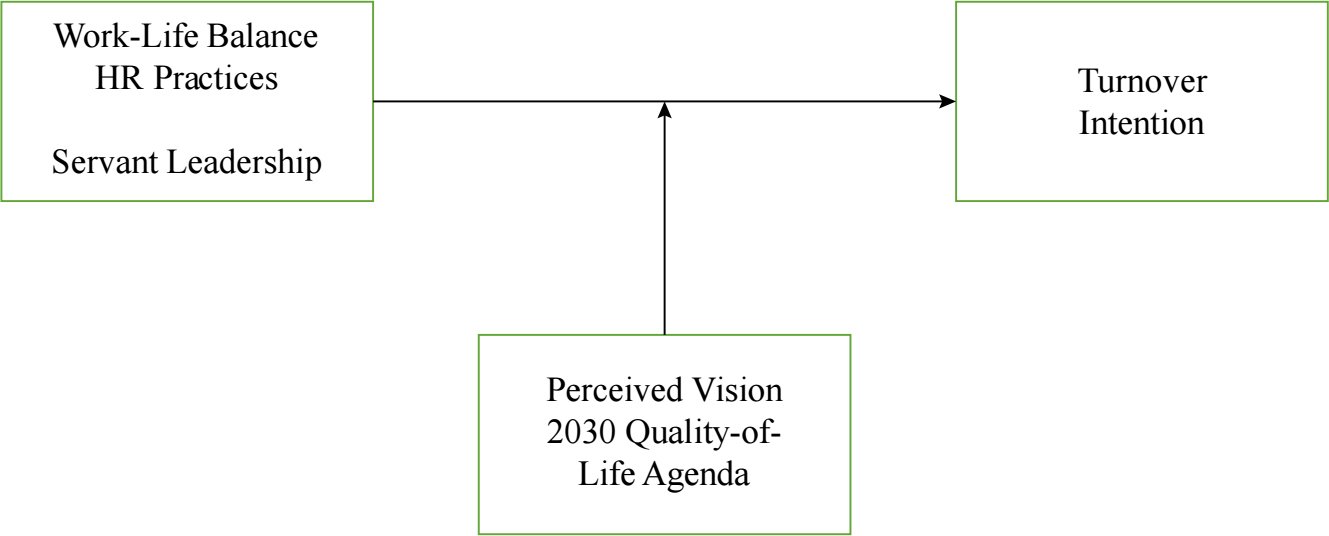
Fig. (1). Conceptual framework.
H3a: Perceived Vision 2030 Quality-of-Life Agenda moderates the relationships between Work–Life Balance HR Practices, and turnover intention in Saudi Arabia’s hospitality sector.
H3b: Perceived Vision 2030 Quality-of-Life Agenda moderates the relationships between Servant Leadership and turnover intention in Saudi Arabia’s hospitality sector.
2.3. Conceptual Framework
In addition, based on a review of studies and arguments developed from emerging literature, the following conceptual framework of the study is developed, as depicted in Fig. (1).
3. METHODOLOGY
This study employs a primary quantitative research design, using a structured questionnaire to collect data from employees in the Saudi hospitality sector. The survey questions were scored according to a five-point Likert scale from “strongly disagree” to “strongly agree” as recommended by (Mazurek et al., 2021), and grouped into the four constructs examined in this study work-life balance (WLB) HR practices, servant leadership, turnover intention, and the perceived Vision 2030 Quality-of-Life agenda.
The questionnaire was divided into four constructs measured using a validated questionnaire scale. The Work–Life Balance (WLB) HR Practices were adapted from (Avadhani & Menon’s, 2022) items, for example, “I Work in a place that is supportive of my family commitment”. The items on Servant Leadership were adapted from Utrecht Zelfmanagement Team (van Dierendonck & Nuijten, 2011); for example, “My manager gives me the authority to take decisions which make work easier for me”. Turnover Intention was adapted from items described by (Ike et al., 2023); for example, “I often feel like quitting this organisation because my years of service do not reflect my present job designation”. The Perceived Vision 2030 Quality-of-Life Agenda construct was operationalised by identifying a comprehensive series of questions based on a comprehensive literature review of the Saudi Vision 2030 Quality-of-Life initiatives dimension, institutional theory, work–life balance, leadership, and employees’ perceptions of organisational environments. Three human resource management/organisational behaviour specialists were used to determine the content validity, construct validity, and clarity of the original item pool. Minor wording adjustments were made based on the group’s recommendations to enhance the context’s suitability for the Saudi hospitality industry. The revised tool was then pilot tested with 30 hospitality staff which resulted in acceptable internal consistency (Cronbach’s α = 0.81). The items were subsequently clarified, made readable, and appropriate for the participants, as confirmed by their comments from the participant feedback before the main survey. The complete questionnaire is provided in the Appendix A.
The study included 400 staff members working in hotels in the main cities of Saudi Arabia. The participants were recruited through the QD questionnaire distribution methodology using the hotel’s HR staff, who facilitated a cross-departmental and cross-level reach of participants. This study used a stratified purposive sampling approach, as recommended by (Nguyen et al., 2021), in which the population was segmented into strata based on the relevant hotel departments and job levels. These participants were then recruited from each stratum to reflect the principal organisational groups with consistency to the study objectives. They were based on access through participating hotels and voluntary employee participation; therefore, they should not be generalised to organisations with similar organisational and workforce properties.
Sample size adequacy was evaluated according to the recommendations of (Kang, 2021) for a multiple regression model, including the moderation terms, using G*Power software. The given values of alpha = 0.05, beta = 0.05, f² = 0.15, and N = 400 (respondents) met the minimum requirement for parameter estimation and moderation analysis. Based on this, it was decided that the sample chosen had adequate statistical power and would include the possibility of loss of data due to screening. A total of 800 hospitality employees were targeted, of whom 450 completed the questionnaires, which is 56.25% of the total. Of the 50 responses, 50 were discarded after data screening for missing values and multivariate outliers, leaving 400 responses for analysis. All returned questionnaires were checked for completeness and data quality before analysis.
Over 10% of the questionnaires had missing recommendations and were therefore omitted. The remaining missing values were few and were filled using mean substitution. Multivariate outliers were detected using Mahalanobis distance at the 0.001 level of significance, and the cases found outside the critical value were deleted. These screening processes guaranteed that the data had no irregularities which would prevent it from being used in subsequent statistical analysis and strengthened the validity of the findings of the study. As indicated by (Nguyen et al., 2021), selection bias was addressed through stratification, while non-response bias was examined by comparing early (n1=30) and late (n2=30) respondents, revealing no significant differences in the key variables. Common Method Bias (CMB) was assessed using the Variance Inflation Factor (VIF), as highlighted in the discussion of (Kock, 2015).
The full collinearity VIF results shown in Table 1 indicate that common method bias is not a substantial concern in this study. Every predictor variable had a VIF value less than the suggested 3.3 level, as recommended by (Kock, 2015), with Work-Life Balance (VIF = 1.686), Servant Leadership (VIF = 1.427), and Perceived Vision 2030 Quality-of-Life Agenda (VIF = 1.448). Consequently, the full collinearity VIF values suggest that common method bias is unlikely to be a serious concern.
Table 1. Full-collinearity VIF for common method bias.
| Collinearity Statistics | ||
| – | Tolerance | VIF |
| Work-Life Balance | 0.593 | 1.686 |
| Servant Leadership | 0.701 | 1.427 |
| Perceived Vision 2030 Quality-of-Life Agenda | 0.690 | 1.448 |
Note: a. Dependent Variable: Turnover Intentions
Data analysis was conducted using IBM SPSS and Andrew F. Hayes PROCESS Macro Model 1. Descriptive statistics were employed to explore participants’ demographic and organisational characteristics, while Cronbach’s alpha assessed the reliability of constructs, confirming internal consistency above the recommended threshold of 0.70 (Abu-Bader & Jones, 2021). To test the proposed hypotheses, including both direct and moderating roles, Andrew F. Hayes’ bootstrapping method was applied, allowing robust estimation of moderation effects with confidence intervals. This method enabled the investigation of the relationships among model constructs, aligning with the study’s aim to examine how WLB HR practices and servant leadership influence turnover intention, with the perceived Vision 2030 Quality-of-Life Agenda acting as a moderator.
4. RESULTS
4.1. Demographic Analysis
The demographic profiles of the study participants (n = 400) are presented in Table 2. As can be observed from the results, among the total surveyed participants, 58.25% were male, 36.75% were female, and 5% preferred not to answer. The predominance of males reflects the workforce composition of Saudi hospitality, particularly in operational and supervisory positions. In addition, among these participants, 25% were 25-34 years old, 15% were between 35 and 44 years, 13.75% were 45-54 years, and 12.50% were 55 years and above. In addition, with regards to nationality, most of the participants were Pakistani (30%), while 26.25% were European expatriates followed by 25% Bangladeshi. Most of the participants that is 28.75% and 26.25%, were Bachelor’s and Master’s qualified respectively. Moreover, 41.25% of the participants served in a supervisory role, 25% served in a managerial role, and 13.75% served in a senior management role in hotel organisations. Lastly, 32.50% and 31.25% of the participants had 3-5 years and 6-10 years of industry experience, respectively, while 11.25% had more than 10 years of experience. Further, in relation to hotel categories, 27.50% and 33.75% of the surveyed participants represented three- and four-star hotels, respectively, while 18.75% represented five-star hotels. In addition, with regards to geographical coverage, 31.25% of the employees served hotels in Riyadh, 43.75% in Jeddah, and 25% in Medina. Lastly, among these participants, 22.50% served in housekeeping department, 18.75% served in operations, 25% in supply chain and 33.75% in guest services.
Table 2. Demographic characteristics.
| Demographic Category | Frequency (n) | Percentage (%) | |
| Gender | Male | 233 | 58.25% |
| Female | 147 | 36.75% | |
| Prefer not to say | 20 | 5.00% | |
| Age Range | Below 25 | 135 | 33.75% |
| 25–34 | 100 | 25.00% | |
| 35–44 | 60 | 15.00% | |
| 45–54 | 55 | 13.75% | |
| 55 and above | 50 | 12.50% | |
| Nationality | Indian | 75 | 18.75% |
| Bangladeshi | 100 | 25.00% | |
| Pakistani | 120 | 30.00% | |
| European | 105 | 26.25% | |
| Educational Qualification | Secondary | 100 | 25.00% |
| Diploma | 80 | 20.00% | |
| Bachelor’s | 115 | 28.75% | |
| Master’s | 105 | 26.25% | |
| Current Job Role | Operational | 80 | 20.00% |
| Supervisory | 165 | 41.25% | |
| Managerial | 100 | 25.00% | |
| Senior Management | 55 | 13.75% | |
| Hotel Industry Experience | Less than 3 years | 100 | 25.00% |
| 3–5 years | 130 | 32.50% | |
| 6–10 years | 125 | 31.25% | |
| More than 10 years | 45 | 11.25% | |
| Hotel Category | Two-Star | 80 | 20.00% |
| Three-Star | 110 | 27.50% | |
| Four-Star | 135 | 33.75% | |
| Five-Star | 75 | 18.75% | |
| Cities | Riyadh | 125 | 31.25% |
| Jeddah | 175 | 43.75% | |
| Medina | 100 | 25.00% | |
| Department | House Keeping | 90 | 22.50% |
| Operations | 75 | 18.75% | |
| Supply Chain | 100 | 25.00% | |
| Guest Services | 135 | 33.75% | |
4.2. Reliability Analysis
The reliability of the measurement model was examined using Cronbach’s alpha, with a standard value of 0.7. The results in Table 3 show that Cronbach’s alpha for all constructs of the measurement model satisfies this condition (α>0.7), which implies that reliability is established.
Table 3. Reliability statistics.
| Construct | Cronbach’s Alpha | No. of Items |
| Work-Life Balance | 0.853 | 3 |
| Servant Leadership | 0.810 | 3 |
| Turnover Intentions | 0.881 | 3 |
| Perceived Vision 2030 Quality-of-Life Agenda | 0.898 | 3 |
4.3. Validity Analysis
Table 4 shows that the inter-item correlation matrix of all the items in the measurement is satisfactory regarding internal consistency and construct validity. The relationship between the indicators of each construct ranged between moderate and high level (WLB: 0.598 to 0.776; PV: 0.702 to 0.776), and there was no excessive redundancy. As predicted, there were moderate negative correlations between the WLB items and turnover intention items (r = −0.396 to −0.581), supporting the expected negative relationship between WLB and employees’ intention to leave. Similarly, most of the items that make up the servant leadership scale have negative correlations with turnover intention, which is in keeping with the hypothesised direction. The high inter-item correlations within the constructs of turnover intention and Vision 2030 add to the evidence of coherent construct measurements. Importantly, there was no correlation above the critical value of 0.90, suggesting that there was no concern for multicollinearity when performing multivariate analyses with this data.
Table 4. Inter-item correlations for validity.
| – | WLB1 | WLB2 | WLB3 | SL1 | SL2 | SL3 | TI1 | TI2 | TI3 | PV1 | PV2 | PV3 |
| WLB1 | 1.000 | 0.705 | 0.598 | 0.352 | 0.393 | 0.439 | -0.581 | -0.518 | -0.436 | 0.477 | 0.406 | 0.496 |
| WLB2 | 0.705 | 1.000 | 0.675 | 0.305 | 0.379 | 0.478 | -0.563 | -0.542 | -0.396 | 0.428 | 0.389 | 0.423 |
| WLB3 | 0.598 | 0.675 | 1.000 | 0.330 | 0.443 | 0.427 | -0.466 | -0.503 | -0.430 | 0.455 | 0.399 | 0.419 |
| SL1 | 0.352 | 0.305 | 0.330 | 1.000 | 0.610 | 0.486 | -0.299 | -0.260 | -0.291 | 0.335 | 0.283 | 0.253 |
| SL2 | 0.393 | 0.379 | 0.443 | 0.610 | 1.000 | 0.675 | -0.337 | -0.360 | -0.422 | 0.366 | 0.293 | 0.306 |
| SL3 | 0.439 | 0.478 | 0.427 | 0.486 | 0.675 | 1.000 | -0.443 | -0.438 | -0.404 | 0.316 | 0.336 | 0.321 |
| TI1 | -0.581 | -0.563 | -0.466 | -0.299 | -0.337 | -0.443 | 1.000 | 0.752 | 0.646 | 0.533 | 0.532 | 0.561 |
| TI2 | -0.518 | -0.542 | -0.503 | -0.260 | -0.360 | -0.438 | 0.752 | 1.000 | 0.740 | 0.526 | 0.537 | 0.595 |
| TI3 | -0.436 | -0.396 | -0.430 | -0.291 | -0.422 | -0.404 | 0.646 | 0.740 | 1.000 | 0.484 | 0.508 | 0.536 |
| PV1 | 0.477 | 0.428 | 0.455 | 0.335 | 0.366 | 0.316 | -0.533 | -0.526 | -0.484 | 1.000 | 0.776 | 0.702 |
| PV2 | 0.406 | 0.389 | 0.399 | 0.283 | 0.293 | 0.336 | -0.532 | -0.537 | -0.508 | 0.776 | 1.000 | 0.766 |
| PV3 | 0.496 | 0.423 | 0.419 | 0.253 | 0.306 | 0.321 | -0.561 | -0.595 | -0.536 | 0.702 | 0.766 | 1.000 |
4.4. Correlation Analysis
The correlation analysis in Table 5 shows that the constructs have strong relationships at the 0.01 level, with both positive and negative relationships. There was a negative relationship between Work-Life Balance, HR Practices to Turnover Intention (r = -0.624) and a moderate positive relationship with Servant Leadership (r = 0.529) and the Perceived Vision 2030 Quality-of-Life Agenda (r = 0.539). Similarly, Turnover Intention is moderately and negatively correlated (r =-0.476), while Perceived Vision 2030 is positively correlated (r = 0.402) with Servant Leadership. Perceived Vision 2030 Quality-of-Life Agenda exhibited the strongest negative association with Turnover Intention (r = -0.652).
Table 5. Correlation analysis.
| Variable | 1 | 2 | 3 | 4 |
| Work-Life Balance (1) | 1 | 0.529** | -0.624** | 0.539** |
| Servant Leadership (2) | 0.529** | 1 | -0.476** | 0.402** |
| Turnover Intentions (3) | -0.624** | -0.476** | 1 | -0.652** |
| Perceived Vision 2030 Quality-of-Life Agenda (4) | 0.539** | 0.402** | -0.652** | 1 |
Note: **: significant at 5%
4.5. Moderation Analysis-Preacher and Hayes Process Model
The model in Table 6 shows (R2 = 0.536, p <0.001), which shows that the model explains 53.6% of the variance in turnover intentions. Work-Life Balance, HR Practices and turnover intention have a strong negative relationship (β = -0.452, p = 0.003), meaning that the greater the work-life balance, the less the turnover intention. The Vision 2030 Quality-of-Life Agenda also showed a moderately negative association (β = -0.236, p = 0.041), indicating that a more positive perceived vision was associated with lower turnover intention. The interaction term was statistically significant (β = −0.087, p = 0.026), suggesting that the Perceived Vision 2030 Quality-of-Life Agenda has a small moderating influence between work and life balance and turnover intention. The interaction effect was statistically significant (ΔR² = 0.006, p = 0.026), indicating evidence of moderation. However, as the interaction explained only 0.6% of the variance in turnover intentions, it is safe to conclude that the moderating role is practically small.
Table 6. Process macro-work-life-balance.
| Model Summary | ||||||
| R | R² | MSE | F | df1 | df2 | P |
| 0.732 | 0.536 | 0.351 | 152.64 | 3 | 396 | < .001 |
| Regression Coefficients | ||||||
| Predictor | B | SE | T | P | 95% LLCI | 95% ULCI |
| Constant | 1.362 | 0.437 | 3.12 | 0.002 | 0.504 | 2.22 |
| Work–Life Balance (WLB) | -0.452 | 0.144 | 2.88 | 0.003 | -0.734 | -0.172 |
| Perceived Vision 2030 (PV) | -0.236 | 0.127 | 2.35 | 0.041 | -0.486 | -0.015 |
| WLB × PV | -0.087 | 0.039 | 2.56 | 0.026 | -0.163 | -0.011 |
| Test of Interaction Effect | ||||||
| Interaction | ΔR² | F | df1 | df2 | P | – |
| WLB × PV | 0.006 | 5.03 | 1 | 396 | 0.026 | – |
The results in Table 7 show that there is a statistically significant predictive relevance of turnover intention (R2 = 0.485, p <0.001). Servant Leadership has a weak yet significant negative relationship with turnover intention (β = -0.313, p = 0.033), and the high servant leadership levels may be associated with a slightly lower turnover intention. There is also a significant negative relationship (β = -0.384, p = 0.006) between the Perceived Vision 2030 Quality-of-Life Agenda and turnover intention, such that the higher the perception, the lower the turnover intention. The interaction term was also significant (β = −0.072, p = 0.043), suggesting a small interaction effect between servant leadership and turnover intention regarding the perceived vision 2030 quality of life agenda. However, the interaction effect accounted for only a small percentage of the variance (ΔR2 = 0.004) and was not practically meaningful, even though it was statistically significant.
Table 7. Process macro for servant leadership.
| Model Summary | ||||||
| R | R² | MSE | F | df1 | df2 | P |
| 0.696 | 0.485 | 0.39 | 124.06 | 3 | 396 | < 0.001 |
| Regression Coefficients | ||||||
| Predictor | B | SE | T | P | 95% LLCI | 95% ULCI |
| Constant | 1.179 | 0.505 | 2.331 | 0.021 | 0.186 | 2.172 |
| Servant Leadership (SL) | -0.313 | 0.155 | 2.022 | 0.033 | -0.618 | -0.008 |
| Perceived Vision 2030 (PV) | -0.384 | 0.138 | 2.773 | 0.006 | -0.656 | -0.112 |
| SL × PV | -0.072 | 0.040 | 1.983 | 0.043 | -0.152 | -0.007 |
| Test of Interaction Effect | ||||||
| Interaction | ΔR² | F | df1 | df2 | P | – |
| SL × PV | 0.004 | 3.22 | 1 | 396 | 0.043 | – |
5. DISCUSSION
The results validated H1, showing a statistically significant negative association between HR practices related to work-life balance and employees’ turnover intention. This indicates that the greater the perceived work-life balance, the lower the employee turnover intention within the Saudi Arabian hospitality sector. This finding aligns with (Kerdpitak & Jermsittiparsert’s, 2020) research, which also found that work-life balance programmes lower turnover rates among employees by enhancing commitment and decreasing stress. Similarly, (Thomas & George, 2024) discovered that work-life balance improves job engagement, which indirectly reduces turnover intention. Nonetheless, the current results differ from those of (Kaur & Randhawa, 2021), who conceptualised because the former considers work-life balance as a predictive factor rather than a moderating factor. This difference can be explained by the Saudi hospitality setting, in which challenging shift systems, intense customer contact, and labour deficits enhance the relevance of work-life balance practices as direct retention strategies, as opposed to indirect psychological processes.
Theoretically, this is in line with the Social Exchange Theory, which states that when employees believe that the organisation is concerned with their work–life balance, they feel valued, and this, in turn, motivates them to become less likely to leave. The results indicate that work–life balance practices are one of the organisational mechanisms related to reduced turnover intention in the Saudi hospitality industry. They may be relevant based on the realities of the hospitality profession itself, such as shift scheduling and workload distribution, but no suggestion can be made of the relative impact of these compared to servant leadership suggested by (Kaur & Randhawa, 2021). This suggests the need to consider more factors than a purely psychological interpretation of the policy, focusing on the structural aspects of WLB policies in the shift planning process and workload management, and shows a more context-specific understanding of dynamics in relation to retention.
The findings show that there is a statistically significant negative predictive relationship between Servant Leadership and employee turnover intention, meaning that the levels of servant leadership correlate with low turnover intention among Saudi Arabian hospitality employees, which validates H2. This finding is connected to the studies by (Huning et al., 2020; and Amah & Oyetuunde, 2020), who also highlighted that servant leadership contributes to lower withdrawal tendencies, which can be achieved based on the relational mechanisms identified as perceived support, job satisfaction, and employee voice. Nevertheless, the comparatively lower level of association in this study is in contrast to (Bieńkowska et al., 2022), who recorded stronger leadership-related retention rates, especially through capability development and performance improvement channels. This disparity can also be explained by the realities of the hospitality industry, where frontline workers have limited direct interaction time with their supervisors due to task-intensive work, shift scheduling, and service urgency, which restricts the complete manifestation of servant leadership behaviours.
In theory, these results are congruent with the Social Exchange Theory which, as discussed by (Bieńkowska et al., 2022), suggests that employees reciprocate supportive leadership behaviour with a lower intention to leave the organisation. The present analysis does not allow for any conclusions as to whether servant leadership has a significant effect compared to work–life balance practices; however, on the measure of turnover intention, servant leadership was negatively associated with turnover intention. This suggests that the influence of leadership is more indirect and relies more on the extent to which organisations structurally provide opportunities for leaders to be accessible rather than on leadership style.
The moderation results showed that the perceived Vision 2030 Quality-of-Life Agenda holds a conditioning role in influencing employees’ perceptions of organisational practices. Although the moderation was statistically significant for both relationships, the interaction effect was stronger for WLB HR practices than for servant leadership. Therefore, Vision 2030 appears to reinforce organisational HR practices slightly more strongly than it does leadership behaviours. This indicates that the links between employees and Vision 2030 Quality of Life initiatives are stronger for formal organisational HR practices than for leadership behaviours, as (Huning et al., 2020) suggested. However, the significant interaction effect for both relationships suggests that perceived Vision 2030 enhances the effect of organisational support mechanisms on the likelihood of turnover intention, but the effect is not as strong for the combination of the two.
In terms of formal HR initiatives, the moderation findings suggest that the effectiveness of HR practices and Vision 2030 reforms, as perceived by employees, is more positively assessed by those whose perceptions are ‘stronger’ than others. Employee perceptions of national reforms did not lead to a new theoretical explanation; rather, the results offer empirical evidence for the proposed institutional mechanism, showing that employee perceptions of national reforms reinforced the influence of organisational work-life balance practices on turnover intention. This finding aligns with the argument of (Khalid & Parveen, 2024) that HR policies are more likely to be associated with institutional initiatives than leadership behaviours, which are more likely to be seen as individualised behaviours that do not have a direct connection to the institutional framework.
This trend differs from the findings of (Al-Hareri & Nassani, 2025; and Ali et al., 2024), which highlight consistent contextual reinforcement throughout the organisational drivers, suggesting that institutional forces can strategically enhance structured HR systems. Although both HR practices and servant leadership were significantly moderated, the interaction was slightly stronger for HR practices. In the Saudi hospitality industry, this means that national reform agendas do not equally influence all mechanisms within the workplace but rather enhance those that are officially correlated to policy-centred quality-of-life gains. Overall, the results indicate that the perceived Vision 2030 Quality-of-Life Agenda provides a conducive institutional environment for the implementation of organisational initiatives to have any meaning to the employees. Nonetheless, rather than directly affecting employees’ decisions to leave, employees’ perceptions seem to have an indirect effect on establishing the effectiveness of the existing elements of the organisation, that is, WLB practices and the behaviours of its leaders in promoting the retention of employees. This, in turn, indicates the complementary effect that the institutional environment has on behavioural reactions to the support mechanisms provided in the workplace in the Saudi hospitality industry.
CONCLUSION AND LIMITATIONS
This study enhances the current knowledge of employee turnover intention in the Saudi hospitality industry by revealing that retention is not defined by a single organisational process but rather a combination of HR systems, leadership relations, and institutional backgrounds. Instead of establishing deterministic relationships, the results point to the conditionality and inconsistent predictive strength of different constructs. Work–Life Balance exhibited a somewhat larger regression coefficient than Servant Leadership in this sample; however, no statistical comparison between coefficients was conducted, and there is a possibility that the structural HR conditions might provide stronger retention support than relational leadership in high-intensity service conditions. Moreover, it has been demonstrated that due to the moderating role of the Perceived Vision 2030 Quality-of-Life Agenda, institutional forces discriminately engage the HR-related processes but have a lesser impact on the leadership processes. This reveals that the suppositions of SET tend to operate distinctively within the institutional context, as it supports the idea that reciprocity mechanisms are moderated institutionally and constrained contextually.
Nevertheless, the research has some weaknesses due to its cross-sectional research design, which only allows for the interpretation of a predictive relationship in forming turnover intentions through WLB and servant leadership. In addition, the use of self-reported survey data creates a risk of common method bias, which could exaggerate the observed relationships. The emphasis on one sector and one national setting also led to a lack of generalisability since the findings cannot be wholly generalised to other sectors and cultural settings outside the hospitality sector of Saudi Arabia. Further studies should adopt longitudinal research designs to ascertain how turnover intention varies over time and develop more causal directions. Self-report bias was minimised by using multi-source data, such as evaluations by the supervisor or actual turnover history. In addition, cross-industry and cross-cultural research is advised to investigate whether institutional moderators, such as Vision 2030, have the same impact in other organisational and national contexts. Other limitations are related to stratified purposive sampling, which could potentially make the results of this study not generalisable beyond the sampled hospitality organisations in key cities in Saudi Arabia. Some representation gaps were identified in the stratification results by department and job level; nonetheless, a self-selection bias was introduced due to the methods used to recruit the participants for HR-facilitated and online recruitment. Thus, the results do not represent the entire Saudi hospitality industry. In future studies, probability-based sampling and a wider geographic reach should be considered to increase external validity and generalisability.
IMPLICATIONS
The results have essential implications for theory and practice. Theoretically, this study builds upon the concepts of Social Exchange Theory and Institutional Theory in that it proves that the reciprocity of employees and behavioural responses depend on the circumstances and that an institutional framework, such as Vision 2030, slightly reinforces HR-driven mechanisms over leadership-based factors. In a practical sense, hospitality managers in Saudi Arabia should consider structured Work-Life Balance, HR practices as key retention strategies with the assistance of Servant Leadership behaviours, but not confined to it. Policymakers must understand that the quality-of-life initiatives implemented as part of Vision 2030 are enabling conditions, and their implementation makes employees more responsive to organisational HR systems. Human resource departments are also implied to align internal policies with national reform agendas to achieve maximum employee retention outcomes.
LIST OF ABBREVIATIONS
| CMB | = | Common Method Bias |
| QoL | = | Quality-of-Life |
| SET | = | Social Exchange Theory |
| TI | = | Turnover Intention |
| VIF | = | Variance Inflation Factor |
| WLB | = | Work–Life Balance |
AUTHORS’ CONTRIBUTION
B.N. contributed to the conceptualization and design of the study, methodology development, data collection, analysis and interpretation of results, manuscript drafting, and critical revision of the final manuscript.
ETHICAL APPROVAL & INFORMED CONSENT
The study procedures followed established ethical guidelines for survey-based research. Participation was voluntary, and informed consent was obtained from all participants prior to completing the survey. To ensure privacy and confidentiality, personally identifiable information was excluded, and all responses were anonymised and analysed in aggregate.
AVAILABILITY OF DATA AND MATERIALS
The data generated and analysed during this study are available from the corresponding author [B.N.] upon reasonable request, subject to applicable ethical and confidentiality requirements.
FUNDING
This study received no external funding or financial support from any public, private, commercial, or non-profit organization. The research was conducted without any financial assistance or sponsorship.
CONFLICT OF INTEREST
The author declares no conflicts of interest.
ACKNOWLEDGEMENTS
None.
DECLARATION OF AI
ChatGPT was used to support the preparation of this manuscript, primarily for language refinement, editing, and improving clarity. It was not used for literature searching, data extraction, analysis, synthesis, or interpretation of the findings. The author reviewed and verified all AI-assisted content and remained fully responsible for the accuracy and integrity of the manuscript.
APPENDIX A: QUESTIONNAIRE
- What is your gender?
- Male
- Female
- Prefer not to say
- What is your age group?
- Below 25
- 25–34
- 35–44
- 45–54
- 55 and above
- What is your highest educational qualification?
- Secondary
- Diploma
- Bachelor’s
- Master’s
- Doctorate
- What best describes your current job role?
- Operational/Frontline
- Supervisory
- Managerial
- Senior Management
- How many years of total experience do you have in this industry?
- Less than 3 years
- 3–5 years
- 6–10 years
- More than 10 years
| Variable | Question Statement | Strongly Disagree (1) | Disagree (2) | Neutral (3) | Agree (4) | Strongly Agree (5) |
| Work–Life Balance Practices. Adapted from: (Avadhani & Menon, 2022). | 1. I can share my work with my colleagues in case of emergency. | ☐ | ☐ | ☐ | ☐ | ☐ |
| 2. The job provides me the option of work from home to meet family needs and commitments. | ☐ | ☐ | ☐ | ☐ | ☐ | |
| 3. I work in such a place that is supportive of my family commitment. | ☐ | ☐ | ☐ | ☐ | ☐ | |
| Servant Leadership. Adapted from: van (Dierendonck & Nuijten, 2011) | 1. My manager gives me the authority to take decisions which make work easier for me. | ☐ | ☐ | ☐ | ☐ | ☐ |
| 2. My manager encourages his/her staff to come up with new ideas. | ☐ | ☐ | ☐ | ☐ | ☐ | |
| 3. My manager appears to enjoy his/her colleagues’ success more than his/her own. | ☐ | ☐ | ☐ | ☐ | ☐ | |
| Vision 2030 Quality-of-Life Agenda | 1. Vision 2030’s quality-of-life agenda has contributed to a better work environment in organisation. | ☐ | ☐ | ☐ | ☐ | ☐ |
| 2. The focus on quality of life has influenced decision to remain with the company. | ☐ | ☐ | ☐ | ☐ | ☐ | |
| 3. Vision 2030 has improved work–life balance policies across the organisation. | ☐ | ☐ | ☐ | ☐ | ☐ | |
| Turnover Intention. Adapted from: (Ike et al., 2023) | 1. If I get better offer, I will leave my present job because of job insecurity. | ☐ | ☐ | ☐ | ☐ | ☐ |
2. I often feel like quitting this organisation because my years of service do not reflect my present job designation. | ☐ | ☐ | ☐ | ☐ | ☐ | |
3. I feel like quitting this organisation because it does not create opportunity for advancement and development. | ☐ | ☐ | ☐ | ☐ | ☐ |
REFERENCES
Abdou, A. H., Khalil, A. A. F., Mahmoud, H. M. E., Elsaied, M. A., & Elsaed, A. A. (2022). The impact of hospitality work environment on employees’ turnover intentions during COVID-19 pandemic: The mediating role of work-family conflict. Frontiers in Psychology, 13, 890418.
https://doi.org/10.3389/fpsyg.2022.890418
Abu-Bader, S., & Jones, T. V. (2021). Statistical mediation analysis using the sobel test and hayes SPSS process macro. International Journal of Quantitative and Qualitative Research Methods, 9(1), 42-61. Available from: https://www.eajournals.org/wp-content/uploads/Statistical-Mediation-Analysis-Using-the-Sobel-Test-and-Hayes-SPSS-Process-Macro.pdf
Akpa, V. O., Mowaiye, B., Akinlabi, B. H., & Magaji, N. (2022). Effect of green human resource management practices and green work life balance on employee retention in selected hospitality firms in Lagos and Ogun states, Nigeria. European journal of human resource management studies, 5(4).
https://doi.org/10.46827/ejhrms.v5i4.1265
Alammash, S. A., Guo, P. S., & Vinnikova, A. (2021). Saudi Arabia and the heart of Islam in Vision 2030: Impact on international relations. Arab Journal of Scientific Publishing, 2663, 5798. Available from: https://www.ajsp.net/research/Saudi_Arabia_and_the_Heart_of_Islam_in_Vision_2030.pdf
Alamoudi, L. H. (2024). Exploring Workforce Dynamics: An In-Depth Analysis of Employee Turnover and Retention in the Saudi Arabian Café Sector. European Journal of Business and Management Research, 9(3), 59-67.
https://doi.org/10.24018/ejbmr.2024.9.3.2242
Alenazy, H. M., & Alsulami, A. F. (2025). The Mediating Role of Culture: Servant Leadership and Faculty Loyalty in Saudi Public Universities. Journal of Posthumanism, 5(5), 2312-2325.
https://doi.org/10.63332/joph.v5i5.1618
Alhaider, M., & Alqahtani, A. (2025, May). Impact of work–life balance on organisational performance with mediating effect of well-being and organisational support as moderator. In Evidence-based HRM: a Global Forum for Empirical Scholarship, 14(2), 433-451.
https://doi.org/10.1108/EBHRM-10-2024-0371
Al-Hareri, M., & Nassani, A. A. (2025). Ethical Leadership in Action: Empirical Insights from Saudi Arabia’s Journey Toward Vision 2030. Arab Journal of Management, 1-18.
https://doi.org/10.21608/aja.2025.374700.1820
Al-Harthy, B., & Yusof, R. (2022). A Conceptual Paper on Compensation and Benefits, Job Security, Work-Life Balance, Employee Retention and Localization in Oman. Global Business & Management Research: An International Journal, 14(3s). Available from: https://gbmrjournal.com/pdf/v14n3s/V14N3s-49.pdf
Ali, A. F., Eid, E., & Alhadad, H. (2024). The impact of organisational citizenship on job performance of employees in the private automotive sector in Saudi Arabia in the light of Vision 2030. Arab Journal of Sciences and Research Publishing, 10(2), 72–87.
https://doi.org/10.26389/AJSRP.A250324
Ali, A., & Salameh, A. A. (2021). Role of travel and tourism sector in the attainment of Vision 2030 in Saudi Arabia: An analytical study. Problems and Perspectives in Management, 19(2), 276-290.
https://doi.org/10.21511/ppm.19(2).2021.23
Allianz HR (2024). Saudi Arabia Hospitality Worker Retention Insights. Retrieved from: https://allianzehr.com/saudi-arabia-hospitality-worker-retention-insights/
Alvi, F. (2025). Moderating Effect of Leadership Styles on the Relationship Between Employee Engagement and Performance Excellence in the Telecom Sector of Abu Dhabi. Advance Journal of Business Management and Social Science, 1(2).
https://doi.org/10.65080/ajbmss.v1i2.32
Amah, O. E., & Oyetuunde, K. (2020). The effect of servant leadership on employee turnover in SMEs in Nigeria: the role of career growth potential and employee voice. Journal of Small Business and Enterprise Development, 27(6), 885-904.
https://doi.org/10.1108/JSBED-01-2019-0009
Asfahani, A. M., Eskandarany, A., Dahlan, D. A., Ullah, Z., Khan, H., & Naheed, R. (2024). Empowering women in Saudi workforce: HR, job satisfaction, and policies for work–life balance. Sustainability, 16(20), 8826.
https://doi.org/10.3390/su16208826
Ashgar, R. I. (2025). Quality of life among university employees considering Saudi Vision 2030: A cross-sectional survey. Social Behavior and Personality: an international journal, 53(11), 1-11.
https://doi.org/10.2224/sbp.14760
Avadhani, V. D., & B Menon, R. (2022). Development and standardization of the work-life balance scale for the insurance sector employees. Cogent Business & Management, 9(1), 2154994.
https://doi.org/10.1080/23311975.2022.2154994
Badaruddin, B., Yusriadi, Y., & Fatmasari, F. (2025). Organisational dynamics of employee performance in Indonesian banking with reference to Islamic work values and workplace engagement. Discover Global Society, 3(1), 180.
https://doi.org/10.1007/s44282-025-00328-9
Bieńkowska, A., Koszela, A., Ludwikowska, K., & Tworek, K. (2022). Turnover-mitigating effect of servant leadership on job performance. Engineering Management in Production and Services, 14(2), 67-81.
https://doi.org/10.2478/emj-2022-0017
Dorta-Afonso, D., Cuéllar-Molina, D., Rodríguez-Robaina, C., & De Saá-Pérez, P. (2025). Servant leadership and HPWS for work-life balance and job satisfaction in the hotel industry: perspectives from conservation of resources theory. Journal of Hospitality and Tourism Insights, 8(5), 2011-2030.
https://doi.org/10.1108/JHTI-06-2024-0631
Fatima, M. (2025). Challenges in Saudi Arabia’s hospitality recruitment sector. RFS HR Consultancy. Available from: https://rfshrconsultancy.com/hospitality-recruitment-in-saudi-arabia/?utm_source=chatgpt.com
Huning, T. M., Hurt, K. J., & Frieder, R. E. (2020). The effect of servant leadership, perceived organisational support, job satisfaction and job embeddedness on turnover intentions: An empirical investigation. In Evidence-Based HRM: a Global Forum for Empirical Scholarship, 8(2), 177-194.
https://doi.org/10.1108/EBHRM-06-2019-0049
Ike, O. O., Ugwu, L. E., Enwereuzor, I. K., Eze, I. C., Omeje, O., & Okonkwo, E. (2023). Expanded-multidimensional turnover intentions: scale development and validation. BMC psychology, 11(1), 271.
https://doi.org/10.1186/s40359-023-01303-2
Islam, Q., & Assiri, S. (2019). Staff Turnover crisis in hotel industry of Saudi Arabia: Challenges and projections of employees and employers. Saudi Journal of Business and Management Studies, 4, 548-555.
https://doi.org/10.21276/sjbms.2019.4.6.10
Kakar, A. S., Saufi, R. A., Devadhasan, B. D., Meyer, N., Vetrivel, S. C., & Magda, R. (2021). The mediating role of person-job fit between work-life balance (WLB) practices and academic turnover intentions in India’s higher educational institutions. Sustainability, 13(19), 10497.
https://doi.org/10.3390/su131910497
Kang, H. (2021). Sample size determination and power analysis using the G* Power software. Journal of educational evaluation for health professions, 18.
https://doi.org/10.3352/jeehp.2021.18.17
Kaur, R., & Randhawa, G. (2021, July). Supportive supervisor to curtail turnover intentions: do employee engagement and work–life balance play any role? In Evidence-based HRM: a Global Forum for Empirical Scholarship, 9(3), 241-257.
https://doi.org/10.1108/EBHRM-12-2019-0118
Kerdpitak, C., & Jermsittiparsert, K. (2020). The effects of workplace stress, work-life balance on turnover intention: an empirical evidence from pharmaceutical industry in Thailand. Systematic Reviews in Pharmacy, 11(2), 586-594.
http://dx.doi.org/10.5530/srp.2019.2.04
Khalid, K., & Parveen, M. (2024). Compassionate leadership: as a support to enhance employees’ core self-evaluation, retention, and subjective career success. International Journal of Organisational Leadership, 13(3), 507-528.
https://doi.org/10.33844/ijol.2024.60428
Kock, N. (2015). Common method bias in PLS-SEM: A full collinearity assessment approach. International Journal of e-Collaboration, 11(4), 1-10.
https://doi.org/10.4018/ijec.2015100101
Lamprinou, V. D. I., Tasoulis, K., & Kravariti, F. (2021). The impact of servant leadership and perceived organisational and supervisor support on job burnout and work–life balance in the era of teleworking and COVID-19. Leadership & Organisation Development Journal, 42(7), 1071-1088.
https://psycnet.apa.org/doi/10.1108/LODJ-12-2020-0526
Lin, Z., Gu, H., Gillani, K. Z., & Fahlevi, M. (2024). Impact of green work–life balance and green human resource management practices on corporate sustainability performance and employee retention: Mediation of green innovation and organisational culture. Sustainability, 16(15), 6621.
https://doi.org/10.3390/su16156621
Ludwikowska, K. (2023). Employee-oriented human resource policy as a factor shaping the influence of servant leadership on job performance. International Journal of Productivity and Performance Management, 72(8), 2335-2348.
https://doi.org/10.1108/IJPPM-09-2021-0525
Mazurek, J., Rico, C. P., García, C. F., Magnot, J. P., & Magnot, T. (2021). The 5-item Likert scale and percentage scale correspondence with implications for the use of models with (fuzzy) linguistic variables. Journal of Quantitative Methods for Economics and Business Administration, 31, 3-16.
10.46661/revmetodoscuanteconempresa.4010
Mohammad, T., Kassem, B., & Mohammad, S. (2024). Employee wellbeing and quality of life of Saudi Arabian workers. In Employee wellbeing in the global south: a critical overview, pp. 121-144.
https://doi.org/10.1007/978-3-031-63249-5_6
Nabawanuka, H., & Ekmekcioglu, E. B. (2022). Millennials in the workplace: perceived supervisor support, work–life balance and employee well–being. Industrial and Commercial Training, 54(1), 123-144.
https://doi.org/10.1108/ICT-05-2021-0041
Nguyen, T. D., Shih, M. H., Srivastava, D., Tirthapura, S., & Xu, B. (2021). Stratified random sampling from streaming and stored data. Distributed and Parallel Databases, 39(3), 665-710.
https://doi.org/10.1007/s10619-020-07315-w
Omanwar, S. P., & Agrawal, R. K. (2022). Servant leadership, organisational identification and turnover intention: an empirical study in hospitals. International Journal of Organizational Analysis, 30(2), 239-258.
https://doi.org/10.1108/IJOA-08-2020-2374
Opoku, F. K., Kwao, I. T., & Johnson, A. P. (2023). Human resource policies and work–life balance in higher education: Employee engagement as mediator. SA Journal of Human Resource Management, 21, a1939.
https://doi.org/10.4102/sajhrm.v21i0.1939
Saleh, Z. T., Aslanoğlu, A., Elshatarat, R. A., Al-Za’areer, M. S., Almagharbeh, W. T., Alhejaili, A. A., Alhumaidi, B. N., Al-Akash, H. Y., Al-Momani, M. M., Alfanash, H. A., & Alasmari, A. A. (2025). Exploring the reasons and significant influencing factors of serious turnover intentions among nurses in Saudi ArabiaJournal of Education and Health Promotion, 14(1).
https://doi.org/10.4103/jehp.jehp_1227_24
Saufi, R. A., Aidara, S., Che Nawi, N. B., Permarupan, P. Y., Zainol, N. R. B., & Kakar, A. S. (2023). Turnover intention and its antecedents: The mediating role of work–life balance and the moderating role of job opportunity. Frontiers in Psychology, 14, 1137945.
https://doi.org/10.3389/fpsyg.2023.1137945
Santhanam, N., Kumar, J. R., Kumar, V., & Saha, R. (2020). Employee turnover intention in the milieu of human resource management practices: moderating role of work-life balance. International Journal of Business Innovation and Research, 24(1), 57-75.
https://doi.org/10.1504/IJBIR.2021.111979
Saudi Arabia Market Research (2025). Saudi Aims to Double Tourism GDP to 10% by 2030. Available from: https://saudimarketresearchconsulting.com/insights/articles/saudi-aims-to-double-tourism-gdp-to-10-by-2030
Suprayitno, D. (2024). Assessing the effect of compensation packages, work-life balance policies, and career development opportunities on employee retention: A case study of MSME employee. International Journal of Business, Law, and Education, 5(2), 1592-1561.
https://doi.org/10.56442/ijble.v5i2.609
Thomas, S. E., & George, J. (2024). Work-life balance practices: Drivers of job engagement and mitigators of turnover intention. Research Review International Journal Of Multidisciplinary, 9(3), 178-190. https://doi.org/10.31305/rrijm.2024.v09.n03.019
Udin, U. (2024). Ethical leadership and employee turnover intention in the social exchange perspective: Exploring a dual pathway model. Organizational Psychology, 14(4), 65-79.
https://doi.org/10.17323/2312-5942-2024-14-4-65-79
van Dierendonck, D., & Nuijten, I. (2011). The Servant Leadership Survey: Development and Validation of a Multidimensional Measure. Journal of Business & Psychology, 26, 249-267.
https://doi.org/10.1007/s10869-010-9194-1
Westbrook, K. W., & Peterson, R. M. (2022). Servant leadership effects on salesperson self-efficacy, performance, job satisfaction, and turnover intentions. Journal of Business-to-Business Marketing, 29(2), 153-175.
https://doi.org/10.1080/1051712X.2022.2068820
Yang, S., Tran, M. H., & Wiklund, J. (2026). Family support, work-life balance and entrepreneurial well-being: a global systematic review with a gendered perspective. International Journal of Entrepreneurial Behavior & Research, 32(5), 1124-1155.
https://doi.org/10.1108/IJEBR-03-2025-0351