


Article ID: PDT2601203004
Views: 903Influence of Employee Empowerment on Perceived Organisational Innovation and Creativity: The Moderating Role of Perceived Vision 2030 in Saudi Arabia’s Food and Beverage Industry
 Article DOI
10.67887/PDT2601203004
Article DOI
10.67887/PDT2601203004
 PDF
PDF
⬇ Downloads: 38
1Department of Registrar Office, Lincoln University College Malaysia, Selangor, Malaysia
Received: 09 June, 2026
Accepted: 21 August, 2026
Revised: 04 August, 2026
Published: 07 September, 2026
ABSTRACT:
Introduction: This study examined the predictive relationship between employee empowerment and perceived organisational innovation and creativity in the Saudi Arabian food and beverage industry and how Perceived Vision 2030 moderates this relationship.
Methodology: A quantitative research design was used, and data were collected through a structured questionnaire with a five-point Likert scale from 400 participants. Proportional representation was provided by stratified purposive sampling of organisational departments and job levels. Data were analysed using Partial Least Squares Structural Equation Modelling (PLS-SEM) to determine measurement reliability, convergent validity, path coefficients, and moderating relationships.
Results: The findings showed a strong positive relationship between employee empowerment and perceived organisational innovation and creativity. Moreover, Perceived Vision 2030 had a weak but positive moderating role in this relationship when employees felt that organisational policies were aligned with the national framework. These results highlight the interaction between empowerment and institutional perception in promoting innovation and creativity.
Conclusion: The study extends existing applications of Psychological Empowerment Theory by integrating it with Institutional Theory to explain how perceived institutional alignment may condition the relationship between employee empowerment and innovation-related outcomes. Additionally, it adds to the literature and theory by proposing a micro-level perception of institutional alignment that affects the link between perceived employee empowerment and perceived organisational innovation and creativity, Perceived Vision 2030. This study adopted a quantitative methodology and attempted to combine two theories, namely, Institutional Theory and Psychological Empowerment Theory, in the context of food and beverage in Saudi Arabia. It integrates a macro-oriented institutional theoretical perspective with micro-level employee perceptions of Vision 2030 alignment.
Keywords: Employee empowerment, perceived organisational innovation and creativity, vision 2030, Saudi Arabia, food and beverage industry, moderating role.
1. INTRODUCTION
The Food and Beverage (F&B) sector in Saudi Arabia is recognised as a core contributor to economic diversification, as stipulated by Vision 2030, driving a substantial portion of non-oil GDP, job creation, and tourism (MANMORE Intelligence, 2022; Research & Markets, 2024). As reported by (Alotaibi et al., 2025; and Almutairi & Alharthi, 2024), the sector has experienced rapid growth due to rapid urbanisation, changing consumer preferences, and increased foreign investment, making it a competitive and innovation-driven environment. In this context, organisFations are finding themselves being expected to increase their creative ability and innovative outputs to enable them to be sustained and competitive, as suggested by (Janssen, 2022; and Mukund, 2024). Nevertheless, (Arab News, 2026; and Andriana, 2025) found that these results cannot be achieved solely because of technological integration and capital investment, but also because of effective human resource policies which empower employees and harness their creative potential. The Saudi food and beverage industry is growing and pivotal, but maintaining innovation is a significant challenge for organisations. Thus, the focus of this research has increasingly moved from investments in technology and finance to practices that help employees enhance innovation and creativity within the organisation.
The Food and Beverage sector in Saudi Arabia is among the most critical sectors of national growth and development, and several organisations in this industry do not succeed in developing protracted innovation and creativity, as supported by (MarkNtel Advisors, 2026; Mariod et al., 2024) reported that despite the high government backing, the industry still experiences challenges in productivity, knowledge integration, and employee-driven innovation. According to recent estimates, although the hospitality and F&B industry has been increasing its contribution to the entire national economy, the level of innovation performance is relatively low, especially within small and medium-sized businesses (Elbushra, 2024).
Employee empowerment as a critical determinant of innovative behaviour and creative performance has widely been recognised, and empirically, the concept has yet to be fully established within the Saudi F&B context, as (Ali et al., 2022; and Ganji et al., 2021) point out that the consequences of employee empowerment are extremely contextual. Moreover, although Vision 2030 highly facilitates innovation, entrepreneurship, and organisational change, the perceived impact of Vision on internal organisational processes has not been adequately studied (Aldabbas et al., 2023). Thus, the moderation of the Perceived Vision 2030 on the effectiveness of empowerment practices on innovation outcomes is a large and understudied research gap. To overcome this challenge, it is necessary to discover a way to empower staff’s innovative input through organisational mechanisms. Employee empowerment has become a leading management strategy, as it increases employees’ willingness and capability to brainstorm, share, and implement new ideas.
(Zulkifli et al., 2023) suggest that autonomy, participation in the decision-making process, and access to information which are usually associated with employee empowerment, have been widely correlated with increased intrinsic motivation and sharing of knowledge which are critical antecedents to organisational innovation and creativity.
In this perspective, (Azevedo et al., 2021; and Hutajulu et al., 2021) claim that when employees are empowered, they are better placed to share ideas, exchange novel solutions, and assist in maintaining a consistent improvement, but these types of relationships can differ depending on institutional and contextual variables. However, the success of empowerment is not solely a function of organisational practice. Employees’ perceptions of empowerment in the context of the wider institutional setting imply that national strategic programs can affect how empowerment manifests in an organisation. In emerging economies such as Saudi Arabia, the national transformation agenda tends to influence employees’ perceptions and the impact of empowerment on achieving concrete results. Several studies, such as (van den Berg, 2022), have focused on employee empowerment and institutional changes separately, but few have focused on the relationship between employee perceptions of national strategic initiatives and the effectiveness of employee empowerment. This disparity raises several unanswered theoretical and empirical questions.
From the literature there are three major gaps. First, there is a lack of empirical evidence in the Saudi Arabian food and beverage context, especially in the areas of employee empowerment and outcomes related to innovation. Second, the moderator Vision 2030 has been neglected in previous research, such as (Aldabbas et al., 2023; and Hanafy et al., 2025), particularly how employees’subjective perception of national strategic initiatives moderates the links between the others. Third, the high fragmentation of macro-level explanations of institutional aspects from micro-level explanations of psychological mechanisms leads to limited integration. To explore empowerment, perceived Vision 2030, and perceived organisational innovation and creativity in this study, the above-mentioned gaps need to be addressed.
This study addresses these shortcomings by evaluating the direct association between employee empowerment and perceived organisational innovation and creativity, as well as exploring the moderating role of Perceived Vision 2030 in the relationship between employee empowerment and creativity in organisational practices in the Saudi F&B industry. This study contributes to the literature by integrating a micro-level psychological perspective of perceived national vision alignment as a moderating mechanism between macro-level institutional frameworks and the cognition level. This study combines the subjective perception of employees regarding institutional pressures, where previous studies lacked emphasis on how institutional policies or programs, such as Vision 2030, influence organisational strategies for employee empowerment and its eventual effect on innovation within the organisation. In this regard, it complements the current literature by detailing how national strategic objectives are internalised at the individual level and influence behaviours related to innovation in organisations in the Saudi F&B context.
The remainder of this paper is organised as follows. The theoretical background and literature review are presented in the next section, followed by the research methodology in the third section. The empirical results are then presented and discussed from the perspectives of the literature and theory. Finally, the paper ends with implications, limitations of the study, and recommendations for future research.
1.1. Research Objectives and Questions
This study examines whether employee empowerment is associated with perceived organisational innovation and creativity in the Saudi Arabian food and beverage industry and whether employees’ perceived alignment of organisational practices with Vision 2030 strengthens this relationship.
- To examine the relationship between employee empowerment and perceived organisational innovation and creativity in the Saudi Arabian food and beverage industry.
- This study investigates the moderating role of Perceived Vision 2030 in the relationship between employee empowerment and perceived organisational innovation and creativity.
- To explain the proposed relationships, we integrated Institutional Theory and Psychological Empowerment Theory.
Based on the objectives and aims, this study aims to answer the following questions:
Research Question 1: How does employee empowerment influence the perception of organisational innovation and creativity in the Saudi Arabian food and beverage industry?
Research Question 2: Does perceived Vision 2030 moderate the relationship between employee empowerment and perceived organisational innovation and creativity?
2. LITERATURE REVIEW
2.1. Theoretical Framework
The proposed theoretical framework is based on Institutional Theory and Psychological Empowerment Theory which together characterise the mechanisms relating to employee empowerment, perceived organisational innovation and creativity, and the moderating effect of Perceived Vision 2030. According to (Gelaidan et al., 2022; and Joo et al., 2023), Institutional Theory holds that practices in organisations are influenced by external factors such as regulatory bodies, culture, and normative systems. Vision 2030 functions as a normative and coercive institutional power within the context of Saudi Arabia, compelling organisations to focus on innovation and change. According to (Llorente-Alonso et al., 2024), organisations adhere to institutionalised structures to be legitimate, and (Lv et al., 2021) propose that such influences result in isomorphic alterations in the behaviour of organisations. (Barua et al., 2025) argue that institutional environments affect not only formal structures but also internal processes, although this view has been criticised due to the overemphasis on conformity and the lack of employee agency. This means that employees’ impressions of Vision 2030 can influence the magnitude to which such institutional pressures can impact organisational performance.
Furthermore, if alignment with Vision 2030 is weak, a boundary condition, it can function as a ‘weakener’ that may result in a lack of strategic direction and institutional legitimacy of employee empowerment, translating into a lack of innovation and creativity. Under these conditions, autonomy has the potential to be interpreted as ambiguity rather than opportunity, which decreases employees’ motivation to engage in innovative behaviour. This is in line with the Institutional Theory, which states that when there is a lack of strong normative conformity, internal practices do not work well, as illustrated by (Li et al., 2021). Likewise, (Oliveira et al., 2023) argue that according to Psychological Empowerment Theory, employees need to perceive meaning and purpose; if meaning and purpose are not perceived, then those employees may or may not direct autonomy into creative outcomes.
Perceived Vision 2030 alignment is a psychological mechanism that reinforces the effectiveness of employee empowerment in relation to institutional conditions. The more employees feel empowered by organisational empowerment practices and the more they see a link with the strategic trajectory of Vision 2030, the more they believe that autonomy, discretion, and participation are legitimate, strategically meaningful, and supported by the organisational environment. Employees’ acceptance of empowerment based on their perceived legitimacy boosts their trust in the consistency of empowered decision-making with organisation and nation agendas, thus enhancing employees’ motivation and confidence for autonomous decision-making and innovative ideas. Therefore, institutional alignment does not directly boost innovation but enhances the psychological atmosphere in which empowerment translates into employees’ perception of organisational innovation and creativity, thus connecting institutional influences at a high level to the psychological process at a low level.
To complement this, Psychological Empowerment Theory determines how empowerment can be converted into innovation and creativity in terms of intrinsic motivation and cognitive involvement. According to (Supriyanto et al., 2023), competence, self-determination, and impact are some of the behaviours promoted by empowerment. Key to creativity is intrinsic motivation, as suggested by (Hanafy et al., 2025), who also indicated that employees who are empowered have a high chance of engaging in innovation in their performance. Nevertheless, (Joo et al., 2023) warned that strategic alignment can restrict the effective implementation of empowerment. Thus, the combination of both theories can be seen as a comprehensive explanation, with empowerment leading to creativity and Vision 2030 supporting this dynamic.
Institutional Theory and Psychological Empowerment Theory are used together to explain external institutional legitimacy and how it influences the psychological factors that may explain the relationship between employee empowerment and innovation-related outcomes. Institutional Theory, as espoused by (Al Doghan et al., 2022), asserts that employees’ perception of organisational practices according to the perception of alignment with Vision 2030 enhances organisational legitimacy and strategic direction. Such institutional fit boosts the significance of empowerment programs for employees, since they are seen as being linked to legitimate organisational and national goals and outcomes. Thus, staff members are more inclined to embrace their autonomy, discretion, and competence in identifying innovative solutions. According to (Supriyanto et al., 2023), Psychological Empowerment Theory can be used to understand the importance of perceived meaning, autonomy, and intrinsic motivation in fostering employee empowerment and driving innovation. Thus, the combination of these two theories provides a logical macro–micro explanation for how perceived institutional alignment is associated with the psychological processes that underlie organisational innovation and creativity in the food and beverage sector in Saudi Arabia.
2.2. Hypotheses Development
2.2.1. Employee Empowerment and Perceived Organisational Innovation and Creativity
Employee empowerment has been progressively investigated as one of the most important antecedents of organisational innovation and creativity; however, the essence and stability of this relationship are contingent on the context. Basing their study on the dynamic capability perspective, (Chaubey & Sahoo, 2022) provide empirical results based on which employee creativity is the key driver of organisational innovation and the ability to raise the competitive advantage in a firm by using internal capabilities, including empowerment. Their structural equation modelling, which has a large sample, enhances the strength of the findings; however, the study limits the findings to the Indian automobile industry, making it difficult to generalise the study to industries that deal with services such as food and beverages. Similarly, (Liu et al., 2020) discovered that leader empowerment behaviour has a beneficial impact on employee creativity based on cognitive flexibility, a crucial psychological process that complies with the Psychological Empowerment Theory. However, the fact that they rely on survey data and the situation of particular cultures casts doubt on the external validity of their findings.
Furthermore, (Siddiqui, 2025) provides a more critical view by exposing the fact that empowerment is not always a guarantee of innovation, especially in a work environment that is hierarchically constrained and an organisational culture that is demotivating. The study identified that creativity is inhibited by lack of decision-making power and structural obstacles which may challenge the generalisability of the empowerment theory. Nonetheless, these findings have methodological constraints, including a small institutional sample size and a descriptive analysis that diminishes the explanatory effectiveness of the findings. Building on this argument, (Farooq & Khan, 2025) present good empirical evidence from a mixed-methods research study that empowers innovation outcomes to a significant degree, especially when leadership and organisational culture support the same. Their results support the fact that empowerment increases intrinsic motivation and risk-taking as proposed by Spreitzer in his conceptualisation, but also provide a warning regarding too much autonomy, which may lead to inefficiencies without adequate control systems.
The additional complexity is contributed by (Nuwagaba et al., 2026), who find both the empowering and disempowering directions of empowerment. Although information and skills can increase self-efficacy and innovation, performance-driven pressure can cause stress and creativity inhibition. This duality is a critical extension of Psychological Empowerment Theory, which posits that empowerment is not a tool but rather a design and strategic initiative. Taken together, these studies present converging evidence on the beneficial nature of empowerment, in addition to pointing out inconsistencies in research settings and methodological shortcomings of the research approach, such as sectoral bias, cross-sectional designs, and reduced incorporation of perceptual variables.
Despite these contributions, studies are still lacking in the Saudi Arabian F&B industry, especially in the area of perceived organisational innovation and creativity. In addition, subjective perceptions of employees, which are key to the Psychological Empowerment Theory, have not been sufficiently studied. These gaps are addressed in this study which proposes that perceived organisational innovation and creativity are positively affected by employee empowerment, resulting in the following hypothesis:
H1: There is a positive relationship between employee empowerment and perceived organisational innovation and creativity in the Saudi Arabian food and beverage industry.
2.2.2. Moderating Role of Perceived Vision 2030
The moderating impact of macro-level institutional structures on organisational performance has received growing interest, especially in settings experiencing rapid socio-economic change. Although there are limited studies which study Vision 2030 as a moderator, a number of studies, such as (Banwo et al., 2022), present indirect evidence on the role that institutional forces play in determining the success of internal practices such as employee empowerment. By referring to Institutional Theory, it is possible to perceive such external structures as coercive and normative forces that influence organisational priorities and how employees perceive them.
For example, (Alateeg & Alhammadi, 2024) looked at how national transformation programs in Saudi Arabia affect organisational commitment to innovation and discovered that alignment with Vision 2030 contributes to organisational commitment to innovation and implies that a macro-level vision could be used to support internal initiatives. Institutional pressures have a considerable impact on organisational innovation through strategic direction and resource allocation; however, their research does not specifically refer to the level of employee mechanisms. Similarly, (Truong et al., 2024) show that government innovation policies enhance the connection between internal capabilities and innovation results, confirming that external institutional settings reinforce organisational practices.
Nonetheless, (Ma et al., 2023) also present opposing evidence and point out that institutional pressures can also promote the adoption of innovation practices symbolically instead of substantively and undermine an internal initiative like empowerment. This criticism is consistent with the argument of Institutional Theory that organisations follow to gain acknowledgement and not performance benefits. Moreover, (Banwo et al., 2022) discovered that the effectiveness of empowerment practices depends on how employees perceive the organisational vision, indicating that when employees do not perceive the alignment between their organisational vision and empowerment, the latter might not lead to creativity. Similarly, (Truong et al., 2024) point out that employees’ interpretation of external vision is critical in terms of influencing behavioural outcomes, which validates the significance of perceptual variables.
Further, as suggested by (Okochi & Ateke, 2020), employee empowerment offers employees autonomy, discretion, participation, and access to resources but does not equate to employee perceptions of organisational innovation and creativity unless the employees see themselves as oriented towards Vision 2030. If such alignment is high, employees have a stronger perception of an authentic empowerment process, one that has a strategic purpose and resonates with the priorities of the organisation and the nation, reinforcing the link between empowerment and innovation. However, if perceived alignment is weak, empowerment is interpreted as fragmented or unclear, and employees are less likely to apply their autonomy to innovation-related organisation outcomes.
Most importantly, these studies unify the concept that institutional environments affect organizational behaviour but differ in their explanations of whether the impacts are facilitating or limiting. Most studies are based on cross-sectional research, which does not allow for the combination of macro and micro variables and prevents causal conclusions. In addition, a significant lack of studies specifically analysing Vision 2030 as a perceived moderator in the Saudi F&B industry is evident. The connection between the concept of empowerment and the national vision frameworks is also missing in the available literature, which ignores the moderating impact of employee perceptions, thereby leaving a gap in perception research. To fill these gaps, this study formulates H2, while the arguments of the literature reviews derive the conceptual framework of the study, as depicted in Fig. (1).
H2: Perceived Vision 2030 significantly moderates the relationship between employee empowerment and perceived Organisational innovation and creativity in the food and beverage sector of Saudi Arabia.
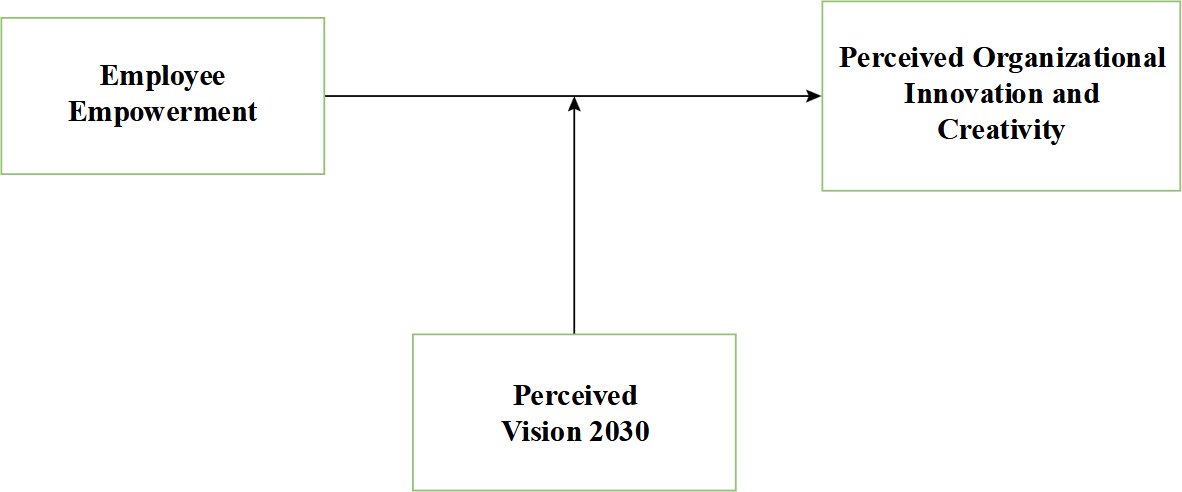
Fig. (1). Conceptual framework.
3. METHODOLOGY
The present study applied a primary quantitative research design, with the help of a structured questionnaire to gather data from employees working in the Saudi Arabian food and beverage sector. Questionnaire items were measured on a five-point Likert scale ranging from (1) strongly disagree to (5) strongly agree, as shown in the Appendix A. The constructs of the study were employee empowerment, perceived Organisational innovation and creativity, and perceived Vision 2030. Structured questionnaires are especially well-suited to large-scale quantitative studies because of the possibility of using standardised measurements and conducting rigorous statistical analyses, as recommended by (Russo et al., 2021).
A questionnaire consisting of three items (Appendix A) for each construct on a 5-point Likert scale was developed. The items used for the measurement of Employee Empowerment consisted of three items, including the representative one, “I am encouraged to handle customer problems by myself,” adapted from (Tsou et al., 2025). Measured using three items adapted from those of (Zeb et al., 2021), Perceived Organisational Innovation and Creativity was defined as “There are adequate resources devoted to innovation in this organisation.” Perceived Vision 2030 was measured using three items specifically developed for this study after an exhaustive review of the literature on the influence of national institutional policies on organisational practices in the area of workforce empowerment and innovation. “Vision 2030 has helped empower employees to become more involved in creative decision-making.”
The original scales were slightly modified to achieve contextual relevance in the context of food and beverages in Saudi Arabia. The instrument was then subjected to an expert evaluation by content to determine content validity, which was undertaken by three academics and two industry practitioners. The internal consistencies of the respondents were assessed in a pilot study with 30 respondents. The results showed that Cronbach’s alpha values of all constructs were above the suggested level of 0.70, indicating good internal consistency, and that the questionnaire was suitable for collecting full-scale data.
Perceived Organisational Innovation and Creativity (POIC) is defined as an employee-perceived organizational-level variable that signifies the level of support, resources, and implementation of organisational activities related to innovation. Employee creativity is defined as the origination of new ideas, whereas organisational innovation is the application of these ideas in organizational processes (Acar et al., 2024). Nonetheless, even if these two terms seem to be different, there is a close connection, and conceptually, both are interconnected, as suggested by (Volery & Tarabashkina, 2021), as employees’ creative work is the source of innovation. Likewise, (Gouvea et al., 2021) proposed that creativity and innovation are steps in a continuous process that belong to the same organisational process but occur as a continuum. This study adopts an organisational perspective that examines employee perceptions of their organisation’s innovative climate rather than performance at the individual level. Thus, research on employee creativity and innovative work behaviour continues to be important for further theoretical consideration, as it is through the collective efforts of empowered employees that ideas are created and implemented, which can support the proposed organizational-level relationship in the form of employees’ perception of their organisation’s innovativeness.
Perceived Vision 2030 is specifically outlined as an employee’s perception of organisational alignment – an examination of how well an institution’s values, practices, and goals align with the national strategic objectives suggested by (Ma et al., 2023). This construct is not simply policy consciousness, policy support, or external policy legitimacy; it is a measure of internal structural integration, again in the sense of (Campos‐García et al., 2024). In the Saudi F&B context, it conveys the perceptions held by staff about Vision 2030 being integrated within the core processes of their organisation, shaping the behaviours, decision-making, and innovative activities of the workplace.
Data were collected from 400 employees working in food and beverage organisations in major cities in Saudi Arabia. Outreach to participants was conducted through social media networks such as Instagram, Twitter, and Facebook to reach as many people as possible and achieve sample diversity. As suggested by (Ahmad & Wilkins, 2025), stratified purposive sampling was used to ensure that organisational departments and job levels were represented in the same proportion as they existed in the real population. This was adequate as approaching participants on social media platforms (Instagram, Twitter, Facebook), the data collection was purposive, with a need for access to participants that were relevant to defined strata, thus limiting sampling bias and improving relevance of the responses that were elicited (Zaman, 2021) suggest.
Professional and organisational social media groups were used to spread recruitment messages via Instagram, Twitter, and Facebook. The pre-questionnaire was administered to check if the respondents were working in the Saudi food and beverage sector and to determine their department and job level. Predetermined quotas were set for each stratum, and data collection proceeded until adequate representation was achieved across all strata. Given this, the study employed a quota-based stratified purposive sampling technique to acquire only eligible respondents and ensured the proportional representation of organisational departments and jobs.
A sampling framework was developed using two of the following predefined strata: organisational department (operation, production, sales and marketing, human resources, finance and administration, customer service) and job level (frontline, supervisors, middle managers, senior managers). Industry workforce distributions for each stratum were made publicly available, and quotas were calculated based on them and checked throughout the data collection. Professional social networks were used for recruitment until the predefined quotas were met, which resulted in enhanced balancing of the samples and representation of functional areas and organisational levels in the Saudi food and beverage industry.
The minimum required sample size was calculated using G*Power 3.1 software for multiple regression analysis. Given the medium effect size, f2 = 0.15, a significance level of 0.05, a statistical power of 0.95, and two predictors, it was recommended that at least 107 respondents should be included in the study (Kang, 2021). The study was conducted with a larger sample than necessary for the minimum requirements for robustness, model stability, and model requirements for structural equation modelling.
A total of 800 employees were contacted, 450 of which responded to the questionnaires, resulting in a response rate of 56.25%. After screening for missing values and outliers, 50 responses were removed, and a final sample of 400 respondents was obtained. The issue of selection bias was managed by proportionate stratification of departments and job levels, and non-response bias was measured by comparing the first respondents (n1 = 60) and the last respondents (n2 = 60), showing that these groups did not differ significantly in the key variables, as proposed by (Russo et al., 2021). As suggested by (Kock, 2015), Common Method Bias (CMB) was assessed using full collinearity VIF, as indicated in Table 1.
Table 1. Full collinearity variance inflation factor common method bias.
| – | VIF |
| Employee Empowerment | 2.094 |
| Perceived Vision 2030 | 1.775 |
| Perceived Organisational Innovation and Creativity | 2.172 |
As indicated in Table 1, low full collinearity VIF values imply that the common method bias is not a significant problem because values lower than 3.3 imply the absence of CMB, as suggested by (Kock, 2015).
Data analysis was performed using Partial Least Squares Structural Equation Modelling (PLS-SEM). The evaluation of the measurement models comprised of the reliability Cronbach’s Alpha and composite reliability and convergent validity. Average Variance Extracted (AVE) indicated by (Haji-Othman & Yusuff, 2022). To gauge the hypothesised relationships and the moderating influence of Perceived Vision 2030, a structural model assessment was used that allowed effective evaluation of direct and conditional effects.
4. RESULTS
4.1. Demographics Analysis
The statistical figures reported in Table 2 show the demographic specificities of the study participants (n=400). The results show that out of the total sampled population of the study, 60% were males, 30% were females, and 10% preferred not to answer. Regarding the ages of the participants, 35% were in the age bracket of 20-30 years, 25% in the 30-35 years, 16.25% between 35-40 years and 12.50% between 40-50 years. Moreover, the educational qualification statistics of the participants shows that 37.50% and 30%, were Bachelor’s and Master’s degree holders, respectively. In addition, regarding the job position of the participants, 40% were Senior Executives and 28.75% served in managerial positions. Lastly, regarding the type of food and beverage organisations, the results revealed that 27.50% of the respondents worked in restaurants, 25% in catering firms, and 32.50% represented resorts.
Table 2. Demographics analysis.
| Demographic Category | Frequency (n) | Percentage (%) | |
| Gender | Male | 240 | 60.00% |
| Female | 120 | 30.00% | |
| Prefer not to say | 40 | 10.00% | |
| Age | 20-30 | 140 | 35.00% |
| 30-35 | 100 | 25.00% | |
| 35-40 | 65 | 16.25% | |
| 40-50 | 50 | 12.50% | |
| 50 and above | 45 | 11.25% | |
| Educational Qualification | Diploma | 100 | 25.00% |
| Bachelor’s | 150 | 37.50% | |
| Master’s | 120 | 30.00% | |
| Doctorate | 30 | 7.50% | |
| Job Position | Executive | 80 | 20.00% |
| Senior Executive | 160 | 40.00% | |
| Managerial | 115 | 28.75% | |
| Senior Management | 45 | 11.25% | |
| Type of Food and Beverage Organisation | Restaurant | 110 | 27.50% |
| Catering Firms | 100 | 25.00% | |
| Resorts | 130 | 32.50% | |
| Production-Distribution Retail | 60 | 15.00% | |
4.2. Model Fitness
The results of the model fit in Table 3 show adequate overall model fitness. The SRMR values for both the saturated (0.055) and estimated models (0.056) were lower than the recommended value of 0.08, indicating an adequate model fit. In addition, the low d_ULS and d_G values reflect a low discrepancy between the observed and model-implied correlations. Although the NFI values (0.873 and 0.867) were slightly below the conventional 0.90 threshold, the SRMR values and other fit indicators suggested an acceptable model fit.
Table 3. Model fitness.
| – | Saturated Model | Estimated Model |
| SRMR | 0.055 | 0.056 |
| d_ULS | 0.138 | 0.143 |
| d_G | 0.126 | 0.131 |
| Chi-square | 313.682 | 327.121 |
| NFI | 0.873 | 0.867 |
4.3. Measurement Model Assessment
The measurement model of this study was assessed for internal consistency and reliability using Cronbach’s alpha and Composite Reliability and Convergent Validity using Average Variance Extracted (AVE), as suggested by (Fauzi, 2022). The results are presented in Table 4.
Table 4. Measurement model assessment.
| Latent Variables | Indicators | Factor Loadings | Cronbach’s Alpha | Composite Reliability (Rho_C) | Average Variance Extracted (AVE) |
| Employee Empowerment | EE1 | 0.901 | 0.889 | 0.937 | 0.832 |
| EE2 | 0.927 | ||||
| EE3 | 0.907 | ||||
| Perceived Organisational Innovation and Creativity | POIC1 | 0.896 | 0.881 | 0.927 | 0.808 |
| POIC2 | 0.927 | ||||
| POIC3 | 0.873 | ||||
| Perceived Vision 2030 | PV1 | 0.879 | 0.853 | 0.911 | 0.773 |
| PV2 | 0.904 | ||||
| PV3 | 0.853 |
The results of the measurement model assessment, as shown in Table 4, reveal stronger factor loadings ranging between (0.853 and 0.927) as they exceeded the threshold of 0.7, which shows a strong association between an observed variable item or question and a latent construct. In addition, the results also show high internal consistency reliability through Cronbach’s Alpha and Composite reliability values surpassing the standard threshold of (α> 0.7). Convergent validity was also established as the AVE Values exceeded 0.5 for all constructs in the measurement model.
4.4. Discriminant Validity
The discriminant validity results shown in Table 5 allow for the measurement of separability and conceptual overlap among the constructs of the study. The results reveal that the HTMT values for all constructs are lower than the threshold of 0.85 which signifies separability among constructs and no issue of conceptual overlapping within the model.
Table 5. Discriminant validity.
| – | Employee Empowerment | Perceived Vision 2030 |
| Employee Empowerment | – | – |
| Perceived Vision 2030 | 0.512 | – |
| Perceived Organisational Innovation and Creativity | 0.458 | 0.631 |
4.5. Path Coefficient Analysis
The path coefficient results in Table 6 show that Employee Empowerment has a positive and significant relationship with perceived Organisational Innovation and Creativity (β = 0.476, t = 10.475, p < 0.001), supporting H1 and indicating that increased employee empowerment is associated with stronger perceptions of innovation and creativity. Likewise, Perceived Vision 2030 demonstrates a positive and significant relationship between Perceived Organisational Innovation and PC (β = 0.398, t = 8.952, p < 0.001). Furthermore, the interaction between Employee Empowerment and Perceived Vision 2030 was positive and statistically significant (β = 0.067, t = 3.832, p = 0.004), supporting H2. The value of the beta coefficient indicates that Perceived Vision 2030 moderately influences the relationship between Employee Empowerment and Perceived Organisational Innovation and Creativity, but the value of the beta coefficient is too small to be declared as a strong effect.
Table 6. Path coefficient.
| – | Path Coefficients | T Statistics | P Values | F-Square |
| Employee Empowerment -> Perceived Organisational Innovation and Creativity | 0.476 | 10.475 | 0.000 | 0.308 |
| Perceived vision 2030 -> Perceived Organisational Innovation and Creativity | 0.398 | 8.952 | 0.000 | 0.241 |
| Perceived vision 2030 x Employee Empowerment -> Perceived Organisational Innovation and Creativity | 0.067 | 3.832 | 0.004 | 0.012 |
Finally, the size of the f-values reflects the effect size for each predictor of Perceived Organisational Innovation. Employee Empowerment has a medium-to-large effect size (f² = 0.308), indicating that it has significant practical application. Perceived Vision 2030 showed a moderate value (f² = 0.241), thus having a significant contribution to the outcome variable. In comparison, the interaction term (f² = 0.012) has a small effect size, indicating that the moderating effect of Vision 2030 is small but statistically significant.
4.6. Confidence Intervals
The bootstrap method was used to generate confidence intervals for the structural relationships, which are also reported in Table 7. The two confidence intervals for Employee Empowerment → perceived Organisational innovation and creativity and perceived vision 2030 → perceived Organisational innovation and creativity were both positive, supporting positive and stable relationships. In contrast, the interaction term has a confidence interval ranging from 0.033 to 0.1011. This implies that the moderating effect was statistically significant in the bootstrap test, but had lesser precision, and the size of the moderation should be interpreted with caution, meaning that the model has less practical power.
Table 7. Confidence intervals.
| – | Original Sample (O) | Sample Mean (M) | 2.5% | 97.5% |
| Employee Empowerment -> Perceived Organisational Innovation and Creativity | 0.476 | 0.474 | 0.384 | 0.563 |
| Perceived vision 2030 -> Perceived Organisational Innovation and Creativity | 0.398 | 0.401 | 0.312 | 0.487 |
| Perceived vision 2030 x Employee Empowerment -> Perceived Organisational Innovation and Creativity | 0.067 | 0.066 | 0.033 | 0.101 |
4.7. Model Explanatory Power
According to Table 8, the R-squared value is 0.540 which means the variance of 54% in Perceived Organisational innovation and creativity is accounted for by Employee Empowerment and Perceived Vision 2030. This can be regarded as moderate-to-substantial explanatory power.
Table 8. Model explanatory power.
| R-Square | R-Square Adjusted | |
| Perceived Organisational Innovation and Creativity | 0.540 | 0.536 |
4.8. Predictive Relevance
The predictive relevance outcomes in Table 9 reveal that the model has high performance because the Q2 predict value (0.527) is significantly higher than zero, which substantiates the acceptable predictive accuracy of perceived organisational innovation and creativity. In addition, the values of the RMSE (0.693) and MAE (0.495) are relatively low, indicating the presence of a small error in prediction and that this model has good predictive power and strength in estimating the dependent construct.
Table 9. Predictive relevance.
| – | Q²predict | RMSE | MAE |
| Perceived Organisational Innovation and Creativity | 0.527 | 0.693 | 0.495 |
5. DISCUSSION
The results of this study indicate that organisational innovation and creativity are strongly positively associated with employee empowerment, which is consistent with the existing empirical data but also broadens its context to the Saudi Arabian food and beverage industry, supporting H1. These outcomes align with (Nuwagaba et al., 2026), who argue that internal capabilities, such as empowerment, drive creativity which subsequently boosts innovation performance. In contrast to their manufacturing-driven context, the current research suggests that empowerment is also instrumental in the service-driven industry, where customer interaction and flexibility are key factors. Likewise, the results support (Farooq & Khan, 2025), who emphasise that cognitive flexibility is promoted by empowerment, implying that empowered employees tend to have more opportunities to become creative in solving problems. This upholds the Psychological Empowerment Theory, which involves intrinsic motivation and perceived autonomy fuelling innovative behaviours.
However, the results differ from those of (Siddiqui, 2025), who found little creativity in non-empowering organisational cultures. This difference can be explained by sectoral and cultural variations, as the Saudi F&B sector is more affected by the modernisation process and competitive forces, creating a more enabling environment for empowerment practices. In addition, (Liu et al., 2020) stated that leadership and organisational culture should facilitate empowerment; the high association found in this study indicates that enabling elements could already be changing in Saudi organisations. Nonetheless, in line with (Chaubey & Sahoo, 2022), the results also suggest that empowerment is not always positive, and its efficacy is contingent on implementation. Hierarchical traditions can exist in the Saudi context alongside new empowerment practices, forming a hybrid environment that selectively boosts creativity through empowerment. In the case of the retail-focused F&B industry, the findings suggest that empowering front-line staff can enhance innovative service delivery and customer interaction; however, it must be aligned with the organisational framework and cultural norms.
The findings also suggest that employee empowerment is significantly moderated by Perceived Vision 2030 when it comes to employee perceived organisational innovation and creativity, implying the importance of institutional context in the process of defining organisational dynamics, supporting H2. This result is consistent with the findings of other researchers, including (Ma et al., 2023), who posit that national policy frameworks and government initiatives are more effective in enhancing practices related to innovation in an organisation. However, the current research takes this view a step further by showing that not only the presence of Vision 2030, but also the perception of employees towards it, preconditions the empowerment-innovation relationship. This observation is especially crucial when considered in terms of Institutional Theory, which states that the effect of institutional pressures on organisational behaviour is possible, although it requires internalisation among organisational members to be effective.
On the other hand, the results undermine the claim by (Okochi & Ateke, 2020), who postulate that institutional pressures can contribute to symbolic adoption instead of substantive results. The existence of positive moderation here suggests that Vision 2030 is not purely symbolic but strengthens the connection between empowerment and innovation when perceived positively by employees. The difference can be justified by the high national commitment and exposure of the Vision 2030 initiatives in Saudi Arabia, especially in the areas that the country focuses on to diversify its economy, such as F&B. The relatively small moderating effect suggests that institutional perception plays a supportive rather than a dominant role. Moreover, in line with (Banwo et al., 2022), this study identifies the issue of perceptual alignment as significant, implying that employees who think Vision 2030 is a meaningful aspect are more likely to convert empowerment into innovative behaviours. Thus, the findings extend the existing application of Psychological Empowerment Theory by demonstrating boundary conditions. The theory functions more effectively when empowerment is professed within a legitimate institutional setting, demonstrating that employees’ psychological responses to autonomy rely not merely on inner organisational practices but also on professed strategic institutional alignment.
Industrially, Saudi Arabia’s retail F&B industry is fast-paced with limited governmental changes, digitalisation, and overlapping consumer demands. Vision 2030 is an important institutional influence that promotes the effectiveness of internal practices. These results suggest that organisations need not merely introduce programs in empowerment but also be proactive in communicating and aligning them with national vision frameworks to achieve maximum outcomes in terms of innovation and creativity.
CONCLUSION
This study progresses the argument that organisational innovation and creativity in the Saudi Arabian food and beverage sector are influenced by both internal empowerment and external institutional alignment through internal managerial practices such as employee empowerment. However, it should be assessed in combination with broader institutional forces. The results indicate that although empowerment is linked to improved attitudes towards innovation and creativity, it is a process that depends on how employees embrace national change agendas, including Vision 2030. This highlights an important interaction between micro-level psychological processes and macro-level institutional forces, indicating that organisational results are formed through a mixture of inner capacity and outer consistency. Other than perceiving empowerment as an unconditionally useful approach, the study highlights its situational characteristics, especially within a setting where socioeconomic transformation occurs at an accelerated rate.
LIMITATIONS
The research is limited in several ways. First, this study examined employee-level perceptions of organisational innovation and creativity rather than objective firm-level outcomes. Second, the cross-sectional design limits the opportunity to conclude temporal dynamics and changes in perceptions over time. Moreover, the use of self-reported information can lead to perceptual bias, even though common method variance is unlikely to substantially influence the findings. There is also a need to concentrate on the food and beverage industry, which restricts generalisability to other sectors in Saudi Arabia. In addition, the potential reverse causality between empowerment and perceived innovation cannot be ruled out. Future studies should use longitudinal designs to examine changes in empowerment and institutional perceptions over time. Comparative research in sectors and regions would also contribute to a better understanding of the differences in context. Additionally, the integration of qualitative methods offers a closer understanding of how employees make sense of empowerment and Vision 2030, thus contributing to the extension of Institutional Theory and Psychological Empowerment Theories.
IMPLICATIONS
This research has certain implications for various stakeholders. Theoretically, it builds on Psychological Empowerment Theory by illustrating its interplay with macro-level institutional situations and Institutional Theory by finding that perceived identification with Vision 2030 amplifies empowerment-innovation relationships. The results indicate that there is a need to formalise employee empowerment to tackle challenges within HR policies by establishing the delegation of decision-making, autonomy, and information sharing in a transparent manner in Saudi Food and Beverage Organisations. Supervisors need to be provided with leadership training, which includes coaching and participative leadership skills, to support the use of empowerment. Employers must embed Vision 2030 goals into induction, ongoing training, evaluation, performance procedures, and communication within the organisation to improve staff engagement with corporate priorities. Moreover, organisations can implement reward and recognition processes to recognise innovative ideas and offer effective implementation. Employee suggestion take-up, process improvement initiatives, and the number of employees working on innovation projects should be included in performance management to measure the success of empowerment policies. Policymakers can further ease these efforts by creating industry-specific HR principles in line with Vision 2030 to enhance employees’ capabilities and organizational competitiveness.
LIST OF ABBREVIATIONS
AVE | = | Average Variance Extracted |
CMB | = | Common Method Bias |
F&B | = | Food and Beverage |
PLS-SEM | = | Partial Least Squares Structural Equation Modelling |
POIC | = | Perceived Organisational Innovation and Creativity |
AUTHORS’ CONTRIBUTION
K.U. contributed to the conceptualization and study design, model implementation, experimental evaluation, data analysis and interpretation, methodological development, manuscript drafting, and critical revision of the final manuscript.
ETHICAL APPROVAL & INFORMED CONSENT
The study was conducted in accordance with applicable ethical guidelines and principles for research involving human participants. After receiving an informational sheet about the study’s purpose, voluntary participation, and eligibility, the participants electronically provided informed consent. Following the withdrawal rights ethics, participants were allowed to leave the study at any time with no consequences. To ensure anonymity and confidentiality of responses, no personally identifiable information was gathered.
AVAILABILITY OF DATA AND MATERIALS
The data generated and analyzed during this study are not publicly available due to the privacy and confidentiality of the participants. The data were collected through a structured questionnaire under appropriate ethical guidelines, with informed consent obtained from all participants. Access to the dataset is restricted to the research team and may be made available by the corresponding author upon reasonable request, subject to ethical and confidentiality requirements.
FUNDING
None.
CONFLICT OF INTEREST
The author declares that there is no conflict of interest regarding the publication of this article.
ACKNOWLEDGEMENTS
None.
DECLARATION OF AI
No Artificial Intelligence (AI) tools were used in the preparation, analysis, or writing of this manuscript.
APPENDIX A: QUESTIONNAIRE
Demographic Questions:
- What is your gender?
- Male
- Female
- Prefer not to say
- What is your age group?
- 20-30
- 30-35
- 35-40
- 40-50
- 50 and Above
- What is your highest educational qualification?
- Diploma
- Bachelor’s
- Master’s
- Doctorate
- What best describes your current job position?
- Executive
- Senior Executive
- Managerial
- Senior Management
- Type of Food and Beverage Organisation working in?
- Restaurant
- Catering Firms
- Resorts
- Production-Distribution Retail
| Variable | Question Statement | Strongly Disagree (1) | Disagree (2) | Neutral (3) | Agree (4) | Strongly Agree (5) |
| Employee Empowerment. Adapted from: (Tsou et al., 2025) | I am encouraged to handle customer problems by myself | ☐ | ☐ | ☐ | ☐ | ☐ |
| I am empowered to correct customer problems when they occur. | ☐ | ☐ | ☐ | ☐ | ☐ | |
| I have sufficient autonomy to resolve customer problems. | ☐ | ☐ | ☐ | ☐ | ☐ | |
| Organisational Innovation & Creativity. Adapted from: (Zeb et al., 2021) | There are adequate resources devoted to innovation in this organisation. | ☐ | ☐ | ☐ | ☐ | ☐ |
| There is adequate time available to pursue creative ideas here. | ☐ | ☐ | ☐ | ☐ | ☐ | |
| Funding is available to investigate creative ideas in this organisation. | ☐ | ☐ | ☐ | ☐ | ☐ | |
| Vision 2030 as a Moderator | Vision 2030 has helped empower employees to become more involved in creative decision-making. | ☐ | ☐ | ☐ | ☐ | ☐ |
| Vision 2030’s goals support employee empowerment and innovation in my organisation. | ☐ | ☐ | ☐ | ☐ | ☐ | |
| Vision 2030 initiatives have played a key role in fostering creativity and innovation within my company. | ☐ | ☐ | ☐ | ☐ | ☐ |
REFERENCES
Acar, O. A., Tuncdogan, A., van Knippenberg, D., & Lakhani, K. R. (2024). Collective creativity and innovation: An interdisciplinary review, integration, and research agenda. Journal of Management, 50(6), 2119-2151.
https://doi.org/10.1177/01492063231212416
Ahmad, M., & Wilkins, S. (2025). Purposive sampling in qualitative research: A framework for the entire journey. Quality & Quantity, 59(2), 1461-1479.
https://doi.org/10.1007/s11135-024-02022-5
Al Doghan, M. A., Alayis, M. M. H. A., & Abdelwahed, N. A. A. (2022). Determining entrepreneurs’ characteristics towards psychological empowerment in Saudi Arabia. Journal of Sport Psychology, 31(4), 52-65. Available from: https://rpd-online.com/manuscript/index.php/rpd/article/download/960/359
Alateeg, S., & Alhammadi, A. (2024). The impact of organisational culture on organisational innovation with mediation role of strategic leadership in Saudi Arabia. Journal of Statistics Applications & Probability, 13(2), 843-858. Available from: https://www.naturalspublishing.com/Article.asp?ArtcID=28179
Aldabbas, H., Pinnington, A., & Lahrech, A. (2023). The influence of perceived organisational support on employee creativity: the mediating role of work engagement. Current psychology, 42(8), 6501-6515.
https://doi.org/10.1007/s12144-021-01992-1
Ali, H., Li, M., & Qiu, X. (2022). Employee engagement and innovative work behavior among Chinese millennials: mediating and moderating role of work-life balance and psychological empowerment. Frontiers in psychology, 13, 942580.
https://doi.org/10.3389/fpsyg.2022.942580
Almutairi, A. S., & Alharthi, S. (2024). Consumer Behavior and E-Commerce adoption in the food industry in Saudi Arabia. Arab Journal for Scientific Publishing, 7(4), 1-23. https://doi.org/10.36571/ajsp741
Alotaibi, I. S. (2025). Examining the success factors of influencer marketing campaigns in the food and beverage industry: an empirical study. Management & Sustainability: An Arab Review.
https://doi.org/10.1108/MSAR-12-2024-0223
Andriana, R. (2025). The influence of digital marketing and brand trust on customer loyalty through customer satisfaction of food and beverage companies. International Journal Of Education, Social Studies, And Management (IJESSM), 5(1), 214-224.
https://doi.org/10.52121/ijessm.v5i1.628
Arab News (2026). Saudi Arabia’s food & beverage sales drive $3.14bn in consumer spending. Available from: https://arab.news/8ht9z
Azevedo, M. C. D., Schlosser, F., & McPhee, D. (2021). Building organisational innovation through HRM, employee voice and engagement. Personnel Review, 50(2), 751-769.
https://doi.org/10.1108/PR-12-2019-0687
Banwo, A. O., Onokala, U., & Momoh, B. (2022). Organisational climate–institutional environment nexus: why context matters. Journal of Global Entrepreneurship Research, 12(1), 357-369.
https://doi.org/10.1007/s40497-022-00330-4
Barua, B., Islam, M. O., Kibria, H., & Barua, R. (2025). Analysis of creativity at the workplace through employee empowerment. International Journal of Organisational Analysis, 33(8), 2547-2572.
https://doi.org/10.1108/IJOA-05-2024-4534
Campos‐García, I., Alonso‐Muñoz, S., González‐Sánchez, R., & Medina‐Salgado, M. S. (2024). Human resource management and sustainability: Bridging the 2030 agenda. Corporate Social Responsibility and Environmental Management, 31(3), 2033-2053. https://doi.org/10.1002/csr.2680
Chaubey, A., & Sahoo, C. K. (2022). The drivers of employee creativity and organisational innovation: a dynamic capability view. Benchmarking: An International Journal, 29(8), 2417-2449.
https://doi.org/10.1108/BIJ-06-2021-0316
Elbushra, A. A. (2024). Food prices and food security in Saudi Arabia: Facts and Trends. In Food and Nutrition Security in the Kingdom of Saudi Arabia, Vol. 2: pp. 29-46. Cham: Springer.
https://doi.org/10.1007/978-3-031-46704-2_2
Farooq, N., & Khan, S. (2025). Employee empowerment and its link to innovation in organisations. Journal of Strategic Business Research, 3(1), 1-15. Available from: https://jsbrjournal.com/index.php/journal/article/view/47
Fauzi, M. A. (2022). Partial least square structural equation modelling (PLS-SEM) in knowledge management studies: knowledge sharing in virtual communities. Knowledge Management & E-Learning, 14(1), 103-124.
https://doi.org/10.34105/j.kmel.2022.14.007
Gelaidan, H. M., Houtgraaf, G., & Al-kwifi, O. S. (2022). Creativity and innovation in rapidly developing Qatar: the impact of leadership and the mediation of psychological empowerment amidst rapid growth. International Journal of Public Sector Management, 35(3), 257-275.
https://doi.org/10.1108/IJPSM-01-2021-0016
Ganji, G. S. F., Rahimnia, F., Ahanchian, M. R., & Syed, J. (2021). Analyzing the impact of diversity management on innovative behaviors through employee engagement and affective commitment. Interdisciplinary Journal of Management Studies, 14(3), 649-667.
10.22059/IJMS.2020.307781.674164
Gouvea, R., Kapelianis, D., Montoya, M. J. R., & Vora, G. (2021). The creative economy, innovation and entrepreneurship: an empirical examination. Creative industries journal, 14(1), 23-62.
https://doi.org/10.1080/17510694.2020.1744215
Haji-Othman, Y., & Yusuff, M. S. S. (2022). Assessing reliability and validity of attitude construct using partial least squares structural equation modeling. International Journal of Academic Research in Business and Social Sciences, 12(5), 378-385.
https://dx.doi.org/10.6007/IJARBSS/v12-i5/13289
Hanafy, H. A., Al-Hajla, A. H., & Elsharnouby, M. H. (2025). Empowering leadership and employee innovation: unraveling the roles of psychological empowerment and knowledge sharing. Journal of Humanities and Applied Social Sciences, 7(4), 366-391.
https://doi.org/10.1108/JHASS-11-2024-0200
Hutajulu, R. S., Susita, D., & Eliyana, A. (2021). The effect of digitalization and virtual leadership on organisational innovation during the COVID-19 pandemic crisis: A case study in Indonesia. The Journal of Asian Finance, Economics and Business, 8(10), 57-64.
10.13106/jafeb.2021.vol8.no10.0057
Janssen, M. (2022). Top trends to watch in Saudi Arabia’s food & beverage market. Available from: https://exportconnect.com.au/top-trends-to-watch-in-saudi-arabias-food-beverage-market/
Joo, B. K., Yim, J. H., Jin, Y. S., & Han, S. J. (2023). Empowering leadership and employee creativity: the mediating roles of work engagement and knowledge sharing. European journal of training and development, 47(9), 881-899.
https://doi.org/10.1108/EJTD-02-2022-0016
Kang, H. (2021). Sample size determination and power analysis using the G* Power software. Journal of educational evaluation for health professions, 18.
https://doi.org/10.3352/jeehp.2021.18.17
Kock, N. (2015). Common method bias in PLS-SEM: A full collinearity assessment approach. International Journal of e-Collaboration, 11(4), 1-10.
https://doi.org/10.4018/ijec.2015100101
Li, B., Fan, X., Álvarez-Otero, S., Sial, M. S., Comite, U., Cherian, J., & Vasa, L. (2021). CSR and workplace autonomy as enablers of workplace innovation in SMEs through employees: Extending the boundary conditions of self-determination theory. Sustainability, 13(11), 6104.
https://doi.org/10.3390/su13116104
Liu, X., Zhu, Z., Liu, Z., & Fu, C. (2020). The influence of leader empowerment behaviour on employee creativity. Management Decision, 58(12), 2681-2703.
https://doi.org/10.1108/MD-02-2019-0281
Llorente-Alonso, M., García-Ael, C., & Topa, G. (2024). A meta-analysis of psychological empowerment: Antecedents, organisational outcomes, and moderating variables. Current Psychology, 43(2), 1759-1784.
https://doi.org/10.1007/s12144-023-04369-8
Lv, M., Yang, S., Lv, X. Y., Zhang, L., Chen, Z. Q., & Zhang, S. X. (2021). Organisational innovation climate and innovation behaviour among nurses in China: A mediation model of psychological empowerment. Journal of nursing management, 29, 2225-2233.
https://doi.org/10.1111/jonm.13381
Ma, Y., Wang, J., & Bai, Y. (2023). Macro-institutional pressures and firms’ environmental management behavior: the moderating effect of micro-institutional pressures. Sustainability, 15(4), 3662. https://doi.org/10.3390/su15043662
MANMORE Intelligence (2022). Evolving food & beverages landscape in Saudi Arabia. Available from: https://www.marmoremena.com/en/insights/evolving-food-and-beverages-landscape-in-saudi-arabia/
Mariod, A., Tahir, H. E., & Salama, S. (2024). Food consumption patterns in Saudi Arabia. In Food and Nutrition Security in the Kingdom of Saudi Arabia, Vol. 2: pp. 303-319. Springer, Cham.
https://doi.org/10.1007/978-3-031-46704-2_13
MarkNtel Advisors (2026). Saudi Arabia food and beverage market. Available from: https://www.marknteladvisors.com/research-library/saudi-arabia-food-beverage-market-study.html
Mukund, N. (2024). Sustainability in the Kingdom of Saudi Arabia’s food and beverage sector. Available from: https://ffcc.global/sustainability-in-the-kingdom-of-saudi-arabias-food-and-beverage-sector/
Nuwagaba, O., Han, Y., & Kim, S. Y. (2026). Exploring the dual effects of employee empowerment on innovative behavior: Encouraging and discouraging pathways. Public Personnel Management, 55(1), 38-66.
https://doi.org/10.1177/00910260251340741
Okochi, K., & Ateke, B. W. (2020). Employee empowerment: a strategy for optimizing employee performance. Nigerian Business and Social Review, 11(2), 125-137. Available from: https://www.researchgate.net/profile/Brown-Ateke/publication/368449588_Employee_Empowerment_A_Strategy_for_Optimizing_Employee_Performance/links/63e7c5ecdea6121757a039e3/Employee-Empowerment-A-Strategy-for-Optimizing-Employee-Performance.pdf
Oliveira, M., Andrade, J. R., Ratten, V., & Santos, E. (2023). Psychological empowerment for the future of work: Evidence from Portugal. Global Business and Organisational Excellence, 42(5), 65-78.
https://doi.org/10.1002/joe.22194
Research and Markets (2024). Saudi Arabia food & beverage – market share analysis, industry trends & statistics, growth forecasts (2026 – 2031). Available from: https://www.researchandmarkets.com/reports/5937980/saudi-arabia-food-and-beverage-market-share?srsltid=AfmBOornthL7zhYXZRYmkuUZBQO
Russo, G. M., Tomei, P. A., Serra, B., & Mello, S. (2021). Differences in the use of 5-or 7-point likert scale: an application in food safety culture. Organisational Cultures, 21(2), 1-17.
https://doi.org/10.18848/2327-8013/cgp/v21i02/1-17
Siddiqui, A. (2025). Employee Empowerment And Innovation: Fostering A Culture Of Creativity in The Workplace. Agribusiness Management: Agribusiness Journal, 25(2), 219-225.
https://doi.org/10.32503/agribisnis.v25i2.7803
Supriyanto, A. S., Ekowati, V. M., Rokhman, W., Ahamed, F., Munir, M., & Miranti, T. (2023). Empowerment leadership as a predictor of the organisational innovation in higher education. International Journal of Professional Business Review, 8(2), e01538.
https://doi.org/10.26668/businessreview/2023.v8i2.1538
Truong, B. T. T., Nguyen, P. V., & Vrontis, D. (2024). Enhancing firm performance through innovation: the roles of intellectual capital, government support, knowledge sharing and knowledge management success. Journal of Intellectual Capital, 25(1), 188-209.
https://doi.org/10.1108/JIC-08-2023-0181
Tsou, H. T., Chen, J. S., Mai, T. O., & Jade, N. B. N. (2025). Soft HRM practices fostering service innovations and performance in hospitality firms. Sustainability, 17(3), 895.
https://doi.org/10.3390/su17030895
van den Berg, J., Alblas, A., Blanc, P. L., & Romme, A. G. L. (2022). How structural empowerment boosts organisational resilience: a case study in the Dutch home care industry. Organisation Studies, 43(9), 1425-1451.
https://doi.org/10.1177/01708406211030659
Volery, T., & Tarabashkina, L. (2021). The impact of organisational support, employee creativity and work centrality on innovative work behaviour. Journal of Business Research, 129, 295-303.
https://doi.org/10.1016/j.jbusres.2021.02.049
Zaman, T. (2021). An efficient exponential estimator of the mean under stratified random sampling. Mathematical Population Studies, 28(2), 104-121.
https://doi.org/10.1080/08898480.2020.1767420
Zeb, A., Akbar, F., Hussain, K., Safi, A., Rabnawaz, M., & Zeb, F. (2021). The competing value framework model of organisational culture, innovation and performance. Business process management journal, 27(2), 658-683.
https://doi.org/10.1108/BPMJ-11-2019-0464
Zulkifli, Z., Purwati, A. A., Renaldo, N., Hamzah, Z., & Hamzah, M. L. (2023). Employee performance of Sharia Bank in Indonesia: The mediation of organisational innovation and knowledge sharing. Cogent Business & Management, 10(3), 2273609.
https://doi.org/10.1080/23311975.2023.2273609