


Article ID: PDT2601203003
Views: 849The Moderating Role of Perceived Saudi Vision 2030 in the Relationship Between Job Enrichment, Employee Autonomy, and Perceived Organisational Resilience in Saudi Arabia
 Article DOI
10.67887/PDT2601203003
Article DOI
10.67887/PDT2601203003
 PDF
PDF
⬇ Downloads: 38
1Bath Spa University, London, United Kingdom
2BPP University, London, United Kingdom
3University of Great Manchester, Bolton, United Kingdom
4Commecs Institute of Business and Emerging Science, Karachi, Pakistan
Received: 20 May, 2026
Accepted: 20 July, 2026
Revised: 29 June, 2026
Published: 03 Sep, 2026
ABSTRACT:
Introduction: This study aimed to assess the association between job enrichment, employee autonomy, and perceived organisational resilience, while also investigating the moderating effect of Saudi Vision 2030 on organisations in Saudi Arabia. It seeks to identify the relationship between internal job design practices and national transformation policies in defining perceived organisational resilience.
Methodology: This study used a survey questionnaire based on a 5-point Likert scale. Convenience sampling was used, and 375 employees who were employed in public and private sector organisations were recruited. Partial Least Squares Structural Equation Modelling (PLS-SEM) was used to test the direct and moderating relationships by analysing the data on SmartPLS 4.0.
Results: The results indicated that Job Enrichment was significantly and positively related to Perceived Organisational Resilience. Likewise, Employee Autonomy was found to be positively and significantly correlated with Perceived Organisational Resilience, but the magnitude of the relationship was smaller. Perceived Vision 2030 was also significantly and positively related to Perceived Organisational Resilience. Moreover, the relationships between Job Enrichment, Employee Autonomy and Perceived Organisational Resilience were positively moderated by Perceived Vision 2030, as revealed by the moderating analysis.
Conclusion: This study emphasises the need to devise safe and sustainable job designs in parallel with institutional-reform agendas. Theoretically, this study contributes to the literature by building on Job Characteristics Theory and Institutional Theory to explore the relationship between Employee Job Enrichment, Employee Autonomy, and perceived Organisational resilience, as influenced by employees’ perceptions of organisational alignment with Vision 2030. Practically, the findings offer guidance for policymakers, management, and decision-makers looking to support the national agenda for change with the right workforce practice.
Keywords: Job enrichment, employee autonomy, perceived organisational resilience, vision 2030, Saudi Arabia, institutional theory.
1. INTRODUCTION
Modern organisations in Saudi Arabia is grappling with a fast-changing socio-economic environment influenced by diversification agendas, public sector reforms, and the growing involvement of the private sector (Harshan, 2025; Phillips, 2024). According to (Aldogiher et al., 2025), in industries, including both private and public, service and production sectors, companies are likely to become more flexible, innovative, and agile while simultaneously increasing workforce capability. In this context, perceived organisational resilience has become a vital ability that can help organisations overcome these disruptive events and remain functional, as suggested by (Alfalah et al., 2025). According to (Aburub & Khanfar, 2025; and Zaki et al., 2025), the application of human resource practices, especially job enrichment and employee autonomy, is identified as a driving force of such resilience, especially in reform-focused settings such as Saudi Arabia.
The 2030 reforms have also caused Saudi organisations to rapidly transform to introduce innovation, empowerment, and resiliency among the workforce (Aldogiher et al., 2025). The relationships between job enrichment, employee autonomy, and perceived organisational resilience have been comparatively little explored and have been examined in relation to Saudi Vision 2030 in recent studies, such as (Zaki et al., 2025). The existing literature, such as (Gupta & Saranya, 2025; and Krajcsák & Bakacsi, 2025), offers detailed evidence about how an organisation can change, but limits the discussion to a multi-layered process by which the national reform agenda can affect the outcomes of work and the capacity of the organisation at the level of the individual employee. Moreover, there is limited empirical evidence on how practices focused on empowerment can help promote innovation and resiliency during policy-driven change, despite the fact that most Saudi companies have already incorporated restructuring initiatives responsive to Vision 2030 (Asem et al., 2024).
In theory, job enrichment leads to increased task meaningfulness, skillfulness, and accountability which in turn results in adaptive behaviours, whereas employee autonomy allows them to take initiative and responsiveness, as suggested by (Albrecht et al., 2021; and Sung et al., 2022). Nevertheless, their efficacy depends on the institutional context. As a structural reform agenda, (Asem et al., 2024) revealed that Vision 2030 can either intensify or restrict these relations by influencing organisational values, leadership behaviours, and resource distribution.
The study is timely, as there is ongoing institutional reform and an increasing focus on resilient organisations as part of Saudi Arabia’s transformation agenda. This study combines the perspectives of job design and institutions, offering both context and configurations to consider how workplace practices function in a reform-oriented setting. It derives its understanding of the relationship between job enrichment, autonomy, and resilience from empirical evidence, not presenting a theory breakthrough, and offers practical insights to help design workforce practices for consistency with the transformation goals. Furthermore, it provides a policy-implicative understanding of the operationalisation of national policies in organisations to increase employee engagement, innovation, and long-term flexibility. This study fills the gap in the literature by addressing the theoretical and practical shortcomings of earlier studies to create a cohesive framework for understanding the interaction between macro reforms and micro behaviours and provide a broad study on future research in the context of emerging economies. The findings eventually aid in evidence-based decision-making and help organisations traverse uncertainty while remaining competitive in changing economic conditions due to reform initiatives and strategies.
2. LITERATURE REVIEW
2.1. Theoretical Framework
The theoretical framework of this research combines Institutional Theory and Job Characteristics Theory to describe both contextual and behavioural processes underlying the association between job enrichment, employee autonomy, and perceived organisational resilience. According to (Gunarathne et al., 2021), Institutional Theory assumes that organisational activities are influenced by external forces such as regulatory systems and national transformation agendas. According to (Alotaibi & Campbell, 2022), institutional expectations make organisations act in line with them to obtain some level of legitimacy, whereas (Baah et al., 2021) also indicate that these pressures have an impact on internal structures and managerial choices. These normative and coercive forces in the framework of Saudi Vision 2030 make firms consider practices based on empowerment; nonetheless, such practices are often merely symbolic rather than actual, as pointed out by (Ren et al., 2023). This means that Vision 2030 can not only lead to change but also predispose the degree to which job enrichment and autonomy can produce resilient outcomes.
Furthermore, Job Characteristics Theory provides a micro-level explanation of how job design influences employee behaviour and organisational outcomes. According to (Arshad et al., 2022), enriched jobs make employees feel more meaningful and responsible, thus boosting their motivation, and as (Unguren & Kacmaz, 2022) noted, autonomy promotes proactive and adaptive behaviour. The importance of enriched and autonomous job roles is emphasised by (Cai et al., 2024), who cite these as two major factors of adaptability and performance. Others, such as (Dekoulou et al., 2023; and Mehmood & Saeed, 2021), argue that such a relationship is context-dependent, as empowerment practices can have a positive impact on certain situations but not in others without a supportive institutional environment. Incorporating Institutional Theory is thus more illustrative than Job Design theory because it suggests that institutional resource alignment and normative legitimacy as a result of Vision 2030 influence how job design translates into resilience outcomes. In particular, coercive pressures come from government reform policies, normative pressures from cultural norms around innovation and empowerment, and mimetic pressures from organisational benchmarking. However, the moderating effect of Vision 2030 can differ when Vision 2030 is truly embraced by organisations or when it is simply taken as a form of symbolic legitimacy.
Combining Job Characteristics Theory and Institutional Theory provides a multilevel explanation of organisational resilience. The micro-level mechanism by which job enrichment and employee autonomy positively impact employees’ sense of responsibility, meaningfulness, and proactive behaviour is explained by the Job Characteristics Theory suggested by (Alateeg & Alhammadi, 2024). On the other hand, (Ziadlou, 2021) specified that Institutional Theory proposes that such job design practices are effective only when viewed in the context of the existing institutional framework. In the Saudi context, Vision 2030 is an institutional structure that enacts “coercive pressures” through policy change, “normative pressures” by expectations about empowerment and innovation, and “mimetic pressures” through explicit organisational benchmarking. Such pressures lead organisations to invest resources, reimagine work practices, and normalise empowerment-focused practices. Therefore, stronger organisational alignment with Vision 2030 is more likely to be linked to resilient behaviours by employees that are both enriched and autonomous. Hence, Vision 2030 functions as a contextual mechanism which affects and shapes the effectiveness of job design practices in shaping perceived organisational resilience.
2.2. Hypotheses Development
Job Enrichment has gained a lot of attention in the existing literature on organisational behaviour, such as (Siruri & Cheche, 2021), an aspect of structural job design that enables the improvement of employee psychological conditions and, therefore, organisational performance. Based on Job Characteristics Theory, Job Enrichment enhances skill variety, task significance, and responsibility, which in turn promotes motivation and adaptive performance which are important constituents of perceived organisational resilience, as indicated by (Obiakor et al., 2023).
(Abd-el Aliem & Abou Hashish, 2021) empirically showed that this leadership-influenced work environment plays an important role in perceived organisational resilience and job involvement among nurses, explaining up to 43% of the variance in resilience. Although their results support the role of empowered work structures in amplifying resilience, the study mainly attributes this to transformational leadership and not job design attributes, thus indirectly validating the role of enriched roles but not directly testing it. Similarly, (Unguren & Kacmaz, 2022) demonstrate that perceived organisational resilience positively affects work engagement and perceived organisational support in the hotel industry during a crisis. Their model places resilience as an antecedent, but the results suggest that positive organisational structures also positively influence employee attitudes, suggesting that enriched and supportive working environments can be essential in promoting resilience in the face of a crisis.
Moreover, (Ibrahim & Hussein, 2024) identified a strong positive relationship between resilience in the workplace, work engagement, and job satisfaction among engineers, and resilience was found to be an excellent variable for predicting positive employee outcomes. Their regression findings affirm the positive relationship between robust work environments and greater engagement and satisfaction; however, the study conceptualises resilience mostly as a psychological construct on an individual level, as opposed to job design characteristics such as enrichment.
These studies show a certain trend, such as resilience being closely related to employee engagement, job involvement, and satisfaction. The findings of studies such as (Abd-el Aliem & Abou Hashish, 2021) are consistent with the Job Characteristics Theory (JCT) perspective on the relationship between job enrichment and resilience. It is considered an outcome of these characteristics, a driver of employees’ attitudes, and an individual psychological resource, as revealed by (Ibrahim & Hussein, 2024; and Unguren & Kacmaz, 2022). It proposes that the theory of task enrichment leads to a higher level of task significance, task responsibility, and task meaningfulness, which results in proactive and adaptive employee behaviours. These behavioural abilities are key to an organisation’s resilience, as they help staff adapt when faced with uncertainty, disruptions, and different expectations at work. Thus, organisations with enriched jobs are expected to have higher levels of perceived organisational resilience. The above theoretical reasoning leads to the following hypothesis:
H1: Job Enrichment has a statistically significant and positive relationship with organisational resilience in Saudi Arabian organisations.
Employee Autonomy is a well-known element of job design in the organisational behaviour literature that improves employees’ sense of control, responsibility, and proactive decisions, which are a necessity under Job Characteristics Theory. (Unguren & Kacmaz, 2022) empirically examined transformational leadership practices in a Saudi university hospital and their connection with perceived organisational resilience and job involvement. Their results further revealed a considerable positive association between leadership practices and perceived organisational resilience, which accounts for a large percentage of the variance in resilience results. Nevertheless, their dependence on leadership-based constructs restricts the separation of autonomy as an independent predictor of OCB.
Moreover, (Nie et al., 2023) reported a considerable predictive value between resilience in the workplace, work engagement, and work satisfaction in engineers, indicating that resilience is a strong predictor of engagement results. Although the narrow scope of their study includes individual resilience, their regression findings indicate that employees who work in flexible and self-regulated workplaces report greater engagement, which is indirectly associated with the autonomy-resilience relationship. However, structural autonomy and psychological resilience are not clearly differentiated in the study, and thus the constructs lack clarity.
Throughout these studies, a shared theme emerges: environments that are empowering, supportive, and adapted in terms of leadership structure are linked to greater resilience and employee outcomes. A major contradiction, however, lies in construct operationalisation: resilience is differentially addressed as an antecedent, outcome, or psychological characteristic, and autonomy is under-theorised and under-measured.
Applying these findings to Job Characteristics Theory, autonomy is an essential psychological motivating factor that leads to increased responsibility and intrinsic drive, which, in theory, empowers perceived organisational resilience through proactive behaviour and adaptive decision-making, as suggested by (Gerschberger et al., 2023). Although this is theoretically true, in practice, most current research, such as (Cotič et al., 2025), does not explicitly recognise autonomy as an independent factor but rather incorporates it within other frameworks of leadership or resilience.
The studies reviewed in this study are mostly cross-sectional in design and assessed using the self-report method, but there is convergence on the conclusions reached in the studies with the propositions of Job Characteristics Theory reflected in (Nabawanuka & Ekmekcioglu, 2024). According to (Abd-el Aliem & Abou Hashish, 2021), the theory posits that granting employees autonomy leads to more discretion, self-direction, and ownership of their work activities, which can help them act with greater creativity to adapt to changing situations and workplace demands. Self-employed individuals are more likely to be proactive, make quick decisions, and adapt their behaviours in the face of uncertainty. Abilities that can be adapted are very important for organisational resilience as they enable organisations to become flexible and responsive to disruption. Thus, organisations with greater employee autonomy are anticipated to have higher levels of employee-perceived organisational resilience. Consequently, the following hypothesis is proposed:
H2: There is a statistically significant and positive relationship between Employee Autonomy and Perceived Organisational Resilience.
2.3. Saudi Vision 2030 as the Moderating Construct
Saudi Vision 2030 is the national transformation framework launched by the Kingdom to diversify its economy, enhance the efficiency of institutions, and alleviate its reliance on oil by reducing the country’s reliance on the oil sector (Aldosari, 2026). It is based on three pillars: a viable society, a strong economy, and an aspiring nation, which are supported by programs focused on human capital development, organisational effectiveness, digital transformation, innovation, and workforce participation (Sallam et al., 2026). These reform measures push organisations to modernise management practices, increase the skill levels of their employees, and make them more flexible in adapting to a more competitive environment.
From an organisational perspective, Vision 2030 impacts leadership priorities, human resource management, organizational restructuring, and employee development. Given this context, this study aims to research how organisations have developed practices to support national reform priorities to improve their operational capacity and workforce engagement in a more recent phase of the reform. In the current context, this study seeks to investigate the practices of linking workplace practices to national reform priorities to boost operational capacity and workforce engagement in more recent times. Similarly, (Asem et al., 2024) suggest that institutional changes can influence managerial decision-making and resource allocation, while (Gupta & Saranya, 2025; and Krajcsák & Bakacsi, 2025) believe that national transformation agendas play a crucial role in how organisational processes are understood and enacted. In light of this, this study takes a conceptual approach to perceived Saudi Vision 2030, namely employees’ perceptions of the degree to which their organisations integrate their internal policies, management practices, and priorities that correspond to the principles of the Vision 2030 reform. This conceptualisation serves as a theoretical framework to explore Vision 2030 as a contextual moderator between the workplace and perceived organisational resilience in Saudi Arabia.
Recent research indicates that Vision 2030 impacts not only macroeconomic targets but also workplace outcomes. As (Zaki et al., 2025) argue, the need for a more adaptive and employee-centred approach has increasingly become a mandate in reform-driven organisational changes in firms. Likewise, (Asem et al., 2024) argue that institutional changes influence leadership priorities, decisions regarding resource allocation, and workforce management strategies. In its current form, however, research around implementation and strategic implications of Vision 2030 has mainly focused on how this is put into practice, while offerings on employees’ perceptions of how well the organisation is aligning with the reform goals have been comparatively limited. (Gupta & Saranya, 2025; and Krajcsák & Bakacsi, 2025) argue the need to study the impact of higher-level transformation agendas on an organisation’s behaviour through messenger processes at the employee level. Hence, this study defines Perceived Vision 2030 as employees’ perceptions of the degree to which their organisations’ practices, managerial approaches, and strategic priorities are aligned with the principles and objectives of Perceived Vision 2030. This view allows for an analysis of embedding national reforms into workplace experiences and organisations.
The ability to moderate the relationship between institutional forces in modifying the relationship between job design factors and perceived organisational resilience lies within Institutional Theory. As per (Liang & Cao, 2021) the theory further states that organisational practices do not only depend on the internal structures but are highly affected by external forces like regulations, cultural norms and national transformation agendas. In this context, Saudi Vision 2030 is a powerful institutional framework that enhances empowerment, innovation, and resiliency within Saudi Arabian organisations.
(Georgescu et al., 2024) also point out that organisations tend to take advantage of formal structures to seek legitimacy without necessarily incorporating them into day-to-day activities. This means that job enrichment and autonomy can be present in the structure but cannot yield resilience unless supplemented with an effective institutional fit. (Isensee et al., 2023) further argue that institutional logics either facilitate or inhibit organisational change, which supports the notion that macro-level reforms determine micro-level HR results.
This moderating logic is indirectly supported by empirical studies. (Heredia et al., 2022) demonstrated that leadership practices have a strong effect on perceived organisational resilience, suggesting that the conditions of the context determine resilience outcomes. (Liang & Cao, 2021) determined that perceived organisational resilience is highly connected with employee engagement and crisis support, which means that external environmental factors impact internal reactions. (Isensee et al., 2023) also revealed that resilience is a strong predictor of engagement and satisfaction; however, there are differences among people that suggest that the relationships between them are contextually sensitive.
Taken together, these studies indicate a shortcoming in not explicitly looking at institutional moderation in the job design-resilience relationship. The incorporation of Institutional Theory implies that the effects of job enrichment and employee autonomy on perceived organisational resilience are enhanced when well-established institutional structures support them. Thus, it is assumed that perceived Vision 2030 has a positive moderating role in such relationships, increasing the transformation of job enrichment and autonomy into perceived organisational resilience to generate hypotheses H3a and H3b.
H3a: Perceived Vision 2030 significantly and positively moderates the relationship between Job Enrichment with Perceived Organisational Resilience.
H3b: Perceived Vision 2030 significantly and positively moderates relationship of Employee Autonomy with Perceived Organisational Resilience.
The hypothesised relationships are shown in Fig. (1).
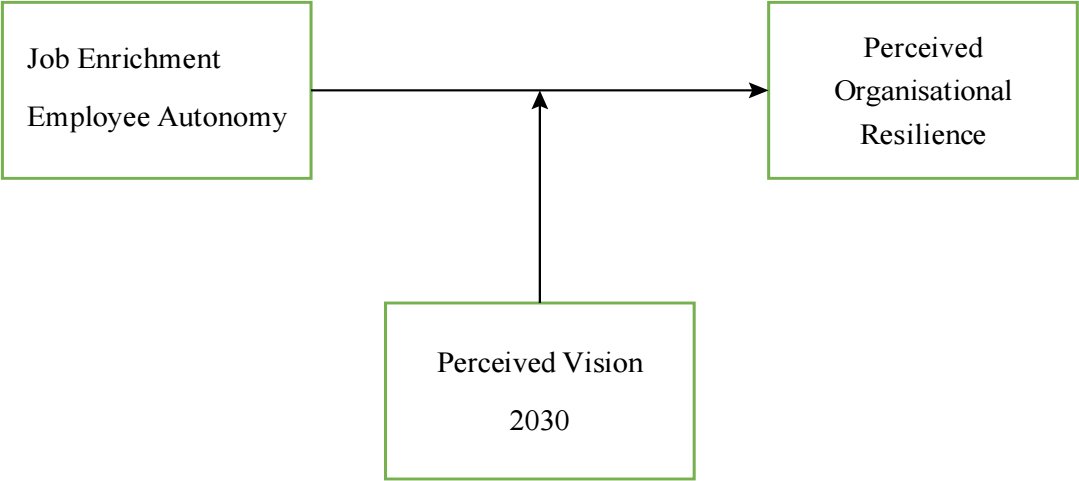
Fig. (1). Conceptual framework.
3. METHODOLOGY
In this study, the primary research design is quantitative, to investigate the relationships and connections between job enrichment, employee autonomy, perceived organisational resilience, and perceived Saudi Vision 2030. A structured questionnaire, depicted in Appendix (A), was used to collect data on a five-point Likert scale ranging from strongly disagree to strongly agree which is highly recommended in studies aimed at gauging perceptions and attitudes (Koo & Yang, 2025). The instrument was separated into four parts that represent the study constructs: Perceived Organisational Resilience, Perceived Vision 2030, Job Enrichment, and Employee Autonomy, which guarantee construct-specific measurement validity.
In this study, Perceived Organisational Resilience is the subjective perception of an employee’s organisation’s capacity to prepare for, adapt to, and respond to disruptions, uncertainty, and challenges from the environment. The construct is conceived at the perceptual level of the individual rather than at the objective organisational level or the organisational level in terms of an aggregation of individuals. To attain this, respondents judged resilience by observing and experiencing how resilient organisations are in terms of practice, adaptability, and responsiveness. This is significant because an employee’s perception of Organisational Resilience can vary according to their job, experiences, and exposure to organisational processes, even within the same organisation.
Moreover, Perceived Vision 2030 denotes employees’ perception of the degree to which their organisations internal policies, managerial practices, workforce practices, and strategic objectives support the evolution of reform principles and national transformation goals outlined in Vision 2030. As indicated by (Alotaibi & Campbell, 2022), the construct is conceptualised at the level of individual perception, imitating ways in which employees interpret organisational commitment and alignment across institutional policies, such as Vision 2030 initiatives, by means of their experiences at workplaces, organisational communication, and implementation practices across public and private sector companies in Saudi Arabia.
The Perceived Vision 2030 Scale was developed specifically to capture employees’ perceptions of organisational alignment with Vision 2030 reform principles. The first items emerged from the Vision 2030 policy framework and relevant literature on organisational change. The instrument was fielded for content validation with three academic experts with experience in HRM and organisational behaviour, which resulted in limited changes in wording and clarity of the instrument. A small-scale exploratory study (n = 70) of Saudi organisation participants was then conducted to evaluate item comprehension and relevance. Further changes were made after receiving feedback in the pilot testing phase, prior to administering the final questionnaire, where Cronbach’s alpha value of 0.831 implied construct reliability. Finally, content and construct validity were evaluated using PLS-SEM procedures.
The target population was employees serving in public and private sector organisations in Saudi Arabia. Participants were recruited using a convenience sampling method via social media, including Instagram, Twitter, and Facebook. This method is suitable for behavioural studies, whereby access to respondents is limited, as suggested by (Obilor, 2023). Using G*Power, the minimum threshold was determined to be approximately 129 respondents based on a medium effect size (f 2 = 0.15), power = 0.95, and four predictors, which was calculated using the G*Power analysis. However, a larger sample size is required to strengthen the findings. A total of 800 employees were approached, with 412 responding, giving a response rate of 51.5%.
Following data screening, 37 questionnaires were filtered out based on missing values and outliers, leaving a final sample of 375 valid responses. Selection bias was curtailed by guaranteeing diversity in sectoral and job role representation within the framework of convenience sampling, as suggested by (Elston, 2021). Early (n1 = 30) and late (n2 = 30) respondents were also compared to assess non-response bias; no significant differences were found. (Castillo et al., 2026) suggested evaluating common method bias using the VIF full collinearity test. The results are presented in Table 1.
Table 1. Full collinearity VIF.
| – | VIF |
| Employee Autonomy -> Perceived Organisation Resilience | 1.462 |
| Job Enrichment -> Perceived Organisation Resilience | 1.745 |
| Perceived Vision 2030 -> Perceived Organisation Resilience | 1.686 |
| Perceived Vision 2030 x Employee Autonomy -> Perceived Organisation Resilience | 1.309 |
| Perceived Vision 2030 x Job Enrichment -> Perceived Organisation Resilience | 1.614 |
The full collinearity VIF values (Table 1) of all the predictors were between 1.309 and 1.745, which is considerably less than the acceptable level of 3.3. This implies that there is no concern regarding the common method as a critical issue in the model. In addition, the values of VIF are low, indicating that there is no multicollinearity among constructs, which proves that Employee Autonomy, Job Enrichment, and Perceived Saudi Vision 2030 cannot and do not interact to produce redundant effects on perceived Organisational resilience. Harman’s single-factor test was also used to check for common method bias, where all measurement items were entered into an exploratory factor analysis without rotation. The total variance accounted for by the first factor was 34.7% which was below the recommended 50% provided by (Aguirre-Urreta & Hu, 2019), suggesting that common method bias was not a major problem for this study.
As proposed by (Ayu et al., 2024), SmartPLS was used as the tool to analyse the data with the help of Partial Least Squares Structural Equation Modelling (PLS-SEM), which is appropriate in complex models including moderation and prediction-oriented analysis. This method facilitated the testing of direct and moderating hypotheses. Furthermore, the use of PLS-SEM for the study was considered appropriate, as the study was based on prediction-oriented relationships embedded with interaction effects, and the latent constructs were assessed based on the perceptual indicators suggested by (Tian et al., 2021). Furthermore, according to (Subhaktiyasa, 2024), it is used as an exploratory approach for institutional-contextual research in emerging organisational contexts, such as Saudi Arabia, as it is less dependent on the number of distributional assumptions needed for complex models.
4. RESULTS
4.1. Demographics Analysis
The statistics depicted in Table 2 signify the demographic characteristics of the total (n=375) participants of the study. The results show that 58.67% of the participants were male, 37.33% were female, and 4% did not prefer to answer. In addition, the results also show that among these participants, 34.67% were below 25 years, 24% were 25-34 years, 16.67% were 45-54 years and 13.33% were 55 and above. Regarding the educational qualifications of the participants, 30.67% were bachelor’s degree holders and 28% held master’s degrees, while 42.67% of the surveyed employees served in Senior Executive roles, 24% in managerial roles, and 14.67% in Senior Management roles. Moreover, with respect to the type of organisations the surveyed employees belonged to, 33.33% represented private organisations, 30.67% represented public organisations, and 36% represented public-private organisations. Lastly, in terms of the nature of the organisations, 40% work in the services sector, 36% in the manufacturing sector, and 24% in the trading sector.
Table 2. Descriptive analysis.
| Demographic Category | Frequency (n) | Percentage (%) | |
| Gender | Male | 220 | 58.67% |
| Female | 140 | 37.33% | |
| Prefer not to say | 15 | 4.00% | |
| Age Range | Below 25 | 130 | 34.67% |
| 25-34 | 90 | 24.00% | |
| 35–44 | 50 | 13.33% | |
| 45–54 | 55 | 16.67% | |
| 55 and above | 50 | 13.33% | |
| Educational Qualification | Secondary | 70 | 18.67% |
| Diploma | 85 | 22.67% | |
| Bachelor’s | 115 | 30.67% | |
| Master’s | 105 | 28.00% | |
| Current Job Role | Executive | 70 | 18.67% |
| Senior Executive | 160 | 42.67% | |
| Managerial | 90 | 24.00% | |
| Senior Management | 55 | 14.67% | |
| Type of Organisation | Private | 125 | 33.33% |
| Public | 115 | 30.67% | |
| Public-Private | 135 | 36.00% | |
| Nature of Organisation | Services Sector | 150 | 40.00% |
| Manufacturing | 135 | 36.00% | |
| Trading | 90 | 24.00% | |
4.2. Measurement Model Assessment
The measurement model was assessed in terms of internal consistency, reliability, and convergent validity by applying Cronbach’s alpha, composite reliability, and Average Variance Extracted (AVE) approaches, as suggested by (Ayu et al., 2024). The results of the measurement model assessment are presented in Table 3.
Table 3. Measurement model assessment.
| Latent Variables | Indicators | Factor Loadings | Cronbach’s Alpha | Composite Reliability | Average Variance Extracted (AVE) |
| Employee Autonomy | EA1 | 0.772 | 0.815 | 0.848 | 0.728 |
| EA2 | 0.900 | ||||
| EA3 | 0.882 | ||||
| Job Enrichment | JE1 | 0.879 | 0.852 | 0.854 | 0.772 |
| JE2 | 0.905 | ||||
| JE3 | 0.851 | ||||
| Perceived Organisational Resilience | POR1 | 0.896 | 0.885 | 0.889 | 0.813 |
| POR2 | 0.930 | ||||
| POR3 | 0.879 | ||||
| Perceived Vision 2030 | PV1 | 0.904 | 0.902 | 0.903 | 0.836 |
| PV2 | 0.930 | ||||
| PV3 | 0.908 |
As depicted by the results in Table 3, there is a high factor loading which ranges between (0.772-0.930) indicating, high strength as well as direction of the association amid the observed construct and its latent factors. Moreover, internal reliability and consistency were established through high Cronbach’s alpha and composite values satisfying the condition (α>0.7). Convergent validity was also observed through AVE values higher than the standard value of 0.5.
4.3. Discriminant Validity
The HTMT values in Table 4 for all constructs shows the HTMT values lower than the recommended value of 0.85, which is considered sufficient discriminant validity. This implies that the constructs of employee autonomy, job enrichment, perceived Organisational resilience, and perceived Saudi Vision 2030 are conceptually different and do not overlap. This relatively moderate HTMT further supports the results that although there is some relationship between the constructs, there is enough separability between them so that the variables do not overlap or ambiguity of the measurement.
Table 4. Discriminant validity.
| Pair | Construct A | Construct B | HTMT Value |
| Pair 1 | Employee Autonomy | Job Enrichment | 0.522 |
| Pair 2 | Employee Autonomy | Perceived Organisation Resilience | 0.546 |
| Pair 3 | Employee Autonomy | Perceived Vision 2030 | 0.464 |
| Pair 4 | Job Enrichment | Perceived Organisation Resilience | 0.517 |
| Pair 5 | Job Enrichment | Perceived Vision 2030 | 0.407 |
| Pair 6 | Perceived Organisation Resilience | Perceived Vision 2030 | 0.33 |
4.4. Path Coefficient Analysis
Table 5 shows that both Employee Autonomy (β = 0.121, p = 0.015) and Job Enrichment (β = 0.341, p = 0.000) have positive and statistically significant relationships with Perceived Organisational Resilience, with Job Enrichment having a comparatively stronger relationship. However, there was a relatively weak association with the coefficient of Employee Autonomy, suggesting that this has only a small contribution to perceived organisational resilience in the model. Similarly, Perceived Saudi Vision 2030 was positively related (β = 0.462, p = 0.000), indicating that it is quite relevant to the model. In terms of the moderating role, both Vision 2030 × Employee Autonomy (β = 0.031, p = 0.002) and Vision 2030 × Job Enrichment (β = 0.048, p = 0.000) were statistically significant, with a small effect size. The findings indicate that Vision 2030 has a moderate and positive moderating effect on the relationship between job enrichment and perceived organisational resilience, and between employee autonomy and perceived organisational resilience. Furthermore, the f-square results depict varying effect sizes among the associations within the model. The effect sizes for Perceived Saudi Vision 2030 and Job Enrichment were medium (f² = 0.284) and approaching medium (f² = 0.149), respectively. The effect size of Employee Autonomy (f² = 0.022), on the other hand, is small. Moreover, the statistical significance of the moderating interaction effects of Vision 2030 with Employee Autonomy (f² = 0.003) and Job Enrichment (f² = 0.005) are still relatively small in magnitude, showing relatively smaller practical value.
Table 5. Path coefficient.
| – | Path Coefficients | T Statistics | P Values | F-Square |
| Employee Autonomy -> Perceived Organisation Resilience | 0.121** | 2.424 | 0.015 | 0.022 |
| Job Enrichment -> Perceived Organisation Resilience | 0.341*** | 6.596 | 0.000 | 0.149 |
| Perceived Vision 2030 -> Perceived Organisation Resilience | 0.462*** | 9.464 | 0.000 | 0.284 |
| Perceived Vision 2030 x Employee Autonomy -> Perceived Organisation Resilience | 0.031*** | 2.532 | 0.002 | 0.003 |
| Perceived Vision 2030 x Job Enrichment -> Perceived Organisation Resilience | 0.048*** | 3.331 | 0.000 | 0.005 |
Note: *: Significance at 10%; **: Significance at 5%; ***: Significance at 1%
4.5. Model Explanatory Power
The results in Table 6 specify that the model explanatory power is moderate, as (R2 is 0.554), that is, 55.4% of the variation in the perceived organisation’s resilience is explained by its predictors.
Table 6. Explanatory power.
| – | R-Square | R-Square Adjusted |
| Perceived Organisation Resilience | 0.554 | 0.548 |
4.6. Predictive Relevance
In Table 7, the Q2 predictive value of 0.533 shows that the model has moderate predictive significance of Perceived Organisational Resilience. In addition, the values of the RMSE (0.687) and MAE (0.487) are regarded as relatively small, which indicates that the model can be considered to have good out-of-sample predictability and reliability when predicting Perceived Organisational Resilience in the environment of Saudi Vision 2030.
Table 7. Predictive relevance.
| – | Q²predict | RMSE | MAE |
| Perceived Organisation Resilience | 0.533 | 0.687 | 0.487 |
4.7. Bootstrapped Confidence Intervals
The bootstrapped confidence intervals in Table 8 offer further support for the stability of the estimated relations. Employee Autonomy (β = 0.121, 95% CI [0.027, 0.223]), Job Enrichment (β = 0.341, 95% CI [0.237, 0.439]), and Perceived Vision 2030 (β = 0.462, 95% CI [0.363, 0.558]) showed positive confidence intervals that did not include zero, supporting their statistical significance. Likewise, the interaction terms for Vision 2030 are still statistically significant because they do not include zero in their confidence interval. The results showed that the direct and moderating relationships were stable and reliable in all bootstraps.
Table 8. Bootstrapped confidence intervals.
| – | Original Sample (O) | Sample Mean (M) | 2.5% | 97.5% |
| Employee Autonomy -> Perceived Organisation Resilience | 0.121 | 0.124 | 0.027 | 0.223 |
| Job Enrichment -> Perceived Organisation Resilience | 0.341 | 0.340 | 0.237 | 0.439 |
| Perceived Vision 2030 -> Perceived Organisation Resilience | 0.462 | 0.460 | 0.363 | 0.558 |
| Perceived Vision 2030 x Employee Autonomy -> Perceived Organisation Resilience | 0.031 | 0.034 | 0.030 | 0.105 |
| Perceived Vision 2030 x Job Enrichment -> Perceived Organisation Resilience | 0.048 | 0.044 | 0.042 | 0.137 |
5. DISCUSSION
Hypothesis H1 was confirmed by the results of the study, suggesting that Job Enrichment and Perceived Organisational Resilience are significantly positively related, as assumed in the Job Characteristics Theory. This contributes to the literature that enriched job roles help elevate the feeling of responsibility and meaning in employees, which is essential in adaptive organisational operations. Comparatively, (Abd-el Aliem & Abou Hashish, 2021) focused on leadership practices as a prime predictor of resilience; however, the lack of job design variables implies that their argument about resilience inherently relies on an indirect, but not direct, account of how resilience occurs. Their research is furthered in this study because it establishes that structural job characteristics have an independent relationship with resilience and are not based on the influence of leadership.
Likewise, (Unguren & Kacmaz, 2022) found close correlations between perceived organisational resilience and employee engagement in times of crisis, which means that favourable work conditions contribute to adaptive processes. Nevertheless, their approach to resilience as an antecedent is opposed to the current study, where resilience is placed as an outcome linked to job enrichment. The difference could be explained by sectoral contexts, with crisis-based sectors like tourism being more responsive-focused in the present, and more institutionalised organisations of Saudi Arabia being more focused on structural change and long-term capacity-building.
Moreover, (Ibrahim & Hussein, 2024) define resilience as a personal-level construct associated with engagement and satisfaction; however, this study places it at the organisational level with a shift in focus from a psychological to a structural explanation. This drift highlights the significance of contextual aspects, especially national reform agendas, which stimulate organisations to redesign jobs to improve their adaptability. Comprehensively, the results support the notion that job enrichment also provides resilience to organisations, as it leads to proactive and responsible behaviour. To Saudi organisations, especially in the public and private sectors that are undergoing transformation, this implies that jobs should be redesigned to increase skill variety and autonomy to ensure resilience in the systems that can withstand performance in a changing environment.
The findings reveal that Employee Autonomy and Perceived Organisational Resilience have a positive and significant relationship, which confirms the assumption that more discretion in decision-making increases adaptive organisational capacity, supporting H2. This observation complies with the postulates of Job Characteristics Theory, according to which autonomy is one of the most important sources of intrinsic motivation and proactive behaviour. The coefficient value is also relatively weaker than that of job enrichment; however, it indicates that autonomy might not be strong enough in the absence of structural support.
(Nie et al., 2023), on the other hand, base perceived organisational resilience on transformational leadership practices in a way that indirectly suggests that autonomy is facilitated by empowering leadership. This study narrows down their view by separating autonomy as a unique construct and showing that it is independently related to resilience. Correspondingly, (Gerschberger et al., 2023) emphasised the role of organisational support and engagement in crises, which can implicitly entail aspects of autonomy, but do not directly quantify it. This exclusion is indicative of a larger gap in current studies that realise autonomy as a construct within broader constructs and not as a specific construct. According to (Cotič et al., 2025), the level of association between resilience, engagement, and job satisfaction is high, implying that employees in a flexible environment perform better. However, their attention to individual resilience constrained the comprehension of how autonomy functions at the organisational level. This gap is addressed in the current study, which directly connects autonomy to perceived organisational resilience, especially in the context of Saudi Arabia, which is reform-driven.
The results support H3a, as they show a positive moderation between job enrichment and perceived Organisational resilience. In line with Institutional Theory, organisational practices are influenced and reinforced by institutional pressures from outside the organisation. Although both (Heredia et al., 2022; and Isensee et al., 2023) recognise the role of context in shaping organisational resilience, the focus is mainly on background conditions, and context is not considered a direct institutional mechanism. This study builds upon this line of thought by bridging the gap between the study of Vision 2030 as a contextual factor and job design and its impact on employee resilience. However, despite the moderating effect being statistically significant, its practical significance is limited, as evidenced by the small effect size. Therefore, the study results indicate that the relationship between job enrichment and organisational perceived resilience is slightly amplified when employees’ alignment with Vision 2030 is moderate. The relative medium size of the interaction compared to autonomy could be explained by the focus of Vision 2030 on restructuring the organisations and strengthening the workforce, but the impact in practice is limited.
The findings corroborate H3b, as they show that the relationship between employee autonomy and perceived Organisational resilience is positively moderated by Perceived Vision 2030. The results confirm that, as in (Georgescu et al., 2024), resilience outcomes are context-specific, but their research does not specifically focus on institutional influences. The current study broadens this view by introducing Vision 2030 as an institutional moderator between the macro-level of reforms and micro-level of organisational behaviour. However, the interaction effect is statistically significant but does not seem to have a meaningful impact in practice, given the very small effect size. This indicates that Vision 2030 has a low influence on the relationship between autonomy and perceived organisational resilience. One possible explanation, which was not directly measured in this study, is that the organisational hierarchy may influence employee discretion. Therefore, while organizational support for Vision 2030 can create a positive institutional environment, autonomy-related resilience outcomes seem to be more strongly influenced by institutional and managerial aspects than by alignment with reforms.
CONCLUSION
The current study identifies that perceived organisational resilience in Saudi Arabia cannot be viewed through the lens of inner managerial practices but must be framed within the context of the institutional change that Saudi Vision 2030 causes. This study extends prior leadership-focused explanations and other psychologically driven explanations because it shows that structural job design factors, specifically job enrichment, are more relevant in promoting resilience than autonomy. More importantly, the research findings provide evidence that organisational alignment with Vision 2030 slightly strengthens these relationships. This supports the claim that resilience is a co-production between micro-level practices and macro-level institutional forces and not a product of solitary organisational efforts. Finally, the results indicated that both the Job Enrichment and Employee Autonomy constructs enhance the effectiveness of the moderating construct of Perceived Saudi Vision 2030 in varying degrees for each construct in relation to Perceived Organisational Resilience. Although institutional alignment seems to play a more important role in the case of structurally embedded practices like job enrichment, its importance for enhancing autonomy-related outcomes is relatively weak, especially in the context of changing organisational settings in the Kingdom of Saudi Arabia.
LIMITATIONS
This study has some limitations. Convenience sampling leads to limited generalisability of the study in terms of sectors and organisational levels or hierarchies, and the cross-sectional design prevents the study of dynamics over time. Second, the use of self-reported measures results in procedural remedies, even with clauses of perceptual bias. Future studies should consider longitudinal study designs to factor in longitudinal changes and use multi-source data to increase validity. In countries and particular industries, additional studies would further enhance insights into the differences between institutional reforms influencing perceived organisational resilience. Another limitation of this study is the use of social media platforms to recruit participants. While these enabled younger, more educated, and digitally savvy respondents to be reached across a range of organisations and sectors, it could have biased the sample towards younger, more educated, and highly connected individuals. Therefore, the sample may not be representative of employees who are not highly engaged online or those working in more traditional occupations. This sampling characteristic can impact perceptions of job enrichment, employee autonomy, Vision 2030, and organisational resilience; hence, the generalisability of the findings is limited. More representative samples can be achieved by using a wider range of recruitment methods and probability sampling in future studies.
IMPLICATIONS
The findings have both theoretical and practical implications. Ideally, the study provides insights into the contextualisation of the study, as it combines two theories, job characteristic theory and institutional theory, to capture how job design practices work in a national reform environment. The results show that job enrichment is more strongly related to perceived organisational resilience than employee autonomy, and employee autonomy remains statistically significant but not high. From a practical standpoint, managers in public and private organisations should focus on job enrichment, more task variety, responsibility, and skill use rather than just autonomy, because the latter seems to be more strongly linked to resilience results. Although the relatively weak autonomy effect implies that simply providing discretion is not enough without larger organisational structures and capacities. Small interaction effects suggest that an organisation’s alignment with Vision 2030 should not replace internal human resource practices aimed at alignment with Vision 2030. Therefore, resilience-building interventions need to be directed in the first place at job design, and the measures of Vision 2030 should serve as a context for other resilience-building interventions rather than the main tool used for interventions.
LIST OF ABBREVIATIONS
| AVE | = | Average Variance Extracted |
| JCT | = | Job Characteristics Theory |
| PLS-SEM | = | Partial Least Squares Structural Equation Modelling |
AUTHORS’ CONTRIBUTIONS
M.B. formulated the research objectives and methodology, developed the questionnaire and research framework, collected and preprocessed the data, conducted the statistical analysis, interpreted the findings, and drafted the manuscript. I.I. contributed to the interpretation of the findings, critically revised the manuscript, and approved the final version for publication.
ETHICAL APPROVAL & INFORMED CONSENT
The study was conducted in accordance with applicable ethical guidelines and principles for research involving human participants. Participants were provided with information regarding the purpose and nature of the study, the voluntary nature of participation, confidentiality, and their right to withdraw from the study without repercussions. Informed consent was obtained from all participants prior to completing the questionnaire. No personally identifiable information was collected, and responses were anonymised and analysed in aggregate form to protect the privacy and confidentiality of participants throughout the research process.
AVAILABILITY OF DATA AND MATERIALS
The data supporting the findings of this study are available from the corresponding author upon reasonable request [M.B.].
FUNDING
This research received no financial support from any public, commercial, or not-for-profit funding agency.
CONFLICT OF INTEREST
The authors declare that they have no competing interests or conflicts of interest relevant to the content of this work.
ACKNOWLEDGEMENTS
None.
DECLARATION OF AI
The authors utilised ChatGPT solely for language editing and refinement during the preparation of this manuscript. All AI-assisted content was carefully reviewed, verified, and approved by the authors, who retain full responsibility for the accuracy, integrity, and final content of the manuscript.
APPENDIX A
- Demographic Questions:
- What is your gender?
- Male
- Female
- Prefer not to say
- What is your age group?
- Below 25
- 25–34
- 35–44
- 45–54
- 55 and above
- What is your highest educational qualification?
- Secondary
- Diploma
- Bachelor’s
- Master’s
- Doctorate
- What best describes your current job role?
- Operational/Frontline
- Supervisory
- Managerial
- Senior Management
- How many years of total experience do you have in this industry?
- Less than 3 years
- 3–5 years
- 6–10 years
- More than 10 years
| Variable | Question Statement | Strongly Disagree (1) | Disagree (2) | Neutral (3) | Agree (4) | Strongly Agree (5) |
| Job Enrichment | Job enrichment increases my motivation and job satisfaction. | ☐ | ☐ | ☐ | ☐ | ☐ |
| My role is designed to provide autonomy and opportunities for growth. | ☐ | ☐ | ☐ | ☐ | ☐ | |
| Job enrichment has a direct impact on my ability to contribute to organisational success. | ☐ | ☐ | ☐ | ☐ | ☐ | |
| Employee Autonomy | I have the freedom to make decisions related to my job responsibilities. | ☐ | ☐ | ☐ | ☐ | ☐ |
| My organisation encourages employee autonomy and self-direction. | ☐ | ☐ | ☐ | ☐ | ☐ | |
| Employee autonomy is essential for job satisfaction and innovation in my role. | ☐ | ☐ | ☐ | ☐ | ☐ | |
| Vision 2030 as a Moderator | Vision 2030 has helped improve job enrichment practices in my organisation. | ☐ | ☐ | ☐ | ☐ | ☐ |
| Vision 2030 has enhanced employee autonomy and decision-making in my organisation. | ☐ | ☐ | ☐ | ☐ | ☐ | |
| Vision 2030 initiatives have strengthened organisational resilience in Saudi firms. | ☐ | ☐ | ☐ | ☐ | ☐ | |
| Organisational Resilience | My organisation is able to quickly adapt to unexpected changes and challenges in the external environment. | ☐ | ☐ | ☐ | ☐ | ☐ |
| My organisation effectively maintains its operations and performance during times of crisis or disruption. | ☐ | ☐ | ☐ | ☐ | ☐ | |
| My organisation demonstrates strong capability in recovering and learning from difficult situations to improve future performance. | ☐ | ☐ | ☐ | ☐ | ☐ |
REFERENCES
Abd‐el Aliem, S. M. F., & Abou Hashish, E. A. (2021). The relationship between transformational leadership practices of first-line nurse managers and nurses’ organisational resilience and job involvement: A structural equation model. Worldviews on Evidence-Based Nursing, 18(5), 273–282.
https://doi.org/10.1111/wvn.12535
Aburub, A., & Khanfar, F. (2025). Cultural dimensions of human resource practices in Saudi Arabia: Navigating identity, diversity, and social change in STC. Journal of Cultural Analysis and Social Change, 10(2), 2958–2972.
https://doi.org/10.64753/jcasc.v10i2.2039
Aguirre-Urreta, M. I., & Hu, J. (2019). Detecting common method bias: Performance of the Harman’s single-factor test. ACM SIGMIS Database: The DATABASE for Advances in Information Systems, 50(2), 45–70.
https://doi.org/10.1145/3330472.3330477
Alateeg, S., & Alhammadi, A. (2024). The impact of organizational culture on organizational innovation with mediation role of strategic leadership in Saudi Arabia. Journal of Statistics Applications & Probability, 13(2), 843–858. Available From: https://www.naturalspublishing.com/Article.asp?ArtcID=28179
Albrecht, S. L., Green, C. R., & Marty, A. (2021). Meaningful work, job resources, and employee engagement. Sustainability, 13(7), 4045.
https://doi.org/10.3390/su13074045
Aldogiher, A., Halim, Y. T., El-Deeb, M. S., Maree, A. M., & Kamel, E. M. (2025). The impact of digital teaching technologies (DTTs) in Saudi and Egyptian universities on institutional sustainability: The mediating role of change management and the moderating role of culture, technology, and economics. Sustainability, 17(5), 2062.
https://doi.org/10.3390/su17052062
Aldosari, M. S. (2026). A critical review of environmental sustainability policies in light of Saudi Arabia’s Vision 2030. Research Journal in Advanced Humanities, 7(1).
https://doi.org/10.58256/2qh6kx59
Alfalah, A. A., Abubakar, A. A., Al-Mamary, Y. H., Goaill, M. M., Al-Samhi, N. M., Salisu, I., & Alhaidan, H. (2025). Bridging the digital divide: Empowering Saudi Arabia’s future through psychological resilience and digital literacy. Humanities and Social Sciences Communications, 12, 1627.
https://doi.org/10.1057/s41599-025-05914-5
Alotaibi, H. S., & Campbell, N. (2022). Organisational culture towards Saudi Arabia’s Vision 2030: Evidence from National Water Company. Businesses, 2(4), 562–577.
https://doi.org/10.3390/businesses2040035
Arshad, M., Qasim, N., Farooq, O., & Rice, J. (2022). Empowering leadership and employees’ work engagement: A social identity theory perspective. Management Decision, 60(5), 1218–1236.
https://doi.org/10.1108/MD-11-2020-1485
Asem, A., Ghofaili, A. Y. R. A., Almushaiti, M. A., & AlZaidan, Z. I. (2024). Navigating digital transformation in alignment with Vision 2030: A review of organisational strategies, innovations, and implications in Saudi Arabia. Journal of Knowledge Learning and Science Technology, 3(2), 21–29.
https://doi.org/10.60087/jklst.vol3.n2.p29
Ayu, R., Abdullah, N. A., Wan Sulaiman, W. S., & Bin Selamat, M. N. (2024). Structural equation modeling based SmartPLS 3.0 software in measuring psychological empowerment and readiness to strengthen structural transformation. International Journal on Advanced Science, Engineering & Information Technology, 14(4), 1428-1433.
https://doi.org/10.18517/ijaseit.14.4.17494
Baah, C., Opoku-Agyeman, D., Acquah, I. S. K., Agyabeng-Mensah, Y., Afum, E., Faibil, D., & Abdoulaye, F. A. M. (2021). Examining the correlations between stakeholder pressures, green production practices, firm reputation, environmental and financial performance: Evidence from manufacturing SMEs. Sustainable Production and Consumption, 27, 100–114.
https://doi.org/10.1016/j.spc.2020.10.015
Cai, M., Wang, M., & Cheng, J. (2024). The effect of servant leadership on work engagement: The role of employee resilience and organisational support. Behavioral Sciences, 14(4), 300.
https://doi.org/10.3390/bs14040300
Castillo, A., Rescalvo-Martin, E., & Karatepe, O. M. (2026). How is common method bias addressed using partial least squares structural equation modeling in hospitality and tourism research?. Tourism Review, 81(1), 204–228.
https://doi.org/10.1108/TR-07-2025-0762
Cotič, L. P., Man, M. M. K., Soga, L. R., Konstantopoulou, A., & Lodorfos, G. (2025). Job characteristics for work engagement: Autonomy, feedback, skill variety, task identity, and task significance. Global Business and Organisational Excellence, 44(5), 75–85.
https://doi.org/10.1002/joe.22295
Dekoulou, P., Anastasopoulou, A., & Trivellas, P. (2023). Employee performance implications of CSR for organisational resilience in the banking industry: The mediation role of psychological empowerment. Sustainability, 15(15), 11946.
https://doi.org/10.3390/su151511946
Elston, D. M. (2021). Participation bias, self-selection bias, and response bias. Journal of the American Academy of Dermatology.
https://doi.org/10.1016/j.jaad.2021.06.025
Georgescu, I., Bocean, C. G., Vărzaru, A. A., Rotea, C. C., Mangra, M. G., & Mangra, G. I. (2024). Enhancing organisational resilience: The transformative influence of strategic human resource management practices and organisational culture. Sustainability, 16(10), 4315.
https://doi.org/10.3390/su16104315
Gerschberger, M., Ellis, S. C., & Gerschberger, M. (2023). Linking employee attributes and organisational resilience: An empirically driven model. Journal of Business Logistics, 44(3), 407–437.
https://doi.org/10.1111/jbl.12337
Gunarathne, A. N., Lee, K. H., & Hitigala Kaluarachchilage, P. K. (2021). Institutional pressures, environmental management strategy, and organisational performance: The role of environmental management accounting. Business Strategy and the Environment, 30(2), 825–839.
https://doi.org/10.1002/bse.2656
Gupta, S.K. & Saranya T.S. (2025). Developing a robust digital industry infrastructure: macro and micro levels. Digital Transformation and IT Implementation: Driving Sustainable Development Across Nations: Monograph, In Z. Zhyvko (Eds.), Scientific Center of Innovative Research. Estonia. 248p. (pp. 34-60).
https://doi.org/10.36690/DTIT-34-60
Harshan, A. (2025). Saudi Vision 2030: As Kingdom’s diversification efforts enter final phase, what’s left now? Global Business Outlook. Available From: https://globalbusinessoutlook.com/economy/saudi-vision-kingdoms-diversification-efforts-enter-final-phase-whats-left-now/
Heredia, J., Rubiños, C., Vega, W., Heredia, W., & Flores, A. (2022). New strategies to explain organisational resilience on the firms: A cross-countries configurations approach. Sustainability, 14(3), 1612.
https://doi.org/10.3390/su14031612
Ibrahim, B. A., & Hussein, S. M. (2024). Relationship between resilience at work, work engagement and job satisfaction among engineers: A cross-sectional study. BMC Public Health, 24, 1077.
https://doi.org/10.1186/s12889-024-18507-9
Isensee, C., Teuteberg, F., & Griese, K. M. (2023). Success factors of organisational resilience: A qualitative investigation of four types of sustainable digital entrepreneurs. Management Decision, 61(5), 1244–1273.
https://doi.org/10.1108/MD-03-2022-0326
Koo, M., & Yang, S. W. (2025). Likert-type scale. Encyclopedia, 5(1), 18.
https://doi.org/10.3390/encyclopedia5010018
Krajcsák, Z., & Bakacsi, G. (2025). The three levels of organisational change to build future potential organisations. International Journal of Innovation Science, 17(3), 630–649.
https://doi.org/10.1108/IJIS-08-2023-0173
Liang, F., & Cao, L. (2021). Linking employee resilience with organisational resilience: The roles of coping mechanism and managerial resilience. Psychology Research and Behavior Management, 18, 1063–1075.
https://doi.org/10.2147/PRBM.S318632
Mehmood, K. K., & Saeed, S. (2021). Exploring the nexus between empowering leadership and work engagement through employee resilience during times of COVID-19. Sustainable Business and Society in Emerging Economies, 3(3), 375–387.
https://doi.org/10.26710/sbsee.v3i3.1961
Nabawanuka, H., & Ekmekcioglu, E. B. (2024). Understanding the link between supervisor and co-worker support, job characteristics, work engagement and employee resilience: Evidence from Uganda. African Journal of Economic and Management Studies, 15(4), 670–686.
https://doi.org/10.1108/AJEMS-05-2023-0184
Nie, T., Tian, M., Cai, M., & Yan, Q. (2023). Job autonomy and work meaning: Drivers of employee job-crafting behaviors in the VUCA times. Behavioral Sciences, 13(6), 493.
https://doi.org/10.3390/bs13060493
Obiakor, U. J., Okeke, C. O., Udodiugwu, M. I., & Obiakor, J. N. (2023). Job enrichment and organisational citizenship behaviour of brewing firms in South East, Nigeria. International Journal of Advanced Academic Research, 9(11), 49–66. Available From: https://www.openjournals.ijaar.org/index.php/ijaar/article/view/257
Obilor, E. I. (2023). Convenience and purposive sampling techniques: Are they the same? International Journal of Innovative Social & Science Education Research, 11(1), 1–7. Available From: https://www.researchgate.net/publication/398681103_Convenience_and_Purposive_Sampling_Techniques_Are_they_the_Same
Phillips, C. (2024). Vision 2030 and Saudi Arabia’s changing business environment. Diligencia Group. https://www.diligenciagroup.com/blogs/vision-2030-and-saudi-arabias-changing-business-environment
Ren, S., Cooke, F. L., Stahl, G. K., Fan, D., & Timming, A. R. (2023). Advancing the sustainability agenda through strategic human resource management: Insights and suggestions for future research. Human Resource Management, 62(3), 251–265.
https://doi.org/10.1002/hrm.22169
Sallam, M. A. M., Sadraoui, T., & Alwehaibi, S. A. (2026). Building a green economy: The role of sustainable energy in Saudi Arabia’s economic diversification under Vision 2030. International Journal of Energy Economics and Policy, 16(1), 847-857.
https://doi.org/10.32479/ijeep.21680
Siruri, M. M., & Cheche, S. (2021). Revisiting the Hackman and Oldham job characteristics model and Herzberg’s two factor theory: Propositions on how to make job enrichment effective in today’s organisations. European Journal of Business and Management Research, 6(2), 162–167.
https://doi.org/10.24018/ejbmr.2021.6.2.767
Subhaktiyasa, P. G. (2024). PLS-SEM for multivariate analysis: A practical guide to educational research using SmartPLS. EduLine: Journal of Education and Learning Innovation, 4(3), 353–365.
https://doi.org/10.35877/454RI.eduline2861
Sung, M., Yoon, D. Y., & Han, C. S. H. (2022). Does job autonomy affect job engagement? Psychological meaningfulness as a mediator. Social Behavior and Personality: An International Journal, 50(5), 1–10.
https://doi.org/10.2224/sbp.11275
Tian, H., Iqbal, S., Anwar, F., Akhtar, S., Khan, M. A. S., & Wang, W. (2021). Network embeddedness and innovation performance: A mediation moderation analysis using PLS-SEM. Business Process Management Journal, 27(5), 1590–1609.
https://doi.org/10.1108/BPMJ-08-2020-0377
Unguren, E., & Kacmaz, Y. Y. (2022). Innovations in management of hotel employees: The relationship between organisational resilience and work engagement. Marketing and Management of Innovations, (2), 141–150.
https://doi.org/10.21272/mmi.2022.2-13
Zaki, K., Alhomaid, A., Ghareb, A., Shared, H., Raslan, A., Khalifa, G. S., & Elnagar, A. K. (2025). Digital synergy and strategic vision: Unlocking sustainability-oriented innovation in Saudi SMEs. Administrative Sciences, 15(2), 59.
https://doi.org/10.3390/admsci15020059
Ziadlou, D. (2021). Strategies during digital transformation to make progress in achievement of sustainable development by 2030. Leadership in Health Services, 34(4), 375–391.
https://doi.org/10.1108/lhs-08-2020-0056