


- ABSTRACT:
- 1. INTRODUCTION
- 2. LITERATURE REVIEW
- 3. METHODOLOGY
- 4. RESULTS
- 5. DISCUSSION
- CONCLUSION
- RECOMMENDATIONS
- LIMITATIONS AND FUTURE DIRECTIONS
- POLICY IMPLICATIONS
- LIST OF ABBREVIATIONS
- AUTHOR'S CONTRIBUTION
- ETHICAL APPROVAL & INFORMED CONSENT
- AVAILABILITY OF DATA AND MATERIALS
- FUNDING
- CONFLICT OF INTEREST
- ACKNOWLEDGEMENTS
- DECLARATION OF AI
- APPENDICES A
- REFERENCES
Article ID: PD2601203005
Views: 920Adaptive Change Management and Organisational Resilience in the Era of Algorithmic Decision-Making: The Moderating Effect of Ethical Leadership
 Article DOI
10.67887/PD2601203005
Article DOI
10.67887/PD2601203005
 PDF
PDF
⬇ Downloads: 36
1Imam AbdulRahman Bin Faisal University, Dammam, Saudi Arabia
Received: 04 April, 2026
Accepted: 12 July, 2026
Revised: 03 July, 2026
Published: 02 September, 2026
ABSTRACT:
Introduction: This study examined how algorithmic decision-making relates to organisational resilience through adaptive change management, rather than assuming a direct technological effect, and whether ethical leadership conditions the influence of algorithmic decision-making on organisational resilience.
Methodology: A quantitative research design was employed using a structured, five-point Likert-scale questionnaire. Data were collected from 430 managers and professional staff working in organisations that actively used algorithmic decision-making tools. Partial Least Squares Structural Equation Modelling was applied using SmartPLS. Measurement reliability and validity were assessed using Cronbach’s alpha, composite reliability, and Average Variance Extracted.
Results: The effect of algorithmic decision-making on adaptive change management was significant, but it did not affect organisational resilience. Adaptive change management was a strong predictor of resilience and fully mediated the relationship between algorithmic decision-making and resilience. Ethical leadership moderated the effect of algorithmic decision-making on organisational resilience, although the combination of the two was negative and small.
Conclusion: The findings indicate that algorithmic systems do not independently generate organisational resilience. Resilience emerged only when algorithmic decision-making was translated through structured adaptive change processes that were supported by ethical oversight. This study endorses the perception of algorithmic decision-making as a potential whose role in resilience depends on adaptive organisational processes and situational leadership.
Keywords: Algorithmic decision-making, adaptive change management, organisational resilience, ethical leadership, digital transformation, mediation, moderation, PLS-SEM.
1. INTRODUCTION
Adaptive change management and organisational resilience have become core issues for organisations as the rapid rate of technological transformation is altering the systems and practices of work and decision-making (Dajani, 2022). In this study, adaptive change management is the use of a process that is structured and based on learning, which assists organisations in adapting roles, routines, and structures of disruption. Organisational resilience is defined as the capacity to absorb shocks, recover, and maintain a strategic direction while continuing operations (Al Masaeid, 2025). Moreover, resilience is conceptualised as a successful transformation rather than a dimension of capability. Nevertheless, the course of resilience is still susceptible to ethical breaches during the sensing and seizing phases. Thus, ethical leadership is a boundary condition that influences the achievement of dynamic capabilities for sustainable resilience. Algorithmic decision-making involves decisions supported by artificial intelligence-driven systems that process large volumes of data to guide managerial decision-making. Such systems are transforming work expectations, processes, and control systems in the workplace (Dajani, 2022). Ethical leadership is perceived as leadership based on fairness, accountability, and transparency, with a strong interest in people and consequences.
In the United Kingdom, specifically in the retail industry, the sense of urgency regarding algorithmic decision-making is crucial. With a rise of more than GBP 510 billion per annum in sales and approximately 3 million employees, retail is the biggest employer in the UK private sector (Statista, 2024). However, the industry is experiencing a growing straining cost, with more than 17, 000 store closures between 2020 and 2023 and escalating labour costs amidst higher increases in the National Living Wage (The Industry, 2024). In response, large retailers are hastening AI-based forecasting, automated scheduling, and performance-tracking software. According to a survey of AI use in the UK Government, 15% of large companies in the UK already have AI in place, and retail is one of the most responsive sectors (Gov.UK, 2023). Although the issue of algorithmic bias, invasive monitoring of workers, and information management have become matters of concern, especially with GDPR compliance regulations. Digitalisation also damages the trust of the workforce and organisational resilience without adaptive change management and ethical leadership.
Moreover, despite the growing attention, existing research presents an implied rather than explicit understanding of how these constructs interact, particularly in the context of the UK, specifically its retail industry, which is undergoing massive digital transformation and technological change. Many studies discuss the benefits of technology without examining the organisational processes that convert tools into stable outcomes (Roundy, 2022). Others focus on ethics or leadership but overlook how adaptive change connects technology and resilience. However, there remains a limited explanation of how algorithmic decision-making influences resilience through internal learning and adjustment and how ethical leadership shapes employee trust and readiness during digital transitions (Muadzah & Suryanto, 2024). This gap highlights the need to clarify the mechanisms linking technology, adaptation, and resilience in real-world organisational settings.
This study addresses this gap by proposing that algorithmic decision-making affects resilience through adaptive change management, while ethical leadership moderates this relationship. The theoretical contribution lies in integrating technological, organisational, and leadership perspectives within one framework. This study contributes to the theory in three ways. First, it is not one-dimensional in terms of tech-determinism, proposing an organisational translation model; the algorithmic dimension of decision-making affects resilience through the perspective of adaptive change management. Second, it operationalises algorithmic decision-making as a sense process, adaptive change management as a seize process, and organisational resilience as a transformation outcome in the context of Dynamic Capabilities Theory. Third, it introduces ethical leadership as a boundary contribution and sets up a condition in which ethical contributions translate algorithmic findings into organisational action. The UK retail sector is a theoretically relevant sector as it is highly digitalised, work-intensive, and has a complex regulatory landscape.
Furthermore, the empirical contribution is provided through quantitative testing using data from organisations actively using algorithmic tools. This practical contribution supports managers in leading digital transformation with fairness and transparency. This research contributes to the field of knowledge by replacing a technology-deterministic frame of view in which algorithmic systems are supposed to automatically improve performance with an organisational translation model. This shows that the value of digital systems is created by adaptive change processes with the help of managerial interpretation and governance. Finally, through the incorporation of ethical leadership, the study indicated how actors within organisations convert the outputs of algorithms into sustainable outputs.
2. LITERATURE REVIEW
2.1. Theoretical Framework
2.1.1. Dynamic Capabilities Theory
Dynamic Capabilities Theory (DCT) describes how organisations actively feel, capture, and change in line with technological disruptions, as suggested in the findings of (Land et al., 2022). Instead of viewing these stages as abstract processes, this study focuses on Algorithmic Decision-Making (ADM) and Adaptive Change Management (ACM) in the micro-foundations of dynamic capabilities. According to (Al Masaeid, 2025), the operational dimensions of ADM are the sensing dimensions. (Meena & Santhanalakshmi, 2023) highlighted that sensing is a scanning, interpretation, and formulation of opportunities using managerial cognition and analytical processes. Environmental scanning is boosted by algorithmic tools that receive patterns and predict changes in demand and unusual performance, as revealed by (Banks et al., 2021). In this regard, ADM reinforces information-processing routines and managerial structures, which intensifies the organisation’s ability to read digital signals. Algorithmic decision-making increases the sensing capacity; however, it also generates over-reliance risks, the enhancement of biases, and technocratic inflexibility.
Ethical leadership acts as a boundary condition which influences the manner in which algorithmic decision-making influences organisational outcomes. Ethical leadership does not directly regulate the processes of organisations but rather the interpretation and application of algorithmic insights by managers, as revealed by (Ademola, 2024). According to (Bagheri et al., 2023), ethical leadership shapes the translation of sensed data into strategic action, impacting the magnitude and direction of the connection between algorithmic decision-making and organisational resilience, as revealed by (Dajani, 2022), through its ability to promote fairness, transparency, and accountability processes in decision-making. Nevertheless, sensing is only possible if the outputs of the algorithms are carefully considered and interpreted in context and not mechanically accepted. The ACM is equivalent to the seizing dimension. Seizing is the process of mobilising resources, redesigning workflows, and organising organisational reactions to perceived opportunities (Land et al., 2022). ACM converts knowledge of algorithms into strategic initiatives implemented in practice through cross-functional coordination and iterative implementation through structured training. ACM, therefore, embodies the routinised processes of managerial processes whereby firms invest resources and make change institutional (Lăzăroiu et al., 2022)
The transforming dimension refers to the constant reconfiguration of assets, structures, and competencies. (Muadzah & Suryanto, 2024) view organisational resilience not as an abstract conceptualisation of dynamic capability but as an observable implication of successful sensing and seizing that generates sustainable renewal. As processes that are successfully transformed recalibrate routines and skill bases, organisations can display the resiliency of recovery, stability, and adaptive continuity suggested by (Shafizadeh, 2024). Ethical leadership, as a cross-cutting micro-foundation, impacts the three dimensions. Ethical leaders influence the sensing of algorithmic knowledge by framing values, trust, interpretive frames, and change initiatives and processes by legitimising change processes and ensuring equitable and accountable transformation processes. Thus, DCT offers a combined description of how technology-based adjustment leads to the development of resilience in organisational performance.
2.1.2. Ethical Leadership Theory
The Ethical Leadership Theory describes leadership as a value-based influence grounded in fairness, accountability, and trust. Ethical leaders model integrity, communicate expectations clearly, and accept responsibility for outcomes, which builds credibility across the organisation (Banks et al., 2021). Employees see that decisions consider the impact on people and communities, which reduces fear and supports open dialogue. In settings that rely on algorithmic systems, ethical leaders question data sources, model functioning, and potential harm, which reduces ethical risks and promotes responsible practice (Aakula et al., 2024). Based on the logic of Dynamic Capabilities, ethical leadership is a boundary condition that influences the manner in which the sensing, seizing, and transforming processes follow. It ensures that digital insights are not blindly followed but rather filtered through values, fairness, and accountability before it makes its way to change decisions. In this sense, ethical leadership does not replace dynamic capabilities but defines the conditions under which they are used effectively and responsibly.
In algorithmic decision-making situations, ethical leadership functions as a boundary condition that influences the lived experience of technology-enabled decision-making processes, rather than as an active force that drives the adaptation processes themselves. When leaders provide explanations for the introduction of algorithmic systems, clarify how data are used, and invite feedback, employees see fairness and accountability and are more willing to cooperate with change (Ademola, 2024; Banks et al., 2021). Such trust helps to overcome the fear of opaque digital tools and makes it easier to open up dialogue about trade-offs, which helps to keep things functioning through disruption. Thus, ethical leadership is considered a boundary condition in this study, playing a small moderating role in the correlation between algorithmic decision-making and organisational resilience, rather than being the primary cause of organisational resilience.
In summary, the empirical model provides an exogenous approach to algorithmic decision-making as a predictor of adaptive change management and organisational resilience, adaptive change management as a mediator between algorithmic decision-making and organisational resilience, ethical leadership as a moderator of the direct path of algorithmic decision-making organisational resilience, and organisational resilience as the main outcome rather than a moderating construct.
2.2. Hypotheses Development
2.2.1. Algorithmic Decision-Making and Organisational Resilience
Algorithmic decision-making (ADM) has gained massive significance in planning and resource allocation in organisations when uncertainty prevails in decision-making. On the other hand, ADM delivers organisations with dynamic capabilities to enhance their ability to sense patterns, emerging risks, and opportunities that are not easily identified by managerial judgement, as noted by (Lazaroiu et al., 2022). (Kliestik et al., 2023) specified that predictive analytics also helps in the early detection of threats and what to do next in a structured way, which can increase the readiness of an organisation for disruption and its continuity. Each of these arguments implies that ADM can positively impact an organisation’s resilience by improving information processing and decision support.
However, there is debate and empirical evidence suggesting that the resilience effects of ADM are not certain. Algorithmic systems can potentially enhance the accuracy of predictions and response time but can also lead to unintentional new vulnerabilities. However, (Aakula et al., 2024; and Johnson, 2023) found that when relying excessively on algorithmic outputs, the risk of losing sight of the process of making decisions and reflecting on them narrows contextual understanding and makes it harder for managers to prepare for unexpected disruptions, especially when algorithms are developed based on incomplete and biased data. Likewise, automatic alerting could support effective mobilisation when needed, but excessive reliance on automatic alerts can lead to “reactive decision making” and misallocation of resources if outputs are not critically reflected in the findings (Dunleavy & Margetts, 2025; Gade, 2021).
De Bruijn et al., 2022 also that indicates that it is not just the amount of information that is important to resilience. Three elements of adaptive responses, coordinated communication, and reconfiguring available resources under changing conditions are required for effective resilience. However, in this perspective, (Ayibam, 2024; Georgescu et al., 2024; Ivanov & Dolgui, 2021) revealed that excessive technical solutions can limit the ability to make sense together as a community and limit flexibility; a balanced view of algorithmic insights and human judgement can help recovery and adaptation processes.
Thus, previous studies have presented conflicting arguments regarding the consequences of ADM on resilience. While algorithmic systems can contribute to organisational resilience, their effectiveness seems to rely on the interpretation, integration, and action of algorithmic outputs within the process of the organisation. In view of these theoretical predictions, the actual direction and intensity of the relationship are empirical questions. Therefore, the following working hypothesis is proposed: On this basis, the literature supports proposing H1 of the study,
H1: Algorithmic decision-making is significantly related to organisational resilience.
2.2.2. Mediating Role of Adaptive Change Management
Adaptive change management helps to understand why the application of algorithmic tools alone does not provide resilient outcomes. Technology may improve the exchange of information and forecasts, but unless change processes are well facilitated, it may disintegrate and lead to panic. Organised learning and participation are the only ways to achieve efficient algorithms (Kaggwa et al., 2024). (Rajagopal et al., 2022) suggest that, adaptive change management enhances the organisational resilience as ongoing monitoring of practices will help the organisation to adapt quickly to the changes in the environment. Likewise, (Roundy, 2022) proposes that the key to resilience is for an organisation to communicate the importance of digital knowledge in its distinct roles, explicit training plans, and formal processes, extending the lines of employee behaviour towards technological goals. These arguments suggest that the importance of information alone is not enough; it is the quality and ability of the organisation to respond to the information in coordinated action.
A positive correlation between adaptive change management and organisational resilience is not guaranteed; therefore, (Saxena & Guha, 2024) warn of the dangers of over-consultation and slow responses, as actions may need to be taken in a timely manner. Similarly, (Salomon et al., 2020) note that frequent changes within the organisation could impact employees’stability, as these changes could lead them to feel uncertain and tired. Likewise, (Lazaroiu et al., 2022) argue that adaptive change processes can boost resilience or contribute to destabilisation, depending on the process and the institutionalisation of its implementation.
Most theories, such as Dynamic Capabilities Theory (DCT), also support that adaptation to change management is the mechanism by which organisations absorb the disruption, coordinate responses, and reconfigure resources, despite these concerns. Flexibility combined with providing structure for implementation seems important to maintain operations in times of uncertainty. Therefore, a positive correlation is predicted between an organisation’s adaptive change management capability and its organisational resilience. Nevertheless, when leaders do not take their time to effect change, it can turn out to be incoherent and inconsistent. (Ara et al., 2024) demonstrate that organisations, which develop learning habits and reflective dialogue, enhance their ability to absorb shocks without going astray.
Therefore, adaptive change operates as the pathway through which algorithmic decision support becomes embedded in everyday practice. (Martins, 2025) explains that mediation occurs when new tools reshape communication, workflows and decision rules across units. However, as noted by (Andronie et al., 2021), when adaptation is not strong, technologies are not utilised extensively and even disintegrate coordination. Supporting experimentation and reflection by leaders enables employees to combine data with local knowledge and maintain performance in times of shock. (Shafa, 2025) found that organisations with strong adaptive processes convert digital capabilities into stable operations and recovery capacity. On this basis, the present study was conducted.
H2: Adaptive change management mediates the relationship between algorithmic decision-making and organisational resilience.
2.2.3. Moderating Role of Ethical Leadership
According to (Mahmoudi et al., 2022; and Zhang et al., 2021), ethical leadership boosts trust, fairness, and procedural justice by holding leaders accountable for their actions and decisions. These characteristics are important in algorithmic decision-making because employees look to leadership when evaluating the legitimacy, transparency, and acceptance of algorithmic systems. As this suggests, (Elumilade et al., 2023) demonstrated that clear explanations and accountability decrease employees’ apprehensions about technology-driven systems, and (Mahmoudi et al., 2022) showed that ethical leadership stimulates workers to air their issues about technological changes. However, (Zhang et al., 2021) warned that moral values impact an organisation’s outcome only if they are consistently lived in the organisation. Although there is emerging evidence of the direct impact of ethical leadership on employee attitudes and behaviour, little research has focused on the moderating influence of ethical leadership on technology and organisational outcomes. Such a void is relevant because algorithmic systems are not out of the context of organisations. Instead, their impact is moulded by what managers perceive, validate, and do with algorithmic results.
(Bagheri et al., 2023; Ingram et al., 2023) propose that ethical leaders promote critique, inquiry and testing of algorithmic suggestions prior to its decision-making impact. This monitoring can help build resilience by mitigating risks stemming from the use of biased data, unsuitable automation, and a lack of understanding of outputs. The same type of review can also lessen the impact of algorithms on the outcomes of organisations. However, as ethical people care more about being conservative, consulting stakeholders, and ensuring procedures, they are more likely to wait and see before implementing AI. Likewise, (Roux et al., 2025) state that algorithms can reduce near-term costs, but they can also heighten the risks to users in the long term and lead to a loss of trust. In addition, (Shafizadeh, 2024) argues that initiatives that focus on algorithmic knowledge do not necessarily lead to organisational gains without sensitive managerial intervention. Hence, the impact of algorithmic decision-making on organisational resilience is hypothesised to be mediated by ethical leadership.
Importantly, ethical leadership does not necessarily reinforce the positives of algorithmic decision-making. Although previous research has mostly focused on the positive effects of ethical leadership on organisational outcomes (Mahmoudi et al., 2022; Zhang et al., 2021), from a boundary-condition perspective, high ethical leadership can serve as a buffer between the direct effects of algorithms and organisational resilience. Ethical leaders tend to be more rigorously evaluated, involve more consultation with stakeholders, and include more safeguards and validation of algorithmic recommendations in the way leaders are considered before implementation (Bagheri et al., 2023; Ingram et al., 2023). This supervision could delay quick decisions and mitigate the initial resilience benefits of algorithmic systems. However, this limitation should not be considered a dysfunction. Instead, it represents a conscious compromise between being efficient and doing what is needed in terms of responsible adaptation, lowering the risk of algorithmic overreach and bias, and could lead to unintended organisational consequences. Ethical leadership can consequently counterbalance the direct ADM-OR relationship and facilitate more sustainable and legitimate processes, leading to resilience through adaptive change processes. Based on these arguments, it is anticipated that ethical leadership conditions the remaining direct relationship between algorithmic decision-making and resilience:
H3: Ethical leadership moderates the direct relationship between algorithmic decision-making and organisational resilience.
2.3. Conceptual Framework
All hypothesised relationships are illustrated in Fig. (1). Algorithmic decision-making (ADM) is an exogenous construct. Adaptive change management (ACM) is placed as the mediating variable between ADM and Organisational Resilience (OR) such that it is anticipated that ADM can influence OR only through ACM. Ethical leadership (EL) is modelled as a single moderator to condition the direct relationship between ADM and OR. Thus, organisational resilience is considered the primary outcome of the model. This structure allows a clear test as to whether ACM completely mediates the ADM-OR link and whether EL slightly strengthens or weakens any residual direct association between ADM and resilience.
Fig. (1) shows the tested relationships among algorithmic decision-making, adaptive change management, ethical leadership, and organisational resilience in the structural equation model.
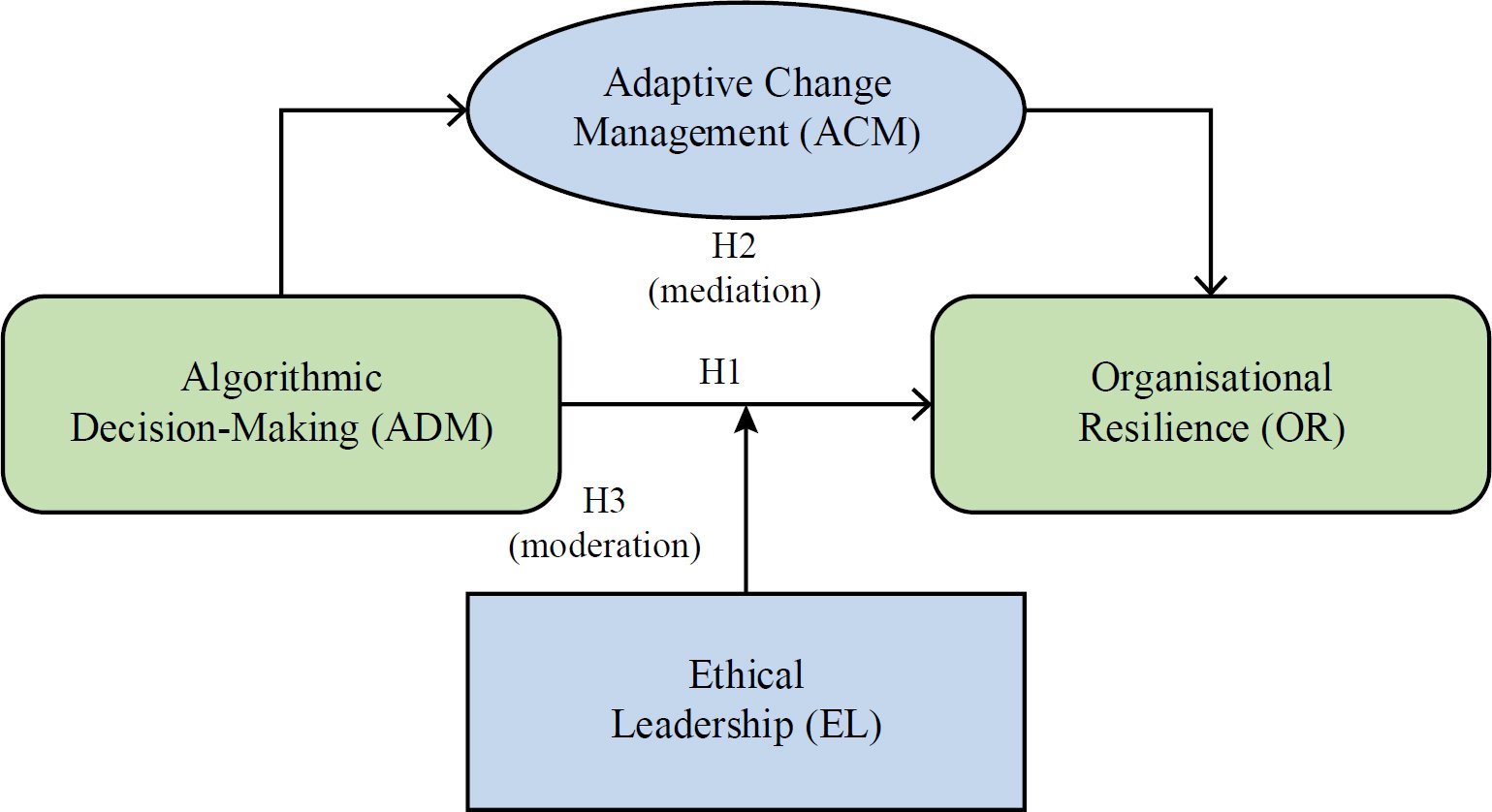
Fig. (1). Conceptual framework.
3. METHODOLOGY
The study adopted a quantitative, cross-sectional design using a structured Likert-scale questionnaire to collect data from managers and professional staff working in retail organisations in the UK that actively use algorithmic decision-making tools. Each item was rated on a five-point scale ranging from 1 = strongly disagree to 5 = strongly agree, which is widely used and minimises respondent fatigue in management research, as depicted by (Kusmaryono et al., 2022). Four latent constructs were examined: Algorithmic Decision-Making (ADM), Adaptive Change Management (ACM), Organisational Resilience (OR), and Ethical Leadership (EL). Each construct was measured using five items adapted from validated leadership, resilience, change, and artificial intelligence decision-making scales, with wording modified to suit the organisational context of the present study. ADM was conceptualised as the exogenous variable, ACM as the mediating variable, OR as the main outcome, and EL as the moderating variable. In this study, resilience is treated as an observable organisational outcome rather than a capability dimension. A pilot test with 60 professionals was conducted to assess clarity and content validity. Reliability coefficients were acceptable, no items were confusing or redundant, and none were removed. The Cronbach’s alpha value was above 0.75 for each construct, indicating the reliability of the instrument. Further minor wording revisions were made as guided by expert reviewers which contributed to the reliability of the instrument. The full questionnaire including demographics items and all construct measures were provided in Appendix A.
A purposive sampling strategy was used because the study required participants who had direct involvement in technology-enabled decision-making contexts. The sampling frame included medium- and large-sized organisations that had been using AI-supported decision systems for at least one year. A systematic screening process ensured that only relevant respondents participated in the study. First, potential participants were asked whether their organisation used algorithmic or AI-supported decision tools. Second, the respondents confirmed whether they personally worked with or were affected by these systems in their routine roles. Third, they confirmed that they held supervisory, managerial, or professional responsibilities, rather than purely operational tasks. Individuals who reported no exposure to algorithmic systems, minimal interaction with decision-making tools, or positions below the supervisory level were excluded from the survey.
A priori power analysis using G*Power (as suggested by Sarstedt et al., 2017), with power of 0.95, significance level of 0.05, and medium effect size (f² = 0.15), indicated that at least 160 completed questionnaires were required for power estimation, following minimum path logic consistent with PLS-SEM recommendations for a model with one exogenous variable, one mediator, one moderator, and one outcome. To exceed this requirement and improve statistical stability, approximately 1,050 eligible respondents were invited using a secure online link. A total of 520 questionnaires were returned and analysed. After screening for missing data, inconsistent response patterns, and extreme outliers, 430 usable responses were obtained. To assess potential non-response bias, early and late respondents were compared across all main constructs using independent samples t-tests, with no significant differences observed (all p > 0.05). Harman’s single factor tests also indicated that no dominant factor was present, suggesting that non-response and common method bias were unlikely to threaten the validity of the findings (Coon et al., 2020).
Several procedural remedies were used in the design of the questionnaires and to collect data to minimise the threat of common method bias. The respondents were assured of anonymity and confidentiality to minimise evaluation apprehension and create honesty in the respondents’ answers. Adequate explanations were provided, and items on the measurement scales were modified from existing scales to make the items more understandable and less subject to misinterpretation. In addition, the constructs were introduced individually in the different parts of the questionnaire to minimise the respondents’ tendency to infer relationships between variables. Common method bias was tested using the full collinearity approach (Table 1) after data collection. The Variance Inflation Factor (VIF) values were below the suggested level, and the highest value was 3.3, suggesting that there was no common method bias issue affecting the validity of the results.
Table 1. Full-collinearity VIF.
| – | VIF |
| Adaptive Change Management -> Organisational resilience | 1.462 |
| Algorithm Decision Making -> Adaptive Change Management | 1.745 |
| Algorithm Decision Making -> Organisational resilience | 1.686 |
| Ethical Leadership -> Organisational resilience | 1.309 |
| Ethical Leadership x Algorithm Decision Making -> Organisational resilience | 1.614 |
Partial Least Squares Structural Equation Modelling (PLS-SEM), a computer-based form of data analysis, was performed using SmartPLS software in accordance with the recommendations provided by (Hair et al., 2021; and Sarstedt et al., 2017). This study was conducted in two phases. To measure the internal consistency reliability (Cronbach’s alpha and composite reliability), convergent validity (Average Variance Extracted), and discriminant validity (heterotrait-monotrait ratio), the measurement model was first evaluated using confirmatory factor analysis. The indirect effect of ADM on OR via ACM was used to test the mediating role of adaptive change management, where an interaction term of ADM and EL was also specified to test whether the direct relationship between the two variables was moderated by ethical leadership (EL x ADM → OR). Thus, a mediation factor (ADM → ACM → OR) was added to the distinct moderation of the ADM → OR link; no conditional indirect effects (moderated mediation) were estimated.
4. RESULTS
4.1. Demographics Profile Analysis
As indicated in Table 2, the sample was nearly balanced in terms of gender, with 48.8% males (n = 210) and 51.2% females (n = 220), which made the sample less prone to the bias of perception of algorithmic decision-making and resilience towards a single gender. The age is also widely distributed with 27.0% of ages falling within the age bracket of 18-29, 24.0% within the 30-39 age group, 22.6% within the 40-49 age range, and 26.5% in the 50 and above age group, which shows the presence of both early career staff and those who are experienced. On the hierarchy, 28.4% of the respondents are supervisors, 26.3% were assistant managers and 24 and 21.4% are middle managers and senior managers respectively. The ratios are comparatively equal, which is significant since the research focuses on constructs such as adaptive change management and ethical leadership that may be viewed differently by the representatives of various organisational levels. There was also an equal distribution in departmental representation, with operations (26.3%) having the highest number of representatives, followed by human resources (25.6%), information technology (25.1%), and finance (23.0%), with significant contributions.
Table 2. Demographics analysis.
| Demographic Category | Group | Frequency (n) | Percentage (%) |
| Gender | Male | 210 | 48.8 |
| Female | 220 | 51.2 | |
| Age | 18–29 years | 116 | 27.0 |
| 30–39 years | 103 | 24.0 | |
| 40–49 years | 97 | 22.6 | |
| 50 years and above | 114 | 26.5 | |
| Job title / Position | Supervisor | 122 | 28.4 |
| Assistant Manager | 113 | 26.3 | |
| Middle manager | 103 | 24.0 | |
| Senior manager | 92 | 21.4 | |
| Department | Operations | 113 | 26.3 |
| Information Technology | 108 | 25.1 | |
| Human Resources | 110 | 25.6 | |
| Finance | 99 | 23.0 | |
| Total | – | 430 | 100 |
4.2. Measurement Model Analysis
The results specified in Table 3 show that all constructs show high factor loadings ranging between 0.731 and 0.91. On the other hand, internal reliability and consistency were examined using Cronbach’s Alpha and Composite Reliability with an acceptable threshold of 0.7 or higher. The results show that in the case of each construct in the measurement model, Cronbach’s alpha is found to be (α > 0.7) which validates internal reliability. In addition, convergent validity was attained, as the AVE values were higher than the threshold of 0.5 for each construct.
Table 3. Measurement model.
| Latent Variables | Indicators | Factor Loadings | Cronbach’s Alpha | Composite Reliability | Average Variance Extracted (AVE) |
| Algorithm Decision Making | ADM1 | 0.850 | 0.883 | 0.887 | 0.681 |
| ADM2 | 0.776 | ||||
| ADM3 | 0.834 | ||||
| ADM4 | 0.845 | ||||
| ADM5 | 0.818 | ||||
| Adaptive Change Management | ACM1 | 0.864 | 0.914 | 0.918 | 0.745 |
| ACM2 | 0.891 | ||||
| ACM3 | 0.883 | ||||
| ACM4 | 0.895 | ||||
| ACM5 | 0.777 | ||||
| Ethical Leadership | EL1 | 0.788 | 0.838 | 0.874 | 0.609 |
| EL2 | 0.793 | ||||
| EL3 | 0.866 | ||||
| EL4 | 0.731 | ||||
| EL5 | 0.818 | ||||
| Organisational Resilience | OR1 | 0.857 | 0.924 | 0.924 | 0.767 |
| OR2 | 0.899 | ||||
| OR3 | 0.910 | ||||
| OR4 | 0.856 | ||||
| OR5 | 0.855 |
4.3. Discriminant Validity
Table 4 evaluates discriminant validity by observing the strength and validity of the latent constructs and ensuring that there is an empirical distinction between each construct. The HTMT ratios of the core variables were moderate and high, yet fit within the generally accepted levels of discriminant validity. The correlation between Algorithmic Decision-Making and Adaptive Change Management is 0.672, and with Ethical Leadership and Organisational Resilience, it is theoretically strong at 0.533 and 0.599, respectively, which means that algorithmic tools are supported but not identical to the following capabilities of organisations. This HTMT trend indicates that the constructs have overlapping yet conceptually different facets of management in the digital era.
Table 4. Discriminant validity.
| – | Adaptive Change Management | Algorithm Decision Making | Ethical Leadership |
| Algorithm Decision Making | 0.672 | – | – |
| Ethical Leadership | 0.515 | 0.533 | – |
| Organisational resilience | 0.561 | 0.599 | 0.661 |
The most intense connection in the matrix is between Adaptive Change Management and Organisational Resilience (0.561), followed by the relationship between Adaptive Change Management and Ethical Leadership (0.515) and the relationship between Ethical Leadership and Organisational Resilience (0.661). The HTMT result indicates that ACM and OR are closely related but still empirically distinct constructs, which is consistent with the conceptual framework. These comparatively high values are theoretically possible, as adaptive processes are supposed to underlie resilience, and ethical leadership should contribute to adaptation or resilience. Nonetheless, the coefficients are not very close to cut-offs, which are quite stringent, such as 0.85, which means that the constructs, albeit being closely related, are not redundant. The significance of this balance is that it demonstrates that the model distinguishes between the change management practices of organisations, their resilience to disruption, and how leadership ethics influence such processes, although the three domains are closely interconnected in practice.
4.4. Path Coefficient Analysis
As shown in Table 5, the strongest indicator of Organisational Resilience in the model is Adaptive Change Management. The correlation between Adaptive Change Management and Organisational Resilience is very large and highly significant (β = 0.804, t = 24.224, p < 0.001), such that organisations with stronger adaptive change practices report being much higher in resilience. According to this finding, resilience in disruption is primarily preserved by organised learning, effective communication, and adaptive redistribution of resources.
Table 5. Path analysis.
| – | Path coefficients | T statistics | P values | F-Square |
| Adaptive Change Management -> Organisational Resilience | 0.804*** | 24.224 | 0.000 | 1.176 |
| Algorithm Decision Making -> Adaptive Change Management | 0.603*** | 16.688 | 0.000 | 0.570 |
| Algorithm Decision Making -> Organisational Resilience | 0.033 | 1.178 | 0.239 | 0.003 |
| Ethical Leadership -> Organisational Resilience | 0.018 | 0.520 | 0.603 | 0.001 |
| Ethical Leadership x Algorithm Decision Making -> Organisational Resilience | -0.071*** | 4.813 | 0.000 | 0.033 |
| Specific Indirect Effects | ||||
| Algorithm Decision Making → Adaptive Change Management → Organisational Resilience | 0.484*** | 13.073 | 0.000 | – |
Note: * indicates significance at p < 0.05; ** indicates significance at p < 0.01; *** indicates significance at p < 0.001
The impact of Algorithmic Decision-Making on Adaptive Change Management is also high (β = 0.603, t = 16.688, p = 0.001), but its effect on Organisational Resilience is insignificant (β = 0.033, t = 1.178, p = 0.239). This implies that algorithmic tools cannot become resilient directly when adaptive processes are considered. Instead, its contribution is mostly through allowing organisations to modify processes, change repeatedly, and realign structures with information-based knowledge. Ethical Leadership also did not have a noteworthy direct effect on Organisational Resilience (β = 0.018, t = 0.520, p = 0.603); therefore, moral leadership in and of itself was not a distinct predictor of variation in resilience outcomes.
4.5. Model Explanatory Power
Table 6 shows that the model has a reasonably strong explanatory power. The R-square of Adaptive Change Management is 0.363 (adjusted 0.362), and that is approximately 36 percent of the change in adaptive change practices is attributed to Algorithmic Decision-Making, and other predictors, which is a medium degree of prediction. In contrast, organisational Resilience has a much greater R-squared value of 0.761 (adjusted 0.759), indicating that approximately 76 percent of its variance is explained by the model, indicating considerable explanatory power and the applicability of the proposed structural relationships.
Table 6. Explanatory power.
| – | R-Square | R-Square Adjusted |
| Adaptive Change Management | 0.363 | 0.362 |
| Organisational resilience | 0.761 | 0.759 |
The values of Q2 predict shown in Table 7 are positive for Adaptive Change Management (0.311) and Organisational Resilience (0.732), the structural model has good out-of-sample predictive relevance. Furthermore, the RMSE and MAE values are rather low for the corresponding endogenous constructs, indicating good prediction accuracy and verifying the ability to predict the endogenous constructs in a reliable manner.
Table 7. Predictive relevance.
| – | Q²predict | RMSE | MAE |
| Adaptive Change Management | 0.311 | 0.512 | 0.412 |
| Organisational resilience | 0.732 | 0.631 | 0.401 |
5. DISCUSSION
The results indicate that algorithmic decision-making had no significant and direct impact on organisational resilience, leading to the rejection of H1. The insignificant direct effect of algorithmic decision-making (ADM) on organisational resilience in the UK retail industry indicates the initial phase of digital adoption among most retailers. The introduction of algorithmic systems tends to be superimposed over existing governance and coordination systems, which enhances surveillance and information flows without always improving the quality of decisions and alignment of operations. This is unlike the results of other authors, such as (Dajani, 2022), who found that more developed digital infrastructures promoted direct impacts on resilience to a greater extent. The influence of culture and industry, including the focus of the UK retail workforce on customer-facing discretion and strict compliance with stringent data protection (GDPR), can restrict the unmediated influence of the algorithm. According to the Dynamic Capabilities approach, sensing through ADM is insufficient; instead, resilience becomes evident when technology is embedded in adaptive change activities (Lazaroiu et al., 2022; Muadzah & Suryanto, 2024). The findings suggest that the deliberate development of capabilities and ethical controls is necessary when UK retailers utilise algorithms to convert them into well-founded operational reactions, which is a sector-specific solution for human-focused interpretation alongside technological resources.
The positive correlation between adaptive change management and organisational resilience is strong, which supports H2 and reinforces the important assumptions of Dynamic Capabilities Theory in the case of the UK retail sector. The sampled retail organisations showed resilience mainly through structured learning, communication coordination, and flexible reallocation of resources. The continuity of necessary operations during disruption, as described by respondents, is facilitated by planned adaptation and the importance of human-mediated processes. In comparison to the findings of other studies, such as (Meena & Santhanalakshmi, 2023), UK retailers use more team-oriented coordination and routinised learning, which is due to regulatory systems, labour demands, and customer service factors. There is also evidence that guided change facilitates trust and communication in digitalisation at a rapid pace, which supports the findings of (Al Masaeid, 2025) regarding organisational cohesion. These results imply that capturing and changing mechanisms are substantial for robust outcomes, whereas sensing is insufficient. In practice, UK retailers should prioritise adaptive structures, collaborative processes, and communication channels, as technological inputs are transformed into sustainable resilience rather than believing that digital sophistication would automatically bring stability (Shafizadeh, 2024).
The results of the full mediation further prove the acceptance of H2 by showing that adaptive change management mediates the relationship between algorithmic decision-making and organisational resilience in its entirety. Algorithmic tools only influenced resilience through their effect on changes in routines, training practices, and coordination mechanisms. The full statistical mediation of adaptive change management (ACM) in the UK retail sector clarifies why algorithmic decision-making (ADM) did not display a significant direct association with organisational resilience. Rather, these outcomes signify that ADM is related to resilience chiefly through its effect on adaptive change management, whereas ACM itself confirmed a robust and substantial direct association with organisational resilience, thus supporting H2. Algorithms only affect resilience by transforming routines, training, and coordination processes. In line with previous studies (Roundy, 2022; Rajagopal et al., 2022), technology does not add much value without complementing adaptive organisational processes and continuous learning. In Dynamic Capabilities Theory, this mediation helps depict how sensing (ADM) leads to seizing and transforming (ACM) and how resilience can be formed once the process of transforming data-based insights into coordinated action is done purposely. UK retailers investing in technology but without proper adaptive mechanisms can become efficient but easily disrupted, as revealed by (Ivanov & Dolgui, 2021).
The results of the moderation analysis also support H3, as they suggest that ethical leadership is a moderating variable in the direct association between algorithmic decision-making and organisational resilience in the context of the UK retail sector. The interaction findings exhibited a negative coefficient that was small yet statistically significant, indicating that under conditions where ethical leadership is stronger, the residual direct effect of ADM on resilience is somewhat dampened when adaptive change management is considered. This can be associated with the focus of UK retail leaders on close monitoring, adherence to the GDPR, and employee and customer protection, which results in further investigation of algorithmic outputs prior to their implementation in operations. Ethical leaders may slow down immediate algorithmic responses by introducing deliberation and risk evaluation. (Meena & Santhanalakshmi, 2023) stated that when driven by ethical concerns, leaders tend to reduce the direct and immediate resilience benefits of ADM alone, with the promotion of responsible adaptation and mitigation of risks. This corresponds to the Ethical Leadership Theory that emphasises supervision, justice, and the absence of harm, as argued by (Aakula et al., 2024; and Banks et al., 2021). However, the magnitude of the effect is low, and the direction was not highly anticipated by previous studies, meaning that although EL moderates the effect, it operates as a calibrating cheque but not as a driving force of resilience in UK retail organisations.
Overall, the findings reveal that organisational resilience in the algorithmic age is first and foremost a function of adaptive change management, with algorithmic decision-making and ethical leadership playing supporting roles. The results of the study – rejection of H1 and strong support for H2–confirm that algorithmic systems on their own did not predict resilience; they were effective only when integrated into structured learning, communication, and resource-reallocation processes (Ivanov & Dolgui, 2021; Roundy, 2022). Ethical leadership played only a small role by moderating the direct relationship that had been left over between algorithmic decision making and resilience, but this was small and negative. Taken together, the results promote the view of resilience as the result of sensing, seizing, and transforming mechanisms in concert with human judgement and ethical oversight, rather than as a simple output of technological sophistication (Dajani, 2022; Georgescu et al., 2024).
CONCLUSION
This study investigated the connection between algorithmic decision-making, adaptive change management, and ethical leadership in relation to organisational resilience among organisations that are actively adopting digital tools. The structural model indicated that algorithmic decision-making did not significantly affect organisational resilience directly once adaptive change management was included. Instead, adaptive change management emerged as the primary factor promoting resilience, fully mediating the relationship between algorithmic decision-making and resilience. In this case, ethical leadership had no meaningful direct effect on resilience and a small negative moderating impact on the remaining direct path on resilience from algorithmic decision-making.
These results show that in the sampled organisations, resilience was created through structured adaptive practices rather than algorithmic systems alone. Algorithmic tools helped build resilience only when they were embedded in processes that supported ongoing learning, transparent communication, and flexible reallocation of time, training, and resources. Ethical leadership offered a cautious overlay to this relationship by slightly reducing the residual direct impact of algorithmic decision-making on resilience, consistent with an emphasis on scrutiny and responsibility. Overall, the findings point to the need for investments in digital decision tools to be accompanied by robust adaptive change capabilities and considered leadership to support resilience during disruption.
RECOMMENDATIONS
- Organisations should invest in structured change programs that train managers and employees to integrate algorithmic tools with clear workflows, transparent communication, and continuous learning practices.
- Leaders should establish explicit ethical review processes that regularly assess data sources, potential biases, fairness, and accountability in algorithmic decisions before implementation.
- Management teams should promote employee participation in technology adoption by encouraging feedback, openly discussing concerns, and recognising contributions that improve system use and resilience.
- Organisations should link algorithmic decision-making to strategic planning by monitoring performance impacts, adjusting resource allocation, and refining processes when the unintended consequences emerge.
- Policymakers and senior executives should prioritise leadership development initiatives that cultivate ethical awareness, responsible oversight, and values-driven decision-making cultures across all organizational levels.
LIMITATIONS AND FUTURE DIRECTIONS
However, there are several limitations to interpreting these findings. First, the cross-sectional design restricted the possibility of causal inference. Longitudinal studies are required to monitor the paths that the co-evolution of algorithmic decision-making, adaptive change management, and resilience takes from one phase of digital transformation to the next. Second, the study was based on the self-reported perceptions of managers and professional staff which may be subject to optimism and/or scepticism, reflecting the organisational culture. Future research could use survey data to triangulate performance indicators or case-based evidence of how organisations respond to specific disruptions.
Third, the sample came from organisations that already used algorithmic tools, so the results may not be applicable to firms that are very early in adopting digital use. Comparative studies across sectors and institutional environments would be useful in clarifying whether the observed full mediation by adaptive change is replicable in other contexts and whether the small negative moderation by ethical leadership is replicable or context-specific. Finally, the model focused on one mediator and one moderator; future work could include the addition of more boundary conditions, such as organisational culture or regulatory pressure, to develop a more comprehensive explanation of how the combination of technology, leadership, and change processes shapes resilience.
Finally, the study utilised a five-point Likert scale with an ordinal scale, although it is suitable for testing the proposed conceptual model and examining complex mediation and moderation relationships. The present findings could be supplemented by future research using alternative analytic models to test the results of ordered logit and ordered probit models as robustness checks, where appropriate. The results of the different estimation methods can be compared to obtain more evidence on the stability of the relationships observed, which would lend more support to the empirical evidence.
POLICY IMPLICATIONS
The findings imply that managers should not assume that algorithmic systems automatically enhance organisational resilience. Rather, investments in digital technologies must be coupled with a carefully planned change management program, such as employee training, the development of communication plans, and the introduction of coordination structures between functions. It is necessary to have formal processes in place to review algorithmic recommendations before they are deployed and to make decisions that are transparent and accountable to managers, especially regarding the review and approval steps. Leadership training and development programs could be more effective in improving managers’ capacity to recognise algorithmic biases, break down assumptions in data, and find a balance between efficiency and employee well-being. In addition, they need to have workforce data literacy, where employees can evaluate the results from algorithms instead of taking them for granted. Employing these actions will enable UK retailers to convert algorithmic understanding into adaptable organisational solutions, enhancing their ability to withstand shocks while limiting the potential risks of technology-driven change.
LIST OF ABBREVIATIONS
| ACM | = | Adaptive Change Management |
| ADM | = | Algorithmic Decision-Making |
| DCT | = | Dynamic Capabilities Theory |
| EL | = | Ethical Leadership |
| OR | = | Organisational Resilience |
| PLS-SEM | = | Partial Least Squares Structural Equation Modelling |
| VIF | = | Variance Inflation Factor |
AUTHOR’S CONTRIBUTION
F.A. conceived and designed the study, acquired and preprocessed the dataset, performed the statistical analyses, interpreted the results, developed the proposed framework, drafted and revised the manuscript, and approved the final version of the manuscript.
ETHICAL APPROVAL & INFORMED CONSENT
The study adhered to established ethical guidelines for social science research. Before completing the questionnaire, participants were provided with information about the study objectives, voluntary participation, confidentiality, and their right to withdraw at any time. Informed consent was obtained from all participants prior to data collection. No personally identifiable information was collected, and all responses were treated anonymously and used solely for academic purposes. The study ensured compliance with principles of privacy, data protection, and responsible research conduct.
AVAILABILITY OF DATA AND MATERIALS
The data will be made available on reasonable request by contacting the corresponding author.
FUNDING
None.
CONFLICT OF INTEREST
The author declares that there is no conflict of interest regarding the publication of this article.
ACKNOWLEDGEMENTS
Declared none.
DECLARATION OF AI
During the preparation of this manuscript, ChatGPT was used solely for language editing and refinement. All AI-assisted revisions were carefully reviewed, verified, and approved by the author, who retains full responsibility for the accuracy, originality, integrity, and final content of the manuscript.
APPENDICES A
Questionnaire
Demographic Information
- Gender
- Male
- Female
- Age range
- 18–29 years
- 30–39 years
- 40–49 years
- 50 years and above
- Job title / Position
- Assistant Manager
- Supervisor
- Middle manager
- Senior manager
- Department
- Operations
- Information Technology
- Human Resources
- Finance
| Construct | Item No. | Questionnaire Item | Likert Scale (1–5) | ||||
| Algorithmic Decision-Making | ADM1 | Systems in our organisation are algorithmic systems that assist in the process of making key operational decisions. | 1 | 2 | 3 | 4 | 5 |
| ADM2 | There is a high impact of algorithmic tools on the strategic decisions of this organisation. | 1 | 2 | 3 | 4 | 5 | |
| ADM3 | This organisation is dependent on algorithmic outputs in making its day-to-day decisions by managers. | 1 | 2 | 3 | 4 | 5 | |
| ADM4 | Most of our key performance indicators can be tracked using automated and algorithmic systems. | 1 | 2 | 3 | 4 | 5 | |
| ADM5 | Algorithms can produce knowledge on which changes to work processes are made. | 1 | 2 | 3 | 4 | 5 | |
| Adaptive Change Management | ACM1 | Whenever new information is available, our organisation realigns the work processes. | 1 | 2 | 3 | 4 | 5 |
| ACM2 | The employees are encouraged to offer feedback that is utilised to improve change initiatives. | 1 | 2 | 3 | 4 | 5 | |
| ACM3 | Implementation of change projects in this organisation is done in small and iterative steps as opposed to a one-off event. | 1 | 2 | 3 | 4 | 5 | |
| ACM4 | The process of communicating decisions regarding changes is straightforward and makes the staff realise why changes are necessary. | 1 | 2 | 3 | 4 | 5 | |
| ACM5 | Time, training, and tools are re-allocated in a flexible fashion with the aim of accommodating the changes. | 1 | 2 | 3 | 4 | 5 | |
| Organisational Resilience | OR1 | When disruption occurs, our organisation was able to execute critical services. | 1 | 2 | 3 | 4 | 5 |
| OR2 | Our organisation can resume operations in a decent time after a crisis. | 1 | 2 | 3 | 4 | 5 | |
| OR3 | Our past lessons are applied to enhance our systems and procedures. | 1 | 2 | 3 | 4 | 5 | |
| OR4 | There exists effective coordination of different departments in responding to the occurrence of unexpected events. | 1 | 2 | 3 | 4 | 5 | |
| OR5 | Our organisation will be in a position to sustain its provision of critical services even in times of disruption. | 1 | 2 | 3 | 4 | 5 | |
| Ethical Leadership | EL1 | Leaders in this organisation clarify the effects of the implementation of algorithmic tools on employees in advance. | 1 | 2 | 3 | 4 | 5 |
| EL2 | Leaders take into consideration the effects of the algorithm on employees and other stakeholders. | 1 | 2 | 3 | 4 | 5 | |
| EL3 | The leaders are clear regarding the way data is utilised within the algorithmic systems. | 1 | 2 | 3 | 4 | 5 | |
| EL4 | The employees are not afraid to speak out in case they suspect that an algorithmic decision is not fair. | 1 | 2 | 3 | 4 | 5 | |
| EL5 | Leaders assume the responsibility of rectifying the issues that are caused by algorithmic decisions. | 1 | 2 | 3 | 4 | 5 | |
REFERENCES
Aakula, A., Saini, V., & Ahmad, T. (2024). The impact of AI on organisational change in digital transformation. Internet of Things and Edge Computing Journal, 4, 75–115. Available from: https://thesciencebrigade.com/iotecj/article/view/465
Ademola, O.E. (2024). Change management trends in the AI modern world: Adapting to the future of work. Journal of Behavioral Informatics, 10(1), 41–49. Available from: https://www.isteams.net/_files/ugd/185b0a_f5f1fc36e0b24c2c974d193a898aba4c.pdf
Al Masaeid, T., Alkhalidi, M. M., Al Ali, A. A. A., Almaazmi, S. M. G. A., & Alami, R. (2025). Artificial Intelligence-Augmented Decision-Making: Examining the Interplay Between Machine Learning Algorithms and Human Judgment in Organizational Leadership. Journal of Ecohumanism, 4(1), 4683. Available from: https://ecohumanism.co.uk/joe/ecohumanism/article/view/6364
Andronie, M., Lăzăroiu, G., Iatagan, M., Uță, C., Ștefănescu, R., & Cocoșatu, M. (2021). Artificial intelligence-based decision-making algorithms, Internet of Things sensing networks, and deep learning-assisted smart process management in cyber-physical production systems. Electronics, 10(20), 2497.
https://doi.org/10.3390/electronics10202497
Ayibam, J. N. (2024). Adaptive corporate governance in crisis: A case study of Airbnb’s post-pandemic turnaround. Journal of Contemporary Sociological Dialectics, 12(1). Available from: https://ojs.unm.ac.id/elektikakontemporer/article/view/73995
Ara, A., Maraj, M. A. A., Rahman, M. A., & Bari, M. H. (2024). The impact of machine learning on prescriptive analytics for optimized business decision-making. International Journal of Management Information Systems and Data Science, 1(1), 7–18.
https://doi.org/10.62304/ijmisds.v1i1.112
Bagheri, S., Ridley, G., & Williams, B. (2023). Organisational cyber resilience: Management perspectives. Australasian Journal of Information Systems, 27.
https://doi.org/10.3127/ajis.v27i0.4183
Banks, G. C., Fischer, T., Gooty, J., & Stock, G. (2021). Ethical leadership: Mapping the terrain for concept cleanup and a future research agenda. The Leadership Quarterly, 32(2), 101471.
https://doi.org/10.1016/j.leaqua.2020.101471
Coon, J. J., van Riper, C. J., Morton, L. W., & Miller, J. R. (2020). Evaluating nonresponse bias in survey research conducted in the rural Midwest. Society & Natural Resources, 33(8), 968–986.
https://doi.org/10.1080/08941920.2019.1705950
Dajani, M. (2022). Adaptive leadership, organisational resilience, and the mediating effect of change management amid Egyptian academia crises. International Business Research, 15(12), 47–64.
https://doi.org/10.5539/ibr.v15n12p47
De Bruijn, H., Warnier, M., & Janssen, M. (2022). The perils and pitfalls of explainable AI: Strategies for explaining algorithmic decision-making. Government Information Quarterly, 39(2), 101666.
https://doi.org/10.1016/j.giq.2021.101666
Dunleavy, P., & Margetts, H. (2025). Data science, artificial intelligence and the third wave of digital era governance. Public Policy and Administration, 40(2), 185–214.
https://doi.org/10.1177/09520767231198737
Elumilade, D. O., Mhlongo, N. Z., & Gabela, N. (2023). The role of data analytics in strengthening financial risk assessment and strategic decision-making. Iconic Research and Engineering Journals, 6(10), 1-6. Available from: https://www.researchgate.net/profile/Oluwafunmike-Elumilade/publication/389264688_The_Role_of_Data_Analytics_in_Strengthening_Financial_Risk_Assessment_and_Strategic_Decision-Making/links/67bb93d8207c0c20fa93e291/The-Role-of-Data-Analytics-in-Strengthening-Financial-Risk-Assessment-and-Strategic-Decision-Making.pdf
Gade, K. R. (2021). Data-driven decision making in a complex world. Journal of Computational Innovation, 1(1), 1-6. Available from: https://researchworkx.com/index.php/jci/article/view/2
Georgescu, I., Bocean, C. G., Vărzaru, A. A., Rotea, C. C., Mangra, M. G., & Mangra, G. I. (2024). Enhancing organisational resilience: The transformative influence of strategic human resource management practices and organisational culture. Sustainability, 16(10), 4315.
https://doi.org/10.3390/su16104315
Gov.UK (2023). Artificial Intelligence sector study 2023. Available from: https://www.gov.uk/government/publications/artificial-intelligence-sector-study-2023/artificial-intelligence-sector-study-2023 (Assessed on: June 2026).
Hair, J. F., Jr., Hult, G. T. M., Ringle, C. M., Sarstedt, M., Danks, N. P., & Ray, S. (2021). Partial least squares structural equation modeling (PLS-SEM) using R: A workbook. Springer Nature.
https://doi.org/10.1007/978-3-030-80519-7
Ingram, T., Wieczorek-Kosmala, M., & Hlaváček, K. (2023). Organisational resilience as a response to the energy crisis: Systematic literature review. Energies, 16(2), 702.
https://doi.org/10.3390/en16020702
Ivanov, D., & Dolgui, A. (2021). A digital supply chain twin for managing the disruption risks and resilience in the era of Industry 4.0. Production Planning & Control, 32(9), 775–788.
https://doi.org/10.1080/09537287.2020.1768450
Johnson, J. (2023). Automating the OODA loop in the age of intelligent machines: Reaffirming the role of humans in command-and-control decision-making in the digital age. Defence Studies, 23(1), 43–67.
https://doi.org/10.1080/14702436.2022.2102486
Kaggwa, S., Eleogu, T. F., Okonkwo, F., Farayola, O. A., Uwaoma, P. U., & Akinoso, A. (2024). AI in decision making: Transforming business strategies. International Journal of Research and Scientific Innovation, 10(12), 423–444.https://doi.org/10.51244/IJRSI.2023.1012032
Kliestik, T., Nica, E., Durana, P., & Popescu, G. H. (2023). Artificial intelligence-based predictive maintenance, time-sensitive networking, and big data-driven algorithmic decision-making in the economics of Industrial Internet of Things. Oeconomia Copernicana, 14(4), 1097–1138.
https://doi.org/10.24136/oc.2023.033
Kusmaryono, I., Wijayanti, D., & Maharani, H. R. (2022). Number of response options, reliability, validity, and potential bias in the use of the Likert scale in education and social science research: A literature review. International Journal of Educational Methodology, 8(4), 625–637.
https://doi.org/10.12973/ijem.8.4.625
Land, A., Gruchmann, T., Siems, E., & Beske-Janssen, P. (2022). Dynamic capabilities theory. In Handbook of Theories for Purchasing, Supply Chain and Management Research. Edward Elgar Publishing, P.p 378-398.
https://doi.org/10.4337/9781839104503.00029
Lazaroiu, G., Androniceanu, A., Grecu, I., Grecu, G., & Neguriță, O. (2022). Artificial intelligence-based decision-making algorithms, Internet of Things sensing networks, and sustainable cyber-physical management systems in big data-driven cognitive manufacturing. Oeconomia Copernicana, 13(4), 1047–1080.
https://doi.org/10.24136/oc.2022.030
Mahmoudi, A., Javed, S. A., & Mardani, A. (2022). Gresilient supplier selection through fuzzy ordinal priority approach: Decision-making in post-COVID era. Operations Management Research, 15(1–2), 208–232.
https://doi.org/10.1007/s12063-021-00178-z
Martins, M. R. (2025). Artificial intelligence in business strategy: How AI-driven analytics is reshaping decision-making. International Journal of Humanities and Information Technology, 7(1), 63–71. Available from: https:/ijhit.info/index.php/ijhit/article/view/113/113
Meena G , K. Santhanalakshmi. (2022). Organizational resilience: adapting to rapid technological changes. Redshine Archive, 7(2). Available from: https://chapters.redshine.in/index.php/redshine/article/view/266#10.25215/9358797991.29
Muadzah, S., & Suryanto, S. (2024). Organisational culture and resilience: Systematic literature review. Scientific Journal of Management, Economics, & Accounting (MEA), 8(2), 4175.
https://doi.org/10.31955/mea.v8i2.4175
Rajagopal, N. K., Qureshi, N. I., Durga, S., Ramirez Asis, E. H., Huerta Soto, R. M., Gupta, S. K., & Deepak, S. (2022). Future of business culture: An artificial intelligence-driven digital framework for organisation decision-making process. Complexity, 2022, 7796507.
https://doi.org/10.1155/2022/7796507
Roundy, P. T. (2022). Artificial intelligence and entrepreneurial ecosystems: Understanding the implications of algorithmic decision-making for startup communities. Journal of Ethics in Entrepreneurship and Technology, 2(1), 23–38.
https://doi.org/10.1108/JEET-07-2022-0011
Roux, M., Chowdhury, S., Kumar Dey, P., Vann Yaroson, E., Pereira, V., & Abadie, A. (2025). Small and medium-sized enterprises as technology innovation intermediaries in sustainable business ecosystem: Interplay between AI adoption, low carbon management and resilience. Annals of Operations Research, 355(2), 1537–1586.
https://doi.org/10.1007/s10479-023-05760-1
Salomon, J., Broggi, M., Kruse, S., Weber, S., & Beer, M. (2020). Resilience decision-making for complex systems. ASCE-ASME Journal of Risk and Uncertainty in Engineering Systems, Part B: Mechanical Engineering, 6(2), 020901.
https://doi.org/10.1115/1.4044907
Sarstedt, M., Ringle, C. M., & Hair, J. F. (2017). Partial least squares structural equation modeling. Handbook of market research (pp. 587–632). Springer.
https://doi.org/10.1007/978-3-319-05542-8_15-1
Saxena, D., & Guha, S. (2024). Algorithmic harms in child welfare: Uncertainties in practice, organisation, and street-level decision-making. ACM Journal on Responsible Computing, 1(1), 1–32.
https://doi.org/10.1145/3616473
Shafa, H. (2025). Artificial intelligence-driven business intelligence models for enhancing decision-making in US enterprises. ASRC Procedia: Global Perspectives in Science and Scholarship, 1(1), 771–800.
https://doi.org/10.63125/b8gmdc46
Shafizadeh, H. (2024). Decision-making under uncertainty: How organisations adapt to environmental changes? Journal of Resource Management and Decision Engineering, 3(1), 4–10.
https://doi.org/10.61838/kman.jrmde.3.1.2
Statista. (2024). Retail market worldwide. Available from: https://www.statista.com/topics/5922/retail-market-worldwide/ (Accessed on: 26 June 2026).
The Industry. (2024). Retail chain collapses contribute to 170,000 job losses in 2024. Available from: https://theindustry.beauty/retail-chain-collapses-contribute-to-170000-jobs-losses-in-2024/
Zhang, J., Long, J., & Von Schaewen, A. M. E. (2021). How does digital transformation improve organisational resilience? Findings from PLS-SEM and fsQCA. Sustainability, 13(20), 11487.
https://doi.org/10.3390/su132011487