


Article ID: PDT2601203002
Views: 48The Impact of Perceived Ethical Leadership on Job Satisfaction in Saudi Arabian Technological Firms: The Moderating Role of Perceived Vision 2030 Initiative
⬇ Downloads: 0
1Imam Abdulrahman Bin Faisal University, Dammam, Saudi Arabia
Received: 06 April, 2026
Revised: 05 May, 2026
Accepted: 20 May, 2026
Published: 02 June, 2026
Abstract:
Introduction: The aim of this study was to explore how perceived ethical leadership is related to job satisfaction and the moderating role of perceived Vision 2030 initiatives among these relationships in the context of Saudi Arabian technological firms.
Methodology: In this study, the quantitative research design was used, and a survey was conducted using a structured questionnaire measured on a five-point Likert scale. Sampling of data was conducted through a purposive method where 450 employees of various levels of organization working in Saudi technological companies were sampled. Data was analyzed using SPSS, and moderate test was carried out using the Hayes PROCESS Macro (Model 1).
Results: The outcomes showed that the perceived ethical leadership is positively and statistically significantly related to job satisfaction. The results also indicated a positive relationship between job satisfaction and perceived Vision 2030 initiatives. In addition, the moderating influence is also supported by a positive, significant interaction effect between ethical leadership and the Vision 2030 initiatives. The model explains a medium degree of variability in job satisfaction that is explained by the predictors of job satisfaction.
Conclusion: The results implied that employee job satisfaction can be improved by promoting ethical leadership and aligning organizational strategies with Vision 2030 activities. The results are especially applicable to managers and policymakers who seek to enhance workforce engagement, improve the organizational climate, and promote the sustainable development of the technological industry in Saudi Arabia.
Keywords: Ethical leadership, job satisfaction, vision 2030, moderation analysis, Saudi Arabia, technology sector
1. INTRODUCTION
The rapid digitalization across the entire Middle East has greatly transformed organizational practices, especially in the technology sector. According to (Ahmed et al., 2025; and Alansi et al., 2026), Saudi Arabia has become one of the most active economies in the region in investing in information and communication technologies, artificial intelligence, and digital entrepreneurship to diversify its oil-dependent economy. As per (Al-Roubaie, 2025; and Alayed, 2023), the government policy efforts have boosted the growth of information technology companies and information infrastructure in the Kingdom. (Kazinform International News Agency, 2025) estimates that the digital economy contributes 19% of the GDP of Saudi Arabia by 2030 and that the number of people working within the information and communication technology sector has surged by over 15% in the past five years (Canales, Regardless of this growth, technological organisations have increasingly become confronted with the problem of employee retention, job satisfaction and effectiveness of leadership in highly competitive knowledge intensive setting supported by the findings of (Hauer et al., 2021; and Venkat et al., 2023) as well. (Steil et al., 2022) show that dissatisfaction and turnover remain significant issues in technology sectors worldwide, with close to 40% of technology workers planning to switch jobs due to poor leadership practises and a lack of organizational support. Researchers such as (Pujianto et al., 2025; and Xu & Loang, 2024) thus stress that it is critical to adopt leadership styles that foster equity, transparency, and ethics to sustain employee satisfaction and organizational performance.
One of the key aims of Saudi Arabia’s national development agenda, as outlined in the national vision 2030, is to improve the technological sector and establish a knowledge-based economy, and the power of innovation ecosystems is also suggested by (Alhamad et al., 2024; and Alam et al., 2023). Nevertheless, the high rate of industrial change puts pressure on the organization to ensure that its productivity and employee welfare are upheld. Ethical leadership has been identified as playing a significant role in shaping employees’ perceptions of the workplace. According to (Nejati et al., 2021), ethical leaders are role models who exemplify integrity, fairness, and accountability in decision-making.
In a similar vein, according to (Sun et al., 2023), ethical leadership results in a positive perception of organizational justice and employee trust in the workplace. (Tufan et al., 2023) found that employees with ethical leaders report much higher levels of job satisfaction and organizational commitment. However, the issue of leadership still persists in emergent technology industries, where the pace of organizational development can easily outpace leadership development. According to (Adekanmbi & Ukpere, 2022), a lack of knowledge about leadership mechanisms for reshaping the economy means organizations lack the potential to enhance employee welfare and work satisfaction.
Recent research, such as (Saad, 2021), also shows that employees’ perceptions of expanded institutional reforms may affect how they interpret leadership behaviors. Scholars of institutional and organisational behaviour argue that employees consider leadership practices within the wider socio-economic environment that defines organizational priorities. The national transformation plans, such as Vision 2030, may thus be related to employee attitudes by emphasizing the demands of ethical administration and responsible leadership (Al-Dossary, 2022). Nevertheless, the available literature (Ebrahim & Mohamed, 2024) on the analysis of ethical leadership and job satisfaction is mostly in Western or East Asian contexts and still lacks empirical data in Gulf economies, especially in Saudi Arabia’s fast-growing technological field. To address these gaps, this study examines how perceived ethical leadership relates to employees’ job satisfaction in Saudi technology companies and explores how perceived Vision 2030 initiatives moderate this relationship. This study is novel in contributing to the literature by investigating the relationship between leadership and employee job satisfaction through employees’ perceptions of macro-level policy changes in their organizational setting. The study does not introduce Vision 2030 as an environmental condition, but rather examines the psychological internalization of the national transformation initiatives by employees and how these perceptions influence the effectiveness of ethical leadership. By examining the perceived Vision 2030 initiatives as a moderating factor, the study identifies the translation of macro-policy narratives into micro-level workplace attitudes and provides a contextually oriented outlook of the technological industry in Saudi Arabia. Empirically, it offers contextual evidence in the Saudi Arabian technological sector, where leadership has not been sufficiently researched, and presents its findings to managers and policymakers who are expected to support leadership practices aligned with Vision 2030 and enhance employee satisfaction and organizational sustainability.
Furthermore, this study considers Vision 2030 as a psychological construct, operationalized in comparison with other external macro-level variables in previous studies, such as (Asfahani et al., 2025; and Uluturk et al., 2023), which treated national reform initiatives as exogenous variables for policy alignment in the organizational context of employees. This provides a detailed analysis of how the institutional forces are micro-internalized and transformed into employee attitudes and behavior. The research gives a greater understanding of the impact of national reform discourse on leadership performance by focusing on perceptions of people, but not structural policy. Therefore, it takes Institutional Theory beyond its traditional macro-centrism and demonstrates how the expanded policy frames intermingle with leadership practices to impact employee job satisfaction within the organizational setting, in particular, a fast-evolving technological environment.
2. LITERATURE REVIEW
2.1. Theoretical Framework
The theoretical framework of the study is founded on the Social Exchange Theory (SET) and the Institutional Theory, which are integrated with an aim to examine and analyse the mechanisms between the perceived ethical leadership (PEL) and the employee job satisfaction (JS) in Saudi technological firms. In many companies, in accordance with the SET, leaders treat employees with fairness, transparency, and integrity, and positively about their job behaviors (Ruwanika & Massyn, 2024). As reported by (Jamal et al., 2023), ethical leaders also serve as role models, and this fosters trust, normative expectations, and, therefore, contributes to employee satisfaction. Similarly, (Rahman et al., 2025) state that the ethical behavior of the leaders is internalized by the employees to a certain degree that the employees feel organizational support, which, consequently, raises their engagement and turnover intentions. While (Nazarian et al., 2024) argue that when perceived congruence between leader behavior and organizational values exists, employees’ psychological contracts are strengthened, thereby increasing satisfaction.
In addition, the Institutional Theory provides the same insight from a complementary perspective, capturing broader socio-economic and policy environments that affect the organization’s behavior, as (Katou & Kafetzopoulos, 2025) also suggested. According to (Balzano et al., 2025), national programs such as Vision 2030 generate institutional pressures that inform employees about what ethical leadership entails, thereby increasing its perceived importance. (Pham et al., 2023) also suggest that contextual factors must be incorporated for effective leadership in transforming economies. Collectively, SET is used to explain the reciprocity mechanism, and Institutional Theory is used to explain the contextual framing, which makes the model strong in explaining the relationship between PEL and JS and the moderation of this relationship by the Vision 2030 initiatives.
While the reciprocity mechanism, in which employees reciprocate ethical leadership by holding positive attitudes toward their leadership, such as job satisfaction, is explained by the Social Exchange Theory (SET), the macro-level legitimacy framework that guides the interpretation of such leadership behaviors is offered by the Institutional Theory. Collectively, these theoretical perspectives imply that employees’ reactions to ethical leadership are not simply the result of direct interactions but are also influenced by broader institutional indicators, thereby contributing to the commonality in explaining the moderated relationship.
2.2. Hypotheses Development
Positive employee outcomes, especially job satisfaction (JS), have been consistently associated with ethical leadership (EL), though the mechanisms of action and contextual conditions are subtle in the literature. In this perspective, (Torlak et al., 2021) found that EL has a positive association with JS and affective commitment (AC) and a negative relationship with turnover intention (TI) in a survey of 153 accountants in Istanbul, conducted using structural equation modeling (SEM). They point out the direct and indirect advantages of EL, and, according to the Social Exchange Theory (SET), employees repay leaders’ fairness and ethical behavior by being more satisfied and committed. Nevertheless, this research is confined by its sector-specificity and a limited study sample, which limits generalizability. Moreover, from a similar perspective, (Guo, 2022) found that EL and employee satisfaction in Macau’s service industry were positively associated, and media richness and perceived organizational transparency mediated this association. These findings are supported by SET, which proposes that employees view ethical leaders as transparent and organizational supporters, and react positively, as argued by (Ahmed et al., 2025; and Al-Roubaie, 2025). Though convenience sampling was used in the study, it introduces selection bias and limits external validity.
(Udin et al., 2023) extended the EL-JS association by showing that it depended on work-life balance (not work stress) among 110 workers in Indonesian privately owned hospitals. This highlights how organizational and personal resources are involved in the reciprocity between leaders and employees as part of the mechanism of response to supportive leadership through rewards, as well as the mechanism of SET. (Uluturk et al., 2023) also confirm a positive relationship between EL-JS among Turkish street-level bureaucrats, with the key mediating variables being the motivation to provide to the community and perceived organizational support. The longitudinal data show that job resources are much more important than job demands, a finding consistent with the SET principle, which states that employees are more responsive to positive resources than to constraints. Nevertheless, the emphasis on the public sector restricts the application directly to the technological private companies.
Compared with these studies, it can be observed that EL positively influences JS improvement in a variety of ways, including affective commitment, organizational support, and psychological resources, which can be explained by the reciprocity concept proposed by SET. Methodologically, cross-sectional surveys, sector-specific samples, and small datasets limit generalisability and causal inference. These limitations in Saudi technological companies signify a gap: the EL-JS relationship has not been tested in the realm of innovation in Saudi Arabia’s technological sector. Based on the findings emerging from the above literature and identified literature gaps, the study claims:
H1: There is a statistically significant and positive relationship between perceived ethical leadership and job satisfaction in the context of Saudi Arabian technological firms.
The moderating role of large-scale national transformation initiatives in shaping organisational behaviour has attracted growing scholarly interest, particularly in emerging economies currently experiencing rapid institutional change. Although no direct empirical evidence is available on Vision 2030, other studies related to it offer some understanding of how the institutional context shaped by the policies contributes to leadership-employee relations. According to (Arous et al., 2025), institutional settings shape employees’ perceptions of leadership behaviors, and thus policies aimed at reform can reinforce the perceived legitimacy of ethical leadership. Similarly, (Alotaibi & Campbell, 2022) believe that organizations within robust institutional structures harmonize internal practises to meet external expectations, thus boosting employee trust and satisfaction. In terms of Social Exchange Theory (SET), such alignment is an indicator of organizational support, and employees tend to reciprocate by displaying a positive attitude towards the organization, including job satisfaction, as (Omar & Badawy, 2025) also support. Moreover, according to (Uluturk et al., 2023), the Perceived Vision 2030 initiatives are conceptualized as employees’ cognitive assessments of the correspondence between national reform goals and organizational behaviors, particularly in innovation, governance, and economic change. The construct indicates how employees perceive broader policy indicators in their work environment, as implied by (Asfahani et al., 2025) as well. Using the Institutional Theory, these perceptions inform individuals’ sense-making of leadership behaviors and organizational priorities, thereby affecting attitudinal outcomes, including job satisfaction, through the contextual framing of expectations focused on reforms.
In comparison, research on national reform efforts in the Gulf and Asian regions indicates that policy-based change improves employee engagement when leadership practices align with it. (Asfahani et al., 2025) note that the reforms of the public sector in Oman were positively associated with employee satisfaction, due to a strengthening of the sense of fairness and transparency. Nevertheless, the causal inference is restricted by their use of cross-sectional survey data. Conversely, (Al-Hareri & Nassani, 2025) found that transformational organizational contexts enhance the association between leadership and employee job satisfaction and turnover intentions; however, their study relied on Western samples, and the generalizability of the results remains a major concern. The existence of conflicting research is also visible in studies such as (Arous et al., 2025), which assumes that there is no meaningful relationship between macro-level attempts in cases where employees believe that there is no relationship between the policy rhetoric and the organizational practice, which focuses on the perspective that institutional structures improve the influence of leadership, across the board.
Majority of these studies use self-reporting survey designs and a single industry sample that limits external validity besides increasing shared-method bias. However, the absence of longitudinal designs prevents the scope of knowledge regarding changes of the institutional reforms over time and their impact on the perception of employees. Nevertheless, as it may appear, as stated in the Institutional Theory, (Al-Hareri & Nassan, 2025) believe that the national efforts like Vision 2030 bring about normative and regulative pressures that shape organisational behaviour and employee expectations. On the other hand, when the employees notice the alignment of the goals of ethical leadership with Vision 2030, SET recommends the strengthened reciprocity mechanism that enhances job satisfaction. However, the current studies do not provide empirical evidence of the Vision 2030 as a moderator variable of privately owned technological firms within Saudi Arabia. It can be considered as a major gap, considering the fact that the industry is fast changing. In order to overcome this weakness and realize any gaps in the literature, the current study suggests the following hypothesis and conceptual framework expressed in Fig. (1).
H2: Perceived Vision 2030 Initiatives statistically significantly and positively moderate the relationship between perceived ethical leadership and job satisfaction in the context of Saudi Arabian technological firms.
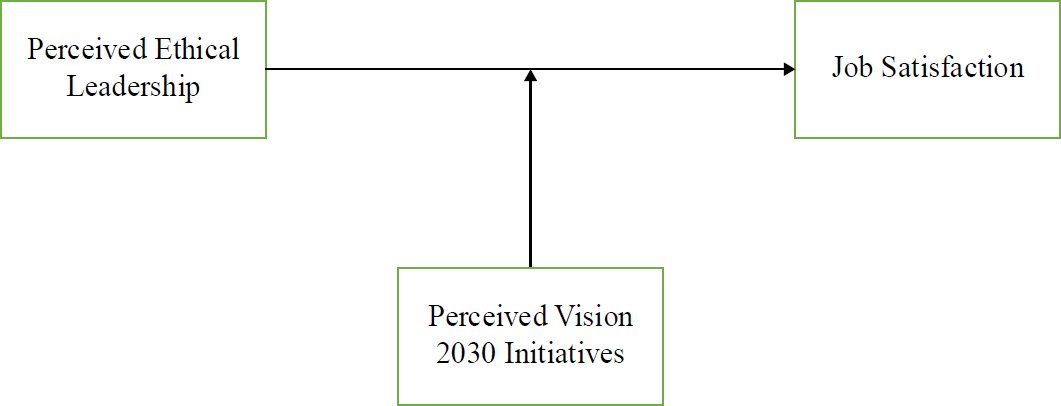
Fig. (1). Conceptual framework methods.
3. METHODOLOGY
The current study adopted a primary quantitative research design suitable for investigating the predictive relationship between variables and testing hypotheses in organisations. The respondents were surveyed using a structured questionnaire on a five-point Likert scale from strongly disagree to strongly agree, a common method for measuring perceptual variables in behavioural research, as suggested by (Russo et al., 2021). To ensure specific measurement of constructs and clarity, the questionnaire was split into the study’s major constructs: Job Satisfaction, Perceived Ethical Leadership, and Perceived Vision 2030 Initiatives. To ensure the validity of the constructs, the items were extracted from established scales (Appendix A). Items of Ethical leadership were adapted from (Langlois et al., 2014), where example items were specified as “Leaders in the organization seek to protect each individual’s dignity”, “Leaders are concerned when individuals or groups have advantages compared to other”. Similarly, items of job satisfaction were adopted from (Spector, 2022), for instance, “I feel I am being paid a fair amount for the work I do”, “When I do a good job, I receive the recognition for it that I should receive”. The Perceived Vision 2030 initiative construct is conceptualised as the assessment of employees’ understanding of how national reform goals are translated into their organisational context, especially regarding innovation practises, governance levels, and economic transformation initiatives. Instead of reflecting the research on the actual policy, the construct is an expression of how employees perceive the degree to which their organisation is oriented toward, communicates, and introduces the changes associated with Vision 2030 in daily work processes. The operational measure is how employees perceive the organisation’s support for innovation, openness in the governance process, and an orientation towards economic diversification. In this way, the construct is grounded at the employee level, where national policy is internalised into observable organisational behaviours, communication, and managerial practices, and will thus be not only measurable but also relevant to the workplace context. Sampling population comprised of the employees at different organisational levels of Saudi Arabian technological organisations. The participants were recruited online through online social media platforms such as Instagram, Twitter and the official Facebook pages of technology firms, which allowed gathering a nonhomogeneous, geographically dispersed sample, as reported by (Obilor, 2023) also. As suggested by (Andrade, 2021), the purposive sampling method was applied, as it enables the researcher to select respondents with relevant knowledge and experience in the study variables. The method is especially appropriate when the study in question requires information-rich cases in a particular industry. Although purposive sampling was used to ensure that only respondents with relevant experience and knowledge of the variables under study were included, it also introduced selection biases and constrained the generalisability of the results to the target population. Although this method is suitable for recruiting participants with greater understanding of the research problem and topic, it might not adequately reflect the diversity of the wider workforce. Thus, the outcomes are explained and evaluated within the chosen sample of workers in the technological companies. As recommended by (Kang, 2021) the size of a sample needed was done using G*Power analysis whereby, in case of the medium effect size (f2 = 0.15), power of 0.95 and three predictor, the minimum required sample size was about 119. Nevertheless, the study’s statistical robustness increases with sample size, which is why the targeted sample size is 450 participants. Eight hundred questionnaires were sent, of which 470 were returned, yielding a response rate of 58.75%. After screening for missing values and outliers, 20 responses were eliminated, leaving 450 for analysis. The evaluation of non-response bias was conducted by comparing early respondents (n1 = 30) and late respondents (n2 = 30) using the method recommended by (AboAlsamh, 2025), and no significant differences were found. In addition, Common method bias (CMB) was assessed by applying Harman’s single-factor test. The results of the exploratory factor analysis of all measurement items indicated that the variance was not explained by a single factor, and the first factor accounted for less than 50% of the total variance. This implies that CMB is not a concern in the current study. SPSS was used to analyse the data, and a moderation analysis was performed using the Preacher and Hayes PROCESS Macro, which allows robust testing of the interaction with bootstrapped confidence intervals, as recommended by (Sürücü et al., 2023).4. RESULTS
4.1. Demographics Analysis
The results shown in Table 1 specify the demographics characteristics of the study participants in the sample (n=450). It can be seen that among the total participants, 55.56% are males and 41.1% are females, and 3.33% preferred not to answer this question. Further, regarding age group, most participants, namely 30% and 32.2%, were found in the age brackets of 25-34 years and 35-44 years, respectively. Among the total participants, 38.89% and 28.89% hold Bachelor’s and Master’s Degrees, respectively, whereas 30.22% serve at Team Leader or Supervisory levels, 24.4% at Managerial levels, and 29.33% at Senior Management levels. Lastly, among total participants, 23.33% have 3-5 years of industry experience, 31.11% have 6-10 years, and 26.67% have more than 10 years. Table 1. Demographics profile analysis.| Demographic Category | Frequency (n) | Percentage (%) | |
| Gender | Male | 250 | 55.56% |
| Female | 185 | 41.11% | |
| Prefer not to say | 15 | 3.33% | |
| Age Range | Below 25 | 50 | 11.11% |
| 25–34 | 135 | 30.00% | |
| 35–44 | 145 | 32.22% | |
| 45–54 | 70 | 15.56% | |
| 55 and above | 50 | 11.11% | |
| Educational Qualification | Diploma | 85 | 18.89% |
| Bachelor’s Degree | 175 | 38.89% | |
| Master’s Degree | 130 | 28.89% | |
| Doctorate | 60 | 13.33% | |
| Current Job Position | Technical/Operational Staff | 72 | 16.00% |
| Team Leader / Supervisor | 136 | 30.22% | |
| Manager | 110 | 24.44% | |
| Senior Management | 132 | 29.33% | |
| Industry Experience | Less than 3 years | 85 | 18.89% |
| 3–5 years | 105 | 23.33% | |
| 6–10 years | 140 | 31.11% | |
| More than 10 years | 120 | 26.67% | |
4.2. Reliability Analysis
The internal consistency and reliability of the model are examined using Cronbach’s Alpha, with a standard value of 0.7. The results are specified in Table 2. Table 2. Reliability analysis.| – | Reliability Statistics | |
| – | Cronbach’s Alpha | N of Items |
| Perceived Ethical Leadership | 0.899 | 3 |
| Job Satisfaction | 0.884 | 3 |
| Perceived Vision 2030 Initiatives | 0.854 | 3 |
4.3. Validity-Inter-Item Correlations
The inter-item correlations are given in Table 3 moderate to strong and positive within each construct, supporting acceptable internal validity and consistency. Within the Perceived Ethical Leadership items (PEL1-PEL3), there are relatively strong positive correlations (r = 0.704-0.777); however, the correlations are below 0.8, supporting the construct’s convergence and indicating no redundancy among the items. Likewise, the Job Satisfaction items (JS1- JS3) exhibited consistency and moderate to high positive correlations (r = 0.652- 0.759), indicating that the construct is stable. A similar pattern to the JS construct was present for the Perceived Vision 2030 items (PV1- PV3), with the observed inter-item correlations for this construct being sufficiently strong to indicate acceptable inter-item associations (r = 0.598-0.707). The cross-construct correlations were all less than the corresponding within-construct correlations, supporting the discriminant validity of the constructs. Therefore, the observed intercorrelation patterns indicate that the items of the constructs are more strongly related to each other than to items in other constructs, thereby establishing the validity and appropriateness of the measurement scale for further analyses. Table 3. Validity and reliability analysis.| Inter-Item Correlation Matrix | |||||||||
| – | PEL1 | PEL2 | PEL3 | JS1 | JS2 | JS3 | PV1 | PV2 | PV3 |
| PEL1 | 1.000 | 0.777 | 0.704 | 0.547 | 0.533 | 0.490 | 0.466 | 0.430 | 0.451 |
| PEL2 | 0.777 | 1.000 | 0.764 | 0.542 | 0.543 | 0.514 | 0.403 | 0.400 | 0.401 |
| PEL3 | 0.704 | 0.764 | 1.000 | 0.573 | 0.597 | 0.545 | 0.492 | 0.434 | 0.418 |
| JS1 | 0.547 | 0.542 | 0.573 | 1.000 | 0.759 | 0.652 | 0.580 | 0.574 | 0.471 |
| JS2 | 0.533 | 0.543 | 0.597 | 0.759 | 1.000 | 0.742 | 0.520 | 0.548 | 0.506 |
| JS3 | 0.490 | 0.514 | 0.545 | 0.652 | 0.742 | 1.000 | 0.439 | 0.412 | 0.433 |
| PV1 | 0.466 | 0.403 | 0.492 | 0.580 | 0.520 | 0.439 | 1.000 | 0.707 | 0.598 |
| PV2 | 0.430 | 0.400 | 0.434 | 0.574 | 0.548 | 0.412 | 0.707 | 1.000 | 0.677 |
| PV3 | 0.451 | 0.401 | 0.418 | 0.471 | 0.506 | 0.433 | 0.598 | 0.677 | 1.000 |
4.4. Correlations
The correlation analysis (Table 4) shows that all variables in the study have statistically significant, positive relationships. Job Satisfaction is positively correlated with Perceived Ethical Leadership (r = .661, p = 0.01), indicating that greater perceptions of ethical leadership are associated with higher employee satisfaction. Similarly, Perceived Vision 2030 Initiatives shows a moderate correlation with Perceived Ethical Leadership (r = .539, p < 0.01) and Job Satisfaction (r = .629, p < 0.01). The implication of these findings is that employees with a positive outlook on national initiatives also report high levels of satisfaction and positive perceptions of leadership. Table 4. Correlations.| Variable | M | SD | 1 | 2 | 3 |
| Perceived Ethical Leadership (PEL) | 3.757 | 0.757 | 1 | ||
| Job Satisfaction (JS) | 3.65 | 0.856 | .661** | 1 | |
| Perceived Vision 2030 Initiatives (PV) | 3.549 | 0.887 | .539** | .629** | 1 |
4.5. Process Model-Preacher and Hayes
According to the Process-Macro results (Table 5), the model has moderate predictive power and accounts for a significant percentage of the variance in job satisfaction (R2 = 0.546, F (3,446) = 179.053, p < .001). Perceived Ethical Leadership (PEL) has a positive, statistically significant direct relationship with Job Satisfaction (β = 0.262, t = 2.137, p = 0.033), confirming its importance as an essential predictor. The perceived vision 2030 initiative (PV) also shows a significant relationship with job satisfaction (β = 0.081, t = 2.121, p = 0.047). The interaction term (PEL x PV) is positively significant (β = 0.081, t = 2.186, p = 0.029), indicating a significant moderating role. The interaction changes in explained variance (ΔR² = 0.0049, F = 4.777, p = .029) indicate a small moderating effect of Perceived Vision 2030. The conditional effects also indicate that the relationship between PEL and JS is slightly enhanced with increased levels of PV, with the relationship starting with (β = 0.478) at low levels to (β = 0.613) at high levels. All these results confirm the direct and interaction effects. Table 5. Direct and moderation analysis using process macro.| Predictor | B | SE | t | p | 95% CI (LL, UL) | |
| Constant | 1.269*** | 0.422 | 3.01 | 0.003 | [0.441, 2.098] | |
| Perceived Ethical Leadership (PEL) | 0.262*** | 0.123 | 2.137 | 0.033 | [0.021, 0.504] | |
| Perceived Vision 2030 (PV) | 0.081** | 0.138 | 2.121 | 0.047 | [0.002, 0.160] | |
| PEL × PV | 0.081** | 0.037 | 2.186 | 0.029 | [0.008, 0.154] | |
| R | R² | MSE | F | df1 | df2 | p |
| 0.739 | 0.546 | 0.335 | 179.053 | 3 | 446 | 0.000 |
| Interaction Effect | – | |||||
| ΔR² | F | df1 | df2 | p | – | – |
| 0.0049 | 4.777 | 1 | 446 | 0.029 | – | – |
| Conditional Effects of PEL on JS at Levels of PV | – | |||||
| PV Level | Effect | SE | t | p | 95% CI (LL, UL) | – |
| Low (2.67) | 0.478 | 0.046 | 10.429 | 0 | [0.388, 0.568] | – |
| Medium (4.00) | 0.586 | 0.054 | 10.826 | 0 | [0.480, 0.692] | |
| High (4.33) | 0.613 | 0.062 | 9.817 | 0 | [0.490, 0.736] | |
5. DISCUSSION
The findings support H1, which posits a positive relationship between perceived ethical leadership and job satisfaction, as supported in previous literature, such as (Guo, 2022; and Torlak et al., 2021). However, it is not only confirmatory; it is also possible to regard that in a range of situations certain basic aspects of ethical leadership such as fairness and transparency can be effective. The work-life balance in this study is, however, not as prominently projected as in (Udin et al., 2023) due to the fact that the study managed and observed the work-life balance as a direct mediator, and this study demonstrates its direct relationship presumably due to the nature of technological companies, where leaders tend to focus on short-term support rather than on long-term well-being procedures. Similarly, where (Uluturk et al., 2023) focus on organisational support, the direct influence can be considered strong because of the relatively dynamic and non-formalised organisational structure of Saudi Arabian privately operating technological enterprises. Such variations suggest that ethical leadership cues are more significant to employees in this industry in how they handle uncertainty, underscoring the role of leadership integrity in maintaining job satisfaction. Consistency in the findings is explained by the applicability of ethical leadership behaviours across cultures or economies similar to Saudi Arabia. Though variations become apparent in a Saudi context, where corporate hierarchies and the speed of sector growth can increase employees’ dependence on leadership signals to find a stable work environment. In contrast to the Western environment, where institutional structures are more developed, employees in emerging economies emphasise leadership ethics to a greater extent as an alternative to formalised organisational structures. In a Social Exchange Theory (SET) view, the findings reinforce the idea that fair and ethical treatment is reciprocated by employees through positive attitudes (job satisfaction). Ethical leaders signal organisational support, strengthen psychological contracts, and boost employees’ well-being. In the case of Saudi technological companies, the findings indicate that leadership development programmes grounded in ethical behaviour are essential to maintaining high levels of employee satisfaction in extremely competitive, innovation-driven environments. The findings support H2, which states that perceived Vision 2030 initiatives have a positive moderating role in the relationship between ethical leadership and job satisfaction, although context-specific rather than universal. Although the outcomes of the research are consistent with those of (Al-Hareri & Nassani, 2025; and Asfahani et al., 2025), who suggest that the role of leadership behaviours is interpreted in the context of institutional environments, the stronger moderating effect in the current study could be attributed to the high visibility and strategic value of Vision 2030 in Saudi Arabia. Unlike (Campbell, 2022), who argues that macro-level efforts do not affect employee job satisfaction in the case of weak organisational alignment, the current evidence suggests that workers in Saudi technological organisations perceive greater alignment between policy discourses and work practises. This implies that institutional legitimacy enhances the effectiveness of ethical leadership when employees adopt national reform objectives, underscoring the importance of situating organisational activities within a wider policy context. This degree of association could be explained by the fact that Vision 2030 has become one of the cohesive national agendas and has strengthened expectations of responsible governance and organisational accountability. Workers who feel that leadership practises are consistent with Vision 2030 objectives will likely give ethical leadership behaviours greater credibility and meaning. Vision 2030 can be viewed through the lens of Institutional Theory as a normative and regulative process that creates organisational values and expectations for employees. This congruence enhances the performance of ethical leadership by situating it within a broader socio-economic context. The results indicate that, in contrast to certain other settings where policy efforts remain abstract, Vision 2030 appears to be internalised perceptually by workers in the Saudi Arabian technological industry. For practitioners in the technology industry, this underscores the need to align leadership practices within the organisation with the national development agenda. The possible solution is that technological companies that incorporate Vision 2030 ideas into their leadership frameworks can increase employee satisfaction more efficiently.CONCLUSION
This research study analyses the relationship between perceived ethical leadership and job satisfaction in Saudi Arabian technological organisations and considers contextual factors, such as Vision 2030 programmes. The results demonstrate that ethical leadership has positive relationships with job satisfaction and the correlation is strengthened in cases whereby employees consider positive perceptions of the national transformation efforts. The results show the need to be careful about the organisational practices and contextual considerations in understanding the attitude of employees. It implies that the effectiveness of the leadership can be distinguished based on how the employees see more generalised institutional change and everyday work experiences.
LIMITATIONS
Despite the contributions made in this study, the research has some limitations too, which are related to its context. The cross-sectional methodology restricts the insight on how perceptions of employees towards Vision 2030 in Saudi technology-based companies can be altered, as the awareness of reforms may be transformed swiftly. The perceived Vision 2030 initiatives are understood through subjective evaluation of the employees and can vary as employees are exposed to organisational communications and actively engaged in the reformation process. Although purposive sampling technique was used to guarantee that the sample involved respondents who have the relevant knowledge and experience of the study constructs, purposive sampling technique leads to selection bias and restrict a generalisation. The sample can be over-representative of those more knowledgeable about the practises in organisations and regarding the Vision 2030 activities. Hence, probability sampling methods should be used in future research to increase representativeness and minimise sampling bias, thereby enhancing the external validity of results for the wider organisational and sectoral settings. Lastly, focusing on technology companies limits the ability to generalise to other industries where organisational set-ups or interpretations of reforms vary. Longitudinal, multi-sectoral, and multi-source studies can be used in future studies to address these limitations and develop more comprehensive findings.
IMPLICATIONS
The findings are of great theoretical and practical implications. Theoretically, the study approves the use of the Social Exchange Theory and the Institutional Theory to support the outcome of the interaction between the concepts of ethical leadership and broader contextual conditions on job satisfaction among employees. It implies that organisational behaviour can be more effective to analyse the leadership-employee relationships with the institutional forces, including the national reform initiatives. Practically, fairness, transparency, and accountability can be the basis of ethical leadership that would help the managers of the Saudi Arabian technological enterprises to increase the employee satisfaction. Moreover, a communication matching the objective of the Vision 2030 with organisational values and communication might reinforce the positive perceptions of employees towards the leadership and the job at hand. To the policymakers, the findings suggest that organisational behaviour can be tapped by aligning the principles of the national programmes, particularly in rapidly developing sectors such as technology, where employee attitudes can greatly contribute to performance and innovation.
LIST OF ABBREVIATIONS
| AC | = | Affective Commitment |
| CMB | = | Common Method Bias |
| EL | = | Ethical Leadership |
| JS | = | Job Satisfaction |
| SEM | = | Structural Equation Modeling |
| TI | = | Turnover Intention |
AUTHORS’ CONTRIBUTIONS
R.A. contributed to the design and implementation of the study. S.A., L.F., F.A. contributed to the analysis of the results and the writing of the manuscript.
ETHICAL APPROVAL & INFORMED CONSENT
All procedures were carried out in accordance with institutional research ethics committee guidelines and Declaration of Helsinki. Informed consent was not needed as there are no direct human participants. To ensure protection of any secondary data, all data were fully anonymized at the point of collection, and no personal or identifiable data was recorded.
AVAILABILITY OF DATA AND MATERIALS
The data will be made available on reasonable request by contacting the corresponding author [A.A.]
FUNDING
None.
CONFLICT OF INTEREST
The authors declare that there is no conflict of interest regarding the publication of this article.
ACKNOWLEDGEMENTS
Declared none.
DECLARATION OF AI
During the preparation of this work the authors used ChatGPT for editing purposes. After using this tool, the authors reviewed and edited the content as needed and take full responsibility for the content of the published article.
APPENDIX A
Questionnaire Section A: Demographic Information- What is your gender?
- Male
- Female
- Prefer not to say
- What is your age group?
- Below 25
- 25–34
- 35–44
- 45–54
- 55 and above
- What is your highest educational qualification?
- Diploma
- Bachelor’s Degree
- Master’s Degree
- Doctorate
- Other
- What best describes the current job position?
- Technical/Operational Staff
- Team Leader / Supervisor
- Manager
- Senior Management
- How many years of experience does the respondent have in the technology sector?
- Less than 3 years
- 3–5 years
- 6–10 years
- More than 10 years
| Ethical Leadership Adapted from (Langlois et al., 2014) | 1. Leaders in the organization seek to protect each individual’s dignity. |
| 2. Leaders are concerned when individuals or groups have advantages compared to other. | |
| 3. Leaders at our organization speak out against unfair practices. | |
| Vision 2030 Alignment (Moderator) | 1. Vision 2030 initiatives influence organisational practices in technological firms in Saudi Arabia. |
| 2. Organisations align their leadership practices with the strategic goals of Vision 2030. | |
| 3. Vision 2030 initiatives encourage organisations to promote ethical and responsible leadership. | |
| Job Satisfaction. Adopted from (Spector, 2022) | 1. I feel I am being paid a fair amount for the work I do. |
| 2. When I do a good job, I receive the recognition for it that I should receive. | |
| 3. Those who do well on the job stand a fair chance of being promoted. |
REFERENCES
AboAlsamh, H. (2025). The dark side of international talent management: Exploring the negative effect of talent repatriation on multHarerinational enterprises’ performance with the mediating role of reverse culture shock. Advance Journal of Business Management and Social Sciences, 1(1), 1-11. https://doi.org/10.65080/942npc70.
Adekanmbi, F. P., & Ukpere, W. I. (2022). Perceived workplace fairness, ethical leadership, demographics, and ethical behaviors. Journal of Governance and Regulation, 11(2). https://doi.org/10.22495/jgrv11i2siart4.
Ahmed, E. M., Elfaki, K. E., Alamin, Y. M. M., Abdel-Aziz, M. S. E., & Elmoustafa, A. M. G. (2025). Digitalization and Climate Change Spillover Effects on Saudi Digital Economy Sustainable Economic Growth: EM Ahmed et al. Fudan Journal of the Humanities and Social Sciences, 18(4), 687-723. https://doi.org/10.1142/S0217590825500559.
Alam, F., Alam, S., Asif, M., Hani, U., & Khan, M. N. (2023). An investigation of Saudi Arabia’s ambitious reform programme with Vision 2030 to incentivise investment in the country’s non-oil industries. Sustainability, 15(6), 5357. https://doi.org/10.3390/su15065357.
Alansi, M., Al-Qasos, A., & Li, J. (2026). Digital Transformation in the Middle East: Opportunities and Challenges. European Journal of Management, Economics and Business,3(1), 162-170. https://doi.org/10.59324/ejmeb.2026.3(1).13.
Alayed, S. (2023). Technology and digital transformation in Saudi Arabia. Saudi Arabia’s Business Transformation: Strategies for Success in a Changing Economy, 106. https://doi.org/10.14738/eb.362.2025.
Al-Dossary, R. N. (2022). Leadership style, work engagement and organizational commitment among nurses in Saudi Arabian hospitals. Journal of healthcare leadership, 71-81. https://doi.org/10.2147/jhl.s365526.
Alhamad, S. H., Bani Hani, S. I., Dakhli, A. C., & Almahayreh, A. S. (2024). The effectiveness of applying the economic and technological dimensions of the kingdom of Saudi Arabia’s vision 2030 to achieve the competitive advantage of the Hail Region. Frontiers in Energy Research, 12, 1337349. https://doi.org/10.3389/fenrg.2024.1337349.
Al-Hareri, M., & Nassani, A. A. (2025). Ethical Leadership in Action: Empirical Insights from Saudi Arabia’s Journey Toward Vision 2030. 1, 1-18. https://doi.org/10.21608/aja.2025.374700.1820.
Alotaibi, H. S., & Campbell, N. (2022). Organizational culture towards Saudi Arabia’s vision 2030: Evidence from national water company. Businesses, 2(4), 562-577. https://doi.org/10.3390/businesses2040035.
Al-Roubaie, A. S. (2025). Impact of emerging technologies on economic diversification: the case of Saudi Arabia. Journal of Business and Socio-economic Development, 5(4), 402-416. https://doi.org/10.1108/JBSED-12-2024-0130.
Andrade, C. (2021). The inconvenient truth about convenience and purposive samples. Indian Journal of Psychological Medicine, 43(1), 86-88. https://doi.org/10.1177/0253717620977000.
Arous, J. A., ElRabbat, S. A., ElAwad, I. H., El Hamdi, R., & Alruwaili, R. T. (2025). The Relationship Between Sustainable Leadership and Human Resource Management Practices in Educational Institutions in the Kingdom of Saudi Arabia. Journal Of Ecohumanism Учредители: Transnational Press London, 4(2), 2333-2352. https://doi.org/10.62754/joe.v4i2.6629.
Asfahani, A. M., Eskandarany, A., & Dahlan, D. A. (2025). The impact of Saudi Vision 2030 on female leadership: mediating effects of professional development and moderating influences of cultural dynamics. Gender in Management: An International Journal, 40(8), 951-972. https://doi.org/10.1108/GM-03-2024-0129.
Balzano, M., Marzi, G., & Turzo, T. (2025). SMEs and institutional theory: major inroads and opportunities ahead. Management Decision, 63(13), 1-27. https://doi.org/10.1108/MD-05-2023-0734.
Canales, E. (2024). How government policies are driving Saudi Arabia’s ICT agenda – Saudi Arabia 2024. Available from: https://oxfordbusinessgroup.com/reports/saudi-arabia/2024-report/ict-ai/innovation-ecosystem-comprehensive-government-framework-is-driving-digital-agenda-with-initiatives-to-boost-the-sectors-contribution-to-gdp-overview/.
Ebrahim, N. A. E. R., & Mohamed, A. H. (2024). Accounting Requirements for Institutional Reform to Achieve Egypt’s Vision 2030 for Sustainable Financial Discipline: A Proposed Approach. International Journal of Accounting and Management Sciences, 3(3). https://doi.org/10.11648/j.jfa.20241204.12.
Guo, K. (2022). The relationship between ethical leadership and employee job satisfaction: the mediating role of media richness and perceived organizational transparency. Frontiers in Psychology, 13, 885515. https://doi.org/10.3389/fpsyg.2022.885515.
Hauer, G., Quan, T. A. J., & Liang, Y. K. (2021). Leadership as an influencing factor in employee retention-a case study analysis in East Asian multinational corporations in the digital age. Romanian Journal of Information Technology & Automatic Control/Revista Română de Informatică și Automatică, 31(1). https://doi.org/10.33436/v31i1y202107.
Jamal, K., Usman, M., Manzoor, S. R., Ayaz, M. Q., & Safi, A. Q. (2023). How Does the Dark Side of Leadership Affect the Workers Emotions and Creativity. Journal of Positive School Psychology http://journalppw. com, 7(05), 1407-1426. Available from: https://www.journalppw.com/index.php/jpsp/article/view/17656/11118.
Kang, H. (2021). Sample size determination and power analysis using the G* Power software. Journal of Educational Evaluation for Health Professions, 18, 17. https://doi.org/10.3352/jeehp.2021.18.17.
Katou, A., & Kafetzopoulos, D. (2025). Disruptive sustainability and its impact on organizations through the lens of institutional theory. Journal of Strategy and Management, 18(4), 873-893. https://doi.org/10.1108/JSMA-07-2025-0269.
Kazinform International News Agency (2025). Saudi Arabia’s digital economy sees expansion in GDP share. Available from: https://qazinform.com/news/saudi-arabias-digital-economy-sees-expansion-in-gdp-share-f044c5.
Langlois, L., Lapointe, C., Valois, P., & de Leeuw, A. (2014). Development and validity of the ethical leadership questionnaire. Journal of Educational Administration, 52(3), 310-331. https://doi.org/10.1108/JEA-10-2012-0110.
Nazarian, A., Ranjbaran, A., Afifi, M., Atkinson, P., & Sadeghilar, N. (2024). Cross-cultural examination of effects of ethical leadership of independent hotels based on Social Exchange Theory. International Journal of Cross-Cultural Management, 24(3), 463-484. https://doi.org/10.1177/14705958241270817.
Nejati, M., Brown, M. E., Shafaei, A., & Seet, P. S. (2021). Employees’ perceptions of corporate social responsibility and ethical leadership: are they uniquely related to turnover intention? Social Responsibility Journal, 17(2), 181-197. https://doi.org/10.1108/SRJ-08-2019-0276.
Obilor, E. I. (2023). Convenience and purposive sampling techniques: Are they the same. International Journal of Innovative Social & Science Education Research, 11(1), 1-7. Available from: https://www.researchgate.net/profile/Esezi-Obilor/publication/398681103_Convenience_and_Purposive_Sampling_Techniques_Are_they_the_Same/links/693fe9e8a1fd01798907e406/Convenience-and-Purposive-Sampling-Techniques-Are-they-the-Same.pdf.
Omar, A., & Badawy, S. (2025). Innovative Leadership and Sustainability Practices in Egyptian SMEs: A Strategic Pathway to Performance within Egypt Vision 2030. 397-412. https://doi.org/10.21608/aja.2025.415676.1926.
Pham, N. T., Jabbour, C. J. C., Pereira, V., Usman, M., Ali, M., & Vo‐Thanh, T. (2023). Common good human resource management, ethical employee behaviors, and organizational citizenship behaviors toward the individual. Human Resource Management Journal, 33(4), 977-1000. https://doi.org/10.1111/1748-8583.12493.
Pujianto, S., Sumartono, E., & Wulandari, H. P. (2025). Employee Retention Strategies in Industry 4.0: The Role of Employer Branding, Job Satisfaction, and Competitive Compensation. The Journal of Academic Science,2(4), 1118-1125.
Rahman, S. U., Ullah, M., & Shah, S. F. A. (2025). The Impact of Despotic Leadership on Knowledge Sharing Behavior with the Mediating Role of Job Satisfaction: Application of Social Exchange Theory. Journal of Political Stability Archive, 3(2), 510-528. https://doi.org/10.63468/jpsa.3.2.30.
Russo, G. M., Tomei, P. A., Serra, B., & Mello, S. (2021). Differences in the use of 5-or 7-point likert scale: an application in food safety culture. Organizational Cultures, 21(2), 1. https://doi.org/10.18848/2327-8013/CGP/v21i02/1-17.
Ruwanika, E. Q. F., & Massyn, L. (2024). A leadership competence framework for sustainable development in the manufacturing industry in a developing country context: the bicycle metaphor. Cogent Business & Management, 11(1), 2364849. https://doi.org/10.1080/23311975.2024.2364849.
Saad A., G. (2021). The dimensions of transformational leadership and its organizational effects in public universities in Saudi Arabia: A systematic review. Frontiers in Psychology, 12, 682092. https://doi.org/10.3389/fpsyg.2021.682092.
Spector, P. E. (2022). Job satisfaction: From assessment to intervention. Routledge. Available from: https://psycnet.apa.org/doi/10.4324/9781003250616.
Steil, A. V., Bello, J. D. S. A., Cuffa, D. D., & Freitas, A. F. D. (2022). Job satisfaction and employee retention by public and private organizations. Revista de Administração da UFSM, 15(2), 354-369. https://doi.org/10.5902/1983465967123.
Sun, J., Sarfraz, M., & Asghar, M. (2023). The Nexus Between Ethical Leadership and Employees’ Perception of Workplace Safety During COVID-19 Under Mediation and Moderation Model. Risk Management and Healthcare Policy, 1815-1837. https://doi.org/10.2147/RMHP.S426295.
Sürücü, L., Şeşen, H., & Maslakçı, A. (2023). Regression, mediation/moderation, and structural equation modeling with SPSS, AMOS, and PROCESS Macro. Livre de Lyon. Available from: https://www.researchgate.net/profile/Luetfi-Sueruecue/publication/368636444_Regression_Mediation_Moderation_and_Structural_Equation_Modeling_with_SPSS_AMOS_and_PROCESS_Macro/links/63f11c3231cb6a6d1d1228a1/Regression-Mediation-Moderation-and-Structural-Equation-Modeling-with-SPSS-AMOS-and-PROCESS-Macro.pdf.
Torlak, N. G., Kuzey, C., Dinç, M. S., & Güngörmüş, A. H. (2021). Effects of ethical leadership, job satisfaction and affective commitment on the turnover intentions of accountants. Journal of Modelling in Management, 16(2), 413-440. https://doi.org/10.1108/JM2-04-2019-0091.
Tufan, C., Namal, M. K., Arpat, B., Yesil, Y., & Mert, I. S. (2023). The mediating effect of organizational justice perception on the relationship between ethical leadership and workplace deviant behaviors. Sustainability, 15(2), 1342. https://doi.org/10.3390/su15021342.
Udin, U., Nurfitri, D., & Shaikh, M. (2023). Ethical leadership and job satisfaction: Extending the dual mediation mechanism. BISMA (Bisnis dan Manajemen), 47-66. https://doi.org/10.26740/bisma.v16n1.p47-66.
Uluturk, B., Yilmaz Altuntas, E., & Isik, T. (2023). Impact of ethical leadership on job satisfaction and work-related burnout among Turkish street-level bureaucrats: The roles of public service motivation, perceived organizational support, and red tape. Public Performance & Management Review, 46(6), 1502-1534. https://doi.org/10.1080/15309576.2023.2256705.
Venkat, M. V. V., Khan, S. R. K., Gorkhe, M. D., Reddy, M. K. S., & Rao, S. P. (2023). Fostering talent stability: a study on evaluating the influence of competency management on employee retention in the automotive industry. Remittances Review, 8(4), 2300-2328. https://doi.org/10.33182/rr.v8i4.159.
Xu, X., & Loang, O. K. (2024). Mediating role of employee turnover intentions in the relationship between strategic HRM, organizational learning culture, and job satisfaction in the Shanghai technology sector. International Journal of Business and Technology Management, 6(2), 172-187. https://doi.org/10.55057/ijbtm.2024.6.2.16.

