
pdpublishers.com

International-Journal-of-Economics-and-Financ

Article ID: PD2602201011

Views: 263
Volume 2 (2026)
Published 15 Jul 2026

The Influence of Financial Distress, Firm Life Cycle, and Capital Adequacy Ratio on Financial Performance with Non-Performing Loans as a Mediating Variable in Indonesian Banks

📚 Cited by: 0

⬇ Downloads: 9


Authors

1Universitas Pelita Harapan, Tangerang, Indonesia;

2Universitas Bhayangkara, Surabaya, Indonesia;

3Universitas Trisakti, Jakarta, Indonesia

Article History:

Received: 26 January, 2026

Accepted: 29 June, 2026

Revised: 09 June, 2026

Published: 15 July, 2026

ABSTRACT:

Introduction: The paper examines the relationship between Financial Distress (FD) and corporate life cycle phase, capital adequacy and problematic loans and the effect of such loans on the financial performance of Indonesian banks, using the return on assets measure.

Methodology: The panel information in this paper included 37 commercial banks listed on the IDX from 2010 to 2023. It used the fixed effect and random effect model with the choice of the panel data according to the outcomes of the statistical test (Chow and Hausman tests). The study utilised the Baron and Kenny approach and the Sobel test, which are known to test mediation in panel data.

Results & Discussion: Although the financial trouble affected the Non-Performing Loans (NPLs) to a limited extent, it led to a decline in Return on Assets (ROA), and the impact on the bank’s profits was adverse. The results were also not conclusive. The firm’s life cycle has hurt NPLs and positively impacted ROA, as indicated by the ratio of retained earnings to total assets. Banks that had been established with the aim of amassing internal capital had lower credit risk and enhanced financial performance. The Capital Adequacy Ratio did not materially impact NPLs but positively impacted ROA. This theoretical study argues that company maturity and capital structure are important in mitigating the financial performance effects of non-performing loans (NPLs).

Conclusion: The result indicates that bank executives are expected to waste time building their internal reserves and making profits. In addition, it is advisable that the regulatory bodies consider giving well-regulated banks the opportunity to reduce their risk-reward ratios.

Keywords: Asset profitability, capital sufficiency ratio, corporate life cycle, financial strain, problematic loans.

1. INTRODUCTION

Return on Assets (ROA) is an important parameter in asset management and bank profitability. It also plays a critical role in determining financial stability and strategic decision-making (Engelmann & Pham, 2020; Prenaj et al., 2023). Banks and other financial intermediaries play a role in linking borrowers with savers to invigorate economic growth (Brahmana et al., 2018; Prakas et al., 2017). Banks operate as intermediaries to transfer money from high-income regions to low-income regions, leading to long-term financial advantages. To ensure a prosperous country, its financial institutions must be well managed and its economy stable. One of the largest drivers of the economy is the banking industry. It assists entrepreneurs in expanding their businesses, provides more capital for them to operate, and gives them access to significant sources of financing. Banks are also an important source of economic support, other than stocks and bonds. A country’s economy is adversely affected when its banks perform poorly.

Financial instability, business growth and expansion over time have posed a great challenge to global banking. Washington Mutual bankruptcy (Grey, 2020; Wu et al., 2020) is one of these examples, which reveals how the mistakes that can occur in calculating the real worth of real estate and not seeing the real deterioration of its value may result in a bank run and, consequently, a financial crisis. Washington Mutual Bank is also in the maturity stage.

(Habib & Hasan, 2019) state that the life cycle of a bank has two stages: introduction and maturity. The other significant indicator, often overlooked, is the Capital Adequacy Ratio (CAR), which is a key indicator of a bank’s financial soundness. Although it is a critical value, few studies have examined how the Capital Adequacy Ratio (CAR) affects other significant variables, such as financial distress and the business life cycle. As the amount of information is reduced, a more in-depth analysis is required, including CAR and other indicators, to assess their impact on financial performance with respect to Return on Assets (ROA). This paper seeks to illuminate the dynamics influencing the banking industry’s performance, based on financial performance, using CAR as a predictor of ROA (Nasution et al., 2024).

Non-Performing Loans (NPLs) are employed by banks to address credit risk and enhance asset quality (Charoenwong et al., 2024; Jiang & Zheng, 2024). Empirical research has shown that the returns on assets and non-performing loans are highly negative. That appropriate credit risk management practices play a role in improving the bank’s performance and resilience (Limajatini et al., 2019). Based on the comparative financial performance of Indonesian banks in terms of ROA, this research question investigates relationships among financial distress, firm life cycle, and the capital adequacy ratio to develop measures for risk management (Lestari et al., 2020).

(Jiang & Zheng, 2024) suggest that NPLs are significant and can affect the level of efficiency of the banking institution. There is a tendency for nonperforming loans (NPL), return on assets (ROA), and risk reduction to be connected. (Limajatini et al., 2019) reveal that strong financial performance, supported by macroeconomic stability, is highly significant in reducing credit risk and the occurrence of bad loans. The research proposes that banks would be better served by focusing on non-performing loans and considering various credit risk factors in their long-term strategies. Moreover, to achieve profitability and financial gains, banks need to consider the impact of NPLs on ROA (Charoenwong et al., 2024). This paper will explore the relationships among financial distress, the firm’s life cycle, and return on assets as the most relevant drivers of bank performance.

1.1. Theoretical Foundations

These measures include a borrower’s ROA, among others, which is a measure of creditworthiness (Saeed et al., 2020). Bank management should be evaluated based on Return on Assets (ROA), which assesses the use of assets to generate maximum profitability (Kurniasari, 2017). The profit before tax divided by the mean total assets for the past 12 months is referred to as Return on Assets (ROA) in accordance with Bank Indonesia Circular Letter (SEBI) No. 15/43/DPNP dated October 21, 2013. The regulations and measurement standards adopted by Bank Indonesia are observed in this research. Classification of ROA:

  1. Excellent (> 1.5%): The profitability of the Bank is extremely high, and it implies that it has been doing very well with regards to earning generation.
  2. Good (1.25% -1.5%): The profitability of the bank is acceptable, and the amount of the profits is higher than the target, assisting in raising the capital.
  3. Fair (0.5% – 1.25%): The profitability of the Bank is rather average, which leads to clear performance that can be improved.
  4. Adequate (0.5% -0%): This means that the bank has poor profitability, and this is because the bank is not doing well in its profitability.
  5. Unacceptable (≤ 0%): This is because the profitability of the Bank is drastically low, and the profits are not achieved as they must and require an urgent improvement to ensure that the business survives. (www.bi.go.id downloaded on October 14, 2023).

1.1.1. Financial Distress

Failure to pay bills on the agreed date is one of the situations that expose the company to financial stress (Nustini & Amiruddin, 2019). This can be done by analysing the financial statements to establish the financial condition a measure of financial problems (Merton, 1974). In the default probability model, the Black-Scholes option pricing method is employed to value the debt relative to the company’s value and volatility. When there is a high likelihood of default, the bond’s market value equals its unleveraged equity value. When the risk of default is low, the bond’s value is closest to that of a risk-free bond. The model further holds that the greater the probability of default, the lower the value of debt, which tends to be similar to the value of risk-free equity. This change affects both the price of bonds and the dividends they will yield. It illustrates that you should keep an eye on your budget and be careful not to take risks, so you can catch the initial signs of trouble and avoid going bankrupt. This is the main analytical tool that can be most effectively applied in industries with high change intensity and dynamism, such as the banking sector (Manurung, 2023).

1.1.2. Firm Life Cycle

RETA (Retained Earnings to Total Assets) can help you identify the stage of the company’s life cycle, especially by showing how retained earnings can be traced and the company’s financial health. In most cases, the value of RETA is higher at maturity. This means the company is not aggressive and is more stable in its expansion. The value of RETA is lower because existing profits are directed more toward the business (Dhungana & Devkota, 2022; Li et al., 2022).

1.1.3. Capital Adequacy Ratio

The ratio of capital adequacy (CAR) can also be increased, which enhances the bank’s ability to withstand financial shocks and contributes to the stability of the bank and its depositors (Usman & Lestari, 2019). Most financial institutions need capital to mitigate significant risks that are not readily identifiable and could affect profits and losses (Nguyen, 2017). The high CAR helps the bank during the financial crisis by enabling it to maintain its balance and secure the funds deposited by households. According to a report prepared by Obayagbona and Osagiende, it has been established by the Bank of Indonesia that all the banks in Indonesia will reach a 8% CAR by 2023 (Briliantoro, 2022; Ismaulina et al., 2020; Obayagbona & Osagiende, 2023; Rafsanjani, 2020; Usman & Lestari, 2019).

1.1.4. Non-Performing Loan (NPL)

Bad loans can also be very dangerous to the financial position, reputation, and perception of the people (Jaelani, 2023; Su, 2016). The level of Non-Performing Loans (NPLs) can cause a liquidity crisis, reduce consumer confidence and require government intervention in the form of a bailout or recapitalisation. Besides, Bank Indonesia Regulation No. 15/2/PBI/2013 stipulates that banks whose Net Non-Performing Loan (NPL) ratio exceeds 5% of total loans are closely monitored (Bank Indonesia, 2023).

1.2. Conceptual Framework

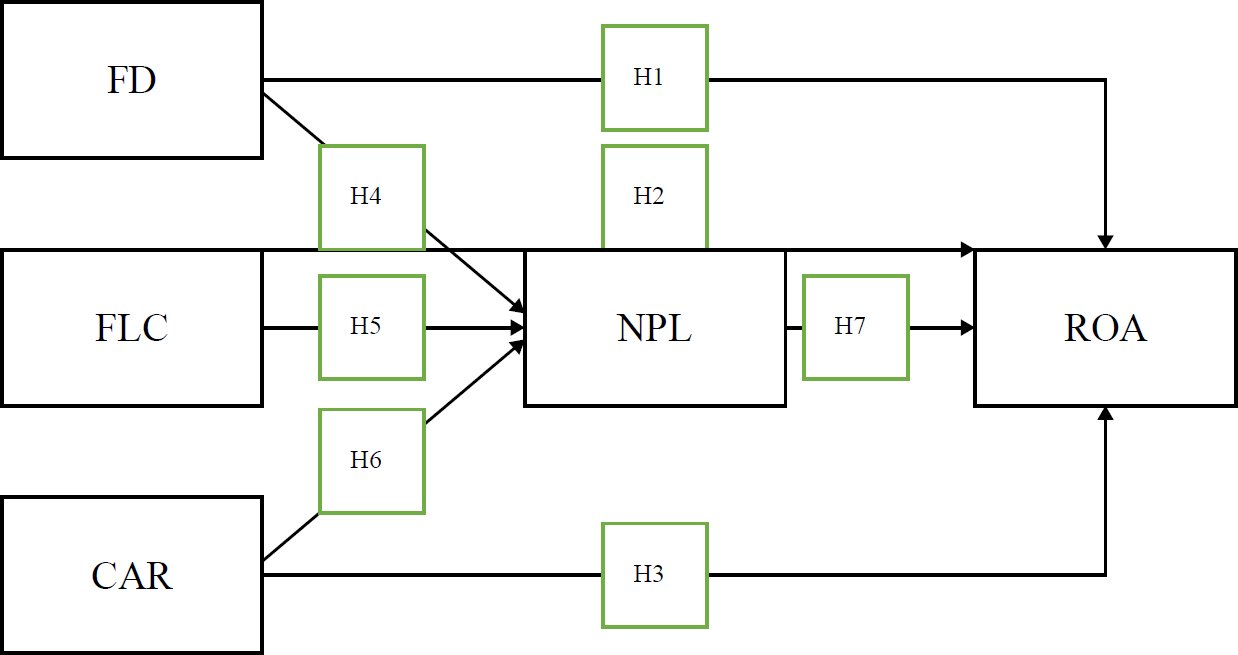
Based on the research objectives, a coneputal framework is designed which illustrates the relationship between variables examined in this study (Fig. 1).

Fig. (1). Conceptual framework.

Financial distress can affect the ROI of different companies and reduce profitability and the efficiency of asset utilisation (Wu, Shao, et al., 2020). The reduction of financial distress, as explained by (Tan, 2012), enhances the profitability of firms in Turkey by increasing their financial performance and reducing regulatory uncertainty, which is detrimental to revenue. The decrease in ROA is attributable to increased financial distress, which, in turn, indicates declining efficiency in asset utilisation and profitability. (Zehri & Ben Mbarek, 2016) analyse the Asian banking sector and find that financial distress has a smaller effect on asset profitability in Islamic banks than in conventional banks, and that there is no significant correlation between the two variables under examination.

H1: ROA is negatively impacted by financial distress.

According to (Ahmed, 2020), the business life cycle does not allow for the strategic placement of corporate resources across its stages to promote investment efficiency. It has been found that companies in the growth and maturity stages exhibit greater investment efficiency and financial performance, with higher ROA, compared to other companies in the remaining stages. The relationship between RETA and ROA, especially at the maturity stage, is quite satisfactory because the companies have been able to use their assets to generate profits. Nevertheless, the connection between the life cycle and the firm’s financial performance is complex and involves many variables and factors, including firm size, risk management, and economic conditions (Haiyan et al., 2021; Khuong et al., 2022; Zhang & Xu, 2021). The impact of a company’s life cycle on its banking performance also depends on the stage of the life cycle the company is in, with the relationships to the growth, maturity, and decline stages differing (Ramzan & Lau, 2023).

H2: RETA, as a measure of Firm Life Cycle, positively impacts ROA during the maturity stage.

Banks with higher CAR values are considered more stable in the event of losses, as they have a stronger capital base that reduces their reliance on external financing (Dao & Nguyen, 2020). The empirical data show a strong positive correlation between CAR and bank profitability, such that higher CAR is associated with higher profitability (Nam et al., 2022; Wang et al., 2023). CAR positively influences the bank’s profitability.

H3: Capital adequacy ratio positively affects ROA.

Financial distress further increased banks’ rigidity in loan management; however, it also increased the costs associated with the recognition of credit losses, worsening the financial situation of the bank itself (Oliveira & Raposo, 2020). Financial distress is a sort of domino effect: the more banks are burdened with financial load, the greater the likelihood that the NPL ratio will increase. The rise in NPLs is more likely to affect the financial health of banks in a poorly operational state, ultimately undermining their stability and profitability. Their strong relationship is that, in periods of liquidity stress resulting from stress testing in financial markets, banks’ inability to address non-performing loans will be exacerbated (Arnould et al., 2017; Foglia, 2022).

H4: Financial distress is positively associated with NPLs.

The stage of the life cycles the bank is operating in affects NPLs, depending on the various practices for dealing with credit risk (Ahmed et al., 2020). The newer banks have been more aggressive in lending, thereby increasing the probability of NPLs. Conversely, older banks tend to be more conservative, and their risk management processes are more developed, which increases credit quality (Abu Amin et al., 2023; Campanella et al., 2020).

H5: There is a negative influence of the firm life cycle on NPLs.

Previous studies indicate that raising the Capital Adequacy Ratio (CAR) is a significant variable that can alleviate the risk of Non-Performing Loans (NPLs), thereby enhancing banks’ capacity to absorb losses and better manage prudential risk. Banks that are well-capitalised are more likely to survive credit shocks and asset quality shocks, as pointed out by (Buyuksalvarci & Abdioglu, 2011). However, it is stated that excessive capital buffers may reduce banks’ ability to lend and to make optimal use of assets, thereby decreasing profitability (Padmadisastra & Nurhayati, 2023). The results of this study indicate that it is important to balance capital management so that sufficient capitalisation will minimise credit risk without adversely affecting banks’ income-generating capacity. Consequently, according to the prudential banking theory, this paper introduces a negative correlation hypothesis between the Capital Adequacy Ratio and the Non-Performing Loans.

H6: There is a negative influence of CAR on NPLs.

High NPLs can negatively affect banks’ profitability, as measured by ROA, since they necessitate greater provisioning for poor credit recovery, ultimately undermining financial performance (Awaluddin et al., 2023; Jolevski, 2015; Wahyuni et al., 2023). The adverse effects of an increase in Non-Performing Loans (NPLs) on Return on Assets (ROA) include a decrease in interest revenue, an increase in loan loss coverage and a reduction in asset productivity. Consequently, banks with high NPL ratios will be less profitable.

H7: NPLs negatively impact ROA.

2. METHODOLOGY

This is a quantitative study that uses secondary data collected from Capital IQ and the official websites of the selected banks. The study sample comprises commercial banks listed on the Indonesia Stock Exchange, with a sample size of 37 banks. The sample is selected based on criteria, including full disclosure of financial data from 2010 to 2023 and disclosure of IT-related costs. The sampling method will ensure that data from complete and digitally active banks are selected, and this will be within the scope of the research analysis.

2.1. Variables and Measurements

Operationalization of each of the variables to be used in this study are mentioned in Table 1.

Table 1. Measurement of variables.

VariablesMeasurementSource
ROA x 100(Wang et al., 2024)
Financial distress = Probability Default

PD = N(−d2)

(Blanco-Oliver, 2021; Manurung, 2023; Merton, 1974)
Firm life cycle = RETA x 100(Abu Amin et al., 2023; Habib & Hasan, 2019)
CAR 

BI regulation No. 15/12/PBI/2013

(Hoque et al., 2020)

NPLNPL Ratio (Fell et al., 2021)

Source: (Simatupang, 2024).

Using purposive sampling, 37 banks were selected for inclusion in this study, as presented in Table 2.

Table 2. Criteria for research samples.

Commercial Banks Registered on the IDXBank
Without comprehensive financial reports spanning(10) bank
Total Sample37 bank

Source: (Simatupang, 2024).

3. RESULTS & ANALYSIS

This study uses panel data regression in establishing the impact of financial distress, life cycle, and the capital adequacy ratio on financial performance of banks in terms of Return on Assets (ROA). Non-performing loans (NPLs) serve as the basis for analysis. The sample includes a complete range of annual financial data for 2010-2023 for Indonesian commercial banks listed on the Indonesian Stock Exchange. In the present research, a three-step regression model, as described by Baron and Kenny, is used to examine the mediating effect of NPL and a formal test of mediation complements it:

The three steps given below provide a clear and concise view of Baron and Kenny’s approach to testing the mediation effect. There is a minor paraphrasing that is required, and it goes as follows:

Step 1: Direct Effect

Test the direct relationship of FD, RETA and CAR with the dependent variable (ROA).

Step 2: Effect on Mediator

Find out how independent variables (FD, RETA and CAR) influence the performance of the mediator (NPL)?

Step 3: Mediation Effect

The mediator (NPL) will influence the dependent variable (ROA), holding the independent variables (FD, RETA and CAR) constant.

These are the systematic steps; hence, they allow measurement of the NPL mediation role with respect to ROA and the independent variables. Through bootstrapping, we can identify the direct and indirect effects and confirm that NPL is a very important mediator among FD/RETA, CAR and ROA.

The analytical processes of the three alternative estimation models are compared (Table 3). As the entire models are employed in the analysis process, the approach to the study of the research is holistic and methodologically appropriate:

1. The Chow Test

Whether the Fixed Effects Model is superior to the Modelling of Common Effects.

2. The Hausman Test

The Hausman test is used to decide whether to use a fixed-effects model or a random-effects model. A low p-value (less than 0.05) means that the fixed effects model is more suitable and non-significant p-value means that the random effects model is the most suitable one.

3. Lagrange Multiplier (LM) Test

The LM test is used to compare the Random Effects Model with the Common Effects Model when the Chow and Hausman tests yield different model specifications. The Random Effects Model is adopted when the p-value is below 0.05. Otherwise, the Common Effects Model is held.

Table 3. Selection of the panel data model.

Model TestingP-ValueComman EffectFixed EffectRandom Effect
ROA as the outcome variable
Chow Test0.1941✔️
Hausman Test0.6752✔️
LM Test0.5492✔️
NPL as a dependent variable
Chow Test0.0375✔️
Hausman Test0.0256✔️
LM TestGiven the Chow Test’s results indicating the inadequacy of the Common Effects Model (CEM), and having already applied the Hausman Test to choose between the Fixed Effects Model (FEM) and Random Effects Model (REM), further model selection is unnecessary

Source: (Simatupang, 2024).

3.1. Empirical Models

Model 1: ROA_it = α + β1 PD_it + β2 RETA_it + β3 CAR_it + €_it

Model 2: NPL_it = α + β1 PD_it + β2 RETA_it + β3 CAR_it + €_it

Model 3: ROA_it = α + β1 PD_it + β2 RETA_it + β3 CAR_it + β4 NPL_it + €_it

The models facilitate indirect and direct effects to be estimated and test them statistically. Formal mediation analysis will also ensure that the role of NPL is assessed not by patterns of significance but by statistical numbers. They should also revisit the previous empirical findings to place the findings into context. Using the example of the fact that, even though the previous research (Akbar et al., 2022; Zehri & Ben Mbarek, 2016) proves the existence of the strong correlation between financial distress and ROA, this study adds a certain twist to the situation by considering the mediating effect played by NPL that the previous literature was largely deficient in. Similarly, the extent to which RETA reduces NPLs and drives profitability growth is consistent with the findings of (Ahmed, 2020), except that the combined effect is established through statistical testing rather than by assumption. The non-significant CAR/NPL observed draws attention to potential issues in the bivariate analysis and indicates that further analysis of banking performance research is warranted (Padmadisastra & Nurhayati, 2023). To capture the impact of the COVID-19 pandemic, a dummy variable was included, and panel unit root tests were conducted to ensure that the variables were in a stationary state, which is a requirement for effective regression analysis (Im et al., 2023).

4. DISCUSSION

4.1. Data Model Selection

The Hausman test and the Lagrange Multiplier test indicated that the Random Effects Model was the most suitable for Model 1, and the diagnostic tests confirmed that the classical assumptions were met. Model 2, however, was best estimated by the FEM, which passed the tests of classical assumptions, thereby justifying its applicability in any subsequent interpretation.

4.2. Regression Modeling

4.2.1. ROA as a Dependent Variable

The panel EGLS regression model that incorporated cross-sectional random effects showed statistically significant negative effects of both Non-Performing Loans (NPL) and Financial Distress (FD) on Return on Assets (ROA), with p-values of 0.00 (Table 4). These significant values at the 1% level indicate that increases in NPL and FD are correlated with reductions in the bank’s profitability. Conversely, the Retained Earnings to Total Assets (RETA) ratio showed a strong positive correlation with ROA, with a correlation coefficient of 6.08 and high statistical significance. In addition, the Capital Adequacy Ratio (CAR) was identified as positively affecting ROA, with a coefficient of 0.17 and a p-value of 0.00, indicating that a high capital position would positively affect a bank’s financial performance.

Table 4. Variable dependent ROA regression results.

VariableCoefficientStd. Errort-StatisticProb.
C2.5576200.22645711.294090.0000
NPL-0.1872290.020218-9.2606000.0000
FD-2.1645200.393882-5.4953460.0000
RETA6.0881490.52084711.688940.0000
CAR0.1776330.0478053.7157710.0002

Source: (Simatupang, 2024).

4.2.2. NPL as a Dependent Variable

The regression analysis in Table 5 indicates a significant association between the profitability of the banks in terms of the ratio of returns on assets and non-performing loans, which implicates that the more profitable the bank is, the less likely it is to default. The financial distress and capital adequacy ratios seem not to have a direct influence on the loan performance. The model accounts for only a small share of the variation in non-performing loans, with the remainder attributable to external factors. Nevertheless, the general model is not statistically insignificant, and there is no autocorrelation in the residuals. Such findings highlight the importance of profitability in managing loan risk and indicate that further studies are needed to identify other major causes of non-performing loans.

Table 5. Variable dependent NPL regression results.

VariableCoefficientStd. Errort-StatisticProb.
C3.9128790.33366111.727100.0000
FD_10.2309800.2819660.8191750.4131
RETA-8.0411121.085433-7.4082060.0000
CAR_20.3298310.2890571.1410570.2544

Source: (Simatupang, 2024).

4.3. Causality Analysis

4.3.1. Direct And Indirect Effect Analysis

Financial distress negatively influences ROA, and RETA positively influences ROA, both directly and indirectly through NPL. Also, CAR positively and directly affects ROA by 0.18, and its indirect effect by negative NPLs (-0.06), such that the overall effect is lesser (0.16), showing that despite the high capital, which might lead to a higher profitability, the effect might be minimised unless good credit management is also present. All in all, RETA was the most influential on the ROA growth, whereas FD contributed the most to reducing ROA, both directly and indirectly (Table 6).

Table 6. Direct, indirect, and total effects.

Independent VariableDirect Effect on ROAInfluence on NPL as a MediatorIndirect Effect on ROA via NPLTotal Effect on ROA
FD-2.164520.230980.043246-2.12127
RETA0.688149-8.041111.5055292.193678
CAR0.1776330.329831-0.061750.115879

Source: (Simatupang, 2024).

H1: Financial Distress negatively impacts ROA.

The findings show that financial distress has a significant negative impact on return on assets (ROA), as indicated by the coefficient (-2.16) and a probability of 0.00. This shows that Return on Assets (ROA) is very sensitive to the intensity of the financial distress. Financial distress refers to the condition that a company, such as a bank, is unable to meet its payments. This may be because profits have declined, debt has been accumulating, or it is suffering from a lack of liquidity. This situation may reduce a bank’s efficiency and profitability in the effective management of its assets (Shaukat & Affandi, 2015; Akbar et al., 2022; Zehri & Ben Mbarek, 2016). The financial distress affects both Islamic and traditional banks similarly in terms of their ROA, according to the data.

H2: The Firm Life Cycle has a positive impact on ROA.

The Retained Earnings to Total Assets (RETA) ratio of the company is highly sensitive to asset returns, depending on the company’s life stage (Muharam & Bandung, 2024). (Haiyan et al., 2021; Wang et al., 2020). As recent empirical studies have shown, financial performance is positively associated with higher retention of earnings. It is evident from the literature in this study that a company should depend on its life cycle stage to determine its Return on Assets (ROA). The findings are consistent with the available findings. The relationship between asset management and the revenue-generating capacity of companies at various stages in their life cycle is subject to the ROA of the same. First, the returns in companies are usually reduced by high investment and risk.

H3: CAR influences Return on Assets (ROA).

Regression analysis indicates a positive correlation between ROI and the Capital Adequacy Ratio (CAR). The coefficient (0.18) and the p-value (0.00) imply that the capital increase directly contributes to an increase in the profits of a bank. With sufficient capital, banks can respond to financial shocks, manage risks more effectively and lend more confidently (Nam et al., 2022; Wang et al., 2023). Financial strength also enables banks to be more flexible in how they conduct business and to earn more because they can make greater use of their assets. Research supporting this has consistently indicated that banks with high levels of capital are more likely to remain profitable in the long run and to meet new risks (Petria et al., 2015). A larger CAR, however, indicates that a company is more stable. Nonetheless, excess capital may also impede growth opportunities, which could be detrimental to profits if it fails to align with a sound risk-return strategy (Sharkas & Al-Sharkas, 2022; Al Mamun et al., 2022; Mir & Shah, 2022). Thus, the impact of CAR on ROA is determined by the fit of a given bank’s capital management with its other activities and investments.

H4: Financial distress has a positive influence on NPLs.

The probability of default Financial Distress (FD) does not have a significant effect on NPLs, as evidenced by the regression comparison between CF and NPS. The result contradicts the claim that FD does not significantly affect NPLs. This research refutes the traditional belief that financial hardship leads to loan defaults (Irwanto et al., 2024; Nufus et al., 2018; Wilevy & Kurniasih, 2021).

H5: The firm life cycle has a negative influence on NPLs.

The findings also suggest that Retained Earnings to Total Assets (RETA) affects Non-Performing Loans (NPLs) across various stages of the firm’s life cycle. According to (Abuhommous, 2023), older banks are less prone to credit risk than new banks because they have higher retained earnings, which help them increase internal financing capacity and improve their credit risk management.

H6: CAR has a negative influence on NPLs.

The regression indicates that the influence of Non-Performing Loans (NPLs) on the Capital Adequacy Ratio (CAR) is not significant, suggesting that other factors, such as credit risk management, macroeconomic conditions, or loan portfolio quality, may be more important.

H7: There is a negative influence of NPLs on ROA.

The management of credit risk is a significant source of profits for a bank, as research has shown that the exploitation of bad loans (NPLs) drastically reduces banks’ profitability, as indicated by Return on Assets (ROA).

CONCLUSION

Some of the factors that affect the financial performance of Indonesian banks are financial distress, the firm life cycle, and the capital adequacy ratio; non-performing loans (NPLs) are a mediating factor leading to the outcome. The primary sources of loss-to-profitability are non-performing loans (NPLs) and financial distress, whereas retained earnings and capital adequacy have opposing effects on performance. The combination of a model with non-performing loans (NPLs) as intermediaries clarifies the extant knowledge on the influence of financial health indicators and internal capital structures on the asset quality and profitability.

Further, the mediation test was evaluated by the regression method. In practice, however, the outcomes indicate that bank managers must monitor signs of financial distress and actively manage retained earnings to ensure that loan quality does not deteriorate further. The regulators must be interested in implementing incentive-based systems for banks that demonstrate good capital management and low non-performing loan rates.

The model deserves a central role in future studies of the impact of macroeconomic indicators, international banking comparisons, or digital transformation initiatives on the correlation among capital strength, credit quality, and financial performance.

IMPLICATION

Capital reliance on CAR is not as significant as retained earnings management (RETA), a strategic approach that greatly helps reduce credit risk and enhance bank profitability. In the case of banking employees, it should be on enhancing the internal capital through the reinvestment of profits. Banks at the maturity stage of their life cycle should consider retained earnings a strategic instrument to maintain asset quality and provide funds for long-term growth, not as a reserve. Instead, the regulators are instructed to consider capital regulation frameworks that are less strict and have risk-based incentives for banks with low NPL ratios and good profit retention. In the evaluative sense, investors and stakeholders should consider RETA an auxiliary measure for evaluating a bank’s financial strength, particularly its loan performance and profitability.

LIMITATIONS AND FUTURE DIRECTION

The limitations of the current study can be overcome in future research to enhance the research. This involves incorporating additional explanatory factors such as corporate governance, cost-to-income ratio, and digital transformation indices, which can influence the dynamics of both NPL and ROA. Better generalizability may be achieved by comparative studies of Islamic and conventional banks or cross-country studies within ASEAN markets. Moreover, future models should include external shocks like COVID-19, international monetary changes, or national banking changes as moderating or intervening variables. These advances can help generate more comprehensive risk management frameworks and ensure that what academics discover reflects what is being addressed in response to the transformation in banking regulations and strategic financial planning.

In future research, the study period can be extended to capture the long-term dynamics and structural change of the banking sector, and the sample size can be expanded by providing cross-country or regional comparisons to increase the generalizability of the research. Moreover, other mediating or moderating factors, e.g., regulatory quality, digital transformation, or ESG factors, might also be included in future studies to give a more holistic view of credit risk and performance. Alternative methodological techniques, such as dynamic panel models, can also be used to address potential endogeneity and provide better insight into bank behaviour across various institutional settings.

LIST OF ABBREVIATIONS

CAR

=

Capital Adequacy Ratio

CEM

=

Common Effects Model

FD

=

Financial Distress

FEM

=

Fixed Effects Model

LM

=

Lagrange Multiplier

NPLs

=

Non-Performing Loans

REM

=

Random Effects Model

ROA

=

Return on Assets

AUTHORS’ CONTRIBUTIONS 

A.S. has contributed to the study conceptualization, methodology, data analysis, interpretation of the results, and manuscript writing. A.H.M. has contributed to the literature review, data collection, formal analysis, and manuscript editing. B.U. has supervised the study, validated the findings, reviewed and revised the manuscript critically for important intellectual content, and approved the final version for publication. All authors read and approved the final manuscript.

ETHICAL APPROVAL & INFORMED CONSENT 

Not applicable.

AVAILABILITY OF DATA AND MATERIALS

The data will be made available on reasonable request by contacting the corresponding author [A.S.].

FUNDING

None.

CONFLICT OF INTEREST

The authors declare that there is no conflict of interest regarding the publication of this article.

ACKNOWLEDGEMENTS

Declared none.

DECLARATION OF AI

The author used ChatGPT solely to improve the language, grammar, and readability of this manuscript. The AI tool was not used to generate, interpret, or analyze research findings, nor to formulate scientific conclusions. Following its use, the authors carefully reviewed, revised, and validated the manuscript and assume full responsibility for the accuracy, integrity, and originality of its content.

REFERENCES

Abuhommous, A. A. A. (2023). Corporate life cycle and credit scoring. Journal of Applied Economics, 26(1), 2255444.
https://doi.org/10.1080/15140326.2023.2255444

Abu Amin, A., Bowler, B., Hasan, M. M., Lobo, G. J., & Tresl, J. (2023). Firm life cycle and cost of debt. Journal of Banking and Finanace, 154.
https://doi.org/10.1016/j.jbankfin.2023.106971

Ahmed, B., Akbar, M., Sabahat, T., Ali, S., Hussain, A., Akbar, A., & Hongming, X. (2020). Does firm life cycle impact corporate investment efficiency?. Sustainability, 13(1), 197.
https://doi.org/10.3390/su13010197

Al Mamun, M. A., Islam, H., & Sarker, N. K. (2022). Affiliation between capital adequacy and performance of banks in Bangladesh. Journal of Business Studies, 3(1), 155-168.
https://doi.org/10.58753/jbspust.3.1.2022.10

Al-Sharkas, A. A., & Al-Sharkas, T. A. (2022). The impact on bank profitability: Testing for capital adequacy ratio, cost-income ratio and non-performing loans in emerging markets. Journal of Governance and Regulation, 11(1 special issue), 231-243.
https://doi.org/10.22495/jgrv11i1siart4

Arnould, G., Bruneau, C., & Peng, Z. (2017). Liquidity and equity short term fragility: Stress tests for the European banking system. Available at SSRN 2784664. https://dx.doi.org/10.2139/ssrn.2784664

Awaluddin, M. R., Imran H., & Kusumawati, A. (2023). The effects of non performing loan and loan to deposit ratio toward return on asset. International Journal of Humanities Education and Social Sciences (IJHESS), 2(6), 2164–2168.
https://doi.org/10.55227/ijhess.v2i6.501

Bank Indonesia. (2023). Peraturan bank indonesia tentang penetapan status dan tindak lanjut pengawasan bank umum konvesional. Peraturan Bank Indonesia Nomor 15/2/PBI/2013 Tentang Penetapan Status Dan Tindak Lanjut Pengawasan Bank Umum Konvensional, 53(9), 1689–1699. Available from: https://ojk.go.id/id/regulasi/Pages/PBI-tentang-Penetapan-Status-dan-Tindak-Lanjut-Pengawasan-Bank-Umum-Konvensional.aspx

Blanco-Oliver, A. (2021). Banking reforms and bank efficiency: Evidence for the collapse of Spanish savings banks. International Review of Economics and Finance, 74, 334–347.
https://doi.org/10.1016/j.iref.2021.03.015

Brahmana, R., Kontesa, M., & Gilbert, R. E. (2018). Income diversification and bank performance: Evidence from Malaysian banks. Economics Bulletin, 38(2), 799–809. Available from: https://ideas.repec.org/a/ebl/ecbull/eb-17-00597.html

Briliantoro, S., & . S. (2022). Pengaruh Capital Adequacy Ratio (CAR), Non Performing Loan (NPL), Beban Operasi Pendapatan Operasi (BOPO) Dan Loan To Deposit Ratio (LDR) Terhadap Net Interest margin (NIM) (Studi pada Bank Umum Swasta Nasional Devisa dengan Manajemen Konvensional yang T. Jurnal Ilmu Administrasi Bisnis, 10(3), 1247–1263.
https://doi.org/10.14710/jiab.2021.32054

Buyuksalvarci, A., & Abdioglu, H. (2011). Determinants of capital adequacy ratio in Turkish Banks: A panel data analysis. African Journal of Business Management, 5(27).
https://doi.org/10.5897/AJBM11.1957

Campanella, F., Gangi, F., Mustilli, M., & Serino, L. (2020). The effects of the credit selection criteria on non-performing loans: Evidence on small and large banks in Italy. Meditari Accountancy Research, 28(2), 251–275.
https://doi.org/10.1108/MEDAR-01-2019-0430

Charoenwong, B., Miao, M., & Ruan, T. (2025). Nonperforming loan disposals without resolution. Management Science, 71(1), 898-916.
https://doi.org/10.1287/mnsc.2022.02163

Dao, B. T. T., & Nguyen, K. A. (2020). Bank capital adequacy ratio and bank performance in Vietnam: A simultaneous equations framework. Journal of Asian Finance, Economics and Business, 7(6), 39-46.
https://doi.org/10.13106/jafeb.2020.vol7.no6.039

Dhungana, A., & Devkota, T. P. (2022). Corporate pay-out policy and test of life cycle theory; Evidence from Nepalese commercial banks. NRB Economic Review, 34(2), 50–79.
https://doi.org/10.3126/nrber.v34i2.49439

Engelmann, B., & Pham, H. (2020). Measuring the performance of bank loans under basel II/III and IFRS 9/CECL. Risks, 8(3), 93.
https://doi.org/10.3390/risks8030093

Fell, J., Grodzicki, M., Lee, J., Martin, R., Park, C. Y., & Rosenkranz, P. (2021). Nonperforming Loans in Asia and Europe—causes, impacts, and resolution strategies. Asian Development Bank. Available from: https://aric.adb.org/pubs/nplresolutionstrategies/npls-in-asia-and-europe-causes-impacts-resolution-strategies.pdf

Foglia, M. (2022). Non-performing loans and macroeconomics factors: The Italian case. Risks, 10(1), 21.
https://doi.org/10.3390/risks10010021

Gray, D. (2020). An international housing market in the British Isles: Evidence from business and medium-term cycles using a Friedman test. Urban Studies, 57(2), 307–322.
https://doi.org/10.1177/0042098019839886

Habib, A., & Hasan, M. M. (2019). Corporate life cycle research in accounting, finance and corporate governance: A survey, and directions for future research. International Review of Financial Analysis, 61, 188–201.
https://doi.org/10.1016/j.irfa.2018.12.004

Haiyan, D., Ahmed, K., & Nanere, M. (2021). Life cycle, competitive strategy, continuous innovation and firm performance. International Journal of Innovation Management, 25(01), 2150004.
https://doi.org/10.1142/S1363919621500043

Hoque, M. A., Ahmad, A., Chowdhury, M. M., & Shahidullah, M. (2020). Impact of monetary policy on Bank’s profitability: A study on listed commercial banks in Bangladesh. International Journal of Accounting & Finance Review, 5(2), 72–79.
https://doi.org/10.46281/ijafr.v5i2.796

Im, K. S., Pesaran, M. H., & Shin, Y. (2023). Reprint of: Testing for unit roots in heterogeneous panels. Journal of Econometrics, 234, 56–69.
https://doi.org/10.1016/j.jeconom.2023.03.002

Irwanto, D. N. A., Rachmawati, L., & Ilmi, M. (2024). The Effect of Financial Ratio on Financial Distress in Banking Companies Listed on The IDX Year 2018-2022. ARTOKULO: Journal of Accounting, Economic and Management , 1(2), 113–120. Available from: https://ejournal.mediakunkun.com/index.php/artokulo/article/view/86

Ismaulina, I., Wulansari, A., & Safira, M. (2020). Capital adequacy ratio (CAR) dan faktor-faktor yang mempengaruhinya di Bank Syariah Mandiri (periode maret 2012-maret 2019). I-Finance: A Research Journal on Islamic Finance, 6(2), 168-184.
https://doi.org/10.19109/ifinance.v6i2.5168

Jaelani, A. (2023). The effect of CAR and NPL on ROA in banking Companies listed on the Indonesia stock exchange for the 2019-2022 period. International Journal of Management Studies and Social Science Research, 5(04), 111–118.
https://doi.org/10.56293/ijmsssr.2022.4667

Jiang, T., & Zheng, Y. (2024). Indicators of non-performing loan: does efficiency matter?. Technological and Economic Development of Economy, 30(1), 129-147.
https://doi.org/10.3846/tede.2024.20453

Jolevski, L. (2017). Non-Performing loans and profitability indicators: the case of the Republic of Macednia. Journal оf Contemporary Economic аnd Business Issues, 4(2), 5-20. Available from: https://www.econstor.eu/bitstream/10419/193475/1/spisanie-vol-4-br-2-trud-1.pdf

Khuong, N. V., Anh, L. H. T., & Van, N. T. H. (2022). Firm life cycle and earnings management: The moderating role of state ownership. Cogent Economics & Finance, 10(1), 2085260.
https://doi.org/10.1080/23322039.2022.2085260

Lestari, H. T., Setiawan, S., & Tripuspitorini, F. A. (2020). Risk profile, good corporate governance, earning, dan capital dalam memprediksi financial distress pada bank umum syariah di Indonesia. JAE (Jurnal Akuntansi dan Ekonomi), 5(2), 100-111.
https://doi.org/10.29407/jae.v5i2.13809

Li, Q., Liu, H., & Zeng, Y. (2022). Size effect and growth options over firm lifecycle. Journal of Management Science and Engineering, 7(2), 197–212.
https://doi.org/10.1016/j.jmse.2021.05.001

Limajatini, L., Murwaningsari, E., & Sellawati, S. (2019). Analysis of the Effect of Loan to Deposit Ratio, Non Performing Loan & Capital Adequacy Ratio in Profitability:(Empirical study of conventional banking companies listed in IDX period 2014–2017). eCo-Fin, 1(2), 55-62.
https://doi.org/10.32877/ef.v1i2.121

Manurung, A. H. (2023). Probabilitas default perusahaan. Journal Research Finance, 1–9. http://mail.finansialbisnis.com/Data2/Riset/Probabilitas Default Perusahaan_AHM_020608.pdf

Merton, R. C. (1974). On the pricing of corporate debt: The risk structure of interest rates. The Journal of finance, 29(2), 449-470.
https://doi.org/10.2307/2978814

Mir, S. M., & Shah, F. A. (2022). Does capital adequacy affect bank performance? A comparative study of select public and private sector banks in India. DLSU Business and Economics Review, 31(2), 34–52.
https://doi.org/10.59588/2243-786X.1187

Muharam, G. T., & Bandung, P. N. (2024). Testing the effect of RETE , RETA and ROA on dividends at bank BCA in the period 2005-2020. Available from: https://www.researchgate.net/publication/381189354_TESTING_THE_EFFECT_OF_RETE_RETA_AND_ROA_ON_DIVIDENDS_AT_BANK_BCA_IN_THE_PERIOD_2005-2020

Nam, P. H., Tan, N. N., Thach, N. N., Ngan, H. T. T., & Nhat, N. M. (2022). What Affects the Capital Adequacy Ratio? A Clear Look at Vietnamese Commercial Banks. In International Econometric Conference of Vietnam (pp. 297-309). Cham: Springer International Publishing.
https://doi.org/10.1007/978-3-030-98689-6_19

Nasution, I., Erlina., & Situmeang, C. (2024). The effect of Capital Adequacy Ratio (CAR), Operational Expenses on Operating Income (OEOI), Loan Deposit Ratio (LDR), and Non-Performing Loan (NPL) on Return on Asset (ROA) with Net Interest Margin (NIM) as an intervening variable on SOEs bank 2014-2022. International Journal of Research and Review, 11(1), 181–194.
https://doi.org/10.52403/ijrr.20240120

Nufus, K., Audina, N., & Muchtar, A. (2018). Effect of financial distress ratio banking company in indonesia period 2011-2015. Research Journal of Finance and Accounting, 9(16), 68–75. Available from: https://iiste.org/Journals/index.php/RJFA/article/viewFile/43839/45172

Nustini, Y., & Amiruddin, A. R. (2019). Altman model for measuring financial distress: Comparative analysis between sharia and conventional insurance companies. Journal of Contemporary Accounting, 1(3), 161–172.
https://doi.org/10.20885/jca.vol1.iss3.art4

Obayagbona, J., & Osagiende, M. (2023). Risk management and performance of the Nigerian banking industry. Journal of Business Studies and Mangement Review, 6(2), 118–127.
https://doi.org/10.22437/jbsmr.v6i2.24891

Oliveira, V. B., & Raposo, C. (2020). How did regulation and market discipline influence banking distress in Europe?: Lessons from the global financial crisis. Studies in Economics and Finance, 37(1), 160–198.
https://doi.org/10.1108/SEF-03-2019-0123

Padmadisastra, Y. N., & Nurhayati. (2023). Pengaruh Ukuran Bank dan Capital Adequacy Ratio terhadap Non-Performing Loan. In Bandung Conference Series: Accountancy, 3(1), 56–62.
https://doi.org/10.29313/bcsa.v3i1.5763

Petria, N., Capraru, B., & Ihnatov, I. (2015). Determinants of banks’ profitability: evidence from EU 27 banking systems. Procedia Economics and Finance, 20, 518–524.
https://doi.org/10.1016/S2212-5671(15)00104-5

Pham, T. X. T., & Nguyen, N. A. (2017). The determinants of capital adequacy ratio: The case of the Vietnamese banking system in the period 2011-2015. VNU Journal of Economics and Business, 33(2).
https://doi.org/10.25073/2588-1108/vnueab.4070

Pinto, P., Hawaldar, I. T., Rahiman, H. U., TM, R., & Sarea, A. (2017). An evaluation of financial performance of commercial banks. International Journal of Applied Business and Economic Research, 15(22), 605-618. Available from: https://www.researchgate.net/publication/324750584_An_Evaluation_of_Financial_Performance_of_Commercial_Banks

Prenaj, V., Imeraj, J., & Smajli, S. (2023). Albania and Kosovo with development potential, but limited support from the banking sector. International Journal of Sustainable Development and Planning, 18(5), 1377–1383.
https://doi.org/10.18280/ijsdp.180507

Rafsanjani, H. (2020). Kewajiban Penyediaan Modal Minimum dan Faktor Faktor yang Mempengaruhi Capital Adequency Ratio pada Bank Syariah di Indonesia. Jurnal Masharif Al-Syariah: Jurnal Ekonomi Dan Perbankan Syariah, 5(2), 170.
https://doi.org/10.30651/jms.v5i2.14498

Ramzan, M., & Lau, W. Y. (2023). Impact of asset preferences on firm performance over its life cycle: Is agency theory or neo‐classical theory more relevant?. Managerial and Decision Economics, 44(1), 595-607.
https://doi.org/10.1002/mde.3702

Saeed, H., Shahid, A., & Tirmizi, S. M. A. (2020). An empirical investigation of banking sector performance of Pakistan and Sri Lanka by using CAMELS ratio of framework. Journal of Sustainable Finance and Investment, 10(3), 247–268.
https://doi.org/10.1080/20430795.2019.1673140

Shaukat, A., & Affandi H. (2015). Impact of financial distress on financial performanace-A study related to Pakistani corporate sector. International Journal of Current Research, 7(2), 12991-12996. Available from: https://www.journalcra.com/sites/default/files/issue-pdf/7458.pdf

Su, W. (2016). Essays in Empirical Finance in the US and China. Available from: https://escholarship.org/uc/item/5kv7k72

Tan, T. K. (2012). Financial distress and firm performance: Evidence from the Asian financial crisis. Journal of Finance and Accountancy, 11(1), 1–11. Available from: https://www.aabri.com/manuscripts/121199.pdf

Usman, B., Lestari, H. S., & Puspa, T. (2019). Determinants of share prices on manufacturing company: Evidence in Indonesia stock exchange. International Journal of Advanced Science and Technology, 29(5), 427-436.

Wahyuni, W., Badollahi, I., Nurhidayah, N., & Mardiastuti, W. (2023). Analyzing the impact of non-performing loans and loan-to-deposit ratios on return on assets: A study of conventional commercial banks in Indonesia. Advances in Management & Financial Reporting, 1(3), 107–118.
https://doi.org/10.60079/amfr.v1i3.124

Wang, J. H., Wu, Y. H., Yang, P. Y., & Hsu, H. Y. (2023). Sustainable innovation and firm performance driven by FinTech policies: Moderating effect of capital adequacy ratio. Sustainability, 15(11), 8572.
https://doi.org/10.3390/su15118572

Wang, M., Mohd Nor, N., & Rahim, N. A. (2024). How to Corporate Financialization Impact on Financial Performance, The Moderating/Mediating Role of ESG (Environmental, Social, and Governance) Practices. Salud, Ciencia y Tecnologia – Serie de Conferencias, 3, 1183.
https://doi.org/10.56294/sctconf2024.1183

Wang, Z., Akbar, M., & Akbar, A. (2020). The interplay between working capital management and a firm’s financial performance across the corporate life cycle. Sustainability, 12(4), 1661.
https://doi.org/10.3390/su12041661

Wilevy, W., & Kurniasih, A. (2021). Financial distress of registered banking in Indonesia stock exchange: Review of the good corporate governance aspect and banking performance. European Journal of Business and Management Research, 6(2), 181-186.
https://doi.org/10.24018/ejbmr.2021.6.2.832

Wu, L., Shao, Z., Yang, C., Ding, T., & Zhang, W. (2020). The impact of CSR and financial distress on financial performance evidence from Chinese listed companies of the manufacturing industry. Sustainability, 12(17), 6799.
https://doi.org/10.3390/su12176799

Wu, Y. C., Chen, T. F., & Lin, S. K. (2020). Risk management of deposit insurance corporations with risk-based premiums and credit default swaps. Quantitative Finance, 20(7), 1085–1100.
https://doi.org/10.1080/14697688.2020.1726437

Zehri, F., & Ben Mbarek, N. (2016). Banks’ Performance in KSA during Financial Distress: A Comparative Study Islamic and Conventional Banks. Arabian Journal of Business and Management Review, 1–6.
https://doi.org/10.4172/2223-5833.S1-009

Zhang, X., & Xu, L. (2021). Firm life cycle and debt maturity structure: Evidence from China. Accounting & Finance, 61(1), 937-976.
https://doi.org/10.1111/acfi.12600

Insert math as
Block
Inline
Additional settings
Formula color
Text color
#333333
Type math using LaTeX
Preview
\({}\)
Nothing to preview
Insert