


- ABSTRACT:
- 1. INTRODUCTION
- 2. LITERATURE REVIEW
- 2.1. Impact of Digital Twin Technology on Sustainable Urban Development
- 2.3. Role of Risk Governance, Financial Implications, and SDG Reporting Frameworks in Enhancing Digital Twin Technology for Sustainable Urban Development and SDG Alignment
- 2.4. Theoretical Framework
- 2.5. Literature Gap
- 2.6. Conceptual Framework
- 3. MATERIALS AND METHODS
- 4. RESULTS
- 4.1. Demographic Analysis
- 4.2. Measurement Model Using Confirmatory Factor Analysis
- 4.3. Path Analysis
- 4.4. Model Explanatory Power
- 4.5. Qualitative-Thematic Analysis
- 4.5.1. Demographic Profile
- 4.5.2. Theme 1: Digital Twin Technology as a Transformational Tool for Urban Planning
- 4.5.3. Theme 2: Financial Implications and the Challenge of Justifying Investment
- 4.5.4. Theme 3: Risk Governance and Data Responsibility in Digital Twin Deployment
- 4.5.5. Theme 4: Alignment with SDG Reporting and Sustainable Urban Development Outcomes
- 5. DISCUSSION
- CONCLUSION
- LIMITATIONS
- POLICY IMPLICATIONS
- FUTURE DIRECTIONS
- LIST OF ABBREVIATIONS
- AUTHOR'S CONTRIBUTION
- ETHICAL APPROVAL & INFORMED CONSENT
- AVAILABILITY OF DATA AND MATERIALS
- FUNDING
- CONFLICT OF INTEREST
- ACKNOWLEDGEMENTS
- DECLARATION OF AI
- APPENDIX A
- APPENDIX B
- REFERENCES
Article ID: PD2602201010
Views: 736Leveraging Digital Twin Technology for Sustainable Urban Development: Financial Implications, Risk Governance, and Alignment with SDG Reporting Frameworks
 Article DOI
10.67887/PD2602201010
Article DOI
10.67887/PD2602201010
 PDF
PDF
⬇ Downloads: 20
1Department of Business Studies, Bahria University, Karachi, Pakistan
Received: 17 February, 2026
Accepted: 26 June, 2026
Revised: 06 June, 2026
Published: 13 July, 2026
ABSTRACT:
Introduction: Digital Twin Technology (DTT) is increasingly recognized as a valuable tool for advancing sustainable urban development amid ongoing digital transformation and sustainability challenges in the UK. This study investigated the role of DTT on sustainable urban development and the mediating role of financial implications, risk governance, and SDG reporting frameworks.
Methods: A mixed methods approach was used, involving a quantitative and qualitative techniques to explore the role of digital twin technology on Sustainable Urban Development (SUD) through financial aspects, risk governance and SDG reporting alignment. Quantitative survey data gathered from 340 participants was analysed by applying PLS-SEM and accompanied by qualitative thematic analysis findings for deeper analysis.
Results & Discussion: The direct link between digital twin technology and sustainable urban development was found as weak but indirect link through risk governance and SDG reporting frameworks was found to be positive and statistically significant. The qualitative results were further complemented by their findings, which identified Digital Twin (DT) Technology as a game-changer in the planning process, increasing collaboration and proactive planning and decision making, and also highlighted existing issues around financial feasibility, cybersecurity, accountability within governance, and uniformity of SDG reporting protocols.
Conclusion: Policymakers must develop clear governance frameworks and cost-effective financial strategies for digital twin implementation. Concerns related to cybersecurity, governance and stakeholders trust signified the necessity for risk frameworks.
Keywords: Digital twin technology, sustainable urban development, financial implications, risk governance, SDG reporting frameworks, sustainable development goals.
1. INTRODUCTION
Digital Twin (DT) is a revolutionary technology that has been used to redefine the principles of urban planning and sustainability (Ali et al., 2025; Ariyachandra & Wedawatta, 2023). DT helps simulate data, modelling processes, and evidence-based policymaking by building virtual replicas of physical assets, processes, and systems (Attaran & Celik, 2023; Botín-Sanabria et al., 2022). With the pressures of climate change, resource shortage and urbanisation growing on cities, these technologies are considered to be centre stage in the development of sustainable cities. In the UK, digital twin technologies are becoming increasingly integrated into the national smart city and sustainability agendas, where they are used to enhance urban resilience, optimise infrastructure operations, and inform and guide urban planning and development decisions (IMARC, 2025). In the meantime, though, despite the increasing interest of institutions and markets and the increase in market size, there are still uncertainties regarding the financial viability and the readiness of governance and sustainability of the implementation of the digital twin in real life (Grand View Horizon, 2025). Concurrently, the UK faces considerable challenges in meeting the Sustainable Development Goals (SDGs), as only two-fifths of its targets are on track, while approximately 57% exhibit implementation gaps and nearly 15% are progressing in the wrong direction (Markets and Markets, 2025). Moreover, the national SDG reporting framework reports data gaps on 12% of the indicators, indicating the restrictions in the measurement of the sustainability performance (SDG Data, 2024). In this context, the potential of DTTs cuts across the national imperatives of sustainable urban development.
Although the digital twin technologies have increasing strategic significance, there is institutional and operational contestation in the use of these technologies in the context of sustainable urban development. At first financial implications such as costs are major problem, where DT implementation incurs substantial cost, and return on investment is hard to measure with the conventional budgeting models (Habib et al., 2025). Second, risk governance is immature, and all the uncertainties regarding cybersecurity, data ethics, and accountability put both legitimacy and adoption in risk (Haraguchi et al., 2024). Third, it is not consistent with SDG reporting frameworks because DTT outputs are not usually standardised with global indicators and cannot be integrated into national and local reporting frameworks (Jafari et al., 2023).
All these issues constrain the capacity of DTTs to maximise their role in sustainable urban development in the UK. SDG Reporting Frameworks are institutional accountability tools that provide measurable and comparable indicators to support urban governance to achieve sustainability commitments. They enable the monitoring, benchmarking, and transparent assessment of a city’s progress toward achieving global sustainability goals, particularly SDG 11, as also highlighted by (Lu et al., 2025). As per (Grace et al., 2023) Sustainable Urban Development (SUD) is a more comprehensive result that is multi-disciplinary in nature including aspects of environment, social and economic aspects of urban systems. In addition to the structured evaluative tools provided by SDG reporting for tracking progress, SUD also represents the overall level of urban sustainability achieved through the interaction of technological, governance, financial and institutional factors, including the adoption of Digital Twin Technology as also suggested by (Villani et al., 2025).
While existing body of literature such as (Perisic et al., 2025) have focused on the technical, engineering or operational aspect of the Digital Twin Technology, there has been scarcity of studies in the context of the financial viability, risk governance and SDG reporting frameworks that collectively influence sustainable urban development outcomes. Moreover, existing research such as (Saif et al., 2025; Zhang et al., 2023) addressed these dimensions separately, not in relation to the interaction between the dimensions as part of the UK context of urban governance. This is an important gap in knowledge that needs to be filled regarding the links between the implementation of a digital twin and its sustainability outcomes, in the context of institutions, financial and regulatory conditions.
This study responds to these gaps by exploring the relationship between Digital Twin Technology (DTT) and Sustainable Urban Development (SUD) in the UK, and analyse the mediating roles of financial implications, risk governance and SDG reporting frameworks. The study aims to identify if the sustainability value driven from a digital twin’s use is unlocked immediately or if it relies on enabling institutional, governance and financial mechanisms. The study covers both these relationships, offering a more complete picture of the conditions for obtaining digital twin technologies to support the achievement of sustainable urban development outcomes.
To meet these objectives, the study implemented a mixed method design which is a combination of qualitative and quantitative evidences. The quantitative data is gathered by survey conducted with urban planning and technology professionals and analysed by PLS-SEM method. The qualitative data gathered by establishing the interview were analysed by thematic analysis. By combining both, the proposed relationships could be statistically analysed and contextualisation of the institutional and operational context of implementation of digital twin in the UK was also possible.
The study makes important contributions in terms of theory, empirical evidence and practical implications. It theoretically combines aspects of the three dimensions (financial implications, risk governance and SDG reporting) that affect the Digital Twin Technology-SUD relationship instead of analysing them separately. In empirical terms, it applies a mixed-methods approach in an integrated manner to generate empirical evidence based on a UK context, completing the lack of contextual evidence on which to base research within the realm of urban sustainability and digital transformation. From an implication perspective, the results provide policy, planning and urban regulatory guidance on governance structures and reporting processes, as well as financing conditions, to enable and support the sustainable adoption of digital twin tools and technologies in cities.
The rest of the article is structured in the following way. The relevant literature of digital twin technology, sustainable urban development, governance and SDG reporting frameworks is briefly reviewed in the next, and the conceptual framework and the hypotheses are developed. The methodology section discusses the mixed methods research design. It is followed by results and analysis section which presents together the quantitative and qualitative results of the study. It is followed by subsequent sections comprising discussion of the results and findings. In the last, Implications, limitations and future directions are presented at the end of the article.
2. LITERATURE REVIEW
2.1. Impact of Digital Twin Technology on Sustainable Urban Development
Digital Twin Technology (DTT) has become increasingly integrated into urban systems, prompting academic discussions regarding its potential to support sustainable urban development. Previous research such as (Grace et al., 2023) broadly confirms that DTT can improve the efficiency of the city in simulation, through predictive modelling and in real time, but diverges on the prerequisites needed for its sustainability in these improvements. City resilience, mobility and environmental sustainability have been highlighted as key areas of potential transformation of Urban Digital Twins by (Mazzetto, 2024; Villani et al., 2025). They identified several factors that suggest that their work is in line with Systems Theory which states that systemic urban transitions are possible if technological innovations are part of larger institutional structures, a view also supported by (Lu et al., 2025).Though, both studies are mainly devoted to the technical optimisation and have only marginal attention to the financial implications and the preparedness of the governments for DTT, leaving some uncertainties about the scalability of DTT in resource-constrained urban setting.
Collectively, prior studies indicate that DTT helps to promote sustainability in various ways, such as creating a more efficient construction process, optimising energy use, monitoring the environment, and coordinating governance (Omrany et al., 2024; Pérez, 2023; Temple et al., 2024; Venkateswarlu & Sathiyamoorthy, 2025). The literature does not suggest that the technical ability to transform cities sustainably is just a matter of technology, it requires the institutional cooperation, capacity and policy alignment mechanisms as well. The sectoral approach for studying sustainability also shows that the results of DTT studies are not easily generalisable to all sectors, which means that there is a need to consider context.
Another theoretical conflict arises when assessing risk management and the financial and economic feasibility. While (Macatulad & Biljecki, 2024; Ozawa et al., 2021) stress on ‘disaster resilience’ and ‘disaster risk preparedness’ for cities, (Ghafari & Samaei, 2025) focus on the optimisation of costs and programs effectiveness. Nonetheless, these studies do not focus on the trade-off of the cost of implementation and maintenance in the long-term and whether cost outweighed by the efficiencies. The literature such as (Zhang et al., 2023) on DTT as a whole indicates that sustainable results are produced as a fusion of technological systems, institutional capacity, governance readiness and financial coordination; and not by operational efficiency as such, following the Systems Theory approach. The findings suggest that the level of organisational integration and institutional support mechanisms play a key role in the potential of DTT to have a scalable and sustainable impact on urban transformation specified in the findings of (Ehwi et al., 2024). The literature provides a strong body of evidence collectively indicating the sustainability potential of DTT, but evidence on the financial viability of DTT in the long-term and institutional scalability in urban contexts is less certain. Although DTT is generally expected to improve sustainability outcomes, implementation burden, institutional immaturity, transition costs and governance deficiencies may initially constrain sustainability performance. Therefore, positive sustainability outcomes may depend on supporting governance and reporting mechanisms. Hence, the following hypothesis is made.
H1: There is a statistically significant and positive relationship between digital twin technology and sustainable urban development.
2.3. Role of Risk Governance, Financial Implications, and SDG Reporting Frameworks in Enhancing Digital Twin Technology for Sustainable Urban Development and SDG Alignment
While technology is still a fundamental element of the symbiosis between Digital Twin Technology (DTT) and sustainable urban development, governance, financial and institutional mechanisms are gaining importance. The existing literature reflects a general consensus on the benefits of digital innovation as it relates to urban resilience and sustainability, with significant variation and uncertainty on the systems needed to promote the benefits. In a Systems Theory approach, the sustainable outcomes of a city are not the end result of single technological solutions, but the result of a coordinated action between the different sub-systems of governance, finances and technologies of a city unveiled in the arguments of (Ehwi et al., 2024; and Karunaratne et al., 2025). This implies that mediation of institutional mechanisms is likely be needed to ensure the sustainability effects of DTT.
The literature as a whole emphasises that GIS-based systems, digital innovation and technologies oriented towards governance contribute to the improvement of urban resilience and decision-making processes in conditions of uncertainty (Rezvani et al., 2023; Tankosić et al., 2025). These studies, often focus more on how to be efficient and how to respond to disaster events, while neglecting institutional accountability, the integration of governance and the financial viability of urban planning systems for the long-term. Likewise, cyber security and digital resilience are discussed and cited as key governance issues in digital infrastructures by (Gautam & Gupta, 2025; Kanmaz, 2025; Ehwi et al., 2022) also. However, the aviation-related evidence is not directly applicable to the context of urban governance, where a range of stakeholders and public accountability make for complex situations.
Another conflict is associated with monetary considerations. According to (Al‐Raeei, 2025; Malekloo et al., 2022; Fox & Macleod, 2023; Kim & Kim, 2021), technology is not enough to achieve sustainable large‐scale digital transformation projects, as there are significant financial barriers. This is in line with Systems Theory which states that innovation in urban areas requires the coordination and balancing of the allocation of resources in the different systems. However, research highlighting technological optimisation tend to underestimate the financial costs of implementation and maintenance in the long-term.
The literature such as (Sahu & Upadhyay, 2024; Tzachor et al., 2022) also indicates that SDG reporting systems contribute to linking digital innovation and SDGs, as they globalise urban technologies and link them with the internationally recognised SDG indicators. However, there has been less attention given to the possible problems that can arise in the implementation process at the local level as a result of fragmented governance systems and inconsistencies in reporting practices. Nonetheless, (Sahu & Upadhyay, 2024) does not adequately consider how ineffectiveness may arise in the implementation process at the local level as a result of fragmented governance systems and inconsistencies in reporting mechanisms. The literature shows that governance readiness, financial viability and integration with SDGs are all important mediators between DTT and sustainable urban development outcomes. Thus, following hypotheses of the study are developed followed the arguments emerged in above literature.
H2: Risk Governance, financial implications and SDG reporting frameworks, mediate the relationship between digital technology and sustainable urban development.
H2a: Risk Governance statistically significantly and positively mediates the relationship between digital technology and sustainable urban development in the context of UK.
H2b: Financial implications statistically significantly and positively mediate the relationship between digital technology and sustainable urban development in the context of UK.
H2c: SDG reporting frameworks statistically significantly and positively mediates the relationship between digital technology and sustainable urban development in the context of UK.
2.4. Theoretical Framework
System theory emphasises the interconnectedness and interdependence of different aspects of the urban environments. This theory is critical in understanding how digital twin optimises urban planning in cities as it simulates and analyses real-time information across various systems to include energy, transportation and water support. According to (Mazzetto, 2024; and Haraguchi et al., 2024), UDTs combine many different urban systems and they assist planners to deal with complexity of the city dwelling. The concept of the Theory of Cities is useful to seeing cities as holistic, adaptive systems with every component of the city affecting and being affected by another: infrastructure, policies, and governance structures. (O’Mrany et al., 2024) also confirm that in this way digital twin influences SDGs relating to enhancing resilience in urban systems. However, the theory equally believes in the significance of governance and risk management systems, as elaborated by (Villani et al., 2025; and Ghafari & Samaei, 2025), without which digital twin in sustainable urban development cannot possibly succeed.
Furthermore, Institutional Legitimacy Theory also provides further support to the argument that technological innovation in urban systems is only sustainable as long as it is perceived as responsible, transparent and accepted by participants. (Ehwi et al., 2022) defines legitimacy as the degree of compliance between organisational and technological practice and societal expectations of stakeholders’, governance norms and values. As per (Grace et al., 2023) legitimacy is particularly relevant in the context of Digital Twin Technology as the transition to data-driven urban systems often poses questions of surveillance, cybersecurity, ethical issues and access to technology. This view goes beyond Systems Theory by arguing that an efficient use of the technologies is not the only precondition to sustainable urban transformation, but so is the institutional trust and the credibility of governance as indicated by (Villani et al., 2025). To secure the lasting acceptance and sustainability of Digital Twin initiatives in urban development systems, confidence of stakeholders in governance structures, SDG reporting mechanisms and ethical safeguards becomes crucial.
2.5. Literature Gap
Although the research on digital twin technology and its application to sustainable urban development are broad, there are gaps, especially in addressing risk governance, and DT-SDG alignment. (Mazzetto, 2024) summarises the promising application of UDTs to smart cities but based on the costs and politics of large-scale implementation, there has been no clear direction on how to rely on these new technologies. In line with this, (Haraguchi et al., 2024) create a maturity model to measure UDT governance without considering financial risk management and scalability issues. (Macatulad & Biljecki, 2024) appreciate the potential of digital twin in disaster risk management without shedding light on the financial governance structures that should be implemented to realise widespread urban digital twin adoption. (Ghafari & Samaei, 2025) present the idea of a digital twin-based model of an urban megaproject without discussing the necessary institutional and financial preparation to support this kind of implementation.
2.6. Conceptual Framework
The framework (Fig. 1) shows digital twin technology as an independent variable, whereas sustainable urban development. Financial implications, risk governance and SDG reporting frameworks are mediating variable that identify the effectiveness and scalability of digital twin technology in the urban development project.
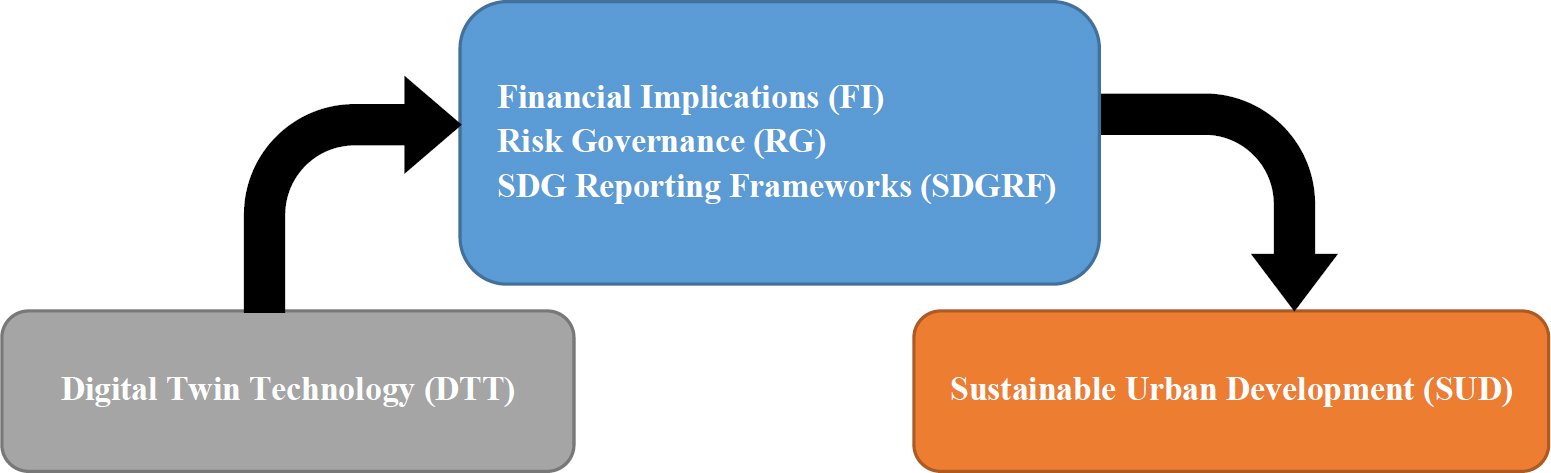
Fig. (1). Conceptual framework.
3. MATERIALS AND METHODS
3.1. Mixed-Methods Integration Strategy
This study used explanatory mixed-methods design where the first phase of qualitative component was used as an interpreting and a contextualising method for quantitative findings. Interviews helped identify the causes of the relationships between the Digital Twin Technology, Sustainable Urban Development, Financial Implications, Risk Governance, and SDG Reporting Frameworks that were identified through the survey data and PLS-SEM analysis. The challenges in implementing Digital Twin Technology, institutional readiness concerns, and resource constraints, as detailed in the negative direct relationship, were explained through the qualitative evidence. It also specified that the Financial Implications are not mediating and showed that there are concerns about Financial Implications such as unclear ROI, budget constraints, and funding problems in the long-term. On the other hand, the interviews highlighted the positive mediation role of Risk Governance and SDG Reporting Frameworks, emphasising the accountability and trust-building properties, governance and sustainability reporting mechanisms. The qualitative findings, thus, played a supportive and explanatory role in enhancing the understanding results from the quantitative roles, so that the results of the qualitative were interpreted and explained with each other, which was carried out with methodological triangulation.
3.2. Data Collection and Sampling
To collect quantitative data survey questionnaire was used (Appendix A). The questionnaire was distributed to 600 potential respondents, primarily focusing on professionals, managers, urban planners, IT experts and policy makers operating in the diverse areas of the UK urban development. These professionals were appropriate as they possess high expertise and relevant experience to provide valuable insights into the implementation the governance of digital twin technology in urban development.
All constructs were operationalised through the use of a structured survey instrument that was established through the themes found in digital twin literature and within urban sustainability. Three reflective indicators were developed for each of the constructs. Digital Twin Technology, Sustainable Urban Development (Patel et al., 2024), Financial Implications (Karunaratne et al., 2025), Risk Governance (Ghaffarian, 2025) and SDG Reporting Frameworks (Stefanescu, 2022) and modified to suit the UK urban development landscape. As suggested by (Russo et al., 2021) the Likert scale was used to measure the perceptions and attitudes of the respondents in a standardised and comparable manner with a 5-point rating scale from 1 (Strongly Agree) to 5 (Strongly Disagree).
Digital Twin Technology was operationalised using items on efficiency perceptions, implementation of real-time data and potential of sustainability. Sustainable Urban Development perceived sustainable improvements in sustainability, decision making processes and alignment with sustainability objectives. Financial implications in this study refer to perceived financial feasibility, investment burden, and long-term economic implications of DTT implementation. The evaluation of cybersecurity risks and the governance’s effectiveness were conducted by Risk Governance, and SDG Reporting Frameworks was used to capture level of alignment to SDG 11 and the usefulness of sustainability reporting mechanisms. This systematic operationalisation ensured a construct validity, conceptual clarity and empirical consistency of the measurement model.
A purposive sampling strategy ensured the sample reflected persons that had the necessary background with regard to the implementation and governance of smart city technologies as suggested by (Campbell et al., 2020). Therefore, purposive sampling method was applied in this study to reach the researcher with the cross-cutting mentioned knowledge and experience in urban planning, digital infrastructure, governance and sustainability projects. The participants were selected based on their role within UK urban development projects and included managers, urban planners and IT professionals who were actively involved in urban development projects, which are relevant to the content and research aims of the study. The sample does not represent the broader professional population, but was analytically representative, because they were selected to provide experiences-based informed opinions to inform the institutional and operational aspects of DTT implementation.
Survey was distributed through various channels, including professionals’ networks (LinkedIn, etc.), email lists and direct contact with respective professionals working in urban development organisations and departments in the government of UK. 350 responses were received with a 60% response rate. 340 valid questionnaires were selected for analysis following data screening and incomplete/invalid responses were removed. The sample size is deemed adequate for PLS-SEM because it is a medium to large sample size that generally does not require normality conditions. Further, the final data set scores above the minimum recommended thresholds for statistical power, thus providing robustness, stability of path estimates and generalisability of the results of the structural model within the framework of the study. Moreover, attempts were made to involve the professionals of varying areas of urban planning, governance, and technology to minimise data bias and ensure a representative sample. The strategy reduced the selection bias, and the variety of the sample promoted the quality of the outcomes (Smith, 2020). Non-response bias was tested using an independent sample t-test by comparing the proportion of respondents between early and late respondents. The comparison revealed no significant differences between the two groups (P-value > 0.1) , indicating the absence of non-response bias and supporting the representativeness of the sample.
In addition, the qualitative data in this study was collected by using semi-structured interview questionnaire from 10 professionals who are actively involved in the process of urban development in the UK, including managers, urban planners, and IT experts. Thus, for qualitative component, the research instrument was comprised of 6 open-ended and semi structured questions (Appendix B). A purposive sampling technique was applied to guarantee representation from different professional backgrounds and geographical contexts, which allowed a detailed analysis and understanding of an application of digital twin applications in sustainable urban planning. The participants were contacted through the professional networks, LinkedIn, and email invitation, which stated the aims of the research and guaranteed confidentiality. The interviewing took place between July and August 2025, with the main platform such as MS Teams and Zoom, according to the schedules of the participants. The sessions remained 30 to 45 minutes long and were audio-taped, following permission of participants and transcribed precisely to be analysed. This strategy was necessary to guarantee the gathering of practical and rich insights to supplement the financial, governance, and sustainability aspects of the research.
3.3. Econometric Models
In the following equations, ‘i’ is representing the cross-sections and variable acronyms are the same as used in the conceptual model.
SUDi=β0+β1DTTi+β2FIi+β3RGi+β4SDGRFi+ϵi
FIi=α0+α1DTTi+ϵi
RGi=γ0+γ1DTTi+ϵi
SDGRFi=δ0+δ1DTTi+ϵi
3.4. Data Analysis
To analyse quantitative data, Partial Least Squares Structural Equation Modelling (PLS-SEM) was used, due to the appropriateness of the method to analyse complicated dependency between several variables and process a small-sized sample (Hair et al., 2017). The study was conducted and analysed within an exploratory mixed methods research framework and PLS-SEM was chosen for the analysis because of the number of mediated relationships to be explored and the modelling of complex predictive relationships involving multiple constructs (Dash & Paul, 2021). While as per (Hair & Alamer, 2022) covariance-based SEM has an implication of theoretical confirmation and involves strict assumption of normality, PLS-SEM is more suitable to prediction-oriented SEM models, with less strict normality assumption. Other methods like multiple regression were not able to simultaneously evaluate the interconnected mediation effects and latent constructs indicated by (Appah et al., 2024) as well. Thus, PLS-SEM was applied as suitable analysis to investigate the multi-dimensional structural relationships of the study and predictive goals. Therefore, PLS-SEM approach allowed to explore both direct and indirect impact of the key variables, which include financial implication of DTT, risk governance frameworks and SDG alignment. To achieve the validity and reliability of measurement model, Confirmatory Factor Analysis (CFA) was performed by evaluations of factor loadings, composite reliability and Average Variance Extracted (AVE) to confirm the validity and reliability of the measurement model.
In addition, the qualitative interview data were analysed using a method recommended by (Braun & Clarke, 2021), six-step thematic analysis. The transcripts of interviews were repeatedly analysed to become familiar with the data and look for possible patterns that are relevant to a digital twin implementation, digital twin governance, financial aspects of a digital twin and sustainability alignment of a digital twin. The second phase involved open coding that was done followed by conceptual labelling of statements and shared views were assigned to every participant. Codes that occurred in similar fashion were then categorically grouped according to thematic themes that represent common institutional and operational issues. The emerging themes were then critically examined and refined based on the findings in the dataset, for coherence and consistency, and to distinguish them conceptually. Lastly, the themes were triangulated with other qualitative findings using qualitative results and existing views in literature, respectively, enhancing the credibility of the results, analytical depth, and reliability of the mixed methods overall.
4. RESULTS
4.1. Demographic Analysis
As per Table 1, the gender analysis also reveals that males dominated the study and formed 64.7% whereas, females make up 35.3%. The gender imbalance reflects the broader demographics of larger areas of consideration such as urban development, technology and governance. The female representation is lower reflecting possible inclusion issues of the future research that might target a more unified perspective on the matter. Moreover, in terms of age, 35.3% respondents fell between the 26 -35 years making up the largest group followed by those between the ages 36-45 years, which was 26.5%. The 18 – 25 years age group constituted 23.5% and the age bracket, 45 years and above recorded 14.7%. Regarding educational level, postgraduate participants were found higher as compare to the undergraduate.
Table 1. Demographics.
| Demographic Variable | Category | Frequency | Percentage (%) |
| Gender | Male | 220 | 64.7 |
| Female | 120 | 35.3 | |
| Age | 18 – 25 years | 80 | 23.5 |
| 26 – 35 years | 120 | 35.3 | |
| 36 – 45 years | 90 | 26.5 | |
| 45 years and above | 50 | 14.7 | |
| Education Level | Undergraduate | 150 | 44.1 |
| Postgraduate | 170 | 50.0 | |
| Other | 20 | 5.9 | |
| Total Participants | – | 340 | 100 |
4.2. Measurement Model Using Confirmatory Factor Analysis
As shown Table 2, the reliability and convergent validity of the constructs in the study were assessed using several developed metrics to ensure the robustness of the measurement model. Measurements of the internal consistency of latent constructs with Cronbach alpha and composite reliability are well-known measures. According to (Kline, 2023) a construct can be considered reliable when the value of the Cronbach alpha, and composite reliability is higher than 0.7. In the case of this study, Cronbach alpha values of Digital Twin Technology (0.852), Sustainable Urban Development (0.901), Financial Implication (0.815), Risk Governance (0.885) and SDG reporting frameworks (0.901) are all above acceptable threshold indicating that these items have a good internal consistency in measuring the study variables. Moreover, the constructs have composite reliability value that ranges between 0.826 and 0.905, which further indicates that the measurement tool that is used in this study is stable and reliable.
Table 2. Reliability and convergent validity testing.
| Constructs | Indicators | Factor Loadings | Cronbach’s Alpha | Composite Reliability | Average Variance Extracted (AVE) |
| Digital Twin Technology | DTT1 | 0.879 | 0.852 | 0.853 | 0.772 |
| DTT2 | 0.902 | ||||
| DTT3 | 0.855 | ||||
| Sustainable Urban Development | SUD1 | 0.911 | 0.901 | 0.905 | 0.825 |
| SUD2 | 0.933 | ||||
| SUD3 | 0.881 | ||||
| Financial Implication | FI1 | 0.795 | 0.815 | 0.826 | 0.731 |
| FI2 | 0.903 | ||||
| FI3 | 0.862 | ||||
| Risk Governance | RG1 | 0.899 | 0.885 | 0.892 | 0.812 |
| RG2 | 0.930 | ||||
| RG3 | 0.874 | ||||
| SDG Reporting Frameworks | SDGRF1 | 0.910 | 0.901 | 0.901 | 0.835 |
| SDGRF2 | 0.929 | ||||
| SDGRF3 | 0.902 |
The proportion of variance of each construct in comparison to the measurement error was presented through the Average Variance Extracted (AVE) to measure the convergent validity. According to (Hair et al., 2017; and Henseler et al., 2015), convergent validity is considered effective with an AVE of 0.5 or more. In the current study, the AVE values that are greater than 0.5, Digital Twin Technology (0.772), Sustainable Urban Development (0.825), Financial Implication (0.731), Risk Governance (0.812), SDG reporting frameworks (0.835) further support the sufficiency of the measurement model.
As per Table 3, it shows that discriminant validity of the constructs was assessed with the Heterotrait-Monotrait (HTMT) ratio, ensuring that each construct is empirically unique, separable and distinctive. As per (Rasoolimanesh, 2022; and Yusoff et al., 2020) HTMT values must not exceed 0.85 to prove that there are enough discriminant validity and no conceptual overlapping. From the results observed in Table 3, the HTMT values in the case of all constructs are found to be lower than the threshold value of 0.85. This shows that there is adequate discriminant validity with no conceptual overlapping between the variables and that all constructs are distinct from each other.
Table 3. Discriminant validity.
| Variables | Digital Twin Technology | Financial Implication | Risk Governance | SDG Reporting Frameworks |
| Digital Twin Technology | – | – | – | – |
| Financial Implication | 0.617 | – | – | – |
| Risk Governance | 0.542 | 0.547 | – | – |
| SDG reporting frameworks | 0.608 | 0.465 | 0.452 | – |
| Sustainable Urban Development | 0.277 | 0.339 | 0.495 | 0.480 |
4.3. Path Analysis
The coefficients presented in Table 4 indicate strong direct relationships between Digital Twin Technology and the key constructs, underscoring its importance in facilitating sustainable urban development. Digital Twin Technology shows a negative, though, statistically significant direct relationship (β = -0.158, p = 0.037), proving that while it is an important area of urban development, its proper application and regard for accompanying matters might be necessary. The negative direct relationship between Digital Twin Technology and sustainable urban development suggests that the uptake of new technologies does not directly connect to sustainable urban development unveiled by (Perisic et al., 2025) also. This indicates that, if governance bodies, financial preparedness, and institutional arrangements supporting sustainability cannot be established, there could be additional challenges in the beginning, such as operational complexity, implementation expenses, technological uncertainty, and institutional adjustments when implementing digital twin systems. This implies that short-term pressures can arise that cancel out the supposed benefits of sustainability provided by DTT. This indicates that technological innovation is not as such sustainable, nonetheless, it relies on the larger socio-institutional context in which it is put into practice. Furthermore, it has a positive indirect impact (B=0.400, P-value = 0.000). Furthermore, SDG regulatory framework (B=0.144, P-value = 0.002) shows positive mediation between digital twin technology and sustainable urban development. Risk governance (B= 0.195, P-value= 0.000) shows positive mediation between digital twin technology and sustainable urban development. It shows that these variables partially mediate the relationship. Furthermore, financial implication (B= 0.061, P-value= 0.107) shows no mediation on the relationship. Although the direct effect of DTT on SUD was negative, the total indirect effect was positive and significant, indicating that sustainability benefits emerge primarily through governance and SDG alignment mechanisms. Implementing the digital twin within a risk management framework and reporting in an SDG reporting framework triggers positive mediating effects, which relate to sustainability outcomes. The governance mechanisms seem to help alleviate uncertainty, increase accountability and boosts trust among stakeholders, and SDG reporting systems integrate technological innovation with long-term sustainability goals. This suggests governance and sustainability alignment are enabling mechanisms through which digital capabilities create sustainable urban outcomes.
Table 4. Structural model.
| Path Coefficient | T-statistics | P-values | |
| Digital Twin Technology -> Financial Implication | 0.518*** | 12.206 | 0.000 |
| Digital Twin Technology -> Risk Governance | 0.628*** | 18.3 | 0.000 |
| Digital Twin Technology -> SDG reporting frameworks | 0.534*** | 13.919 | 0.000 |
| Digital Twin Technology -> Sustainable Urban Development | -0.158** | 2.089 | 0.037 |
| Financial Implication -> Sustainable Urban Development | 0.117 | 1.63 | 0.103 |
| Risk Governance -> Sustainable Urban Development | 0.311*** | 3.794 | 0.000 |
| SDG reporting frameworks -> Sustainable Urban Development | 0.270*** | 3.08 | 0.002 |
| Indirect Effect | |||
| Digital Twin Technology -> Sustainable Urban Development | 0.400*** | 6.982 | 0.000 |
| Specific Indirect Effect | |||
| Digital Twin Technology -> SDG reporting frameworks -> Sustainable Urban Development | 0.144** | 3.072 | 0.002 |
| Digital Twin Technology -> Risk Governance -> Sustainable Urban Development | 0.195*** | 3.699 | 0.000 |
| Digital Twin Technology -> Financial Implication -> Sustainable Urban Development | 0.061 | 1.611 | 0.107 |
Note: *: Significance at 10%; **: Significance at 5%; ***: Significance at 1%
4.4. Model Explanatory Power
In Table 5, the explanatory power of the model is given in terms of R-square values indicating the percent of variance explained by the constructs. The R-square of Financial Implication is 0.268 meaning that, the model can explain 26.8% of the variance in the change of financial outcomes of the Digital Twin Technology. The R-square is comparatively high at 0.394 indicating that 39.4% of the variation of outcomes of governance is surpassed by the model. The SDG reporting frameworks R-square is 0.285 and this indicates that 28.5% of SDG alignment variance is explained. The R-square results in Sustainable Urban Development which is 0.251 meaning that the variance in the outcome of sustainable urban development is explained as 25.1%.
Table 5. Model explanatory power.
| Variables | R-Square | R-Square Adjusted |
| Financial Implication | 0.268 | 0.267 |
| Risk Governance | 0.394 | 0.392 |
| SDG reporting frameworks | 0.285 | 0.283 |
| Sustainable Urban Development | 0.251 | 0.243 |
Although the explanatory power of the model is moderate, such R² levels values indicate that the model’s explanations are acceptable for exploratory governance research which includes complex institutional and sustainability related phenomena. As noted in previous methodological literature such as (Lu et al., 2025) there are several interacting technologies, organisations, regulations and contexts that influence the outcomes of urban sustainability; moderate explanatory variances are prevalent in studies that look into how emerging digital governance systems and institutional transformation processes impact on urban sustainability
4.5. Qualitative-Thematic Analysis
4.5.1. Demographic Profile
The demographic profile results exhibited in Table 7 show that among 10 interview responses (n=10), 60% were males and 40% were females. Further, 30% of the participants were in the 26-35 age bracket, 50% were in the 36-45 age bracket, and 30% were 45 years and above. In addition, considering the occupation of the respondents, 30% were managers, 40% were urban planners, and 30% were IT experts.
4.5.2. Theme 1: Digital Twin Technology as a Transformational Tool for Urban Planning
In light of Table 6, this theme was derived from the recurrent references and arguments related to the role of digital twins in reforming urban planning procedures. Within the interviews, participants repeatedly signified simulation, collaboration, and proactive governance as the primary benefits of the adoption of digital twins. These insights adhere with arguments in the literature where (Nica et al., 2023) argue that digital technologies progressively function as living laboratories for urban areas. The interview responses related to this theme are analysed below.
R3 stated that,
“Digital twins allow us to simulate urban scenarios that were previously impossible to test at scale.”
The response points to digital twins being more than a technology, it is a planning infrastructure to decrease uncertainty prior to physical implementation. The focus on simulations has been due to a shift in governance from reacting to a management approach where policy interventions can be tested digitally upfront to and before their deployment in the city. This is partly due to the ‘living laboratory’ concept that (Omrany et al., 2024) put forward.
In contrast, R7 noted that,
“The technology creates a shared platform for planners, engineers, and policymakers to engage with real-time data.”
This makes digital twins more of an interface of collaboration rather than a simulation tool, as (Nica et al., 2023) believe that data platforms transform interactions of governance. Though, this also leads to the threat of excessive reliance on digital infrastructures, and this may downfall deliberative democratic procedures at the cost of unequal access of digital twins’ technology.
R4 reflected that,
“It pushes us to think proactively, rather than reactively, in city planning.”
This corroborates academic arguments that urban governance is regularly short-term which is reflected by (Malekloo et al., 2022) as well. These findings indicate that digital twins can turn planning into the forward-looking and collaborative process. Nevertheless, the transformative capacity can only be aspirational unless the institutions are ready and there is fair access. Together with the quantitative results, the responses indicate that the contribution to sustainability of digital twins is not just technological, but that they also have a potential to transform institutional coordination, planning behaviour and long-term decision-making processes.
4.5.3. Theme 2: Financial Implications and the Challenge of Justifying Investment
This theme developed from repeated concerns regarding the financial feasibility of digital twins. The participants frequently argued that high development costs and budgetary limitations are major mediating factors, which aligns with the critique of (Habib et al., 2025) that ambiguity between cost and benefit limits innovation despite the potential for sustainability.
R1 stated that,
“The cost of building and maintaining a digital twin often outweighs short-term project budgets.”
Instead of considering cost a matter to be addressed in the short-term, within the implementation phase, R1 considered financial pressure to be a structural problem that is set into public-sector budgeting processes. This argues that the concern is not just affordability but whether the models for fiscal planning and planning long-term investment in digital infrastructure are compatible. This argument echoes with (Jafari et al., 2023) who critiqued of smart city initiatives, where visionary pomposity outstrips fiscal feasibility. The stress on budgetary strain signifies the structural mismatch amid innovation cycles and annualised public finance systems.
Similarly, R5 responded that,
“Return on investment is difficult to quantify because benefits are long-term and diffuse.”
The lack of clarity in ROI is also linked to the fact that indirect sustainability-related return outcomes, like long-term efficiency gains, resilience and prevention, are more difficult to monetise. As a result, R5 considered the evaluation models used for finance to be poorly suited to technological innovation that is aimed at the sustainability agenda. This is in line with (Haraguchi et al., 2024), who argued that digitised innovations frequently introduce indirect efficiencies, lowered mistakes, and energy efficiency that do not follow traditional accounting systems. The problem, nevertheless, is methodological: how to value outcomes that are pre-emptive and systemic instead of immediate and tangible.
Adding another dimension, R9 explained that,
“Private investors remain sceptical without clear cost–benefit models, which delays adoption.”
In this case, there is an overlap between financial issues, governance, and trust. Investor confidence is depressed without clear models to slow down innovation. According to (Habib et al., 2025), by reimagining digital twin financing based on sustainability-based bonds or hybrid public-private bonds, long-term investment could be justified. Overall, these arguments and findings imply the necessity of transitioning the evaluation from a narrow focus on cost-benefit assessment to more inclusive value models consistent with resilience and sustainability outcomes. These findings provide useful additions to the quantitative findings and provide an explanation for why financial implications did not emerge as a significant mediator. Currently, the financial systems seem to be more like implementation constraints than enablers of sustainability transformation, according to the interviews.
4.5.4. Theme 3: Risk Governance and Data Responsibility in Digital Twin Deployment
This theme originated from the concerns and responses provided by participants regarding accountability, governance, and trust in implementing digital twins. Respondents made references related to cybersecurity, ethical safeguards, threats and citizens’ confidence. It highlighted governance as a decisive mediator. The responses of participants associated with this theme are analysed below;
R8 argued that,
“Without clear protocols, digital twins could become vulnerable to misuse or cyber threats.”
R8 did not observed cybersecurity as a purely technical problem but as a governance one that could have an impact on institutional legitimacy and public acceptance. This highlights the ongoing need for city governance to rely on data trustworthiness, and digital governance. This highlights the intersection of technological innovation and governance gaps. According to (Botín-Sanabria et al., 2022), anticipatory governance is vital to reducing the risks that emerge in advance, but in practice, risk management frequently is reactive.
R10 specified that,
“We need frameworks that balance innovation with accountability and ethical safeguards.”
This imitates the critical tension between boosting creativity and implementing safeguards. In this perspective, (Attaran & Celik, 2023) also reflected that the absence of strong governance provides a high risk that smart technologies might disintegrate urban systems and strip trust. The issue highlighted by R10 is that governance must not be a hindrance but they must be enablers that legitimise innovation by making them accountable.
R2 further stressed that,
“Trust is fragile—if citizens feel their data is unsafe, the entire initiative loses legitimacy.”
Often the focus is on trust, which highlights the fact that there are social influences on sustainable solutions, rather than technical ones. R2 stressed to the points of viability, citizen trust and transparency, and legitimacy as linked to the long-term viability of digital twin initiatives. This highlights the fact that risk governance is not a technical problem only, but a societal one. The correspondence to the literature on data justice, (Ariyachandra & Wedawatta, 2023), supports the idea that trust and accountability are preconditions of adoption. Combined, it can be argued that it is essential to incorporate governance early to prevent the pitfalls that can undermine the validity of digital twin projects and compromise their sustainability provisions. The qualitative results therefore complement the quantitative results by showing that risk governance is not only a regulatory process, but also a social legitimisation process impacting on acceptance and sustainability outcomes.
4.5.5. Theme 4: Alignment with SDG Reporting and Sustainable Urban Development Outcomes
The emergence of this theme was observed from the responses of participants where they connected digital twins to sustainability targets and international reporting standards. The responses related visualising impacts, standardisation challenges and efficiency risks signified SDG alignment as vital requirement for sustainable urban development outcomes. Hence, the responses related to this theme are discussed and analysed in detail below.
R6 stated that,
“Digital twins can directly show how urban decisions impact SDG indicators like energy use and emissions.”
R6 observed digital twins as tools that could make intangible sustainability targets tangible and measurable in the context of operations. This implies that DTT can contribute to enhance the implementation of practical sustainability governance, related to making the environmental phenomena in urban areas more visible and traced. This aligns with the (Ali et al., 2025) advocating data-driven monitoring that digital twins can render sustainability results real to the policy makers. This has its strength on visualisation, which transfers abstract objectives into viable insights.
In contrast, R9 noted that,
“The challenge is translating complex simulations into standardised reporting frameworks.”
A large difference was also noted between the technological capability and the institutional reporting sets of standards. This means that SDG integration cannot happen simply through the use of technology but must be performed alongside enabling governance and reporting mechanisms. This indicates the criticism of (Jafari et al., 2023), who also observed that cities embrace SDGs on paper but fail to operationalise them because they have a mixed metric. R9’s perspective explains that not only technological capacity but also methodological integration into global frameworks is necessary.
R4 added that,
“If SDGs are not integrated early, digital twins risk becoming efficiency tools rather than sustainability tools.”
This response as a warning against technocratic drift, in which the gains in efficiency are favoured over the overall sustainability. Importantly, the respondents also point out that adherence to SDGs is not spontaneous; it must be introduced intentionally during the design phase. Consistent with the insights of (Omrany et al., 2024), these standpoints indicate that digital twins have a powerful potential for developing sustainable urban development. Still, these developments must be built on normative alignment of SDGs, rather than on managerial efficiency, so that the dependent variable sustainability is indeed met. The results also add to the quantitative mediation findings by demonstrating that the SDG reporting frameworks are more than just reporting frameworks, but are also institutional structures and that influence the direction of digital twin systems, whether towards sustainability goals or simply towards operating efficiency. The qualitative results were, overall, able to support and build on the statistical results by providing insights into the institutional, financial and governance structures that shape the use of digital twin technologies and their impacts on sustainability outcomes in practice. This qualitative engagement with technological effectiveness in interviews further illuminated the quantitative model, giving us more explanation on the extent to which technological effectiveness is dependent on governance preparedness, financial flexibility, stakeholder support, and integration with the Sustainable Development Goals (SDG).
Table 6. Thematic analysis table.
| Theme | Illustrative Responses | Codes | Keywords |
| Theme 1: Digital Twin Technology as a Transformational Tool for Urban Planning | R3: “Digital twins allow us to simulate urban scenarios that were previously impossible to test at scale.” | Simulation of complex urban scenarios | Simulation, Collaboration, Proactivity, Innovation, Planning |
| R7: “The technology creates a shared platform for planners, engineers, and policymakers to engage with real-time data.” | Collaborative decision-making platform | ||
| R4: “It pushes us to think proactively, rather than reactively, in city planning.” | Proactive planning approach | ||
| Theme 2: Financial Implications and the Challenge of Justifying Investment | R1: “The cost of building and maintaining a digital twin often outweighs short-term project budgets.” | High upfront and maintenance costs | Costs, ROI, Investment Barriers, Adoption, Budgets |
| R5: “Return on investment is difficult to quantify because benefits are long-term and diffuse.” | Uncertain ROI and long-term benefits | ||
| R9: “Private investors remain sceptical without clear cost–benefit models, which delays adoption.” | Investor scepticism delaying adoption | ||
| Theme 3: Risk Governance and Data Responsibility in Digital Twin Deployment | R8: “Without clear protocols, digital twins could become vulnerable to misuse or cyber threats.” | Vulnerability to cyber threats | Cybersecurity, Ethics, Accountability, Trust, Governance |
| R10: “We need frameworks that balance innovation with accountability and ethical safeguards.” | Need for accountability and ethics | ||
| R2: “Trust is fragile—if citizens feel their data is unsafe, the entire initiative loses legitimacy.” | Fragile public trust in data use | ||
| Theme 4: Alignment with SDG Reporting and Sustainable Urban Development Outcomes | R6: “Digital twins can directly show how urban decisions impact SDG indicators like energy use and emissions.” | Visualising SDG impacts | SDGs, Reporting, Indicators, Integration, Sustain |
| R9: “The challenge is translating complex simulations into standardised reporting frameworks.” | Reporting standardisation challenges | ||
| R4: “If SDGs are not integrated early, digital twins risk becoming efficiency tools rather than sustainability tools.” | Risk of efficiency bias over sustainability |
Table 7. Demographic profile of participants.
| Demographic Variable | Category | Frequency | Percentage (%) |
| Gender | Male | 6 | 60% |
| Female | 4 | 40% | |
| Age | 26 – 35 years | 3 | 30% |
| 36 – 45 years | 5 | 50% | |
| 45 years and above | 2 | 20% | |
| Occupation | Managers | 3 | 30% |
| Urban Planners | 4 | 40% | |
| IT experts | 3 | 30% |
5. DISCUSSION
The qualitative analysis was integrated into the discussion, which helped to interpret the quantitative findings. The results of the qualitative analysis complemented the quantitative analysis results by providing a better understanding of why governance and SDG alignment had a stronger relationship between the DTT and SUD outcomes likened to financial implications. The institutional readiness, governance integration, and financial adaptability are highlighted as key factors that influence the potential of digital twin technology to support sustainable urban development, which can be seen as a conditional relationship. At one hand, the findings highlight that digital twin technology ensure the effectiveness of operations and the creation of long-term value through the possibility to perform predictive maintenance, optimal resource distribution, and minimise waste. These results show that the technology can enhance financial implications in case it is integrated successfully. Conversely, both quantitative and qualitative data indicate that none of these benefits are immediately realised, given that high initial costs, unpredictable returns to investment and the lack of proven funding models can keep up the adoption of these.
One of the more significant aspects of this research is that negative direct relationships between Digital Twin Technology and Sustainable Urban Development are found in conjunction with positive indirect relationships through Risk Governance and SDG Reporting Frameworks. This indicates that pressures from institutions and operations could lead to the implementation of digital twin technologies, but this could only be followed by sustainability benefits. (Ehwi et al., 2022) highlights the fact that technological innovations alone do not yield positive results, but do need underlying governance arrangements, organisational capacities, stakeholder buy-in and regulatory congruence. Thus, the negative direct effect indicates the implementation burden, transition costs, technological disruptions and institutional immaturity during the initial phase of digital twin implementation. This is also consistent with the work of (Fox & Macleod, 2023) who claims that urban organisations can experience significant resource demands, skill gaps, organisational integration and accountability and data management issues, all of which could temporarily limit capabilities for sustainability performance. In the meantime, these negative pressures can be mediated when adequate governance arrangements and SDG reporting are put in place as evidenced by the positive mediation role. In this context, the findings suggest that technology adoption is not the only factor that can contribute towards sustainable urban development but its extent of embedding into the systems that reflect accountability and institutional support. The findings thus underlined governance dependency as a key factor to link the technological capacity to sustainability.
These findings can be compared and contrasted with the arguments of (Habib et al., 2025) where the it was argued that the provision of digital twins through strong centralised funding and integrated urban governance to reach the level of delivering quantifiable financial efficiencies is achievable in a relatively short timeframe. Conversely, local authorities in the UK frequently exist under austerity regimes, devolved roles and cultures that are risk averse towards investments, which make the financial effect of digital innovations difficult to deliver (Grace et al., 2023). Moreover, the weak mediating role of financial implications further suggests that financial investment alone does not automatically translate technological innovation into sustainability outcomes. This is because the sustainability returns are hard to measure in existing public-sector accounting policy frameworks, where fiscal responsibility is more of an immediate priority and resilience or preventive investments not necessarily obvious. Financial systems in the UK urban context could therefore now be may currently act as a constraint than a facilitator to digital transformation.
The outcomes of H2 indicate that the mediating effects of risk governance and SDG reporting models are highly supported with weaker results of financial influence. Quantitative data suggests that the positive relationship between the adoption of digital twins and sustainable development results is significantly improved by governance and reporting frameworks. On the other hand, the qualitative also complements the findings by unveiling that accountability, transparency, and SDG alignment being our critical factors that ensure that the technology is valuable in achieving the sustainability goals.
A systems-theoretical view of governance and SDG reporting frameworks seems to imply that they are coordination systems that impinge on institutional accountability, regulatory oversight, and sustainability goals, alongside coordinating technological innovation. These mechanisms are not only about supporting implementation, but also about stabilisation of the interactions, by lowering uncertainties, by legitimising data-driven decision-making and by increasing the trust in digital governance systems among stakeholders indicated by (Omrany et al., 2024) as well. This is also reflected by (Nica et al., 2023) that governance regimes define whether smart technologies are of benefit to society, and (Malekloo et al., 2022) opinion that sustainability reporting is the key to integrating innovation into the long-term urban sustainable development strategy. The qualitative results extend this interpretation, though, by concretising the perception of actors that governance is not just about the regulatory control over digital twins, but also about the process of building legitimacy which impacts on the trust and uptake of digital twins and their compatibility with public sustainability objectives.
The lack of statistical significance for the mediating role of Financial Implications on the relationship between DT and Sustainable Urban Development outcomes is of theoretical interest because it indicates that the assumption that a digital twin can be adopted purely for economic reasons and yield sustainable urban development outcomes is not supported. While the results show that Digital Twin Technology plays a role in the financial aspects, financial mechanisms are only seen as an effective pathway to achieve sustainability benefits, as also noted by (Ehwi et al., 2024; Kim & Kim, 2021) also. This could be due to a number of factors, for instance, the long-term horizon of digital twin investments; return on investment uncertainty; budget limitations; and the lack of developed funding models in the urban governance chain. This means that financial resources alone do not have the capacity to create sustainability outcomes, but require complementary governance and institutional arrangements. Taking this into account, the proposed conceptual framework is also refined by pointing to the fact that the governance and accountability frameworks seem to be a more significant mediator, rather than the financial aspects, in supporting sustainable urban transformation with the aid of digital twin technologies.
One of the valuable contributions of this study is the identification of governance and SDG alignment as institutional enablers which can turn DT technologies into sustainability driven urban governance. In contrast to earlier research, which in the main focuses on the technical optimisation, the current results show that outcomes regarding sustainability occur when technological systems, governance structures and institutional legitimacy are combined in the context of urban development in the UK highlighted in (Fox & Macleod, 2023) also. Overall, the study findings show that ability of digital twin technology to move towards sustainability cannot be assessed by technology alone. Rather, sustainable urban outcomes can be achieved by combinations of digital innovation, governance legitimacy, institution coordination, and procedures and policies oriented towards sustainability. This further confirms the institutional legitimacy approach as it is an enterprise and institutional readiness that is essential to the digital transformation of cities and not just the technical.
CONCLUSION
The study finds that the impact of digital twin technology on sustainable urban development is not necessarily a transformation but is what underpinned by good governance, institutional coordination and reporting frameworks for the SDGs. The findings particularly reveal that digital twin technology may generate short-term institutional, operational, and financial pressures that negatively affect sustainable urban development when implementation occurs without sufficiently developed governance and regulatory mechanisms. Furthermore, the low level of mediation efficacy of financial implications implies that the existing funding mechanism and investment process of the UK urban context cannot sufficiently deliver measurable sustainability outcomes based on technological innovation. This suggests that structural factors such as long-term financing still exist, as well as uncertainty about returns on investment and disconnections in the public-sector budgeting systems. Though, additional research in different regions and long-term consequences is required to realise the full global potential of digital twin solutions. The qualitative results reinforced these findings by showing the importance of sense of governance legitimacy, trust of stakeholders and institutional preparedness to the extent that the digital twin technologies can be seen as sustainability tools rather than simply as tools for operational efficiency. In summary, this study illustrates the potential of digital twin technology to be sustainable, not just because of the capability of the technology itself, but because of its use within systems of governance that are accountable, financial systems that are adaptive, and institutions that have a sustainability agenda and can support short to long-term urban transformation in the UK.
LIMITATIONS
One limitation of this study is it is focussed on UK, which restrict the degree to which results can be generalised into other geopolitics governed by diverse systems and dominated by varying financial institutions. Additionally, the study does not account for long-term interactions between the variables in question, suggesting that additional research is necessary to evaluate how digital twin technology evolves over time. Moreover, the research only looks at the influence of digital twin technology on urban planning and does not examine how it will integrate with other developing technologies, including blockchain and AI. Also, the limitations of the study originate from the use of self-reported survey data that could present common-method bias and a subjectivism in respondents’ answers. Further, the cross-sectional design prevents causal statements until longer time series data are available and in addition, the small amount of variance explained by the model indicates unobservable. Future research agendas should be based on longitudinal research design, objective measures of the operation, and cross-country comparison, as well as the incorporation of new technologies like AI and blockchain for increased explanatory robustness and contextual generalisability.
POLICY IMPLICATIONS
Policy makers need to prioritise making affordable financial plans to enable the mass use of digital twin technology. Additionally, well-defined governance arrangements need to be established that can avoid dangers such as technological faults, cyber-attacks, and data privacy issues so as to enable effective and sustainable urbanisation. Governmental bodies must financially reward the cooperation between the public and the business sectors and resource co-sharing in a bid to implement digital twin technology in urban development successfully.
FUTURE DIRECTIONS
Subsequent research needs to extend the study to other regions of the globe with other types of urban settings and models of administration to deepen knowledge on how digital twin technology functions in varying contexts. Moreover, a study of digital twin’s long-term sustainability and ongoing harmonisation with the SDGs will also be vital. Future research is required to integrate the viewpoints of different stakeholders which are comprised of government officials, private sector actors, and local communities to develop a more detailed comprehension of the applied potential as well as real-world effects of digital twin technology in the context of sustainable urban development.
LIST OF ABBREVIATIONS
AVE | = | Average Variance Extracted |
CFA | = | Confirmatory Factor Analysis |
DTT | = | Digital Twin Technology |
HTMT | = | Heterotrait-Monotrait |
PLS-SEM | = | Partial Least Squares Structural Equation Modelling |
SDGs | = | Sustainable Development Goals |
SUD | = | Sustainable Urban Development |
AUTHOR’S CONTRIBUTION
M.F has contributed to the study conceptualization, methodology, data analysis, interpretation of results, and manuscript writing.
ETHICAL APPROVAL & INFORMED CONSENT
This study was conducted in accordance with applicable institutional and international ethical standards. Participation was voluntary, and informed consent was obtained from all participants before their involvement in the study. Participants were informed of the study’s purpose, their right to withdraw at any time without consequence, and the measures taken to ensure the confidentiality and anonymity of their responses. All data were collected, stored, and analyzed solely for research purposes in compliance with ethical research practices.
AVAILABILITY OF DATA AND MATERIALS
The data will be made available on reasonable request by contacting the corresponding author [M.F.].
FUNDING
None.
CONFLICT OF INTEREST
The author declares that there is no conflict of interest regarding the publication of this article.
ACKNOWLEDGEMENTS
Declared none.
DECLARATION OF AI
The author used ChatGPT solely to improve the language, grammar, and readability of this manuscript. The AI tool was not used to generate, interpret, or analyze research findings, nor to formulate scientific conclusions. Following its use, the authors carefully reviewed, revised, and validated the manuscript and assume full responsibility for the accuracy, integrity, and originality of its content.
APPENDIX A
Survey Questionnaire
- Gender
- Male
- Female
- Age
- 18 – 25 years
- 26 – 35 years
- 36 – 45 years
- 45 years and above
- Education Level
- Undergraduate
- Postgraduate
- Other
Section B: Digital Twin Technology
Rate the following based on the 5-point scale:
1= Strongly Agree, 2= Agree, 3= Neutral, 4= Disagree, 5= Strongly Disagree
– | 1 | 2 | 3 | 4 | 5 |
I believe that Digital Twin Technology has the potential to significantly improve the efficiency of urban infrastructure. |
|
|
|
|
|
I think that Digital Twin Technology provides real-time data that can help predict and optimise urban systems effectively. |
|
|
|
|
|
I feel that the implementation of Digital Twin Technology can lead to more sustainable urban development practices. |
|
|
|
|
|
Section C: Urban Development
Rate the following based on the 5-point scale:
1= Strongly Agree, 2= Agree, 3= Neutral, 4= Disagree, 5= Strongly Disagree
– | 1 | 2 | 3 | 4 | 5 |
I believe that the adoption of Digital Twin Technology positively impacts the sustainability of urban environments. |
|
|
|
|
|
I believe that Digital Twin Technology enhances strategic decision-making procedures in urban planning and development. |
|
|
|
|
|
I think that sustainable urban development practices in my city are significantly enhanced by technologies such as Digital Twin. |
|
|
|
|
|
In my opinion, the current urban development strategies in my city align with sustainability goals driven by technology. |
|
|
|
|
|
Section D: Financial Implications
Rate the following based on the scale described below:
1= Strongly Agree, 2= Agree, 3= Neutral, 4= Disagree, 5= Strongly Disagree
– | 1 | 2 | 3 | 4 | 5 |
I believe that the financial costs of implementing Digital Twin Technology are justified by the benefits it brings to urban development. |
|
|
|
|
|
I feel that financial investment is a significant barrier to the widespread implementation of Digital Twin Technology in urban planning. |
|
|
|
|
|
I think that sufficient financial planning and strategies are essential to support the large-scale deployment of Digital Twin Technology in cities. |
|
|
|
|
|
Section E: Risk Governance
Rate the following based on the scale described below:
1= Strongly Agree, 2= Agree, 3= Neutral, 4= Disagree, 5= Strongly Disagree
– | 1 | 2 | 3 | 4 | 5 |
I believe that effective risk governance frameworks are necessary to manage the technological and cybersecurity risks of Digital Twin Technology. |
|
|
|
|
|
I feel that financial investment is a significant barrier to the widespread implementation of Digital Twin Technology in urban planning. |
|
|
|
|
|
I think that establishing strong governance structures is critical to mitigate the risks of implementing Digital Twin Technology in urban development. |
|
|
|
|
|
Section F: SDG Reporting Frameworks
Rate the following based on the scale described below:
1= Strongly Agree, 2= Agree, 3= Neutral, 4= Disagree, 5= Strongly Disagree
– | 1 | 2 | 3 | 4 | 5 |
I believe that Digital Twin Technology can effectively contribute to achieving SDG 11 (Sustainable Cities) in urban development. |
|
|
|
|
|
I think that SDG reporting frameworks provide valuable insights into how Digital Twin Technology can be utilised for sustainable urban planning. |
|
|
|
|
|
I feel that aligning Digital Twin Technology with SDG reporting frameworks is critical for ensuring the achievement of global sustainability goals in urban areas. |
|
|
|
|
|
APPENDIX B
Interview Questionnaire
Q1. From your professional experience, how are digital twin technologies currently being applied in urban development projects, and in what ways do they transform planning and decision-making processes?
Q2. In what ways do digital twins create opportunities for collaboration among planners, engineers, policymakers, and other stakeholders, and what challenges do you see in ensuring equitable access to such tools?
Q3. What are the key financial opportunities and challenges associated with adopting digital twins in urban development projects, particularly regarding cost justification and return on investment?
Q4. How do you perceive the role of investors and funding bodies in supporting or hindering digital twin adoption, and what financing models could improve long-term feasibility?
Q5. What risks do you associate with deploying digital twin technology (e.g., data misuse, cybersecurity, accountability), and how should governance frameworks be structured to manage these effectively?
Q6. How can digital twin technology support cities in achieving sustainability targets and aligning with SDG reporting frameworks, and what risks arise if such alignment is not prioritised early?
REFERENCES
Ali, Z. A., Zain, M., Hasan, R., Pathan, M. S., AlSalman, H., & Almisned, F. A. (2025). Digital twins: Cornerstone to circular economy and sustainability goals. Environment, Development and Sustainability, 1-42.
https://doi.org/10.1007/s10668-025-06221-4
Al‐Raeei, M. (2025). The smart future for sustainable development: Artificial intelligence solutions for sustainable urbanization. Sustainable Development, 33(1), 508-517.
https://doi.org/10.1002/sd.3131
Appah, M., Long, D. L., Howard, G., & Smith, M. J. (2024). Comparison of methods for mediation analysis with multiple correlated mediators. arXiv preprint arXiv:2406.16174.
https://doi.org/10.48550/arXiv.2406.16174
Ariyachandra, M. M. F., & Wedawatta, G. (2023). Digital twin smart cities for disaster risk management: A review of evolving concepts. Sustainability, 15(15), 11910.
https://doi.org/10.3390/su151511910
Attaran, M., & Celik, B. G. (2023). Digital Twin: Benefits, use cases, challenges, and opportunities. Decision Analytics Journal, 6, 100165.
https://doi.org/10.1016/j.dajour.2023.100165
Botín-Sanabria, D. M., Mihaita, A. S., Peimbert-García, R. E., Ramírez-Moreno, M. A., Ramírez-Mendoza, R. A., & Lozoya-Santos, J. D. J. (2022). Digital twin technology challenges and applications: A comprehensive review. Remote Sensing, 14(6), 1335.
https://doi.org/10.3390/rs14061335
Braun, V., & Clarke, V. (2021). Thematic analysis: A practical guide.
https://doi.org/10.58837/CHULA.PPJ.39.8
Byrne, D. (2022). A worked example of Braun and Clarke’s approach to reflexive thematic analysis. Quality & Quantity, 56(3), 1391-1412.
https://doi.org/10.1007/s11135-021-01182-y
Campbell, S., Greenwood, M., Prior, S., Shearer, T., Walkem, K., Young, S., … & Walker, K. (2020). Purposive sampling: complex or simple? Research case examples. Journal of Research in Nursing, 25(8), 652-661.
https://doi.org/10.1177/1744987120927206
Dash, G., & Paul, J. (2021). CB-SEM vs PLS-SEM methods for research in social sciences and technology forecasting. Technological Forecasting and Social Change, 173, 121092.
https://doi.org/10.1016/j.techfore.2021.121092
Ehwi, R. J., Holmes, H., & Burgess, G. (2024). Shaping smart cities: Problem framing, vertical selection and governance in UK smart cities. Urban Geography, 45(5), 755-775.
https://doi.org/10.1080/02723638.2023.2235940
Ehwi, R. J., Holmes, H., Maslova, S., & Burgess, G. (2022). The ethical underpinnings of Smart City governance: Decision-making in the smart Cambridge programme, UK. Urban Studies, 59(14), 2968-2984.
https://doi.org/10.1177/00420980211064983
Fox, S., & Macleod, A. (2023). Localizing the SDGs in cities: Reflections from an action research project in Bristol, UK. Urban Geography, 44(3), 517-537.
https://doi.org/10.1080/02723638.2021.1953286
Gautam, D., & Gupta, V. (2025). Interaction among climate change, digitalisation, and sustainable urban development. In book: Effects of Digitalization and Circular Economy on Sustainable Policy and Climate Change Prevention (pp. 327-350). IGI Global Scientific Publishing. https://doi.org/10.4018/979-8-3693-9909-5.ch012
Geospatial Industry Advancing Sustainable Development Goals (2021). Available from: https://ggim.un.org/meetings/GGIM-committee/11th-Session/documents/Geospatial_Industry_Advancing_the_SDGs.pdf
Ghafari, R., & Samaei, S. R. (2025). An AI-driven and digital twin-based framework for holistic risk and green project management in sustainable urban megaprojects: The case of Tehran under climate and population pressures. In Proceedings of the 18th International Conference on Mechanical, Construction, Industrial, and Civil Engineering (Vol. 18, No. 18). Available from: https://en.civilica.com/doc/2299978/
Ghaffarian, S. (2025). Rethinking digital twin: Introducing digital risk twin for disaster risk management. npj Natural Hazards, 2(1), 79.
https://doi.org/10.1038/s44304-025-00135-x
Grace, M., Scott, A. J., Sadler, J. P., Proverbs, D. G., & Grayson, N. (2023). Exploring the smart-natural city interface; re-imagining and re-integrating urban planning and governance. Emerald Open Research, 1(5).
https://doi.org/10.1108/EOR-05-2023-0004
Grand View Horizon (2025). UK Digital Twin Market Size & Outlook, 2030. Available from: https://www.grandviewresearch.com/horizon/outlook/digital-twin-market/uk
Habib, A., Habib, M., Bashir, B., & Bachir, H. (2025). Exploring the sustainability benefits of digital twin technology in achieving resilient smart cities during strong earthquake events. Arabian Journal for Science and Engineering, 50(20), 16869-16883.
https://doi.org/10.1007/s13369-025-10017-z
Hair Jr, J. F., Matthews, L. M., Matthews, R. L., & Sarstedt, M. (2017). PLS-SEM or CB-SEM: Updated guidelines on which method to use. International Journal of Multivariate Data Analysis, 1(2), 107-123.
https://doi.org/10.1504/IJMDA.2017.087624
Hair, J., & Alamer, A. (2022). Partial Least Squares Structural Equation Modeling (PLS-SEM) in second language and education research: Guidelines using an applied example. Research methods in applied linguistics, 1(3), 100027.
https://doi.org/10.1016/j.rmal.2022.100027
Haraguchi, M., Funahashi, T., & Biljecki, F. (2024). Assessing governance implications of city digital twin technology: A maturity model approach. Technological Forecasting and Social Change, 204, 123409.
https://doi.org/10.1016/j.techfore.2024.123409
Hassani, H., Huang, X., & MacFeely, S. (2022). Enabling digital twins to support the UN SDGs. Big Data and Cognitive Computing, 6(4), 115.
https://doi.org/10.3390/bdcc6040115
Henseler, J., Ringle, C. M., & Sarstedt, M. (2015). A new criterion for assessing discriminant validity in variance-based structural equation modeling. Journal of the academy of marketing science, 43(1), 115-135.
https://doi.org/10.1007/s11747-014-0403-8
IMARC (2025). UK Digital Twin Market Size Industry Trends Report 2025-2033. Size Industry Trends Report 2025-2033. Available from: https://www.imarcgroup.com/uk-digital-twin-market
Jafari, M., Kavousi-Fard, A., Chen, T., & Karimi, M. (2023). A review on digital twin technology in smart grid, transportation system and smart city: Challenges and future. IEEe Access, 11, 17471-17484.
https://doi.org/10.1109/ACCESS.2023.3241588
Kanmaz, U. (2025). Cyber-Resilient sustainable airports: Managing digital risks in green aviation initiatives. In Utilizing Cybersecurity to Foster Business Innovation and Resiliency (pp. 219-240). IGI Global Scientific Publishing.
https://doi.org/10.4018/979-8-3693-6417-8.ch010
Karunaratne, T., Ajiero, I. R., Joseph, R., Farr, E., & Piroozfar, P. (2025). Evaluating the economic impact of digital twinning in the AEC industry: A systematic review. Buildings, 15(14), 2583.
https://doi.org/10.3390/buildings15142583
Kim, C., & Kim, K. A. (2021). The institutional change from E-Government toward Smarter City; comparative analysis between royal borough of Greenwich, UK, and Seongdong-gu, South Korea. Journal of Open Innovation: Technology, Market, and Complexity, 7(1), 42.
https://doi.org/10.3390/joitmc7010042
Kline, R. B. (2023). Principles and practice of structural equation modeling. Guilford publications. Available from: https://www.scirp.org/reference/referencespapers?referenceid=3710690
Lu, J., García-Badell, G., & Rodriguez, J. B. (2025). Digital heritage from a socio-technical systems perspective: Integrated case analysis and framework development. Heritage, 8(9), 348.
https://doi.org/10.3390/heritage8090348
Macatulad, E., & Biljecki, F. (2024). Continuing from the Sendai Framework midterm: Opportunities for urban digital twins in disaster risk management. International Journal of Disaster Risk Reduction, 102, 104310.
https://doi.org/10.1016/j.ijdrr.2024.104310
Malekloo, A., Ozer, E., AlHamaydeh, M., & Girolami, M. (2022). Machine learning and structural health monitoring overview with emerging technology and high-dimensional data source highlights. Structural Health Monitoring, 21(4), 1906-1955.
https://doi.org/10.1177/14759217211036880
Markets and Markets (2025). Digital Twin Market Size, Share, Industry Trends Report 2030. Markets and Markets. Available from: https://www.marketsandmarkets.com/Market-Reports/digital-twin-market-225269522.html
Mazzetto, S. (2024). A review of urban digital twins integration, challenges, and future directions in smart city development. Sustainability, 16(19), 8337.
https://doi.org/10.3390/su16198337
Nica, E., Popescu, G. H., Poliak, M., Kliestik, T., & Sabie, O. M. (2023). Digital twin simulation tools, spatial cognition algorithms, and multi-sensor fusion technology in sustainable urban governance networks. Mathematics, 11(9), 1981.
https://doi.org/10.3390/math11091981
Omar, O. (2025). Digital twins for climate-responsive urban development: Integrating zero-energy buildings into smart city strategies. Sustainability, 17(15), 6670.
https://doi.org/10.3390/su17156670
Omrany, H., Mehdipour, A., & Oteng, D. (2024). Digital twin technology and social sustainability: Implications for the construction industry. Sustainability, 16(19), 8663.
https://doi.org/10.3390/su16198663
Ozawa-Meida, L., Ortiz-Moya, F., Painter, B., Hengesbaugh, M., Nakano, R., Yoshida, T., … & Bhattacharyya, S. (2021). Integrating the sustainable development goals (SDGs) into urban climate plans in the UK and Japan: A text analysis. Climate, 9(6), 100.
https://doi.org/10.3390/cli9060100
Patel, U. R., Ghaffarianhoseini, A., Ghaffarianhoseini, A., & Burgess, A. (2024). Digital Twin Technology for sustainable urban development: A review of its potential impact on SDG 11 in New Zealand. Cities, 155, 105484.
https://doi.org/10.1016/j.cities.2024.105484
Pérez, P A, (2023). Urban Digital Twins to help climate change and sustainability in Barcelona. Available from: https://ddd.uab.cat/pub/tfg/2023/308181/TFG_Pau_Aguila.pdf
Perisic, A., Perisic, I., Lazic, M., & Perisic, B. (2025). Metamodeling approach to sociotechnical systems’ external context digital twins building: A higher education case study. Applied Sciences, 15(15), 8708.
https://doi.org/10.3390/app15158708
Rasoolimanesh, S. M. (2022). Discriminant validity assessment in PLS-SEM: A comprehensive composite-based approach. Data Analysis Perspectives Journal, 3(2), 1-8. Available from: https://scriptwarp.com/dapj/2022_DAPJ_3_2/Rasoolimanesh_2022_DAPJ_3_2_DiscriminantValidity.pdf
Rezvani, S. M., Falcão, M. J., Komljenovic, D., & de Almeida, N. M. (2023). A systematic literature review on urban resilience enabled with asset and disaster risk management approaches and GIS-based decision support tools. Applied Sciences, 13(4), 2223.
https://doi.org/10.3390/app13042223
Russo, G. M., Tomei, P. A., Serra, B., & Mello, S. (2021). Differences in the use of 5-or 7-point likert scale: An application in food safety culture. Organisational Cultures, 21(2), 1.
https://doi.org/10.18848/2327-8013/CGP/v21i02/1-17
Sahu, Y., & Upadhyay, V. K. (2024). Environmental application of digital twins: A review. Environmental Risk and Resilience in the Changing World: Integrated Geospatial AI and Multidimensional Approach, 287-295.
https://doi.org/10.1007/978-3-031-62442-1_18
Saif, W., Li, J., Doukari, O., & Kassem, M. (2025). Reframing digital twins in construction: A socio-technical lifecycle perspective. In Proceedings of the 2025 European Conference on Computing in Construction.
https://doi.org/10.35490/EC3.2025.424
Sarker, S., & Nuruzzaman, M. (2024). The role of perceived environmental responsibility in artificial intelligence-enabled risk management and sustainable decision-making. American Journal of Advanced Technology and Engineering Solutions, 4(04), 33-56.
https://doi.org/10.63125/7tjw3767
SDG Data (2024). UK data for the Sustainable Development Goals U.K. Indicators for The Sustainable Development Goals. Available from: https://sdgdata.gov.uk/
Smith, L. H. (2020). Selection mechanisms and their consequences: Understanding and addressing selection bias. Current Epidemiology Reports, 7(4), 179-189.
https://doi.org/10.1007/s40471-020-00241-6
Stefanescu, C. A. (2022). Linking sustainability reporting frameworks and sustainable development goals. Accounting Research Journal, 35(4), 508-525.
https://doi.org/10.1108/ARJ-07-2020-0196
Tankosić, J. V., Lekić, N., Davidovac, Z., Bejatović, G., & Lekić, S. (2025). Sustainability and digital innovation in the integrated risk management. Journal of Agronomy, Technology and Engineering Management, 8(2), 1518-1526.
https://doi.org/10.55817/SFNJ7306
Temple, L., Pereira, G. V., & Klausner, L. D. (2024). Unravelling the Use of Digital Twins to Assist Decision-and Policy-Making in Smart Cities. arXiv preprint arXiv:2405.20916.
https://doi.org/10.48550/arXiv.2405.20916
Tzachor, A., Sabri, S., Richards, C. E., Rajabifard, A., & Acuto, M. (2022). Potential and limitations of digital twins to achieve the sustainable development goals. Nature Sustainability, 5(10), 822-829.
https://doi.org/10.1038/s41893-022-00923-7
Venkateswarlu, N., & Sathiyamoorthy, M. (2025). Sustainable innovations in digital twin technology: A systematic review about energy efficiency and indoor environment quality in built environment. Frontiers in Built Environment, 11, 1523464.
https://doi.org/10.3389/fbuil.2025.1523464
Villani, L., Gugliermetti, L., Barucco, M. A., & Cinquepalmi, F. (2025). A digital twin framework to improve urban sustainability and resiliency: The case study of Venice. Land, 14(1), 83.
https://doi.org/10.3390/land14010083
Yusoff, A. S. M., Peng, F. S., Abd Razak, F. Z., & Mustafa, W. A. (2020). Discriminant validity assessment of religious teacher acceptance: The use of HTMT criterion. In Journal of Physics: Conference Series, 1529(4), p. 042045. IOP Publishing.
https://doi.org/10.1088/1742-6596/1529/4/042045
Zhang, X., Nutakor, F., Minlah, M. K., & Li, J. (2023). Can digital transformation drive green transformation in manufacturing companies? Based on socio-technical systems theory perspective. Sustainability, 15(3), 2840.
https://doi.org/10.3390/su15032840