


- ABSTRACT:
- 1. INTRODUCTION
- 2. LITERATURE REVIEW
- 3. METHODOLOGY
- 4. RESULTS
- 4. DISCUSSION
- CONCLUSION
- LIMITATIONS AND FUTURE DIRECTIONS
- POLICY IMPLICATIONS
- LIST OF ABBREVIATIONS
- AUTHOR'S CONTRIBUTION
- ETHICAL APPROVAL & INFORMED CONSENT
- AVAILABILITY OF DATA AND MATERIALS
- FUNDING
- CONFLICT OF INTEREST
- ACKNOWLEDGEMENTS
- DECLARATION OF AI
- APPENDIX A
- REFERENCES
Article ID: PD2601203002
Views: 514Do Consumer Sentiments Mediate the Relationship Between Consumer Solidarity and Brand Loyalty? An In-Depth Analysis of Gaza’s Supportive Marketing Strategies
 PDF
PDF
⬇ Downloads: 16
1University of Gujrat, Gujrat, Pakistan
Received: 27 January, 2026
Accepted: 18 May, 2026
Revised: 09 April, 2026
Published: 19 June, 2026
ABSTRACT:
Introduction: The study was aimed to examine the predictive associations amid consumer solidarity and brand loyalty through direct relationships and indirect relationship under mediating role of consumer sentiments, and moderation of Gaza supportive marketing strategies.
Methodology: The study adopted primary research design, in which close-ended and structured data was collected using 5-points Likert scale from a sample of 300 consumers of brands supporting the Gaza cause. The data was analysed for direct and indirect relationships using the PLS-SEM approach.
Results: The study discovers that positive significant relationship between consumer solidarity and brand loyalty is significant (β = 0.360, p < 0.001). Further, consumer sentiments are also positively and significantly related with consumer solidarity (β = 0.483, p < 0.001). Also, the predictive relationship between consumer sentiments and brand loyalty is statistically significant and positive (β = 0.250, p = 0.002). The study also finds that the brand loyalty has a positive correlation with the supportive marketing strategies (β = 0.460, p < 0.001). Lastly, the association of supportive marketing strategies and solidarity of consumers (β = 0.273, p = 0.003) has also been confirmed as a moderating factor. The statistically and significant indirect predictive relationship through consumer sentiments (β = 0.334, p = 0.024), with a significant direct relationship, indicates a partial mediation of consumer sentiments.
Originality and Theoretical Contributions: This paper is novel because it focuses on the interaction of consumer solidarity and consumer sentiments in shaping brand loyalty for brands supporting Gaza, a long-standing moral crisis. Theoretically, it contributes to the value-emotion-behaviour framework. Value-motivated solidarity triggers emotional reactions that predict persistent brand loyalty in ethically-sensitive consumption.
Keywords: Consumer solidarity, consumer sentiments, brand loyalty, supportive marketing strategies, Gaza, PLS-SEM.
1. INTRODUCTION
The current conflict in Gaza has altered the consumption trends of the world and political solidarity has become a source of brand recognition and acceptance. Consumers are becoming sensitive to ethical aspects and geopolitical orientations as they base their buying choices on the humanitarian crisis witnessed by millions globally (BDS, 2024; Chughtai, 2025). In such a volatile atmosphere, the brands, which obviously shows solidarity with Gaza through their marketing approaches, tends to enhance the emotional connections among the consumers, hence affecting brand loyalty by creating a sense of increased consumer emotions reflected by (Alexander, 2024; Attarwala,2024) also. The Israel-Gaza conflict, which has been intensified heavily since October 2023, has resulted in devastating humanitarian impact and a great deal of international interest. According to international polls, consumer activism has reached new heights in connection to the war: more than a third of consumers worldwide are boycotting brands that can be perceived to support one side of the war with especially high boycott intentions in the Middle Eastern markets of Saudi Arabia (72%) and the UAE (57%) reported by (MEMO, 2024). Increasingly, (Bloomberg, 2024) reports that the values-driven consumption behaviour is on the rise because 60% of consumers globally now state that their purchasing decisions are affected by a brand’s political position. This change is part of a bigger trend in which geopolitics interpenetrate consumer markets and brands are growing under pressure to express moral stances.
Moreover, the beauty industry brands publicly committed humanitarian aid to the Gaza region, and the founder of the company donated about USD 1 million to relief organisations that are operating there (Nation, 2023). These are not just the acts of charity but also strategic marketing messages that convey the message of solidarity to the populations affected. As suggested by (Ganot, 2024; National, 2025) these moves are highly evocative of value-conscious consumers who are more concerned with the level of brand authenticity in terms of moral congruity and social responsibility. Monetary donations are not the only types of supportive marketing in this situation, as advocacy-focused messaging, ethical posturing on social media, cause-associated branding efforts should also be considered in this context which is reflected in the findings of (Buheji & Ahmad, 2023). These strategies can tame the relations between consumer solidarity as the customers were emotionally identified with the Gaza cause, and the brand loyalty by increasing perceived value congruence. More scholarly studies such as (Nero & Haya, 2024; Ragab, 2020) indicate that brand activism that is emotionally compatible increases brand-consumer recognition, specifically in politically salient states. The consumer sentiments, including pride, trust, and emotional attachment are, therefore, a mediating variable upon which solidarity is translated into a long-term loyalty to the supportive brands.
Although the topic of ethical consumption and brand activism continues to gain attraction in the literature, a significant gap in the literature exists on how consumer sentiments play a mediating role in empirical studies on the moderating effect of supportive marketing strategies during the period of extended geopolitical crises like Gaza. The current study holds three major contributions. Contextually, it analyses consumer solidarity, sentiments, and brand loyalty in the case of Gaza where a long-standing and moralised crisis has not been studied in detail in the marketing research. Boundary-testing is offered by showing that consumer sentiments cannot explain altogether the notion of loyalty, and other mechanisms are needed, including supportive marketing strategies. Theoretically, the study helps to streamline the Value-Emotion-Behaviour model by incorporating the moral dimension of loyalty, demonstrating how sentiments and solidarity attitudes trigger perceptual brand loyalty. Together, the research contributes to the academic knowledge of consumerism in political matters and the real-world implications to a brand in a market that is both ethically tense and conflict-ridden.
2. LITERATURE REVIEW
2.1. Theoretical Framework
The theoretical framework on which this research is based is the Value-Emotion-Behaviour (VEB) framework which as per (Islam et al., 2024) consists of detailing how value orientations trigger emotional reactions which in turn facilitates consumer behaviour especially in situations where ethical and political issues are involved. The VEB framework is more suitable in the context of solidarity-based loyalty, as internalised moral values are the initial cause of emotional involvement and behavioural commitment before the Stimulus-Organism-Response model which assumes the externally caused causality, as suggested by (Ahmadian et al., 2023).
In this context, consumer solidarity to Gaza is the value-based orientation embedded in the moral, humanitarian, and political identification. Consumer sentiments will be the emotional process by which these values are converted into market place behaviour. Empathy, moral outrage and compassion and other emotions have been demonstrated to serve as evaluative signals that influence consumption decisions in political consumerism situations as proposed by (Hanchukova & Velikova, 2025) and echoed in further moral emotion studies. Brand loyalty is thus the behavioural result of this value-emotion chain as opposed to a direct response to marketing stimuli.
The supportive marketing strategies are placed as contextual amplifiers in the VEB framework as opposed to the causal stimulus. As indicated by (Patwardhan et al., 2020) this kind of strategies are congruence cues of value, and emotion authenticity-enhancement, reinforcing or diminishing the transfer of solidarity-based values into loyalty. The fact that supportive marketing strategies are theoretically treated as a moderator in VEB is logically consistent since it preconditions the power of value activation and emotional resonance without the violation of the logic of internal models. Hence, the study offers a logical explanation of how the values of solidarity, emotional reactions, and supportive brand actions collectively contribute to the establishment of loyalty in the Gaza context by implementing the VEB framework.
2.2. Hypothesis Development
2.2.1. Consumer Solidarity and Brand Loyalty
Consumer solidarity has been observed to be an important factor of determination of consumer behaviour especially in situations where humanitarian crises and moral contestation are involved. According to (Ahmadian et al., 2023; and Stylidis et al., 2020) solidarity consumption is a tendency where consumer wants to demonstrate ethical fitment by making a decision in a marketplace instead of depending on a solely utilitarian decision. Such consumption gains particular relevance in cases when the brands conspicuously identify themselves with social causes that are controversial.
In response to this phenomenon, (Hanchukova & Velikova, 2025) present empirical data, which supports the fact that solidarity with a country in crisis has a positive and significant impact on the purchase intentions of consumers to products manufactured in a particular country. They found that solidarity comes as a result of positive country image and familiarity, which is translated to supportive consumption behaviour. It is also worth noting that solidarity also enhanced perceptions of product authenticity, but not the perceptions of quality, and authenticity alone did not influence the purchase intentions. This indicates that solidary-centred consumption is influenced more by affections and symbolic factors than cognitive product judgments.
In agreement with this argument, (Cardoso et al., 2022; Severi & Ling, 2013) also stated that value congruence among consumers and brands creates emotional attachment and loyalty especially when the brands express moral congruity. But inconsistent views are seen later. (Hsieh et al., 2023; Mumtazah et al., 2025) warns that support generated by solidarity is often unprepared and dependent on long-term communication ethics, and wonders whether loyalty that is created when a person is in crisis conditions will last. In methodology, most of the literature, such as (Hanchukova & Velikova, 2025), is based on cross-sectional survey designs and intention-based measures, which restrict the causal inference and behavioural generalisation. Consumer solidarity is a value-based orientation in the Value-Emotion-Behaviour model which displays moral and ideological commitment to humanitarian values like Gaza among consumers. Solidarity being a highly internalised value influences the way in which consumers assess brand actions and in which the supportive communication is understood. This value orientation when activated has emotional reactions leading to behavioural companions, such as brand loyalty. Consumer solidarity, based on this, is theoretically based and empirically testable predictor of loyalty in consumption situations that are politically and morally charged, that is, where consumption is a form of expression of ethical and ideological opinions.
H1: There is a statistically significant predictive relationship between consumer solidarity and brand loyalty in the context of brands’ support for Gaza.
2.2.2. Mediation Effect of Consumer Sentiments
The mediating role of consumer sentiments is vital in converting the value-driven orientations into the visible consumption behaviour, especially in the situation that is influenced by the political conflict and ethical consumption. The sentiments of consumers with the Value-Emotion-Behaviour model, the emotional mechanism that transforms value orientations to behaviour. Sentiments are not passive states of organisms elicited by stimuli, but active moral judgement. According to (Jiang et al., 2023; and Wang et al., 2024a), emotional responses chain values to behavioural consequences, which is a pattern that is gaining acceptance in the current consumer activism studies in various ethical consumption settings.
(Lopez et al., 2020; Shah et al., 2024) provides empirical evidence of the mediating role of sentiments in that they prove the existence of a strong relationship between customer sentiments and attitude towards imported brands, which in turn cause demand to local products. Their mediation analysis shows that the sentiments indirectly influence the behavioural outcomes through attitudinal process and this supports the argument that emotions are psychological channels but do not directly predict. Nevertheless, convenience sampling and cross-sectional design used in the study preclude the causal inference and cast doubt on the consequences of temporal stability of sentiment-driven behaviour.
In addition to this quantitative data, (Seyfi et al., 2023; and Wang et al., 2024b) applied a qualitative method of research to study the participation in boycotts in digitally mediated situations. Their results reveal that emotions like moral outrage, self-enhancement and perceived egregiousness are motivation of sustained boycott behaviour and the formation of sentiment is dynamic and process based not a fixed reaction. This criticizes previous models which posit that sentiment-behaviour relationships are linear and emphasizes the changing nature of emotional mediation. However, the qualitative aspect of the study limits the ability to generalise and predict behaviour.
Regarding the lens of crisis-marketing, (Adekuajo et al., 2023) find out that emotionally resonant approaches that prioritise the community support and consumer-focused communication throughout the COVID-19 crisis have increased brand resilience and long-term loyalty. As much as consumer sentiments were not assumed to be a unique behaviour driver, the outcomes reinforce the Value-Emotion-Behaviour logic by demonstrating how the values of solidarity determine the level of emotional reactions that are directed to brand-related results. Nevertheless, there is limited explanatory clarity because there is no direct empirical test on emotional pathways and because they depend on synthesised evidence as opposed to longitudinal or experimental validation. Together these studies come to the conclusion of the significance of consumer sentiments as mediating variables but disagree on the consistency, strength and duration. In politically sensitive situations where consumer solidarity is emotionally loaded like Gaza, it is probable that sentiments serve the pivotal role of catalysing solidarity into brand loyalty. These arguments lead to formulation second hypothesis H2 of the study;
H2: Consumer sentiments significantly mediate the association between consumer solidarity and brand loyalty in the context brands’ support for Gaza
2.2.3. Moderating Effect of Supportive Marketing Strategies
The supportive marketing strategies have also been studied more as contextual processes that influence the compliance of consumer emotion to brand related results more so in ethically and politically sensitive settings. The supportive marketing strategies can be viewed as context amplification within the framework of Value-Emotion-Behaviour, where the value-based orientations and emotional reactions are converted to behavioural results. Instead of being some environmental stimuli, these strategies indicate the congruence of values and authenticity, and thus reinforce or undermine the connections between consumer sentiments and brand loyalty, as suggested by (Quaye et al., 2022; Shahid et al., 2022).
Previous studies such as (Ilyas et al., 2021; Ismail, 2023) of cause related and brand activism marketing indicate that positive consumer sentiments and solidarity increase the degree of loyalty through supportive marketing efforts that strengthen the perceived value congruence. (Islam et al., 2024) argue that through proactive and authentic social initiatives, emotional ties are strengthened hence resulting in positive loyalty. Equally, (Adekuajo et al., 2023) discloses that consumers who are emotionally attached to a brand and thus become determined and resistant to switch brands when the brands remain active in socio-political matters. These studies however warn that inconsistency or symbolic involvement can break down the trust, which can cancel out the loyalty-enhancing effects of positive sentiments.
Opposite evidence can be found in (Ahmadian et al., 2023) claims, stating that supportive marketing can work against the company when regarded as performative or opportunistic, especially in polarised situations. Their results indicate that even a well-developed positive feeling cannot be transformed into loyalty in the case of marketing activities, which are not authentic. To some extent, both analytically and methodologically, this research is based on experimental designs of vignette research, which can be better internal validity but restrict external validity of behaviour in the real world.
In addition, (Tasci et al., 2022) show that the crisis-responsive or supportive marketing approach has the power to moderate sentiment-loyalty relationships by instilling emotional reassurance and moral validation, particularly in the case of humanitarian crises. They, however, have cross-sectional designs that limit the knowledge of long-term moderating effects. In its turn, as (Alexander, 2024) conclude, the digital advocacy and supportive messages enhance emotional involvement and loyalty, although the effect is not uniformly significant across cultural and political backgrounds, which represent the boundaries that previous research did not consider. These arguments lead to formation of third hypothesis H3 of the study;
H3: Supportive marketing strategies, statistically and significant moderates the predictive association between consumer solidarity and brand loyalty in the context of brands’ support for Gaza.
The hypothesised relationships can be seen in Fig. (1):
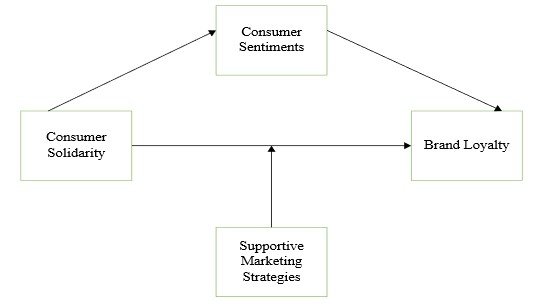
Fig. (1). Conceptual framework.
3. METHODOLOGY
This study applied a primary quantitative research design where the structured questionnaire was utilised to obtain the empirical data. The survey questionnaire was grounded on a five-point Likert-scale strongly disagree to strongly agree, the format that is generally suggested to measure latent psychological constructs in a marketing study of (Tanujaya et al., 2022). The questionnaire was categorised into four constructs that the study was based on which are consumer solidarity, consumer sentiments, supportive marketing strategies, and brand loyalty (Appendix A). Consumer Sentiments and Supportive Marketing Strategies are constructs which are multi-dimensional in nature. Consumer Sentiments contains pride, trust, attachment, and moral satisfaction and Supportive Marketing Strategies include donations, advocacy, messaging, and CSR. In conceptual terms, these dimensions may act as formative indicators, but since this study uses a reflective measure model of both constructs as a conceptual simplification. This methodology is based on pragmatic factors such as survey length, the inability to find enough respondents, and the necessity to have sufficient statistical power and a moderate sample size. The aggregation of several dimensions into single reflective measures enabled a concise measurement, the lessening of the burden on the participants, and simplified the achievement of a high quality of responses.
The Gaza-supportive brand consumers used in the study are interpreted as the people who view brands as supportive of the Gaza cause, and not necessarily the purchasers of the particular products. The research considers the possibility of ideological grouping, in which the moral and political inclinations of the respondents might affect the brand attitudes and brand loyalty ratings. Since a validated brand list or direct exposure measurement is not provided, the results are constituted as perceptual loyalty or the attitudinal commitment and affective compatibility of consumers with Gaza-refined brands, but not purchasing behaviour. This framing makes certain conceptual clarity and locates the loyalty on the ethical and perceptual aspects of the solidarity-oriented consumption.
The consumers, consuming and aware of the brands supporting the Gaza cause and that publicly endorse the Gaza cause were recruited to gather data, which resulted in the final sample of 300 respondents. The study applied a purposive sampling method, where the researcher could intentionally induct the participants successfully to gather relevant information, because according to (Thomas, 2022) the relevant sampled population can provide direct information about a phenomenon of interest. Sample size adequacy was calculated using G*Power taking into consideration the rule of maximum predictors, medium effect size (f2 = 0.15), power = 0.95, and significance = 0.05 that gave a minimum of 220 cases as suggested by (Kang, 2021) also. 750 professionals were contacted to complete questionnaires; 412 respondents returned them, which is a 54.9% response rate. The sample size was narrowed down to 300 after the elimination of 112 questionnaires containing too many missing data and statistical outliers. The respondents were reached out through the professional site like LinkedIn and the official social media accounts of globally operating hospitality and consumer brands. In order to reduce selection bias. To evaluate non-response bias independent sample tests were conducted to compare early respondents (n1 = 30) and late respondents (n2 = 30), and no significant differences were found as per the suggestions made by (Zurakowski & Staffa, 2023).
Participation in this study were voluntary recruited with the necessary information given to the participants on the study purpose and ability to opt out at any point. The responses were strictly confidential and anonymous in order to preserve the personal and political identities. Since the setting of the Gaza context is politically sensitive, questions were worded in a way that would not cause a lot of emotional pain and the participants were advised to avoid any questions that would bring them discomfort. The paper complied with the overall ethical concept of research, which includes the respect, transparency, and sensitivity in data collection and presentation.
As indicated by (Bozionelos & Simmering, 2022) the common method variance was successfully addressed with procedural and statistical solutions such as provision of assured anonymity, randomised order of items and post-hoc analysis with variance inflation factors, which is in line with the direction. The analysis of the data was done with the help of the Partial Least Squares Structural Equation Modelling (PLS-SEM) that was relevant to models with prediction orientation and mediation and moderation effects suggested by (Sarstedt et al., 2021). Confirmatory factor analysis was then conducted to measure reliability in terms of Cronbach alpha and composite reliability and convergent validity in terms of average variance extracted. Then structural path analysis was used to test the direct hypothesis, the mediating hypothesis, and moderating hypothesis. This sequence of analysis allowed sound estimation of causal relationships and support complicated relationships between latent constructs; therefore, methodological rigour matched the theoretical background of the study and valid hypothesis testing throughout the proposed research model and analytical validity.
4. RESULTS
4.1. Demographics Analysis
Statistical results in Table 1 specifies about the demographic characteristics of the study populations. The results indicates that among total 300 participants, 57% were males and 43% were females. Among these participants, 27.33% were 26-35 years of age, 27% were 36-45 years of age, 24% were 46-55 years of age and 21.67% were 55 years and above. Moreover, in terms of educational qualification, 25% were high-school or equivalent, 37.33% were held Bachelor’s degrees, and 37.675% were Masters. In terms of level awareness about brands supporting Gaza cause, 11.67% articulated they were not aware, 16.67% were slightly aware, 36.67% were moderately aware, 35% were highly aware. Moreover, in terms of frequency of buying from brands that support emanation causes, 36.67% of the participants make rare purchase, 35% make occasional purchase, and 28.33% makes frequent purchases.
Table 1. Demographic profile analysis.
| Demographic Category | Frequency (n) | Percentage (%) | |
| Gender | Male | 171 | 57.00% |
| Female | 129 | 43.00% | |
| Age Range | 26-35 | 82 | 27.33% |
| 36-45 | 81 | 27.00% | |
| 46-55 | 72 | 24.00% | |
| Above 55 years | 65 | 21.67% | |
| Highest Educational Qualification | High school or equivalent | 75 | 25.00% |
| Bachelor’s degree | 112 | 37.33% | |
| Master’s degree | 113 | 37.67% | |
| Level of Awareness of Brands Supporting Gaza | Not aware | 35 | 11.67% |
| Slightly aware | 50 | 16.67% | |
| Moderately aware | 110 | 36.67% | |
| Highly aware | 105 | 35.00% | |
| Frequency of Purchasing from Brands That Publicly Support Social or Humanitarian Causes | Rarely | 110 | 36.67% |
| Occasionally | 105 | 35.00% | |
| Frequently | 85 | 28.33% | |
4.2. Measurement Model-Confirmatory Factor Analysis (CFA)
The measurement model of the study is examined for reliability, internal consistency and validity by using CFA approaches which are comprised of Cronbach’s alpha, Composite reliability and Average Variance Extracted (AVE) as suggested by (Zurakowski & Staffa, 2023). The results are specified in Table 2.
Table 2. Validity and reliability.
| Latent Variables | Indicators | Factor Loadings | Cronbach’s Alpha | Composite Reliability | Average Variance Extracted (AVE) |
| Brand Loyalty | BL1 | 0.891 | 0.884 | 0.887 | 0.812 |
| BL2 | 0.929 | ||||
| BL3 | 0.884 | ||||
| Consumer Solidarity | CS1 | 0.870 | 0.837 | 0.839 | 0.755 |
| CS2 | 0.894 | ||||
| CS3 | 0.841 | ||||
| Consumer Sentiments | Csent1 | 0.802 | 0.818 | 0.835 | 0.732 |
| Csent2 | 0.905 | ||||
| Csent3 | 0.857 | ||||
| Supportive Marketing Strategies | SMS1 | 0.902 | 0.901 | 0.902 | 0.835 |
| SMS2 | 0.933 | ||||
| SMS3 | 0.906 |
The results specified in Table 2 articulates that all the constructs in the measurement model of the study shows high factor loading which varies from (0.802-0.933). In terms of internal consistency and reliability, all the constructs in the model are found with Cronbach’s Alpha value and Composite Reliability exceeding the threshold value (α > 0.7) which depicts high reliability. In addition, with regards to validity, the constructs are found with high AVE value of above 0.5 which shows high convergent validity. Hence, the results shows that constructs in the measurement model are reliable and valid for further analysis.
4.3. Discriminant Validity
The discriminant validity test using HTMT ratio allows to measure the separability and conceptual overlapping among constructs. The results are specified in Table 3, against the threshold value of HTMT 0.85 as suggested by (Afthanorhan et al., 2021).
Table 3. Discriminant validity.
| – | Brand Loyalty | Consumer Sentiments | Consumer Solidarity |
| Consumer Sentiments | 0.460 | – | – |
| Consumer Solidarity | 0.704 | 0.577 | – |
| Supportive Marketing Strategies | 0.706 | 0.406 | 0.608 |
The results specified in Table 3, reflects discriminant validity of the constructs as HTMT values are lower than the threshold of 0.85. These results indicates that constructs in the measurement model are separated and distinguished from each other with no issue of conceptual overlapping.
The findings in Table 4 reveal significant predictive relationships among the study variables. The positive significant relationship between consumer solidarity and brand loyalty is significant (β = 0.360, p < 0.001), implying that the greater the levels of solidarity, the greater the levels of loyalty to Gaza-supportive brands. Consumer sentiments are also positively and significantly related with consumer solidarity (β = 0.483, p < 0.001), thus showing that strong emotional reactions are linked to consumer solidarity. In addition, the predictive relationship between consumer sentiments and brand loyalty is statistically significant and positive (β = 0.250, p = 0.002), meaning that sentiments are reliable predictor of loyalty. The brand loyalty has a positive correlation with the supportive marketing strategies (β = 0.460, p < 0.001). Moreover, the association of supportive marketing strategies and solidarity of consumers (β = 0.273, p = 0.003) has also been confirmed as a moderating factor, which reinforced the solidarity-loyalty relationship. The statistically and significant indirect predictive relationship through consumer sentiments (β = 0.334, p = 0.024), with a significant direct relationship, indicates a partial mediation of consumer sentiments.
Table 4. Path coefficient.
| – | Path coefficients | T-statistics | P-values |
| Consumer Sentiments -> Brand Loyalty | 0.250*** | 4.257 | 0.002 |
| Consumer Solidarity -> Brand Loyalty | 0.360*** | 6.022 | 0.000 |
| Consumer Solidarity -> Consumer Sentiments | 0.483*** | 9.560 | 0.000 |
| Supportive Marketing Strategies -> Brand Loyalty | 0.460*** | 8.298 | 0.000 |
| Supportive Marketing Strategies x Consumer Solidarity -> Brand Loyalty | 0.273*** | 6.708 | 0.003 |
| Specific Indirect Effects | |||
| Consumer Solidarity -> Consumer Sentiments -> Brand Loyalty | 0.334*** | 7.215 | 0.024 |
Note: *: Significance at 10%; **: Significance at 5%; ***: Significance at 1%
4.4. Model Explanatory Power
The model explanatory power analysed through R-square and adjusted R-square values allows to examine the percentage of variance that can be predicted in dependent variables by its predictors, suggested in the study of (Zurakowski & Staffa, 2023).
The results of explanatory power in Table 5 shows that, 51.5% variance in brand loyalty and 23.3% variance in consumer sentiments can be predicted by consumer solidarity which shows moderate explanatory power.
Table 5. Model explanatory power.
| – | R-Square | R-Square Adjusted |
| Brand Loyalty | 0.515 | 0.509 |
| Consumer Sentiments | 0.233 | 0.230 |
4. DISCUSSION
The results confirm H1 and indicate that there is a statistically significant predictive relationship between the consumer solidarity and brand loyalty in the case of brand support of Gaza. This observation follows the same conclusion reached by (Hanchukova & Velikova, 2025) who showed that unanimity with the crisis-stricken population promotes supportive consumption patterns. Although they examined in their research the purchase intentions of Ukrainian products, the current results can be applied to the brand loyalty in the case of Gaza and can justify the notion that solidarity is not just a situational factor but a value-driven orientation that could influence the development of brand preferences. The severity and visibility of the Gaza humanitarian crisis have the potential to increase solidarity responses, since consumers will view brand support as an ethical position, and not as a marketing strategy.
Nevertheless, the results are opposite to the studies indicating that solidarity-driven consumption can be momentary or episodic. (Stylidis et al., 2020) claims that socio-political alignment cannot necessarily result in long-term loyalty unless supported by the steadfast brand behaviour. The notable relationship here indicates that solidarity has an increased salience of emotions and ethics in the Gaza case and this may enhance its prediction ability. Consumer solidarity as a value-based orientation under the Value-Emotion-Behaviour framework contributes to the increased chances of positive behavioural commitments. Instead of being triggered by external stimuli, solidarity depicts moral correspondence that influences the development of loyalty. Brands that are seen to be aiding Gaza are therefore long-term psychological reference points, which create loyalty that is not time-based or consumer driven.
The findings confirm H2, which means that consumer solidarity is associated with brand loyalty under mediating role of consumer sentiments This trend is consistent with that of (Shah et al., 2024), who discovered that consumer sentiments have an indirect relationship with behavioural outcomes, by acting through attitudinal processes. Sentiments in both senses serve as psychological channels that make marketplace behaviour out of the orientations that are morally based. The high level of indirect relationship found implies that solidarity increases positive affective reactions to Gaza-supportive brands that further relates to loyalty.
Simultaneously, the significant direct relationship between consumer sentiments and brand loyalty is inconsistent with the results in (Hanchukova & Velikova, 2025), in which emotional authenticity perceptions did not relate directly with purchase intentions. This convergence indicates that emotions can be not enough to maintain loyalty unless they are incorporated in larger value-based identification. The same interpretation is supported by (Seyfi et al., 2023), which conceptualises emotional engagement as a process instead of a trigger, especially in boycott and activism situations with moral overtones. The Gaza crisis, which has been chronic and featured numerous humanitarian calls, can perhaps escalate emotional reactions but can also become conventional, and less predictive independently.
Under the Value-Emotion-Behaviour framework, consumer sentiments are not compulsive intermediaries but act as emotional conduit where value-based solidarity can be converted into behaviour. The deployment of solidarity generates emotional reactions but loyalty is evoked in a stronger way in the event that these emotional reactions are supported by convincing and consistent supportive marketing tactics. The identified partial mediation indicates the stratified psychological of solidarity-based consumption, in which the values might directly inform the behaviour, but the emotions might also increase, as opposed to solely defining, the formation of loyalties in conflict situations like Gaza.
The results have substantiated H3, which ascertained that supportive marketing practises are vital in moderating predictive relationship between consumer solidarity and brand allegiance in the Gaza setting. This finding is consistent with (Shah et al., 2024) who posit that the use of strategic and authentic social programmes enhances the transfer of consumer feelings to loyalty. The supportive marketing techniques like humanitarian messaging, open donations, and advocacy seems to amplify in the Gaza situation the magnitude to which solidarity is commensurate to brand loyalty.
Nevertheless, the outcomes can also be compared to the warning ideas expressed by (Cardoso et al., 2022) who note the danger of perceived performativity in brand activism. The strong moderating effect in this case implies that the supportive strategies do not act in a homogeneous way but they mediate the intensity of solidarity-loyalty relationship. This means that customers differentiate between expressive action and material assistance, especially in politicised crises such as Gaza. Brands that are viewed as authentic enhance solidarity-based loyalty, but any inconsistency and ambiguity in its communication can undermine it. The results also resonate the study conducted by (Adekuajo et al., 2023), who proved that crisis responsive strategies support long term brand relationships and consumer trust. The context of supportive marketing in Gaza is not just an indication of agreement but it forms the patterns of the processing emotions and expressing solidarity behaviours. This highlights the extreme importance of strategic consistency and moral righteousness in turning solidarity into long-lasting brand loyalty during the humanitarian crisis.
CONCLUSION
This study contributes to the research on solidarity-based consumption through illustrating that brand loyalty in the Gaza situation cannot be narrowed down to emotional responses. Instead, loyalty comes about as a result of a combination of moral identification with consumers and brand support communication. The results indicate that solidarity is a strong psychological orientation, but how feasible it turns into loyalty will depend on the extent to which brands make easy and affirmative attempts to build and maintain supportive marketing tactics. Consumer sentiments are a significant, though not necessary, channel, meaning that emotional resonance has to be supported by credible stimuli in order to be behaviourally relevant. Placed in the Stimulus-Organism-Response context, the study emphasises the shortcomings of ethical consumption being regarded as either affective or symbolic. Meanwhile, the findings should be treated with some caution since they are based on perceptions in a particular humanitarian environment and do not reflect universal reactions within the consumer. On the whole, the work identifies the brand engagement with Gaza as having a strategic consequentiality which requires regularity, sincerity and sensitivity.
LIMITATIONS AND FUTURE DIRECTIONS
This research has a certain limitation as well, despite of its contributions that provide a guidance to conduct a future study. At first, the cross-sectional design limits the possibility of tracking how consumer solidarity, sentiments and loyalty are changing with time, especially in the changing geopolitical context. Second, the use of self-reported data can lead to the social desirability bias due to the moral sensitivity of Gaza. Third, the sample is contextual, which makes it impossible to generalise to other cultures and conflict situations. Hence, future researches need to utilise longitudinal and experimental research designs, integrate behavioural data, and consider other moderators like brand credibility or perceived authenticity to learn more about solidarity consumer behaviour.
POLICY IMPLICATIONS
The results provide certain policy implications on brands, advocacy organisations and regulatory stakeholders involved in humanitarian interventions like Gaza. Brands ought to come up with an explicit guideline that would make supportive marketing strategies congruent, understandable and parallel to verifiable actions so as to prevent the chances of being viewed as opportunistic. It is possible to promote ethical standards of communication which can be discouraged by policymakers and consumer protection organisations to avoid the symbolic support without the commitment. These advocacy organisations can partner with the brands to co-develop believable messages that will reinforce consumer trust. Moreover, cause related marketing claims are to be regulated by the regulators to protect misinformation. Altogether, it is possible to advance the idea of responsible solidarity-based marketing that would not infringe on the consumer sentiments but would remain accountable.
LIST OF ABBREVIATIONS
| CFA | = | Confirmatory Factor Analysis |
| CSR | = | Corporate Social Responsibility |
| PLS-SEM | = | Partial Least Squares Structural Equation Modelling |
| VEB | = | Value Emotion Behaviour |
AUTHOR’S CONTRIBUTION
M.A.S. has contributed to conceptualization, idea generation, methodology, results analysis, results interpretation.
ETHICAL APPROVAL & INFORMED CONSENT
All procedures were carried out in accordance with institutional research ethics committee guidelines and Declaration of Helsinki. Informed consent is acquired from all participants and to ensure anonymity no personal or identifiable data was recorded.
AVAILABILITY OF DATA AND MATERIALS
The data will be made available on reasonable request by contacting the corresponding author [M.A.S.].
FUNDING
None.
CONFLICT OF INTEREST
The author declares that there is no conflict of interest regarding the publication of this article.
ACKNOWLEDGEMENTS
Declared none.
DECLARATION OF AI
During the preparation of this manuscript the author has used Chatgpt only to enhance the English of this manuscript. Subsequently the author reviewed the content and took full responsibility for the published article.
APPENDIX A
Demographics Questionnaire
| Item | Question | Option |
| D1 | Age | ☐ 26–35 years |
| ☐ 36–45 years | ||
| ☐ 46–55 years | ||
| ☐ Above 55 years | ||
| D2 | Gender | ☐ Male |
| ☐ Female | ||
| D3 | Highest Educational Qualification | ☐ High school or equivalent |
| ☐ Bachelor’s degree | ||
| ☐ Master’s degree | ||
| D4 | Level of Awareness of Brands Supporting Gaza | ☐ Not aware |
| ☐ Slightly aware | ||
| ☐ Moderately aware | ||
| ☐ Highly aware | ||
| D5 | Frequency of Purchasing from Brands That Publicly Support Social or Humanitarian Causes | ☐ Rarely |
| ☐ Occasionally | ||
| ☐ Frequently |
Survey Questionnaire
| Section B: Consumer Solidarity (CS) Adapted from (Wang et al., 2024b) | ||||||
| Item Code | Statement | 1 | 2 | 3 | 4 | 5 |
| CS1 | I feel close to brands residents supporting the Gaza cause. | ☐ | ☐ | ☐ | ☐ | ☐ |
| CS2 | I have made friends using same brands supporting the Gaza cause. | ☐ | ☐ | ☐ | ☐ | ☐ |
| CS3 | I feel affection toward the brands and their customer supporting Gaza. | ☐ | ☐ | ☐ | ☐ | ☐ |
| Section C: Consumer Sentiments (CSE). Adapted from: (Lopez et al., 2020) | ||||||
| Item Code | Statement | 1 | 2 | 3 | 4 | 5 |
| CSE1 | Consumers perceiving Gaza-supportive brands experience positive sentiments like pride, trust, attachment, and moral satisfaction. | ☐ | ☐ | ☐ | ☐ | ☐ |
| CSE2 | Effective supportive marketing (donations, advocacy, messaging, CSR) strengthens trust and moral alignment while reducing scepticism. | ☐ | ☐ | ☐ | ☐ | ☐ |
| CSE3 | Authentic brand commitment heightens emotional engagement and moral satisfaction, minimizing negative sentiments. | ☐ | ☐ | ☐ | ☐ | ☐ |
| Section D: Supportive Marketing Strategies (SMS). Adapted from (Patwardhan et al., 2020) | ||||||
| Item Code | Statement | 1 | 2 | 3 | 4 | 5 |
| SMS1 | Brands that communicate clear support for Gaza appear more ethical to me. | ☐ | ☐ | ☐ | ☐ | ☐ |
| SMS2 | I trust brands more when they actively support humanitarian causes like Gaza. | ☐ | ☐ | ☐ | ☐ | ☐ |
| SMS3 | Supportive marketing messages about Gaza influence my perception of a brand. | ☐ | ☐ | ☐ | ☐ | ☐ |
| Section E: Brand Loyalty (BL). Adapted from (Severi & Ling, 2013) | ||||||
| Item Code | Statement | 1 | 2 | 3 | 4 | 5 |
| BL1 | I regularly refer this particular product/brand, supporting Gaza, through the social media. | ☐ | ☐ | ☐ | ☐ | ☐ |
| BL2 | I usually use product/brand, favouring Gaza cause, as my first choice in comparison with the other product/brand. | ☐ | ☐ | ☐ | ☐ | ☐ |
| BL3 | I will not switch to another product/brand, particularly those who are anti-Gaza, that appeared in the social media next time. | ☐ | ☐ | ☐ | ☐ | ☐ |
REFERENCES
Adekuajo, I. O., Udeh, C. A., Abdul, A. A., Ihemereze, K. C., Nnabugwu, O. C., & Daraojimba, C. (2023). Crisis marketing in the FMCG sector: A review of strategies Nigerian brands employed during the covid-19 pandemic. International Journal of Management & Entrepreneurship Research, 5(12), 952-977.
https://doi.org/10.51594/ijmer.v5i12.630.
Afthanorhan, A., Ghazali, P. L., & Rashid, N. (2021). Discriminant validity: A comparison of CBSEM and consistent PLS using Fornell & Larcker and HTMT approaches. Journal of Physics: Conference Series, 1874(1).
https://doi.org/10.1088/1742-6596/1874/1/012085.
Attarwala, F.S. (2024). One year of Gaza war and impact of Pakistani ‘boycott’ on Israeli products. Dawn. Available from: https://www.dawn.com/news/1863436 (Accessed on: 17 Dec 2025).
Ahmadian, S., Sahraei, B., & Khosro, S. K. (2023). Brand attachment, brand experience, brand image, perceived quality, perceived value, and brand loyalty. Journal of Humanities Social Sciences and Business, 3(1), 257–269.
https://doi.org/10.55047/jhssb.v3i1.863.
Alexander, K. (2024). Consumers protest the Gaza war by boycotting US goods. STIMSON. Available from: https://www.stimson.org/2024/consumers-protest-the-gaza-war-by-boycotting-us-goods/ (Accessed on: 17 Dec 2025).
BDS. (2024). Guide to BDS Boycott & Pressure Corporate Priority Targeting. BDS Movement. Available from: https://bdsmovement.net/Guide-to-BDS-Boycott (Accessed on: 17 Dec 2025).
Bloomberg. (2024). More consumers choose brands based on politics, survey shows. Bloomberg. Available from: https://www.bloomberg.com/news/articles/2024-06-13/more-consumers-choose-brands-based-on-politics-survey-shows (Accessed on: 17 Dec 2025).
Bozionelos, N., & Simmering, M. J. (2022). Methodological threat or myth? Evaluating the current state of evidence on common method variance in human resource management research. Human Resource Management Journal, 32(1), 194–215.
https://doi.org/10.1111/1748-8583.12398.
Buheji, M., Ahmad, D. (2023). Keeping the boycott momentum—from ‘War on Gaza’ till ‘Free Palestine’. International Journal of Management (IJM), 14(7), 205–229. Available from: https://iaeme.com/Home/article_id/IJM_14_07_017.
Cardoso, A., Gabriel, M., Figueiredo, J., Oliveira, I., Rêgo, R., Silva, R., Oliveira, M., & Meirinhos, G. (2022). Trust and loyalty in building the brand relationship with the customer: Empirical analysis in a retail chain in northern Brazil. Journal of Open Innovation: Technology, Market, and Complexity, 8(3), 109.
https://doi.org/10.3390/joitmc8030109.
Chughtai, A. (2025). The rise of global boycotts against Israel’s genocide in Gaza. Al Jazeera. Available from: https://www.aljazeera.com/news/2025/10/28/the-rise-of-global-boycotts-against-israels-genocide-in-gaza (Accessed on: 17 Dec 2025).
Ganot, S. (2024). Arab consumers favor local brands over Western brands in solidarity with Palestinians. The Media Line. Available from: https://themedialine.org/mideast-daily-news/arab-consumers-favor-local-brands-over-western-in-solidarity-with-palestinians/ (Accessed on: 17 Dec 2025).
Hanchukova, O., & Velikova, N. (2025). Compassionate consumption: How solidarity shapes purchase intentions. British Food Journal, 127(9), 3266-3282.
https://doi.org/10.1108/BFJ-11-2024-1126.
Hsieh, Y. (Jerrie), Canziani, B., & Welsh, D. H. B. (2023). Consumer Purpose: A Holistic Rethinking of Psychological Bonds. Journal of Asia-Pacific Business, 24(2), 76–90.
https://doi.org/10.1080/10599231.2023.2210987.
Ilyas, G.B., Munir, A.R., Tamsah, H., Mustafa, H., & Yusriadi, Y. (2021). The influence of digital marketing and customer perceived value through customer satisfaction on customer loyalty. Journal of Legal, Ethical and Regulatory Issues, 24(S4), 1-14. Available from: https://www.abacademies.org/articles/the-influence-of-digital-marketing-and-customer-perceived-value-through-customer-satisfaction-on-customer-loyalty-12252.html.
Islam, S., Zahin, M., Rahim, S.B. (2024). Investigating how consumer-perceived value and store image influence brand loyalty in emerging markets. South Asian Journal of Business Studies, 13(4), 505–526.
https://doi.org/10.1108/SAJBS-04-2023-0097.
Ismail, I. J. (2023). Speaking to the hearts of the customers! The mediating effect of customer loyalty on customer orientation, technology orientation and business performance. Technological Sustainability, 2(1), 44–66.
https://doi.org/10.1108/TECHS-03-2022-0016.
Jiang, Y., Sun, Y., & Tu, S. (2023). Economic implications of emotional marketing based on consumer loyalty of mobile phone brands: the sequential mediating roles of brand identity and brand trust. Technological and Economic Development of Economy, 29(4), 1318–1335. https://doi.org/10.3846/tede.2023.19278.
Kang, H. (2021). Sample size determination and power analysis using the G*Power software. Journal of Educational Evaluation for Health Professions, 18. https://doi.org/10.3352/jeehp.2021.18.17.
Lopez, A., Guerra, E., Gonzalez, B., & Madero, S. (2020). Consumer sentiments toward brands: The interaction effect between brand personality and sentiments on electronic word of mouth. Journal of Marketing Analytics, 8(4), 203–223.
https://doi.org/10.1057/s41270-020-00085-5.
MEMO. (2024). One-third of consumers boycott brands due to Israel war on Gaza, global survey reveals. Middle East Monitor. Available from: https://www.middleeastmonitor.com/20240614-one-third-of-consumers-boycott-brands-due-to-israel-war-on-gaza-global-survey-reveals/ (Accessed on: 17 Dec 2025).
Mumtazah, F., Araffi, M., & Noor, M. (2025). Digital Empathy and Solidarity: Case Study of Netizen Responses to MSMEs in Crisis. At-Tasharruf” Jurnal Kajian Ekonomi dan Bisnis Syariah”, 7(1), 91-101. Available From: https://ejurnal.unmuhjember.ac.id/index.php/Tasharruf/article/view/3686.
Nation, T. (2023). Huda Beauty to donate $1m to humanitarian organisations in Gaza. The Nation. Available From: https://www.nation.com.pk/09-Nov-2023/huda-beauty-to-donate-dollar-1m-to-humanitarian-organisations-in-gaza (Accessed on: 17 Dec 2025).
National, T. (2025). Palestinian brands to support Gaza. The National. Available From: https://www.thenationalnews.com/lifestyle/fashion-beauty/2024/04/07/palestinian-brands-to-support-gaza/ (Accessed on: 17 Dec 2025).
Nero, A., & Haya, A. (2024). The Power of Boycotts in the Food Industry.: A study of consumer behavior amid conflict. Available from: https://www.diva-portal.org/smash/get/diva2:1864746/FULLTEXT01.pdf.
Patwardhan, V., Ribeiro, M. A., Payini, V., Woosnam, K. M., Mallya, J., & Gopalakrishnan, P. (2020). Visitors’ place attachment and destination loyalty: Examining the roles of emotional solidarity and perceived safety. Journal of travel research, 59(1), 3-21. https://doi.org/10.1177/0047287518824157.
Quaye, E. S., Taoana, C., Abratt, R., & Anabila, P. (2022). Customer advocacy and brand loyalty: the mediating roles of brand relationship quality and trust. Journal of Brand Management, 29(4), 363-382.
https://doi.org/10.1057/s41262-022-00276-8.
Ragab, N. J. (2020). Diaspora mobilisation in a conflict setting: The emergence and trajectories of Syrian diaspora mobilisation in Germany.
https://doi.org/10.26481/dis.20200424nr.
Sarstedt, M., Ringle, C. M., & Hair, J. F. (2021). Partial least squares structural equation modeling. In Handbook of market research. (pp. 587-632).
https://doi.org/10.1007/978-3-319-05542-8_15-2.
Severi, E., & Ling, K. C. (2013). The mediating effects of brand association, brand loyalty, brand image and perceived quality on brand equity. Asian Social Science, 9(3), 125–137.
https://doi.org/10.5539/ass.v9n3p125.
Seyfi, S., Hall, C. M., Saarinen, J., & Vo-Thanh, T. (2023). Understanding drivers and barriers affecting tourists’ engagement in digitally mediated pro-sustainability boycotts. Journal of Sustainable Tourism, 31(11), 2526–2545.
https://doi.org/10.1080/09669582.2021.2013489.
Shah, S. A., Raza, Q., Rajar, H. A., Baig, M. T., Mithiani, S. A., Ahmed, M., … & Malik, S. (2024). Consumer behavior and preferences shift: The impact of boycotting imported brands on local product demand. Bulletin of Business and Economics, 13(2), 455–467.
https://doi.org/10.61506/01.00354.
Shahid, S., Paul, J., Gilal, F. G., & Ansari, S. (2022). The Role of Sensory Marketing and Brand Experience in Building Emotional Attachment and Brand Loyalty in Luxury Retail Stores. Psychology & Marketing, 39, 1398–1412.
https://doi.org/10.1002/mar.21661.
Stylidis, D., Woosnam, K. M., & Ivkov, M. (2020). Tourists’ emotional solidarity with residents: A segmentation analysis and its links to destination image and loyalty. Journal of Destination Marketing & Management, 17, 100458.
https://doi.org/10.1016/j.jdmm.2020.100458.
Tanujaya, B., Prahmana, R. C. I., & Mumu, J. (2022). Likert scale in social sciences research: Problems and difficulties. FWU Journal of Social Sciences, 16(4), 59–101. https://doi.org/10.51709/19951272/Winter2022/7.
Tasci, A. D. A., Uslu, A., Stylidis, D., & Woosnam, K. M. (2022). Place-Oriented or People-Oriented Concepts for Destination Loyalty: Destination Image and Place Attachment versus Perceived Distances and Emotional Solidarity. Journal of Travel Research, 61(2), 430-453.
https://doi.org/10.1177/0047287520982377.
Thomas, B. (2022) The Role of Purposive Sampling Technique as a Tool for Informal Choices in a Social Sciences in Research Methods. Just Agriculture Multidisciplinary E-Newsletter, 2, Article ID: 047. Available from: https://www.scirp.org/reference/referencespapers?referenceid=3503967.
Wang, F., Wang, Y., Han, Y., & Cho, J. H. (2024a). Optimizing brand loyalty through user-centric product package design: A study of user experience in dairy industry. Heliyon, 10(3), e25484.
https://doi.org/10.1016/j.heliyon.2024.e25484.
Wang, S., Berbekova, A., Uysal, M., & Wang, J. (2024b). Emotional solidarity and co-creation of experience as determinants of environmentally responsible behavior: A stimulus-organism-response theory perspective. Journal of Travel Research, 63(1), 115–135.
https://doi.org/10.1177/00472875221146786.
Zurakowski, D., & Staffa, S. J. (2023). Statistical power and sample size calculations for time-to-event analysis. The Journal of Thoracic and Cardiovascular Surgery, 166(6), 1542–1547.
https://doi.org/10.1016/j.jtcvs.2022.09.023.