

- ABSTRACT:
- 1. INTRODUCTION
- 2. METHODOLOGY
- 3. RESULTS
- 3.1. Data Screening
- 3.2. Overview of Included Studies
- 3.3. Engineering Advances Enhancing Editing Precision in Human Cells
- 3.4. Expansion of Editing Capability Beyond Single-Nucleotide Variants
- 3.5. Disease-Specific Therapeutic Applications in Human Models
- 3.6. Delivery Strategies for Human Genome Editing
- 3.7. Editing Outcomes, Fidelity, and Translational Readiness
- 4. DISCUSSION
- LIMITATIONS OF THE REVIEW
- CONCLUSION
- LIST OF ABBREVIATIONS
- AUTHOR'S CONTRIBUTION
- CONSENT FOR PUBLICATION
- REPORTING GUIDELINES
- AVAILABILITY OF DATA AND MATERIALS
- FUNDING
- CONFLICT OF INTEREST
- ACKNOWLEDGEMENTS
- DECLARATION OF AI
- APPENDIX
- REFERENCES
Article ID: PD2601205004
Views: 671Beyond CRISPR Cutting: A Systematic Review of Base Editing and Prime Editing for Therapeutic Precision
 PDF
⬇ Downloads: 41
1Department of Biomedical Laboratory Sciences, University of Management and Technology, Lahore, Pakistan
Received: 16 May, 2026
Revised: 27 July, 2026
Accepted: 16 September, 2026
Published: 24 October, 2026
ABSTRACT:
Introduction: Genome editing has advanced considerably, enabling increasingly precise correction of pathogenic variants in human cells. Base editing and prime editing were developed to address important limitations of nuclease-based CRISPR-Cas systems, particularly the risk of Double-Strand Breaks (DSBs) and associated unintended genomic alterations.
Methods: A systematic review was performed to find human-relevant primary studies of base and prime editing using PubMed, Scopus, and CINAHL databases, following the guidelines set forth by the PRISMA group. Two reviewers used predefined inclusion/exclusion criteria; disagreements among reviewers were resolved by consensus, and methodological quality was evaluated according to ROBINS-I principles.
Results: Base editing was very efficient at replacing single-nucleotide transitions, especially when the right PAM sites and an appropriate editing window were present. The key drawbacks of its use were its PAM dependency, limited window of editing and bystander or off-target deamination. Prime editing supported wider ranges of substitutions, insertions, deletions, and regulatory edits with more control over the positions in editing primary human systems, although it was less efficient. In all the disease models studied, therapeutic potential was not only driven by the greatest percentage of editing but also by efficacy of function, delivery potential and safety of the editing approach.
Conclusion: Base editing appears suitable for efficient correction of eligible single-nucleotide transition mutations, whereas prime editing offers greater flexibility and positional precision for complex edits. The most appropriate platform depends on the mutation type, target tissue, route of administration, and disease-specific functional requirements.
Keywords: Prime editing, base editing, CRISPR-Cas system, precision genome editing, human therapeutic models, gene therapy.
1. INTRODUCTION
Since the development of the CRISPR-Cas9 system, genome-editing technology has evolved significantly [1]. The ability to efficiently and accurately cleave targeted DNA with CRISPR-Cas9 ushered in a new era in functional genomics and disease modelling [2]. Double-strand breaks (DSBs), however, may lead to off-target effects, chromosomal breaks and rearrangements, and insertions or deletions, potentially contributing to genomic instability in therapeutic applications [3, 4]. The aim of base editing and prime editing is to minimise these hazards: modification at the nucleotide level without requiring DSB-mediated repair.
For therapeutic purposes, base editing may reduce unwanted repair outcomes because it does not intentionally generate DSBs [5, 6]. Moreover, Joo et al. [7] and Li et al. [8] discuss how prime editing could correct a broader spectrum of pathogenic variants than that accomplished by conventional CRISPR-Cas9 editing, addressing an important limitation of the latter. Base editing has significant therapeutic relevance since large variations of disease variants are caused by transition mutations in monogenic diseases [9]. Prime editing can introduce all 12 possible base substitutions as well as small insertions and deletions. It uses a Cas9 nickase fused to a reverse transcriptase together with a prime-editing guide RNA (pegRNA) containing the template and primer-binding sequences [7].
Yet, in recent studies in cells applicable to humans, three important “translationally relevant” limitations emerge, these are cell-context dependency, repair-pathway interference, and delivery problems. In general, Zhang et al. [10] reported decreased editing efficiency in differentiated and patient-derived cells compared to immortalised cells. Hua et al. [11] demonstrated that the delivery and cell compatibility issues could not be overcome solely by changing the architecture of the editors. Park [12] also showed that pegRNA design and mismatch-repair activity of prime editing enzymes can constrain prime editing outcomes. All these studies highlight key obstacles to clinical translation, guide design, repair modulation and delivery.
Lee et al. [13] highlighted the difficulty of packaging the relatively large prime-editing components into viral vectors, as well as limitations in tissue penetration and duration of expression associated with non-viral approaches. This focus on human-cell and translational models is justified by these limitations, given that only proof-of-concept editing in simplified models has so far been performed.
Many inherited diseases, such as sickle cell disease, cystic fibrosis (CF), and Duchenne muscular dystrophy (DMD), involve pathogenic variants that could, in principle, be targeted using base or prime editing [14]. Because base and prime editing achieve permanent, genome-level genetic correction without intentionally creating DSBs, they hold promise for achieving therapeutic outcomes while avoiding some of the risks associated with DSB-based genome editing [15, 16]. While some studies have demonstrated proof-of-concept success in vitro or in animal models, translation to human therapeutic applications remains challenging. Editing tools that perform effectively in immortalised cell lines may face greater difficulty when applied in primary cells or patient-derived tissues. Comparative studies of clinically relevant human systems are therefore needed to assess the feasibility of therapeutic application.
This review aims to critically assess the accuracy, efficiency, safety, and translatability of base and prime editing in human primary systems or models of diseases. Ex vivo and in vivo human systems, including haematopoietic stem cells, airway epithelial cell cultures, organoids, and early clinical data, are reviewed. It measures on-target editing efficiency, bystander editing, unintended substitutions, indel rates, off-target DNA/RNA effects, genomic instability, cytotoxicity, delivery strategy, scalability, and disease-technology fit. This synthesis is intended to be focused rather than broad, specifically including only those systems relevant to humans and those translation barriers that affect therapeutic application.
2. METHODOLOGY
2.1. Research Design
This review is reported according to the PRISMA 2020 statement [17]. The search for studies was carried out in the databases from January 1, 2016, to June 26, 2026 (the last search was performed on June 26, 2026). Titles, abstracts and full texts of the articles were independently evaluated by two reviewers, and any conflicts were resolved by discussion and consensus. A prospective protocol was not registered for this review. Study design, type of human cell, editor platform, delivery mode and outcome measures were extracted using a pre-established framework. Because most of the included studies were experimental genome-editing studies, ROBINS-I principles were adapted to evaluate risk of bias and consistency of methodology.
2.1.1. Search Strategy and Selection Criteria
The search was conducted in three databases: PubMed, Scopus, and CINAHL (Appendix, Table 1), which provide comprehensive coverage of research articles in molecular biology, genetics and therapeutic gene editing. Search strings included “base editing”, “prime editing”, “human cells”, “genome editing”, “therapeutic application”, “disease models” and “clinical translation”. Items were screened to establish direct relevance to human systems and therapeutic outcomes with editing. Although the review aimed at providing human-relevant experimental data and did not intend to include reviews or general mechanistic discussions or literature on animal models, 16 primary studies were selected for the final synthesis.
Table 1. Overview of search results for each database.
| Database | Search String | Total Results | Key Focus |
| PubMed | (base editing OR prime editing) AND (human OR human cells) AND (genome editing) AND (therapeutic OR disease) | 347 | Human-based primary studies evaluating therapeutic genome editing using base or prime editing technologies, including efficiency, precision, and disease relevance. |
| Scopus | base editing OR prime editing AND human cells AND genome editing AND therapeutic OR disease AND clinical trials | 64 | Translational and experimental studies in human cells assessing base and prime editing platforms for disease correction and clinical applicability. |
| CINAHL | base editing OR prime editing AND single-nucleotide mutations AND gene therapy AND human clinical trials | 177 | Single-nucleotide mutations, gene therapy, and clinical trials in human systems. |
2.1.2. Eligibility Criteria
2.1.2.1. Inclusion Criteria
Studies were included if they reported human clinical data, ex vivo human primary-cell data, patient-derived cells, organoids, or human tissue models involving base editing or prime editing. Eligible studies had to report clinically relevant outcomes such as editing efficiency, precision, safety, functional restoration, or correction of defined single-nucleotide variants or small insertions/deletions. Articles published between 2016 and 2026 were considered (Table 2). The included studies were stratified into three tiers to clarify model relevance:
Tier 1: Clinical/ex vivo primary systems- This group includes studies based on patient-derived cells, primary stem cells, and clinical trials for therapeutic gene editing.
Tier 2: Organoids- Studies involving organoids that serve as human-relevant disease models.
Tier 3: Immortalised cell lines- Studies that use HEK293T or other immortalised cell lines, which primarily serve as proof-of-concept models rather than direct therapeutic models.
This categorisation helps clarify the relevance of different cell models and their clinical applicability.
Table 2. Study selection criteria.
| Criterion | Included | Excluded |
| Population/model | Human clinical data; human primary or patient-derived cells; HSPC; organoids; human tissues; relevant immortalised human cell lines for proof-of-concept | Animal-only studies or models without a human therapeutic component |
| Intervention | Base editing or prime editing directed at therapeutic genome modification | Conventional nuclease-only CRISPR, non-genetic interventions, or editing outside the review focus |
| Outcomes | Editing efficiency, precision, safety, functional restoration, or correction of defined single-nucleotide variants/small indels | No specific base- or prime-editing outcome; insufficient methodological detail |
| Study type | Primary experimental or clinical evidence with direct relevance to human therapeutic editing | Reviews, theoretical papers, conference abstracts, incomplete reports, or unavailable full text |
| Publication period | 1 January 2016 to 26 June 2026 | Published before 2016 |
| Edit scope | Single-nucleotide variants and small insertions/deletions; larger edits only where directly relevant to platform capability | Large insertions/deletions outside the stated therapeutic focus |
2.1.2.2. Exclusion Criteria
Studies were excluded if they were animal-only, theoretical, or narrative review papers; addressed diseases outside the scope of the review; reported base- or prime-editing results limited to large insertions and deletions outside the review’s focus; were published before 2016; or did not report outcomes of base editing or prime editing. Studies that did not follow clearly established methods, or that had no clear clinical relevance for therapeutic editing in humans, were also excluded. Sixteen of the primary studies were eligible and used for final synthesis.
2.2. Data Extraction and Synthesis
To reduce bias and improve consistency, data extraction was performed independently by two reviewers using a predefined extraction framework. Extracted variables included study design, editor platform, target gene or mutation, delivery method, human model, on-target efficiency, off-target effects, safety outcomes, and therapeutic or functional endpoints. Discrepancies were resolved by discussion until agreement was reached.
2.2.1. Assessment of Editing Precision and Efficiency
Editing accuracy refers to the ability of a genome-editing platform to introduce the desired genetic change at the target locus while minimizing unintended modifications, whereas editing efficiency refers to the proportion of treated cells in which the intended edit is achieved [18–39]. Safety was assessed in terms of off-target deletions, genomic instability, and unintended mutations. The reviewed studies mainly focused on pathogenic single-nucleotide variants, including variants in genes such as HBB [31] and CFTR [22, 24], with editing outcomes varying according to the editing platform, target sequence, and cellular context. Prime editing exhibited high positional accuracy and fewer bystander edits than base editing, though with lower efficiencies in some human systems [19–21].
2.2.2. Data Analysis
The analysis followed a structured qualitative synthesis. Two reviewers assessed the study characteristics, sampling approach, feasibility of blinding, outcome measures and reporting transparency. Since human genome-editing studies are rarely completely blinded, risk-of-bias interpretation focused primarily on model relevance, delivery variability, donor-to-donor variation, outcome measurement, and completeness of reporting.
2.2.3. Quality Assessment
The primary studies included those reported in references [22–37]. Because no validated risk-of-bias instrument exists specifically for experimental genome-editing studies, ROBINS-I was developed for non-randomised studies of interventions. This study was adapted as a structured framework for appraising study design, outcome reporting, and methodological consistency and should not be interpreted as a validated instrument specifically designed for genome-editing research. Studies were classified as low or moderate risk of bias according to model type, delivery method, sequencing validation, functional testing, and reporting transparency (Table 3). Lower risk was assigned to studies using validated sequencing pipelines, functional assays, and clearly described editor architectures, such as CFTR correction in organoids [22, 23], gamma-globin reactivation [24], and genome-wide fidelity profiling of prime editing [25]. Moderate risk was mainly associated with donor variability, delivery constraints, and primary-cell heterogeneity rather than systematic reporting bias.
Table 3. Risk-of-bias mapping for the 16 included primary studies.
| Study | Design | Overall Risk of Bias | Justification |
| Sousa et al., [22] | Primary airway cells | Low | Quantified functional rescue and optimisation strategy |
| Anzalone et al., [23] | Human cell models | Low | Strong controls, precise intervention classification, complete molecular outcomes |
| Bulcaen et al., [24] | Patient-derived organoids | Low | Functional validation, comprehensive molecular and phenotypic data |
| Mbakam et al., [25] | Human myogenic cells | Moderate | Variable editing efficiency across loci |
| Chalumeau et al., [26] | Human HSPC | Moderate | Donor variability and heterogeneity in editing efficiency |
| Chen et al., [27] | Human cell lines | Low | Systematic design, controlled comparisons, consistent reporting |
| Gaudelli et al., [28] | Human cell lines | Moderate | High efficiency but limited off-target assessment |
| Habib et al., [29] | Human stem cells | Low | Whole-genome sequencing and robust fidelity analysis |
| Halegua et al., [30] | hiPSCs / HSC | Moderate | Delivery complexity and scalability limitations |
| Hardouin et al., [31] | CD34⁺ HSPC | Low | Strong functional and lineage integrity validation |
| Jang et al., [32] | Patient fibroblasts | Moderate | Multiple editors but heterogeneous outcomes |
| Koblan et al., [33] | Human fibroblasts | Low | High editing purity and clear molecular endpoints |
| Mbakam et al. [34] | Human myoblasts | Moderate | Delivery limitations in primary cells |
| Nelson et al., [35] | Human cell lines | Low | Clear mechanistic improvement and low off-targets |
| Richter et al., [36] | Human cell models | Moderate | Expanded PAM scope with limited functional validation |
| Sürün et al., [37] | hiPSCs | Moderate | Disease correction was demonstrated, but long-term assessment was limited. |
Abbreviation: PAM: Protospacer Adjacent Motif; hiPSCs: human induced pluripotent stem cells; HSC- Haematopoietic Stem Cell; HSPC: Hematopoietic Stem and Progenitor Cells.
3. RESULTS
3.1. Data Screening
Data screening was conducted systematically to ensure transparency and methodological rigour. Initially, 588 records were identified through database searching: Scopus (n = 64), PubMed (n = 347), and CINAHL (n = 177). After duplicate removal and application of the publication-year filter, 24 records were removed before screening. The remaining 564 records were screened by title and abstract, and 446 were excluded because they were unrelated to therapeutic genome editing, involved non-human models, or did not constitute relevant peer-reviewed evidence. Of the 118 reports sought for retrieval, 82 were unavailable because they were conference abstracts, lacked full text, or were incomplete. Thirty-six full-text articles were assessed for eligibility, and 20 were excluded because they did not report eligible primary base- or prime-editing outcomes, lacked methodological clarity, or were review articles. Sixteen primary studies were included in the final synthesis (Fig. 1).
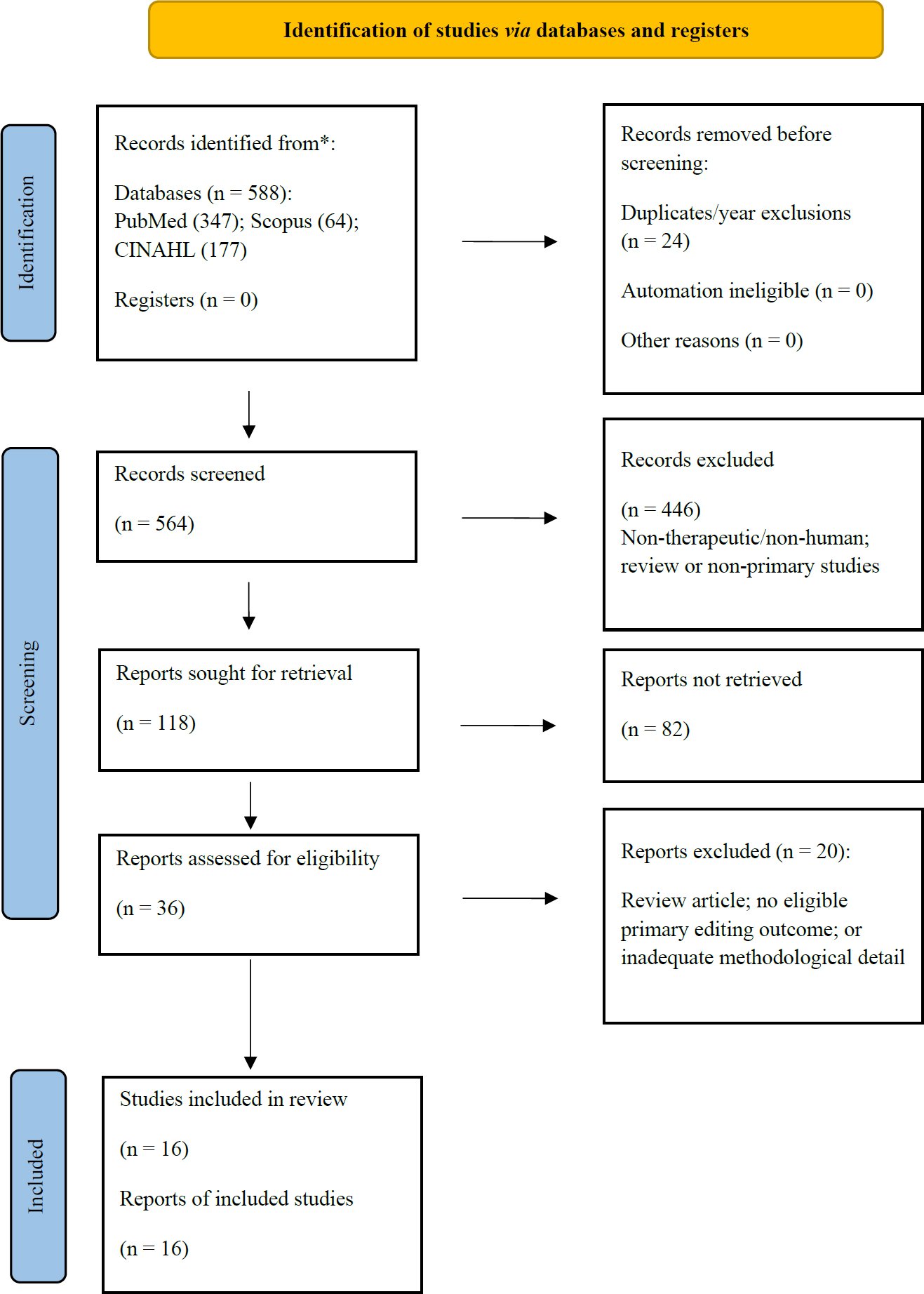
Fig. (1). PRISMA 2020 study-selection flow diagram showing identification, screening, eligibility assessment, and inclusion of 16 primary studies. Adapted from Page et al. [17] under CC BY 4.0.
3.2. Overview of Included Studies
Table 4 summarises the disease settings, target genes, editor platforms, delivery strategies, and therapeutic outcomes reported across the 16 included primary studies. The evidence shows three main patterns:
- Base editing generally performed best for eligible single-nucleotide transitions.
- Prime editing is more adaptable for complex substitutions, insertions, deletions.
- Regulatory changes while therapeutic success depends on functional restoration, delivery feasibility, and safety rather than editing efficiency alone.
Table 4. Characteristics, methods and outcomes of the 16 included primary studies.
| Year | Disease/Model | Target Gene | Editor Platform | Delivery Method | Main Therapeutic Outcome | Reference |
| 2025 | Cystic fibrosis | CFTR (F508del) | Prime editor (PEmax/PE6 with epegRNA) | mRNA and RNA electroporation | Functional CFTR restoration; chloride transport recovery | Sousa et al., [22] |
| 2022 | Duchenne muscular dystrophy model; phenylketonuria model | DMD (exon 51); PAH | Twin prime editor (twinPE) | Plasmid transfection | Precise exon deletion and reading-frame restoration; exonic sequence replacement and pathogenic-region recoding; low indels | Anzalone et al., [23] |
| 2024 | Cystic fibrosis | CFTR (L227R, N1303K) | Prime editor (PE2/PE3) | Lentiviral delivery | Genetic correction; restored CFTR processing and function | Bulcaen et al., [24] |
| 2023 | Duchenne muscular dystrophy | DMD (exons 51, 53) | Prime editor (PE2/PE3) | Plasmid transfection / electroporation | Exon skipping; dystrophin expression restored | Mbakam et al., [25] |
| 2025 | Sickle cell disease | HBG1/HBG2 promoters | Prime editor (PE3/PE5max) | Electroporation | HbF reactivation; increased γ-globin expression | Chalumeau et al., [26] |
| 2021 | Genetic disease models | Multiple loci | Prime editor (PE4/PE5/PEmax) | Plasmid transfection | Increased precise editing efficiency; reduced indels in human cells | Chen et al., [27] |
| 2017 | Genetic disease models | Multiple loci | Adenine base editor (ABE7.10) | Plasmid transfection | Efficient A•T→G•C correction; high purity; minimal indels | Gaudelli et al., [28] |
| 2022 | Alpha-1 antitrypsin deficiency | SERPINA1 | Prime editor (PE2/PE3) | Electroporation | SERPINA1 (PiZZ) correction in patient-derived iPSCs (precise SERPINA1 correction 0.83%), separate genome-wide WGS in H9-iPE2 hESCs showed no significant increase in genome-wide SNVs or indels | Habib et al., [29] |
| 2025 | Genetic disease models | HEK3, RNF2 | Prime editor (PEmax, PE-VLP) | Pseudoviral NanoScribes (VLPs) | Efficient precise editing in hiPSCs and HSC; high fidelity | Halegua et al., [30] |
| 2023 | β-thalassemia | HBB (IVS1-110) | Adenine base editor (SpRY-ABE8e) | mRNA electroporation | Precise mutation correction; restored β-globin expression | Hardouin et al., [31] |
| 2023 | Lesch–Nyhan syndrome | HPRT1 | Cytidine base editor / Adenine base editor / Prime editor | Plasmid transfection / electroporation | Mutation correction; HPRT activity restored in patient fibroblasts | Jang et al., [32] |
| 2018 | Congenital disorder of glycosylation type 1f; β-globin disorders | MPDU1; HBG1/HBG2 promoters | BE4max/AncBE4max; ABEmax | Nucleofection; plasmid transfection | Pathogenic SNP correction in patient fibroblasts; γ-globin activation and fetal-haemoglobin induction | Koblan et al., [33] |
| 2022 | Duchenne muscular dystrophy | DMD (c.8713C>T) | Prime editor (PE2/PE3) | Plasmid transfection | Point mutation correction; dystrophin expression restored | Mbakam et al., [34] |
| 2022 | Genetic disease models | HEK3, EMX1, RNF2 | Prime editor (PE3 with epegRNA) | Plasmid transfection | Increased precise editing efficiency; low off-target activity | Nelson et al., [35] |
| 2020 | Genetic disease models | BCL11A enhancer, HBG promoter | Adenine base editor (ABE8e) | Plasmid transfection | Enhanced A•T→G•C editing; expanded PAM compatibility | Richter et al., [36] |
| 2020 | Aicardi–Goutières syndrome | SAMHD1 | Adenine base editor / Prime editor | mRNA nucleofection | Pathogenic mutation correction in patient-derived hiPSCs | Sürün et al., [37] |
3.3. Engineering Advances Enhancing Editing Precision in Human Cells
3.3.1. Optimisation of Base Editor Architectures in Human Systems
Recent advances in genome editing have focused on improving the accuracy, efficiency, and applicability of base and prime editing in human cells. Gaudelli et al., [28] developed a genome-wide adenine base-editing approach for A•T to G•C conversion by fusing an evolved adenine deaminase to a catalytically impaired Cas9 nickase. In human cell lines, this system generated efficient A•T→G•C conversion with low indel formation, supporting adenine base editing as a high-efficiency platform. However, the study also highlighted persistent limitations, including narrow editing windows and bystander edits within the deaminase activity range.
Expanding these results, Koblan et al., [33] found that intracellular expression level, rather than catalytic activity itself, was the initial and foremost predictor of base-editing efficacy. Nuclear localisation signal optimisation, codon bias, and reconstruction of the ancestral deaminase domains generated BE4max, AncBE4max, and ABEmax. These engineered editors demonstrated substantially improved performance in a variety of human cell types, repairing pathogenic single-nucleotide polymorphisms with higher precision than first-generation editors. Two- to four-fold improvements in editing efficiency were reported compared to ABE7.10, with improved allele-correction frequencies exceeding 70% beyond several disease-relevant sites and reduced bystander editing. These findings extended the work of Gaudelli et al., [28] by demonstrating that editor expression, stability, and host-cell compatibility are important determinants of editing performance.
The remaining drawbacks of base editing were then reduced by Richter et al., [36] through a systematic increase in Protospacer Adjacent Motif (PAM) compatibility and catalytic kinetic optimisation. Using phage-assisted continuous evolution, the authors constructed the ABE8e variant, which had a nearly 590-fold higher deamination rate compared to ABE7.10 and was more broadly compatible with a wider range of Cas proteins. Kinetic studies demonstrated a significantly faster onset of editing, reaching near-maximum activity within 24 h, compared to several days for earlier ABEs. Notably, ABE8e was found to be able to effectively edit genomic loci, including regulatory elements, that were previously inaccessible to base editors. This broader targeting range extended the capabilities described by Koblan et al., [33]. However, increased off-target activity in early ABE8e variants necessitated further specificity-promoting modifications. Genome-wide profiling revealed an increase in off-target editing in both DNA and RNA of early ABE8e variants, thus identifying a measurable trade-off between efficiency and fidelity.
3.3.2. Optimisation of Prime Editing Systems in Human Cells
Chen et al., [27] investigated cellular factors that constrain prime editing in human cells. Using pooled CRISPR-interference screens, they identified mismatch repair as an important suppressor of prime-editing efficiency. The PE4 and PE5 systems, which incorporated transient mismatch-repair inhibition, substantially improved editing outcomes across multiple human loci. These findings show that prime-editing performance is shaped not only by editor design but also by the repair environment of the target cell.
Chen et al., [27] focused on repair-pathway modulation, whereas Habib et al., [29] evaluated prime-editing fidelity in human embryonic stem cells. Using inducible prime-editor platforms, whole-genome sequencing, and a direct comparison with base editing, Habib et al., [29] observed efficient and specific editing with few off-target variants. Genome-wide analysis detected no significant increase in mutations above background rates, supporting the safety and stability of optimised prime editing in therapeutically relevant human cells.
3.4. Expansion of Editing Capability Beyond Single-Nucleotide Variants
3.4.1. Large Insertions, Deletions, and Replacements Using Prime Editing
The ability of genome-editing tools to move beyond single-nucleotide replacement has expanded the therapeutic scope of precision editing in human cells. Anzalone et al., [23] addressed a key limitation of conventional base and prime editing by developing twin prime editing for larger insertions, deletions, inversions, and sequence replacements. This approach uses two pegRNAs to write complementary DNA flaps that can recombine into a defined edited sequence, increasing the range of variants that can be corrected.
Deep sequencing showed precise replacement efficiencies of 20-40% at tested loci and up to 5% for multi-kilobase edits. Comparative genome-wide profiling did not reveal an increase in guide-independent mutations above background. Twin prime editing therefore expanded the ability to perform larger programmed genomic changes, although it required more complex pegRNA design and coordination than canonical prime editing. Efficiency remained dependent on locus, edit size, and genomic context. The capacity for exon-scale correction extends therapeutic scope beyond the variants accessible to base editing, but it also highlights a practical trade-off between editing breadth and design and delivery complexity.
3.4.2. Regulatory and Promoter Editing for Therapeutic Gene Modulation
In an alternative approach to increased editing capability, Chalumeau et al. [26] targeted non-coding regulatory regions rather than protein-coding sequences. They achieved re-expression of foetal haemoglobin by rewriting γ-globin promoters in human haematopoietic cells through prime editing. They achieved approximately 50% accurate editing in human cell lines, and tailorable yet clinically meaningful editing in patient-derived Hematopoietic Stem and Progenitor Cells (HSPC), introducing several mutations associated with hereditary persistence of Foetal Haemoglobin (HPFH) into the HBG1/2 promoters. Interestingly, compounding regulatory edits led to additive action(s) in increased γ-globin expression compared to expression produced by single edits. No significant change in erythroid differentiation markers was observed by RNA sequencing, but levels of gamma-globin transcripts were up to 3x higher than normal. Unlike structural editing strategies, this approach to regulatory editing involves changing regulatory elements instead of directly changing coding elements. In comparison to Anzalone et al., [23], Chalumeau et al., [26] placed emphasis on transcriptional modulation instead of genomic restructuring, which enabled functional rescue through comparatively subtle molecular interventions. However, some editing was more efficient than others depending on the donor, suggesting biologic heterogeneity between primary human stem cell populations.
Regulatory editing was complemented with base editors by Koblan et al., [33]. The authors designed and performed mutations in the promoters to boost adenine and cytidine base editing expression in human cells. Editing levels of over 70% were achieved for selected promoter regions and resulted in uniform upregulation of target-gene expression across all cell types. While base editing is more convenient than the prime-editing approach used by Chalumeau et al., [26] for its ease of guide design and high efficiency in isolated regulatory substitutions, it was not possible to make the same combinations of changes in a single allele. Base editing is thus more efficient for single eligible regulatory variants while prime editing is more versatile for combinatorial regulatory rewriting.
3.5. Disease-Specific Therapeutic Applications in Human Models
3.5.1. Neuromuscular Disorders
Three related but different approaches toward correction were used in these three types of neuromuscular studies: initial correction of the DMD c.8713C>T variant, modifying the splice site(s) to favor exon skipping, and restructuring the gene at the exon level using twin primed editing [23, 25, 34]. The direct correction after RTT was below 20%, and the indel rate was under 5%, while the exon-skipping methods showed an increased level of applicability of the correction method across mutation classes, but results were variable at the level of pegRNA architecture and modulation of splice-site usage. To enable editing of multi-kilobase deletions and insertions, twin prime editing was developed, but this added new features in the editing procedure involving guide design and delivery. The comparative trend is therefore a compromise between specificity and range: direct editing has the highest mutation specificity, exon skipping can be applied to multiple mutation types, while twin prime can be applied to target a wide range of mutations.
The processes of functional evidence were also varied between these approaches. Exon skipping conditions were optimized and up to 40% of dystrophin transcripts could be represented as exon-spliced isoforms, compared to an improved correlation of sequence repair and dystrophin restoration with direct correction [25, 34]. Comprehensively, though, all strategies tested have been primarily performed in human myogenic in vitro models, where local administration of gene constructs to a small number of cells is more easily achieved than systemic administration to skeletal and cardiac muscle. Therefore, achieving broad, accurate, and safe tissue distribution, along with adequate stability, remains the common challenge for both editing approaches. The length of the target sequence in the reverse-transcriptase template also demonstrates that target sequence design is a crucial factor in the performance of the prime-editing system in a DMD model.
3.5.2. Hemoglobinopathies and Blood Disorders
In all haemoglobinopathies, two therapeutic approaches were observed in clinically relevant HSPC: direct correction of a pathogenic HBB allele and regulatory re-activation of foetal haemoglobin. To correct the mutation (HBB IVS1-110) in these CD34+ HSPC, Hardouin et al., [31] tried using SpRY-ABE8e mRNA electroporation, which resulted in high editing success, restoration of beta-globin expression, and unaltered erythroid differentiation. Chalumeau et al., [26] in contrast designed new HBG1/HBG2 promoters that were then incorporated into the genome at previously established disease-causing alleles, which resulted in an elevated level of gamma-globin, but not in the elimination of the disease-causing alleles themselves. The results demonstrate the potential that base editing possesses in situations where a suitable transition and delivery option exists. Promoter editing is a mutation-independent approach that could benefit genetically diverse patients.
Comparative evidence also makes different risks apparent. Direct HBB correction is allele-specific, restores the physiological beta-globin pathway, and is constrained by the editing window, bystander effects, and PAM availability. Regulatory editing was employed to avoid repeated design cycles for each mutation and led to additive increases in gamma-globin, yet there was variability in the efficiency between donors and combination of promoter edits [26, 31, 33]. In both strategies the maturation of erythroid progenitors was generally maintained, and the ability to produce functional haemoglobin was the most informative translational endpoint.
In comparison to solid tumour disorders, the haemoglobinopathy toolkit is more clinically developed as HSPC can be modified ex vivo, quality controlled and re-transplanted autologously, thus providing milder treatment side effects. Lineage-specific functional recovery for the IVS1-110 mutation reflects the association between efficient correction and restoration of haemoglobin production in erythroid progeny.
3.5.3. Cystic Fibrosis
In research on cystic fibrosis, the function of prime editing was tested exclusively in primary airway epithelial cells or organoids derived from patients, and the corrected sequence was directly connected to CFTR processing and chloride-channel function. Bulcaen et al. [24] found that they could correct drug-ineligible CFTR mutants and restore protein maturation, plasma-membrane localisation, and channel activity for N1303K in CFTR. Sousa et al., [22] targeted the common F508del mutation, and designed a combination of pegRNA, editor-expression and delivery optimisation to restore CFTR chloride transport. Both studies demonstrated significant functional rescue for cells with reasonable correction frequencies, where the corrected cells substantially participated in epithelial ion transport.
Both haemoglobinopathy and cystic fibrosis studies demonstrate excellent phenotype-level validation, but delivery for the CF model is more challenging in vivo, and requires repeated targeting of airway epithelia, whereas HSPC delivery, although cumbersome, is more tractable ex vivo. Bulcaen et al., [24] recovered N1303K glycosylation, membrane localisation, and channel function, whereas Sousa et al., [22] found that optimisation of the delivery system of the prime edited sequences and enhancement of the prime editor allowed functional repair of F508del. These studies all set functional restoration as a clear go/no-go benchmark for future translation, with only tissue coverage, durability and pulmonary delivery at larger scales remaining to be determined.
3.5.4. Rare Monogenic and Metabolic Disorders
Phenotype-level restoration is, especially in rare-disease models, an essential, translation-relevant endpoint. In hiPSCs, Sürün et al., [37] showed disease-relevant correction, and in patient fibroblasts, Jang et al., [32] correlated sequence correction with biochemical and cellular outcomes relevant to the disease. Therapeutic relevance was assessed by functional recovery, including human system in the reported cell models, as well as by editing frequency, which was kept below 2% in all cell models reported, further emphasizing that the assessing systems need to be suitable for the type of functional benefit sought.
3.6. Delivery Strategies for Human Genome Editing
3.6.1. Non-Viral and Transient Delivery Approaches
Non-viral delivery methods are broadly employed for therapeutic genome editing because of their ability to expose the genome only for a limited time, and their potential for decreasing the risk to the genome in the long term. In human myogenic cells, Mbakam et al., [34] evaluated plasmid-based and electroporation-based prime editing and found that the efficiency of editing was strongly affected by the delivery feasibility. These results showed that the delivery condition should be considered with the editor performance.
Although the efficiency was not high, editing frequencies were still below 10% and the indel rates were consistently below 2% placing the constructs in a favourable range of safety in relation to their inability to achieve high efficiency. By comparison, Hardouin et al., [31] explicitly tackled the effectiveness of delivery by using mRNA electroporation to transfect patient-derived CD34⁺ haematopoietic stem and progenitor cells with adenine base editors. This was employed to correct the IVS1-110 β-thalassemia mutation; the efficiency of this was around 80% without altering stem-cell characteristics, self-renewal, or erythroid differentiation. When compared to plasmid delivery, mRNA electroporation resulted in sustained expression of the editors and caused less cell stress and toxicity. The properties of these features render ex vivo editing feasible, especially in haematological diseases, where autologous stem-cell transplantation is already in use.
Corrective efficiencies of over 75% led to near normal haemoglobin production in differentiated erythroid progeny further reinforcing the functional relevance. To tackle the delivery related constraints, Nelson et al., [35] optimized the molecular cargo. The prime-editing efficiency and the stability of the RNA were increased in human cell lines and primary human fibroblasts by the addition of structured RNA to the 3′ end of the pegRNAs, with indel frequencies <1%. While not a direct comparison of delivery platforms, the study demonstrated that the improvements were around 3 to 4-fold in the case of engineered pegRNAs, suggesting that cargo architecture can partially mitigate suboptimal delivery conditions.
3.6.2. Pseudoviral and Advanced Delivery Systems
The purpose of advanced delivery systems is to overcome the efficiency and scalability issues of traditional non-viral delivery systems in specific human stem-cell populations. Halegua et al., [30] created new virus-like particles, called NanoScribes, to deliver prime editing components as ribonucleoprotein complexes. The platform was designed to minimize the delivery of exogenous DNA to ensure that nuclease activity is not sustained. The editing efficiencies had optimized fusogens and stabilized epegRNAs of 68-72% in HEK293T cells and approximately 25% in human iPSCs and haematopoietic stem cells.
When compared to plasmid delivery, delivery of the NanoScribe kept indel frequencies below 1%, and reduced the activity of bystander cells, while similar effect seen upon transient exposure. The system also caused editing in stem cells that were otherwise difficult to transfect and did not affect expression of OCT4 and SOX2 nor the clonogenic capacity, confirming maintenance of identity of the edited cells. However, these limitations of clinical translation are still complicated by the complexity of production, batch-to-batch consistency, scale-up of manufacturing, tissue targeting and regulatory characterisation. Optimised mRNA electroporation was not always superior to VLP delivery across all cell types. It would therefore be advisable to consider this as a complementary platform rather than a universal substitute. Furthermore, it will be dependent on reproducible manufacturing and efficient delivery to the target tissue.
The preservation of stemness markers and clonogenic capacity support the short-term cellular compatibility of NanoScribe delivery [30]. However, translational assessment must extend beyond editing efficiency to include reproducible manufacturing, potency testing, biodistribution, immunogenicity, long-term safety, and compatibility with disease-specific clinical workflows.
3.7. Editing Outcomes, Fidelity, and Translational Readiness
3.7.1. Editing Precision and Safety Profiles
The therapeutic potential of base and prime editing in human systems relies on the precision of editing as well as genomic safety. Gaudelli et al., [28] engineered adenine base editing by combining an evolved Adenine Deaminase with a Cas9 nickase, which can convert A•T to G•C without introducing any DSBs. Efficient editing with fewer indels was achieved using this platform with human cell lines, though its efficacy was limited by the availability of PAM, the position of the editing window and a bystander deamination window of 4-6 nucleotides.
Chen et al., [27] followed up this work to demonstrate that prime-editing efficiency can vary across human cell types and genomic targets. CRISPR-Interference (CRISPRi) screening identified mismatch repair as a key inhibitor of prime-editing efficiency. This comparison demonstrates that prime editing is programmable and is tightly coupled to cellular repair pathways.
Habib et al., [29] took fidelity assessment one step further and tested prime editing in human embryonic stem cells. Minimal rates of guide-independent off-target mutations were observed when expressing the editor under an inducer. Prime editing generated fewer bystander effects and RNA-level edits than base editing but showed lower efficiency in some human systems, which remains a major hurdle for clinical translation.
3.7.2. Translational Readiness and Clinical Applicability
Optimal delivery remains a key translational challenge as the optimal approach varies depending on the cell type, tissue access, editor size, and transient exposure requirement. Ultimately, because the functional potential of modest efficiency in prime editing in patient-derived CFTR models can produce meaningful functional rescue, Bulcaen et al., [24] noted that outcomes at the phenotype level are crucial to consider when evaluating therapeutic potential.
Similarly, Sousa and colleagues [22] showed that model-specific optimization can boost the feasibility of prime editing in human primary airway epithelial cells, highlighting the need for optimal editor design and delivery for different target systems.
Though important, delivery is still a tremendous hurdle in clinical translation, especially in human stem-cell systems. To solve this problem, Halegua et al., [30] proposed to transiently deliver prime-editing components to the cell surface with NanoScribe virus-like particles. This strategy facilitated editing, allowed the editors to be used at low toxicity, enabled transient exposure to the editors, and was more efficient in human induced pluripotent stem cells and haematopoietic stem cells. The key challenge, however, is to produce these materials in a scalable manner, to target the tissue specifically, and to be able to reproduce their manufacturing.
4. DISCUSSION
A key advancement over the standard CRISPR-Cas9 system is the emergence of base editing and prime editing, which allow for engineered modifications of DNA without the intention to create DSBs. In therapeutic genome editing, minimizing indel formation, chromosomal rearrangements, and genotoxic stress becomes an important factor, while the lack of DSB in their design can abate some negative repair outcomes [5]. The absence of intentional DSB formation does not eliminate other safety and translational concerns, including bystander editing, incomplete repair, and delivery-related toxicity.
Comparative evidence suggests that the two platforms have different strengths. The efficiency of base editing highly depends on eligible mutations like A→G or C→T substitutions including variants associated with haemoglobinopathies [7]. It has been limited by availability of PAM, editing window size, off-target deamination and bystander editing at neighboring bases [29, 32]. In addition to base editing, prime editing also supports small insertions, deletions, and substitutions without the need for a donor DNA template [38]. This is of specific relevance to CFTR correction in 2D airway epithelial and organoid models [22]. Nevertheless, prime-editing efficiency varies across tissues and cell types, with primary muscle, airway epithelial, and fibroblast cells generally presenting greater challenges than immortalised cell lines. These differences are likely associated with delivery conditions, pegRNA design, and cellular repair pathways, but not an inherent stem cell platform limitation [29, 32].
One noteworthy conclusion from these studies is that editing efficiency alone does not determine therapeutic value. Even modest levels of correction can produce clinically meaningful CFTR functional rescue in relevant airway epithelial and organoid models [22, 24]. By comparison, Duchenne muscular dystrophy has much more widespread delivery and tissue coverage needs [34, 25]. Haemoglobinopathies present a comparatively favourable translational context because HSPC can be edited ex vivo, characterised before autologous transplantation, and assessed for functional recovery [26, 31]. Thus, clinical readiness depends not simply on the percentage of edited cells but also on the proportion of cells that must be corrected, anatomical distribution, durability of functional rescue, and delivery feasibility.
The delivery aspect is thus still a formidable challenge, especially for tissues that lack ex vivo methods for delivery. While the delivery to HSPC and mRNA-based delivery are effective, it is harder to deliver these to skeletal muscle, pulmonary epithelium, and other in vivo targets [16]. All three delivery strategies, non-viral, pseudoviral, and viral face distinct challenges related to immunogenicity, editor size, tissue access, and manufacturing scalability.
Safety and regulatory considerations are also a crucial part of clinical translation. Base-editing and prime-editing technologies lessen dependence on DSB-mediated repair [38–40]. Thus, regulators will expect strong evidence for: genome integrity; off-target activity; long-term safety; and Chemistry, Manufacturing and Controls (CMC) [38, 41]. Considering the implications for future generations from germline editing, as well as other issues regarding ethics, also argues for a somatic-only approach [41].
The two technologies, base editing and prime editing, show therapeutic potential from the 16 systematically selected primary studies, depending on the type of mutation, delivery technology and human cell context (Table 5).
Table 5. Decision framework for base editing and prime editing.
| Factor | Base Editing | Prime Editing |
| Mutation Type | Ideal for single-nucleotide transitions (A→G, C→T) | Suitable for complex mutations (insertions, deletions) |
| Efficiency | High efficiency in target systems (e.g., hematologic disorders) | Lower efficiency in certain primary human systems |
| Target Range | Limited to specific mutations with PAM sites | Broader range including regulatory sequences |
| Delivery Systems | Effective with non-viral systems (e.g., electroporation) | More complex delivery systems required |
| Clinical Relevance | Best for diseases like beta-thalassemia, sickle cell | Best for diseases requiring complex edits like CFTR |
| Regulatory and Ethical Considerations | Regulatory pathway still evolving; specificity data accumulating | Regulatory pathway still evolving; germline-editing ethical considerations apply as they do for base editing |
LIMITATIONS OF THE REVIEW
The limited scope of this review reflects the variety of human cell types, delivery methods, outcome measures, and editor architectures assessed. Few human-relevant studies met the inclusion criteria, further making quantitative meta-analysis difficult.
Further, there are still numerous studies at an early stage included under this umbrella with various endpoints reported such as editing efficiency, specificity, viability and functional restoration [32]. This variability can be a problem in determining the threshold for clinical readiness. Hopefully, in the future, more studies will report standardised safety and functional outcomes on more similar human models, which will strengthen future reviews. As the evidence base expands, transparent machine-learning methods may help integrate heterogeneous molecular, delivery, safety, and functional outcome variables; cross-domain AI studies demonstrate complementary strategies for unstructured-data extraction, prediction from historical and contextual features, and explanation of model outputs [42–44]. Such methods would require biological validation and should supplement, rather than replace, mechanistic and experimental evidence.
CONCLUSION
This review illustrates that base editing and prime editing are significant DSB-free alternatives to the conventional CRISPR-Cas9 system. Based on human primary cells, organoids and stem-cell systems, evidence indicates that base editing is most efficient when the target SNP is within the editing window. Base editing performs optimally when bystander editing can be avoided, while bystander editing remains one of its principal limitations. In contrast, prime editing can be more versatile and precise, making it suitable for complex replacements, indels and regulatory changes and generally exhibiting good fidelity in several key human cell systems, albeit context-dependent efficiency in a few. The functional rescue percentage is a better predictor of therapeutic value than simply editing percentage, and this is true of all models of CF, Duchenne muscular dystrophy, haemoglobinopathy and rare monogenic models. Ongoing improvements in pegRNA engineering, mismatch-repair modulation, mRNA/electroporation delivery, and pseudoviral VLP systems may contribute to improved clinical readiness. In conclusion, in the diverse and rapidly evolving field of precision genome medicine, base editing is more powerful for diseases that require only single-base transition changes, while prime editing is more versatile.
LIST OF ABBREVIATIONS
ABE | = | Adenine Base Editor |
CBE | = | Cytidine Base Editor |
CF | = | Cystic Fibrosis |
CMC | = | Chemistry, Manufacturing and Controls |
CRISPRi | = | CRISPR Interference |
DMD | = | Duchenne Muscular Dystrophy |
HSC | = | Haematopoietic Stem Cell |
HSPC | = | Hematopoietic Stem and Progenitor Cells |
iPSCs | = | induced Pluripotent Stem Cells |
PAM | = | Protospacer Adjacent Motif |
PE | = | Prime Editor |
pegRNA | = | Prime-Editing Guide RNA |
VLP | = | Virus-Like Particle |
AUTHOR’S CONTRIBUTION
The author was responsible for study conceptualization, methodology design, data compilation, analysis and interpretation, and manuscript writing.
CONSENT FOR PUBLICATION
Not applicable.
REPORTING GUIDELINES
This study was conducted in accordance with PRISMA guidelines.
AVAILABILITY OF DATA AND MATERIALS
The data will be made available on reasonable request by contacting the corresponding author [A.H.].
FUNDING
None.
CONFLICT OF INTEREST
The author declares no conflict of interest.
ACKNOWLEDGEMENTS
Declared none.
DECLARATION OF AI
Author declares usage of ChatGPT for language editing and manuscript refinement. They approve the final manuscript and take responsibility for the published content.
APPENDIX

Fig. (A1). Database search outcomes for PubMed.
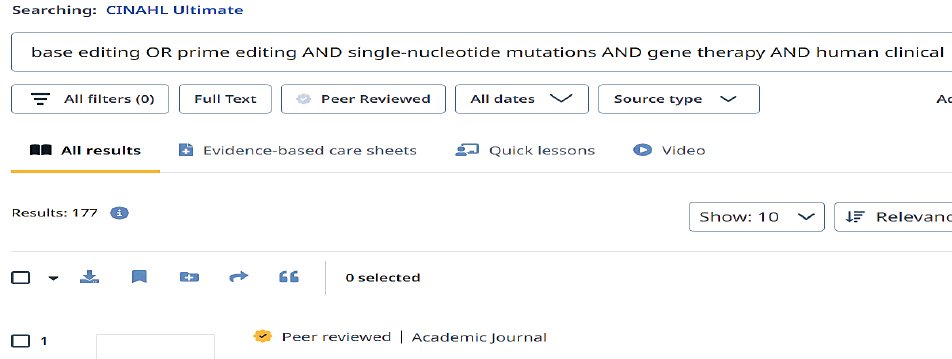
Fig. (A2). Database search outcomes for CINAHL.

Fig. (A3). Database search outcomes for Scopus.
REFERENCES
[1] Kolanu ND. CRISPR-Cas9 Gene Editing: Curing Genetic Diseases by Inherited Epigenetic Modifications. Glob Med Genet. 2024;11(1): 113-22. https://doi.org/10.1055/s-0044-1785234
[2] Jacinto FV, Link W, Ferreira BI. CRISPR/Cas9‐mediated genome editing: From basic research to translational medicine. J Cell Mol Med. 2020;24(7): 3766-78. https://doi.org/10.1111/jcmm.14916
[3] Meyenberg M, Ferreira da Silva J, Loizou JI. Tissue specific DNA repair outcomes shape the landscape of genome editing. Front Genet. 2021;12: 728520. https://doi.org/10.3389/fgene.2021.728520
[4] Bhad V, Bhalerao G, Deokar R. CRISPR-CAS 9 In Gene Editing: Innovations, Applications and Ethical Challenges. IJSTR. 2024;1(11): 59-71. https://doi.org/10.5281/zenodo.14161891
[5] Xu Y, Li Z. CRISPR-Cas systems: Overview, innovations and applications in human disease research and gene therapy. Comput Struct Biotechnol J. 2020;18: 2401-15. https://doi.org/10.1016/j.csbj.2020.08.031
[6] Kalter N, Fuster-García C, Silva A, Ronco-Díaz V, Roncelli S, Turchiano G, et al. Off-target Effects in CRISPR-Cas Genome Editing for Human Therapeutics: Progress and Challenges. Mol Ther Nucleic Acids. 2025;36(3): 102636. https://doi.org/10.1016/j.omtn.2025.102636
[7] Joo JH, Lee S, Kim KP. Precision gene editing: The power of CRISPR-Cas in modern genetics. Mol Ther Nucleic Acids. 2025;36(4): 102733. https://doi.org/10.1016/j.omtn.2025.102733
[8] Li M, Lin Y, Cheng Q, Wei T. Prime Editing: A Revolutionary Technology for Precise Treatment of Genetic Disorders. Cell Prolif. 2025;58(4): e13808. https://doi.org/10.1111/cpr.13808
[9] Rees HA, Liu DR. Base editing: Precision chemistry on the genome and transcriptome of living cells. Nat Rev Genet. 2018;19(12): 770-88. https://doi.org/10.1038/s41576-018-0059-1
[10] Zhang H, Li Y, Li J, Li X, Li T. Base and Prime Editing for Inherited Retinal Diseases: Delivery Platforms, Safety, Efficacy, and Translational Perspectives. Pharmaceutics. 2025;17(11): 1405. https://doi.org/10.3390/pharmaceutics17111405
[11] Hua K, Han P, Zhu JK. Improvement of base editors and prime editors advances precision genome engineering in plants. Plant Physiol. 2022;188(4): 1795-810. https://doi.org/10.1093/plphys/kiab591
[12] Park SH, Bao G. CRISPR/Cas9 gene editing for curing sickle cell disease. Transfus Apher Sci. 2021;60(1): 103060. https://doi.org/10.1016/j.transci.2021.103060
[13] Lee J, Kweon J, Kim Y. Emerging trends in prime editing for precision genome editing. Exp Mol Med. 2025;57(7): 1381-91. https://doi.org/10.1038/s12276-025-01463-8
[14] Lu C, Kuang J, Shao T, Xie S, Li M, Zhu L, et al. Prime Editing: An All-Rounder for Genome Editing. Int J Mol Sci. 2022;23(17): 9862. https://doi.org/10.3390/ijms23179862
[15] Hołubowicz R, Du SW, Felgner J, Smidak R, Choi EH, Palczewska G, et al. Safer and efficient base editing and prime editing via ribonucleoproteins delivered through optimized lipid-nanoparticle formulations. Nat Biomed Eng. 2025;9(1): 57-78. https://doi.org/10.1038/s41551-024-01296-2
[16] Roth TL, Marson A. Genetic Disease and Therapy. Annu Rev Pathol Mech Dis. 2021;16(1): 145-66. https://doi.org/10.1146/annurev-pathmechdis-012419-032626
[17] Page MJ, McKenzie JE, Bossuyt PM, Boutron I, Hoffmann TC, Mulrow CD, et al. The PRISMA 2020 statement: an updated guideline for reporting systematic reviews. BMJ. 2021;372: n71. https://doi.org/10.1136/bmj.n71
[18] Yuan H, Yu T, Wang L, Yang L, Zhang Y, Liu H, Li M et al. Efficient base editing by RNA-guided cytidine base editors (CBEs) in pigs. Cell Mol Life Sci. 2020 Feb;77(4): 719-33. https://doi.org/10.1007/s00018-019-03205-2
[19] Mention K, Santos L, Harrison PT. Gene and Base Editing as a Therapeutic Option for Cystic Fibrosis-Learning from Other Diseases. Genes. 2019;10(5): 387. https://doi.org/10.3390/genes10050387
[20] Mu H, Liu Y, Chi Y, Wang F, Meng S, Zhang Y, et al. Systematic optimization of prime editing for enhanced efficiency and versatility in genome engineering across diverse cell types. Front Cell Dev Biol. 2025;13: 1589034. https://doi.org/10.3389/fcell.2025.1589034
[21] Macarrón Palacios A, Korus P, Wilkens BGC, Heshmatpour N, Patnaik SR. Revolutionizing in vivo therapy with CRISPR/Cas genome editing: breakthroughs, opportunities and challenges. Front Genome Ed. 2024;6: 1342193. https://doi.org/10.3389/fgeed.2024.1342193
[22] Sousa AA, Hemez C, Lei L, Traore S, Kulhankova K, Newby GA, et al. Systematic optimization of prime editing for the efficient functional correction of CFTR F508del in human airway epithelial cells. Nat Biomed Eng. 2025;9(1): 7-21. https://doi.org/10.1038/s41551-024-01233-3
[23] Anzalone AV, Gao XD, Podracky CJ, Nelson AT, Koblan LW, Raguram A, et al. Programmable deletion, replacement, integration and inversion of large DNA sequences with twin prime editing. Nat Biotechnol. 2022;40(5): 731-40. https://doi.org/10.1038/s41587-021-01133-w
[24] Bulcaen M, Kortleven P, Liu RB, Maule G, Dreano E, Kelly M, et al. Prime editing functionally corrects cystic fibrosis-causing CFTR mutations in human organoids and airway epithelial cells. Cell Rep Med. 2024;5(5): 101544. https://doi.org/10.1016/j.xcrm.2024.101544
[25] Happi Mbakam C, Roustant J, Rousseau J, Yameogo P, Lu Y, Bigot A, et al. Prime editing strategies to mediate exon skipping in DMD gene. Front Med. 2023;10: 1128557. https://doi.org/10.3389/fmed.2023.1128557
[26] Chalumeau A, Bou Dames M, Fontana L, Amistadi S, Antoniou P, Loganathan P, et al. A prime editing strategy to rewrite the γ-globin promoters and reactivate fetal hemoglobin for sickle cell disease. Blood. 2025;146(22): 2641-55. https://doi.org/10.1182/blood.2024028166
[27] Chen PJ, Hussmann JA, Yan J, Knipping F, Ravisankar P, Chen PF, et al. Enhanced prime editing systems by manipulating cellular determinants of editing outcomes. Cell. 2021;184(22): 5635-5652.e29. https://doi.org/10.1016/j.cell.2021.09.018
[28] Gaudelli NM, Komor AC, Rees HA, Packer MS, Badran AH, Bryson DI, et al. Programmable base editing of A•T to G•C in genomic DNA without DNA cleavage. Nature. 2017;551(7681): 464-71. https://doi.org/10.1038/nature24644
[29] Habib O, Habib G, Hwang GH, Bae S. Comprehensive analysis of prime editing outcomes in human embryonic stem cells. Nucleic Acids Res. 2022;50(2): 1187-97. https://doi.org/10.1093/nar/gkab1295
[30] Halegua T, Risson V, Carras J, Rouyer M, Coudert L, Jacquier A, et al. Delivery of Prime editing in human stem cells using pseudoviral NanoScribes particles. Nat Commun. 2025;16(1): 397. https://doi.org/10.1038/s41467-024-55604-0
[31] Hardouin G, Antoniou P, Martinucci P, Felix T, Manceau S, Joseph L, et al. Adenine base editor–mediated correction of the common and severe IVS1-110 (G>A) β-thalassemia mutation. Blood. 2023;141(10): 1169-79. https://doi.org/10.1182/blood.2022016629
[32] Jang G, Shin HR, Do HS, Kweon J, Hwang S, Kim S, et al. Therapeutic gene correction for Lesch-Nyhan syndrome using CRISPR-mediated base and prime editing. Mol Ther Nucleic Acids. 2023;31: 586-95. https://doi.org/10.1016/j.omtn.2023.02.009
[33] Koblan LW, Doman JL, Wilson C, Levy JM, Tay T, Newby GA, et al. Improving cytidine and adenine base editors by expression optimization and ancestral reconstruction. Nat Biotechnol. 2018;36(9): 843-6. https://doi.org/10.1038/nbt.4172
[34] Mbakam CH, Rousseau J, Lu Y, Bigot A, Mamchaoui K, Mouly V, et al. Prime editing optimized RTT permits the correction of the c.8713C>T mutation in DMD gene. Mol Ther Nucleic Acids. 2022;30: 272-85. https://doi.org/10.1016/j.omtn.2022.09.022
[35] Nelson JW, Randolph PB, Shen SP, Everette KA, Chen PJ, Anzalone AV, et al. Engineered pegRNAs improve prime editing efficiency. Nat Biotechnol. 2022;40(3): 402-10. https://doi.org/10.1038/s41587-021-01039-7
[36] Richter MF, Zhao KT, Eton E, Lapinaite A, Newby GA, Thuronyi BW, et al. Phage-assisted evolution of an adenine base editor with improved Cas domain compatibility and activity. Nat Biotechnol. 2020;38(7): 883-91. https://doi.org/10.1038/s41587-020-0453-z
[37] Sürün D, Schneider A, Mircetic J, Neumann K, Lansing F, Paszkowski-Rogacz M, et al. Efficient generation and correction of mutations in human IPS cells utilizing mRNAs of CRISPR base editors and prime editors. Genes. 2020;11(5): 511. https://doi.org/10.3390/genes11050511
[38] Chen PJ, Liu DR. Prime editing for precise and highly versatile genome manipulation. Nat Rev Genet. 2023;24(3): 161-177. https://doi.org/10.1038/s41576-022-00541-1
[39] Blattner G, Cavazza A, Thrasher AJ, Turchiano G. Gene Editing and Genotoxicity: Targeting the Off-Targets. Front Genome Ed. 2020;2: 613252. https://doi.org/10.3389/fgeed.2020.613252
[40] Zhao Z, Shang P, Mohanraju P, Geijsen N. Prime editing: advances and therapeutic applications. Trends Biotechnol. 2023;41(8): 1000-12. https://doi.org/10.1016/j.tibtech.2023.03.004
[41] Fiumara M, Ferrari S, Omer-Javed A, Beretta S, Albano L, Canarutto D, et al. Genotoxic effects of base and prime editing in human hematopoietic stem cells. Nat Biotechnol. 2024;42: 877-91. https://doi.org/10.1038/s41587-023-01915-4
[42] Patel V. AI-powered due diligence in private equity: automated analysis of financial, legal, and business intelligence data using NLP and deep learning. J Comput Anal Appl. 2026;35(9): 1-17. Available from: https://eudoxuspress.com/index.php/pub/article/view/5818
[43] Patel V. Machine learning models for predicting private equity fund performance using historical deal-level and macroeconomic data. MSW Manag J. 2026;36(2). Available from: https://mswmanagementj.com/index.php/home/article/view/4234
[44] Patel V. Explainable AI for private equity valuation: integrating financial statements, market signals, and risk-adjusted learning models. J Law Sustain Dev. 2026;14(5): e04658. https://doi.org/10.55908/sdgs.v14i5.4658