


Article ID: PD2601205003
Views: 591Wastewater-Based Antimicrobial Resistance Surveillance: A Systematic Review of Metagenomic and Complementary Molecular Evidence from Wastewater and Wastewater-Impacted Environments
 PDF
PDF
⬇ Downloads: 39
1Department of Animal Sciences, Karakoram International University, Gilgit, Pakistan
Received: 17 May, 2026
Accepted: 17 September, 2026
Revised: 29 July, 2026
Published: 14 October, 2026
ABSTRACT:
Introduction: Wastewater and wastewater-impacted environments are increasingly used to monitor antimicrobial resistance genes (ARGs) and characterize resistance determinants relevant to environmental AMR surveillance. This systematic review aimed to synthesize evidence on ARG prevalence, diversity and persistence, with particular attention to the analytical resolution of shotgun metagenomics, complementary molecular evidence, methodological quality, environmental drivers and public-health interpretation.
Methods: PubMed and Scopus were searched for eligible studies published from January 2018 to July 2025, with Google Scholar used as a supplementary screening source. The initial search was done on July 31, 2025. The final database comprised 652 PubMed/Scopus records, and the first 20 Google Scholar result pages (approximately 200 records) were screened without being counted as a stable PRISMA record set. The study included 15 studies while JBI design-specific appraisal was supplemented by a metagenomic methodological appraisal for the 13 included studies that used shotgun metagenomics. The review was not prospectively registered and no protocol was prepared. Moreover, the scope amendment made during revision is acknowledged as a review limitation.
Results: Clinically relevant ARGs, including blaCTX-M, sul1, tetM, erm, and mcr-1, were detected across global, national, and local wastewater-associated environments. Mobile genetic elements were frequently reported in association with ARGs, indicating potential mobility of resistance determinants. However, this does not necessarily mean the ARGs were horizontally acquired or transmitted. Differences in sampling methods, analytical procedures, ARG databases, normalisation methods, and reporting procedures hindered direct comparisons between studies. Resistome profiles were found to be different depending on the environmental and operational conditions, such as seasonal changes and input of hospital wastewater, but the effect these factors have needs to be further confirmed based on standardised and long-term investigation.
Conclusion: Wastewater metagenomics is a promising complementary One Health surveillance approach for characterizing environmental AMR patterns, but its clinical and public-health utility requires further validation. Standardized sampling, sequencing, normalization and reporting, together with longitudinal clinical correlation and exposure-based interpretation, are needed before wastewater resistome measurements can be used routinely for actionable public-health decisions.
Keywords: Antimicrobial resistance, wastewater metagenomics, resistome, one health, public health, environmental safety, antimicrobial resistance genes.
1. INTRODUCTION
Inflation Antimicrobial Rresistance (AMR) is a property of microorganisms that allows them to survive the action of antimicrobial drugs. The mechanisms that can decrease the effectiveness of an antimicrobial drug are encoded by genes known as Antimicrobial Resistance Genes (ARGs) at the genetic level [1]. The potential mobility of ARGs can be enhanced by the gene transfer capacity of Mobile Genetic Elements (MGEs) like plasmids, integrons and transposons, which can enable the transfer of ARGs among microbial populations [2]. Wastewater contains diverse microbial communities with ARGs and MGEs, making it an important matrix for detecting and characterizing resistance determinants. The identification of the presence of the gene, however, does not confirm that it is expressed, the viability of the host organism, genomic linkage, horizontal transfer, environmental exposure or transmission to humans or animals. A comprehensive global analysis in 2019 found bacterial AMR as directly responsible for 1.27 million deaths while associated with an additional 4.95 million deaths globally [3].
Furthermore, the burden of bacterial AMR is distributed unevenly across geographical regions, globally, only 56% of domestic wastewater was safely treated in 2024 leading to a continuous discharge of inadequately treated effluents into the receiving water bodies. These effluents are environmental reservoirs for the dissemination of Antimicrobial-Resistant Bacteria (ARB) and antimicrobial resistance genes (ARGs), promoting horizontal gene transfer and contributing to the global propagation of antimicrobial resistance [4]. These figures justify an urban-wastewater focus and motivate a metagenomics-anchored evidence synthesis that can resolve ARG diversity, context, and mobility with decision-relevant specificity.
Shotgun metagenomics, sequencing all DNA in a sample, enables culture-independent profiling of ARG diversity and their genomic contexts [5]. Metagenomic surveys of urban sewage have mapped strong geographic structure in the resistome at city and global scales [6]. A more comprehensive study by Munk et al. [7] studied 757 samples of urban sewage from 243 cities in 101 countries, again showing significant geographical differences in the antimicrobial resistance profiles. The geographic scope differs between large-scale wastewater resistome studies. Munk et al. [7] also reported a broader global analysis involving urban sewage from 101 countries. These studies should therefore be interpreted according to their individual sampling frameworks. Clinically relevant markers such as mobilised colistin resistance (mcr) genes for colistin and carbapenemases such as blaNDM/blaOXA, as well as heavy-metal–linked proxies like integron integrase 1 (intI1), are consistently detectable in urban influent and, treated effluents from municipal Waste Water Treatment Plants (WWTPs) following secondary or tertiary treatment including Conventional Activated Sludge (CAS) or Membrane Bioreactor (MBR) with chlorination, UV radiation or ozonation [8].
Prior syntheses leave actionable gaps for public health and environmental safety. Scope mixing is common: reviews often combine phenotypic assays, targeted qPCR/amplicon data, and metagenomics, making it difficult to distinguish the unique contribution of metagenomics in urban municipal systems [9, 10]. Risk translation is underdeveloped: while concordance between wastewater and clinical AMR has been discussed, frameworks converting metagenomic signals into exposure-relevant indicators are still nascent [10]. For example, Ko et al. [11] critiques the limited integration of metagenomic data into actionable public health metrics, showing a gap in translating environmental data to real-world applications.
Methodological heterogeneity remains a barrier, as variations in database choices, read vs. assembly-based inference, and normalisation methods hinder cross-study comparability. Rumi et al. [12] identify how inconsistent database use leads to varying ARG identifications, resulting in data bias. Tools like MetaCompare/2.0 for resistome risk ranking are inconsistently applied, limiting their utility. Martínez-Quintela et al. [13] found fragmented process-stage quantification, where diverse technologies yield differing results on ARG removal. Furthermore, Papp et al. [14] reported sludge and biosolids are vital for ARG persistence studies and remain underexplored, thereby hindering comprehensive environmental risk assessment. A focused systematic review of metagenomic insights into urban wastewater resistomes is warranted. A more focused synthesis is required to identify the extent to which a wastewater shotgun metagenomics approach differs from other molecular methods employed in wastewater AMR surveillance. Previous reviews have mostly combined different approaches, while the present review focused on the metagenomic evidence and consulted selected non-metagenomic studies primarily for methodological comparison and contextual support.
Although shotgun metagenomics has been increasingly applied to study the occurrence of antimicrobial resistance in urban wastewater, available data are currently quite limited in the degree of comparability between different studies, given the use of different sampling strategies, sequencing depths, reference databases, and normalization procedures [15, 16]. Most investigations are descriptive with little effort made to validate wastewater ARG profiles against clinical resistance data, nor are there thresholds for public-health action based on exposure [10, 11]. In addition, the association of ARG–mobile genetic elements are not well resolved, and the assessment is not complete over the entire treatment steps, which leaves gaps in understanding of transmission risks [16]. A focused synthesis is thus needed to normalise metagenomic evidence, assess ARG persistence in wastewater treatment systems and to determine clinically relevant indicators for One Health surveillance and policy action.
This review’s contribution is a focused synthesis of evidence relating to wastewater AMR, with a particular focus on the analytical resolution of shotgun metagenomics. Past reviews have provided a summary of wastewater-associated antimicrobial resistance through various molecular, microbiological, and epidemiological methods; however, variations in analytical resolution, sequencing strategies, and environmental matrices hinder direct comparisons to previous studies. This systematic review focuses primarily on shotgun-metagenomic evidence while incorporating selected complementary molecular studies to provide broader context for wastewater-associated AMR surveillance. The review examines ARG diversity, analytical pipelines, treatment-stage patterns, ARG–mobile genetic element associations, and the extent to which genomic approaches can resolve resistance determinants within wastewater and wastewater-impacted environments.
2. METHODOLOGY
2.1. Research Design
This systematic review synthesized evidence on Antimicrobial Resistance Genes (ARGs) in wastewater and wastewater-impacted environments. The review was metagenomics-anchored: shotgun metagenomic studies formed the principal evidence base, while targeted qPCR and culture-based studies were retained as complementary molecular evidence when they met the stated wastewater-associated eligibility criteria. Eligible matrices comprised municipal and hospital wastewater, wastewater-treatment influent and effluent, sludge/biosolids, and receiving aquatic environments demonstrably affected by wastewater discharge. Because complementary molecular methods and wastewater-impacted receiving environments were added during manuscript revision, this post hoc amendment is reported explicitly and considered when interpreting the breadth and comparability of the synthesis. Study identification, screening and reporting followed PRISMA 2020 [17].
2.2. Literature Search Strategy
A systematic literature search was conducted using PubMed and Scopus, with Google Scholar used as a supplementary dynamic screening source. The initial search was done on July 31, 2025, which is the final search date. The final PubMed and Scopus retrieval counts reported in the PRISMA accounting are the counts through July 31, 2025.
Google Scholar was not treated as an equivalent bibliographic database because it does not provide a stable exportable result set. The first 20 result pages (approximately 200 results) were manually screened; the interface estimate of approximately 1,170 results was not entered into the PRISMA identification total. No additional unique eligible study was added from the Google Scholar manual screening. PubMed and Scopus records were exported to Zotero for deduplication, with automated duplicate identification followed by manual checking. The retained search strings and documented counts are presented in Supplementary Appendix A.
2.3. Eligibility Criteria
Studies were eligible if they reported primary data on ARGs or antimicrobial-resistant organisms in wastewater or a receiving environmental matrix explicitly linked to wastewater discharge. Eligible matrices were municipal wastewater, hospital wastewater, WWTP influent/effluent, sludge/biosolids, and wastewater-impacted canals, rivers or surface waters. Eligible analytical approaches included shotgun metagenomics and complementary targeted molecular or culture-based AMR characterization. Reviews, editorials, conference abstracts, studies without a defined wastewater/wastewater-impact context, studies without relevant AMR outcomes, and reports with insufficient methodological information for interpretation were excluded.
2.4. Data Screening
The final PubMed and Scopus searches identified 652 records (PubMed n = 105; Scopus n = 547). Twenty-two duplicate records were removed before screening, leaving 630 records for title and abstract screening. The Google Scholar interface estimate was not included in these identification totals; approximately 200 Google Scholar results (first 20 pages) were screened as a supplementary source (Supplementary Appendix A).
Of the 630 records screened, 586 were excluded at title/abstract stage. Forty-four reports were sought for retrieval; two could not be retrieved, leaving 42 full-text reports assessed for eligibility. Twenty-seven reports were excluded (Supplementary Appendix B). These include the following: studies outside the wastewater/wastewater-impact scope (n = 7), not relevant to AMR outcome (n = 10), those that were review/editorial/commentary (n = 5), or contained insufficient methodological information (n = 5). Fifteen studies were included in the systematic review and narrative synthesis. The additional eligible study was identified in the update on July 31, 2025 and was included in these counts, as indicated in Fig. (1).
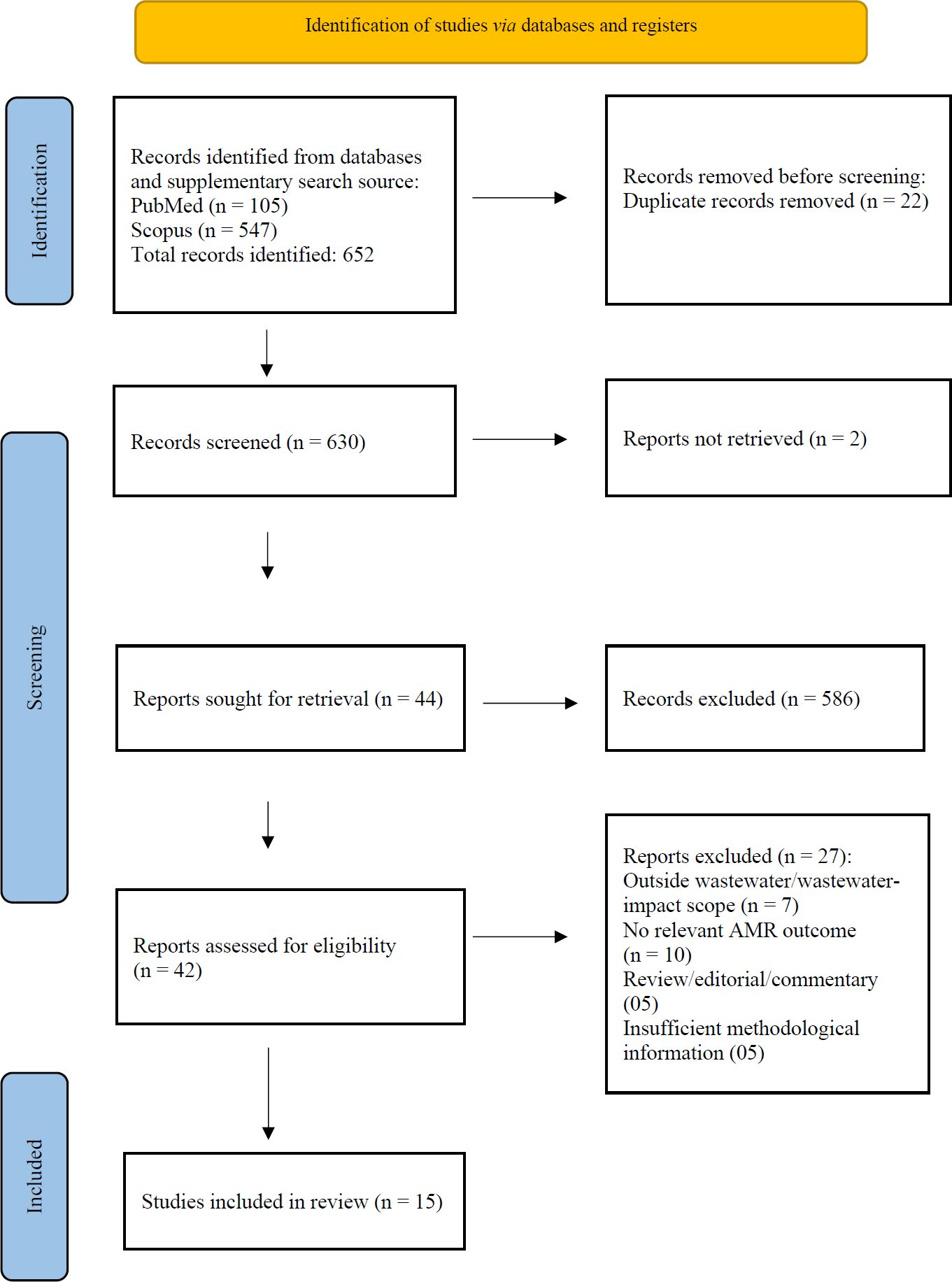
Fig. (1). PRISMA flow diagram.
Two reviewers independently screened the title and abstract and, based on the predetermined inclusion criteria, determined whether the articles met the inclusion criteria. Reports were then evaluated in full text at the same time for potentially eligible reports. At both meetings, differences were resolved by discussion and consensus. Records from the bibliographic databases were merged before screening, and duplicate records were eliminated before the assessment of the titles and abstracts. The reasoning for including or excluding articles at the screening stage was recorded to help with PRISMA reporting purposes.
The scope of this review was refined during the revision process to include wastewater and wastewater-impacted environments, including municipal and hospital wastewater, wastewater treatment plant influents and effluents, sludge/biosolids, and receiving environments affected by wastewater discharge. This amendment was introduced to better capture the environmental pathways through which antimicrobial resistance genes (ARGs) occur and persist.
2.5. Data Extraction and Analysis
Data from the 15 included studies were extracted independently by two reviewers using a structured template. Extracted variables included author/year, study aim, setting/location, number and type of sites where reported, environmental matrix, analytical method, treatment stage or comparison, principal ARG findings, and study/appraisal limitations. Discrepancies were resolved by discussion and consensus. Because the included studies differed in sampling design, sequencing depth, ARG databases, normalization, matrix and analytical platform, formal meta-analysis was not appropriate. A narrative synthesis was organized around ARG diversity and prevalence, genomic context/potential mobility, treatment-stage persistence or removal, and environmental/public-health interpretation. No formal sensitivity analysis, reporting-bias analysis, or GRADE-style certainty assessment was undertaken.
2.6. Quality Assessment
JBI critical appraisal tools were selected according to the way each included study was reported. Studies structured as cross-sectional comparisons of settings, sources or analytical approaches were appraised with the JBI Analytical Cross-Sectional Studies Checklist [18], whereas descriptive occurrence/prevalence surveys were appraised with the JBI Prevalence Studies Checklist [19, 20]. Ten studies were assigned to the cross-sectional checklist and five to the prevalence checklist, with each included study appearing once. Responses were coded as Yes, No, Unclear or Not applicable according to whether the published report clearly satisfied the item, failed it, provided insufficient information, or made the item inapplicable. The JBI tools were used to characterize reporting and methodological limitations, not to validate the review’s scientific conclusions (Supplementary Appendix C).
A methodological appraisal of studies using metagenomic approaches was performed in addition to the general appraisal of the observational-study tools, because there are some technical sources of bias which are not fully captured by the general tools used for observational study appraisal. The appraisal took into account sampling representativeness and replication, sampling and concentration, principle of DNA extraction, depth of sequencing and QC procedures, negative controls, antimicrobial-resistance gene database and versions, identification thresholds, read-based versus assembly-based analyses, abundance normalisation, host assignment, linkage of mobile genetic elements, and availability of sequencing data and analytical code, as indicated in Supplementary Appendix D, E.
2.7. Ethical Consideration
Ethical standards were observed in line with international and institutional guidelines relevant to the study designs included in this review. This review did not involve direct experimentation with humans or animals. Ethical approval was not required and informed consent was not obtained since this was a secondary analysis of previously made studies. However, every effort was made to ensure that there was strict reporting, transparency and that guidance in conducting and reporting reviews was followed.
3. RESULTS
3.1. ARG Diversity and Prevalence Across Wastewater Matrices
The 15 included studies comprised predominantly shotgun-metagenomic investigations together with selected complementary molecular studies. The study by Hendriksen et al. [21] showed a link between national antibiotic use prevalence, sanitation infrastructure and prevalence of ARGs, highlighting the role of sociodemographic factors. Similarly, Becsei et al. [22] noted differences among five cities in Europe, where the outcomes of bioburden testing were affected by Pseudomonas blooms that inhibited the detection of some ARGs. This highlights that the resistome may suffer from microbial community composition bias.
Hospital-wastewater studies reported higher ARG abundance or diversity than municipal/community wastewater in some settings, including clinically relevant blaNDM-1, blaOXA and mcr variants (Table 1). These observations identify settings with elevated resistance determinants but do not by themselves demonstrate selection, amplification, dissemination or transmission. Jantharadej et al. [23] reported 611 ARG subtypes in Bangkok canal-water samples, including abundant β-lactam resistance determinants and pathogenic genera such as Arcobacter and Burkholderia. The canal findings are consistent with wastewater influence on the receiving environment, but do not establish direct transmission pathways.
Table 1. Comparison of major antibiotic resistance genes (ARGs) reported across wastewater studies.
| Study | Wastewater Matrix | Major ARGs Reported | Key Finding |
| Hendriksen et al. 2019 [21] | Urban wastewater (60 countries) | β-lactamases, macrolide, tetracycline | High global ARG diversity (557 ARGs); prevalence linked to antibiotic use and sanitation. |
| Becsei et al. 2024 [22] | Municipal wastewater | β-lactam, macrolide ARGs | ARG profiles varied among cities; microbial composition influenced detection. |
| Jantharadej et al. 2022 [23] | Canal water affected by sewage | β-lactam ARGs | Surface water reflected upstream sewage resistome. |
| Tsvetanova and Boshnakov, 2025 [24] | Wastewater | erm(B), blaOXA | Targeted methods detected fewer ARGs but quantified clinically relevant genes effectively. |
Interestingly, culture-based and targeted qPCR approaches, such as those conducted by Tsvetanova and Boshnakov [24] and Magnano San Lio et al. [25] detected fewer ARGs but a higher relative abundance of clinical relevance resistance genes including erm(B) or blaOXA. This illustrates the trade-off between detection breadth and quantitative sensitivity, indicating that methodological approaches directly influence the diversity and composition of the resistome observed. Although these studies have all demonstrated the ubiquitous presence of ARGs across wastewater matrices, the diversity and abundance reported is systematic, depending on sampling design, sequencing depth and analytical methods (Supplementary Appendix D, E).
3.2. ARG Co-occurrence, Genomic Context, and Potential Mobility
The included studies provided different levels of evidence regarding the genomic context and potential mobility of ARGs. Detection of ARGs in metagenomic reads confirmed the presence of ARGs in a sample. In contrast, taxonomic co-occurrence only confirmed the presence of ARGs and a specific microbial group within a microbial community. However, these levels of evidence should not be interpreted as equivalent to demonstrated transmission, because genomic association or potential mobility does not confirm successful horizontal gene transfer, survival of resistant organisms, or human exposure. More evidence was available for ARGs localized to assembled contigs, metagenome-assembled genomes, plasmids, integrons, or other mobile genetic elements. Genomic linkage does not necessarily imply horizontal gene transfer, but can imply potential for mobility. Likewise, the presence of ARGs in taxa that contain opportunistic pathogens does not mean that the resistance gene was on a viable pathogenic strain unless a host assignment was done with high enough genomic specificity. The integron (intI1) was enriched in the influent samples and often found to be associated with the carbapenemase genes such as blaNDM and colistin resistance genes such as mcr-1 as reported by Sekizuka et al. [26]. In the same way, plasmid associated ARGs were also identified in E. coli, Klebsiella and Acinetobacter by Prieto Riquelme et al. [27] indicating that the distribution of resistomes is related to the bacterial host and the potential for genetic mobility.
Variability across time was observed in some investigations. In Rotterdam, the microbial community of the sewer changed significantly across the seasons [26]. In Copenhagen, the microbial community was different. However, measurements of selected ARGs showed seasonal variation in effluents from the Copenhagen WWTP [26], with some resistance determinants being more abundant in summer than winter effluents. While longitudinal surveillance of selected ARGs was provided in three Sicilian wastewater-treatment plants by Magnano San Lio et al. [25], the authors did not provide supporting analysis to conclude that the plants experienced seasonal changes due to prescription. A comparison of genomic findings across studies revealed significant variability in ARG types and prevalence due to differences in sampling context, sequencing depth, and analysis methods. For example, Hendriksen et al. [21] detected a wide range of ARGs globally, while Silvester et al. [28] found a higher prevalence of carbapenem resistance in hospital wastewater (Table 2). Studies with higher sequencing depth captured rare ARGs, while those using 16S rRNA sequencing missed broader resistome diversity [15, 25]. These genomic discrepancies emphasize the need for standardized methodologies to enable more consistent and comparable findings across studies, highlighting the critical role of hospital effluents in the environmental occurrence or dissemination potential of AMR determinants. The evidence was therefore interpreted hierarchically as follows: ARG detection in unassembled reads; ARG–taxon co-occurrence; ARG localization within assembled contigs or metagenome-assembled genomes; ARG linkage to plasmids, integrons or other mobile elements; and, at the highest level, direct evidence of environmental or human transmission of viable phenotypically resistant organisms. Most included studies provided evidence within the first four levels of this hierarchy; however, none demonstrated direct environmental or human transmission of viable resistant organisms.
Acosta et al. [29] showed that meropenem enrichment increased detection of rare carbapenemases, demonstrating that analytical sensitivity can affect whether low-abundance ARGs are detected. Low abundance alone should not be interpreted as disproportionate public-health risk without information on host, viability, mobility, exposure and clinical relevance. Becsei et al. [22] and Jantharadej et al. [23] also reported associations between ARG signals and microbial taxa. Co-occurrence or association with MGEs can indicate possible genomic context or mobility potential, but does not demonstrate horizontal gene transfer or subsequent transmission to humans or animals.
3.3. Stage-Wise ARG Removal or Persistence
The changes in the indicators of antimicrobial resistance in each of the stages of the wastewater-treatment process were different depending on both the treatment process and the method of measurement. Reported outcomes were absolute abundance, relative abundance, detection frequency, prevalence of resistant organisms, and log reduction, and were not directly interchangeable and were interpreted separately. If an overall biomass of bacteria is decreased during treatment, a decrease in absolute ARG concentration can occur with an increase in relative abundance.
Tsvetanova and Boshnakov [24] reported decreases in culturable counts of AMR bacterial species in treated effluents in all cases, except for Enterobacteriaceae and Enterococcus, which were detected. Sekizuka et al. [26] observed about a 1-log reduction in some signals associated with the ARGs from the influent to effluent. Majeed et al. [30] reported a total ARG abundance approximately 50% less in secondary effluent than in influent, and that approximately 90% of the ARG types found in secondary effluent also appeared in the influent. The findings suggest that the ARG diversity continues to exist despite a decline in some abundance measures. Quantitative comparison of the performance of the different treatments was not appropriate due to differences in the data analysis platform employed, microbial denominators, and sequencing depths used in the included studies. Treatment results were therefore evaluated and compared within each study, based on the results reported in each and not across technologies by incompatible measures.
3.4. Metagenomic Methodological Appraisal
The metagenomic appraisal revealed differences in the reported technical and analytical parameters among metagenomic studies (Table 2). Some discrepancies were noted regarding the reporting of sampling replication, sequencing depth, quality control procedures, ARG database selection, normalisation methods, assembly-based analyses, host assignment, and the availability of sequencing data/analytical code [28, 29, 31]. These differences are sources of methodological heterogeneity and should be taken into account when comparing metagenomic findings from studies.
Table 2. Metagenomic methodological appraisal of included metagenomic studies.
| Study | Sampling Representativeness | Replication | Sample Processing/DNA Extraction | Sequencing Depth & QC | ARG Database/Version | Detection Threshold | Read/Assembly Approach | Normalization Method | Host Assignment | ARG–MGE Linkage | Raw Data Availability |
| Davis et al. 2025 [15] | Yes | Yes | Yes | Yes | Yes (CARD) | Yes | Read-based metagenomics | Yes (16S normalization/qPCR supported) | Unclear | Unclear | Yes |
| Knight et al. 2024 [16] | Yes | Yes | Yes | Yes | Yes | Yes | Shotgun metagenomics | Yes | Unclear | Unclear | Yes |
| Hendriksen et al. 2019 [21] | Yes | Yes | Yes | Yes | Yes (ResFinder/CARD-based annotation) | Yes | Read-based metagenomics | Yes | Unclear | Unclear | Yes |
| Becsei et al. 2024 [22] | Yes | Yes | Yes | Yes | Yes | Yes | Shotgun metagenomics + MAG analysis | Yes | Yes | Yes | Yes |
| Jantharadej et al. 2022 [23] | Yes | Yes | Yes | Yes | Yes | Yes | Shotgun metagenomics + 16S | Yes | Unclear | Unclear | Yes |
| Sekizuka et al. 2022 [26] | Yes | Yes | Yes | Yes | Yes (MEGARes/CARD) | Yes | Shotgun metagenomics | Yes | Yes | Yes | Yes |
| Prieto Riquelme et al. 2022 [27] | Yes | Yes | Yes | Yes | Yes (CARD) | Yes | Shotgun metagenomics | Yes (16S normalized abundance) | Yes | Yes | Yes |
| Silvester et al. 2025 [28] | Yes | Yes | Yes | Yes | Yes (MEGARes) | Yes | Shotgun metagenomics | Yes | Unclear | Unclear | Yes |
| Acosta et al. 2025 [29] | Yes | Yes | Yes | Yes | Yes | Yes | Shotgun metagenomics ± enrichment | Yes | Unclear | Unclear | Yes |
| Rout et al. 2023 [31] | Yes | Yes | Yes | Yes | Yes | Yes | Shotgun metagenomics | Unclear | Unclear | Unclear | Yes |
| Fresia et al. 2019 [35] | Yes | Yes | Yes | Yes | Yes (CARD) | Yes | Read-based metagenomics | Yes | Unclear | Unclear | Yes |
Assessment categories: Yes = criterion clearly reported and satisfied; No = criterion reported but not satisfied; Unclear = insufficient information to determine; Not reported = information unavailable in the publication; Not applicable = criterion not relevant to the study design.
3.5. Implications for Environmental and Public Health Risk
Repeated detection of clinically relevant ARGs in wastewater and wastewater-impacted waters supports their use for environmental hazard identification and surveillance. Detection does not establish gene expression, viable pathogenic hosts, horizontal transfer, direct exposure or transmission. Likewise, co-occurrence of ARGs with microbial taxa or MGEs in the same sample should not be interpreted as genomic colocalization without contig-, plasmid- or MAG-level evidence. Knight et al. [16] and Hendriksen et al. [21] illustrate population-level surveillance applications, while ARGs such as blaNDM-1 and mcr variants detected in hospital and municipal wastewater indicate clinically relevant resistance determinants in environmental matrices [23, 28], as indicated in Table 3. Rout et al. [31] provides contextual evidence from Ganga River sediments rather than evidence of wastewater-treatment efficacy.
Table 3. Summary of methods and outcomes of the 15 included studies.
| Author/Year | Aim of the Study | Methodology | Treatment / Intervention | Findings of the Study | Key Appraisal Observations |
| Davis et al. 2025 [15] | Benchmarking quantitative metagenomics vs ddPCR | Shotgun metagenomics (94 Gb), meta-sequin spike-ins, ddPCR validation | U.S. WWTP (influent, activated sludge, effluent) | ARG quantification feasible; LoD ~1 copy/µL; depth critical (~100 Gb) | Quantitative benchmarking and spike-in calibration were reported; host/MGE linkage remained limited. |
| Knight et al. 2024 [16] | National wastewater AMR surveillance | Shotgun metagenomics vs HT-qPCR | 47 WWTPs in Wales + hospital effluents | Metagenomics detected 491 ARGs; HT-qPCR showed greater sensitivity for low-abundance targeted genes | Broad multi-site coverage with metagenomics/HT-qPCR comparison; host/MGE linkage was not consistently resolved. |
| Hendriksen et al. 2019 [21] | Global surveillance of ARGs in untreated sewage | Shotgun metagenomics, Illumina HiSeq, ResFinder | Untreated sewage from 79 sampling sites representing 74 cities in 60 countries | 557 ARGs identified; β-lactamases, macrolide, tetracycline dominant; carbapenemases detected; resistome profiles mirrored clinical AMR patterns | Clear sampling framework and sequencing workflow; host assignment and ARG–MGE linkage were not consistently resolved. |
| Becsei et al. 2024 [22] | Temporal surveillance across 5 European cities | Shotgun metagenomics, MAG reconstruction | Untreated sewage, time-series | 2,332 MAGs assembled; Pseudomonas blooms masked ARG detection; strong city-level differences | Replication and MAG analysis were reported; microbial blooms may affect detection and interpretation. |
| Jantharadej et al. 2022 [23] | Resistome in urban transport canal | Shotgun metagenomics, 16S | 10 canal sites (Bangkok) | 15 ARG types, 611 subtypes; β-lactams are the most abundant; pathogen hotspots (Arcobacter, Burkholderia) | Shotgun metagenomics plus 16S; surface-water matrix limits direct inference about wastewater-treatment performance. |
| Tsvetanova & Boshnakov, 2025 [24] | ARGs in Bulgarian WWTP | Culture + PCR (Enterobacteriaceae, Enterococcus) | Medium-sized WWTP (influent vs effluent) | Resistant bacteria persisted/increased; 8.8% effluent Enterobacteriaceae ESBL+; Enterococci dominant | Culture/PCR study; metagenomic-specific appraisal was not applicable; JBI prevalence appraisal was used. |
| Magnano San Lio et al. 2025 [25] | ARG surveillance in Sicily WWTPs | qPCR for key ARGs | 3 WWTP influents (tertiary vs secondary) | blaOXA, blaTEM, blaCTX-M, erm(B) prevalent; erm(B) highest | Targeted qPCR study; metagenomic-specific appraisal was not applicable; JBI cross-sectional appraisal was used. |
| Sekizuka et al. 2022 [26] | ARG surveillance in Japan WWTPs | Shotgun metagenomics, MEGARes/CARD | 16 WWTPs (influent, effluent, river) | 408 ARGs; blaCTX-M, blaTEM, mcr-1 in influents; ~1 log reduction post-treatment | Sequencing, normalization and genomic-context reporting were comparatively detailed. |
| Prieto Riquelme et al. 2022 [27] | Develop and demonstrate a standardized metagenomics-based approach for internationally comparable wastewater AMR surveillance | Shotgun metagenomics; CARD-based ARG annotation; 16S rRNA-normalized relative abundance | 14 influent sewage samples from 12 WWTPs across six international locations | Resistome composition differed geographically; Asian sewage generally showed higher relative ARG abundance than European/US samples. | Harmonized sampling and genomic-context analysis were reported; sample numbers per site were limited. |
| Silvester et al. 2025 [28] | Hospital vs community wastewater | Shotgun metagenomics, MEGARes v3, AMR++ | 3 hospitals & 3 linked WWTPs (Wales) | Hospital effluents showed greater ARG relative abundance and diversity than community WWTP samples; ARG removal varied across WWTPs and was incomplete. | Multi-site metagenomics were reported; site variability and incomplete host/MGE resolution remained. |
| Acosta et al. 2025 [29] | Enrichment-based detection of rare ARGs | Shotgun metagenomics ± culture enrichment | Raw and culture-enriched wastewater from two tertiary-care hospitals and two nearby urban neighbourhoods | 1,225 ARGs; enrichment (esp. meropenem) improved detection of carbapenemases; hospitals had higher ARG loads | Enrichment increased rare-ARG detection but can alter community composition and relative abundance. |
| Majeed et al., 2021 [30] | ARGs across WWTP stages | Shotgun metagenomics (MetaStorm, CARD) | U.S. WWTP (influent → effluent) | Total ARG relative abundance decreased by approximately 50%; about 90% of ARG types detected in secondary effluent were also detected in influent. | Transparent metagenomic workflow; relative rather than absolute quantification limited treatment interpretation. |
| Rout et al. 2023 [31] | Characterization of bacterial diversity, ARGs and virulence factors in River Ganga sediments | Shotgun metagenomic analysis | Ganga River sediments, India | ARGs and virulence factors showed spatial variation across river sediments; Proteobacteria predominated | Shotgun metagenomics of river sediment; contextual environmental evidence only, with incomplete host/MGE linkage. |
| Talat et al. 2023 [34] | Resistome in Indian hospital wastewater | Shotgun metagenomics (Illumina) | 6 hospitals (urban, rural) | 183 ARGs; blaNDM-1, blaOXA, mcr-3, mcr-5 detected; plasmid-mediated ARGs frequent | Shotgun metagenomics reported clinically relevant ARGs and plasmid-associated signals; no direct transmission evidence. |
| Fresia et al. 2019 [35] | Resistomes in sewage vs coastal beaches | Shotgun metagenomics, CARD | Montevideo sewage outfalls & beach waters | Sewage carried >90% of ARG classes vs 40% in beaches; overlapping with clinical clones. | Sampling and sequencing methods were reported; some sampling limitations and incomplete host/MGE resolution remained. |
Across the included studies, ARG detection patterns varied with sampling context, treatment stage, microbial ecology, sequencing depth, database coverage and analytical method [32, 33]. Recurrent detection of β-lactamase, sulfonamide and aminoglycoside resistance determinants supports environmental surveillance, but does not establish dissemination or quantitative public-health risk [34, 35]. The quality appraisals identified both strengths and limitations, including variation in sampling design, sequencing depth, normalization, host assignment and reporting thresholds. These methodological limitations should be considered when interpreting consistency and generalisability across studies.
4. DISCUSSION
4.1. Principal Findings
A key difference throughout the body of evidence is that wastewater metagenomics shows the presence, relative abundance, and diversity of ARGs, and at times, the context of the ARGs in the genome. Read-based detection cannot tell if the resistance genes are expressed or if the microbial host is alive. Taxonomic co-occurrence can be used to infer ecological association but not necessarily host assignment, while contig-, MAG-, plasmid-, or integron-level linkage can be used to infer genomic context and potential mobility. Even these approaches do not demonstrate actual horizontal transfer, environmental exposure, or transmission to humans. Wastewater ARG detection, therefore, should be considered a measure of possible hazard and surveillance value, not necessarily as public health importance. Accordingly, the synthesis presented here describes recurring patterns across heterogeneous studies rather than estimating a common effect size across wastewater settings.
This review is not intended to prove that ARGs are present in wastewater, which is already proven, but to contrast the different ways in which shotgun-metagenomic approaches can characterize resistome diversity, quantify treatment stage change, elucidate ARG hosts and mobile genetic context, and provide cross-study surveillance. The review distinguishes metagenomic evidence from complementary targeted methods. It identifies key considerations where sequencing depth, annotation databases, normalization, and assembly strategy have an impact on interpretation and comparability of wastewater AMR results.
The most substantial contributions to the evidence base derive from global-scale investigations. Hendriksen et al. [21] analysed sewage from 79 sites in 60 countries, identifying substantial geographic variability in ARG abundance correlated with sanitation infrastructure and socio-economic indices. Similarly, Prieto Riquelme et al. [27] employed harmonized sampling to show cross-national differences in resistome composition. These studies exemplify the scalability of metagenomic wastewater surveillance and align with international frameworks such as the World Health Organisation’s Global Antimicrobial Resistance and Use Surveillance System (GLASS), which has begun developing environmental modules [32]. The United Nations Environment Programme’s 2023 AMR update also emphasized wastewater as a priority surveillance domain within a One Health strategy [33]. Both Hendriksen et al. [21] and Prieto Riquelme et al. [27] did not directly connect resistome data with patient-level clinical phenotypes, thus restricting their direct translational value.
4.2. Diversity and Distribution of ARGs
Regional and national studies added context on spatial, temporal and source-related variation. Hospital effluents were reported to have higher ARG abundance or diversity than community wastewater in some included studies, including Talat et al. [34]. Seasonal associations were reported in some datasets, but these should be interpreted cautiously unless supported by repeated longitudinal sampling and appropriate analysis. Environmental conditions such as rainfall, runoff and temperature may influence wastewater-associated resistome patterns, but detection patterns alone do not demonstrate transmission. Wastewater surveillance may therefore contribute complementary population-level information within a One Health framework, while proposed early-warning or regulatory applications still require validated thresholds, exposure assessment and clinical correlation [33].
Innovation was evident at the methodological level in a study reported by Davis et al. [15], where shotgun metagenomics was benchmarked against droplet digital PCR, using spike-in standards to quantify detection limits, and concluded that metagenomic data remain semi-quantitative unless calibrated. This finding aligns with broader evaluations that sequencing-based resistome profiling requires internal standards to avoid bias [31]. Authors compare high-throughput qPCR with metagenomics, revealing strong convergence for standard ARGs but divergence for rare ones, a discrepancy also reported in other comparative platforms [25]. Findings further demonstrated that culture enrichment improved detection sensitivity for low-abundance ARGs, though it distorted community structure and relative abundances. Together, these studies underline the methodological fragmentation of the field, an issue also highlighted by the OECD. It has called for harmonised pipelines and inter-laboratory calibration before wastewater AMR data can be used for policymaking.
Smaller-scale studies provided contextual evidence from receiving environments. Rout et al. [31] examined Ganga River sediments and reported spatial variation in ARGs and virulence factors; these findings do not measure wastewater-treatment efficacy. Fresia et al. [35] reported ARGs in Montevideo sewage and coastal waters, supporting environmental co-occurrence across connected settings but not demonstrating direct transmission, treatment-stage removal, or human exposure. Such receiving-environment studies should therefore be interpreted as contextual environmental evidence rather than as direct measures of WWTP performance or quantitative public-health risk.
Across the included studies, recurrent ARG classes and clinically relevant determinants were detected in wastewater-associated matrices. Their repeated detection supports the value of environmental surveillance, but does not establish expression, viability, host pathogenicity, horizontal transfer, or human exposure. Studies of the mobilome may identify genomic contexts compatible with potential mobility [36], but potential mobility should not be described as demonstrated dissemination without direct linkage evidence. Reproducibility is additionally affected by sequencing depth, annotation databases, primer sets, and normalization choices.
4.3. Influence of Wastewater-Treatment Stages
Wastewater surveillance may provide complementary information on population-level resistance patterns and environmental AMR dynamics, although its relationship with clinical AMR outcomes requires further validation. Several global initiatives, including the Joint Programming Initiative on Antimicrobial Resistance (JPIAMR) [37], have advocated the importance of developing standardized environmental AMR surveillance strategies. Despite this, many governments consider monitoring wastewater an experimental practice. Feasibility of wastewater-based AMR surveillance has been explored in different settings; however, evidence from low-resource environments remains limited and requires further validation [38, 39]. However, broader implementation requires evidence linking wastewater resistome measurements with clinical AMR indicators, together with validated thresholds and standardized interpretation frameworks.
4.4. Strengths and Limitations
This review has notable strengths. It systematically synthesized 15 studies across global, national, and local scales, applying JBI cross-sectional and prevalence tools for structured appraisal. By incorporating hospital-specific and community-level data and methodological comparisons, the review captures a broad spectrum of the resistome landscape. However, limitations are equally important. Studies included are very variable in design, sequencing depth, and analysis pipelines and cannot be meta-analyzed, forcing narrative integration. Geographic representation is still biased towards Europe and Asia, and Africa and Latin America are still under-represented. Furthermore, none of the studies directly linked wastewater ARG profiles with clinical AMR outcomes, limiting translational potential.
Methodological weaknesses further constrain interpretation. Short-read sequencing cannot always resolve plasmid contexts or gene hosts, reducing insight into ARG mobility. Variation in annotation thresholds and bioinformatics pipelines undermines cross-study comparability. Few studies accounted for hydraulic or sewer-network variables such as dilution or retention time, which may confound apparent ARG concentrations. These issues echo cautions raised in methodological reviews of metagenomic AMR surveillance [40]. A limitation of this review is the lack of a predetermined protocol and prospective registration. The eligibility criteria were applied uniformly at the screening phase; however, as the scope was revised to incorporate complementary molecular evidence and wastewater-impacted environmental matrices, there was potential for post-hoc methodological decisions to be made.
There are also limitations to the quality appraisal. JBI tools offer a framework for the design and reporting of an observational study, but they are not specifically aimed at environmental metagenomic studies. This may lead them to miss aspects of technical bias such as sequencing depth, extraction method, bioinformatic thresholds, normalisation, negative controls, and genomic host assignment. The supplementary metagenomic-specific appraisal was therefore used, not as an alternative, but to complement the JBI appraisal. The review scope was broadened during revision to include complementary molecular approaches and wastewater-impacted environmental matrices alongside shotgun-metagenomic wastewater studies. This enhances the representation of information from wastewater-associated AMR data, but added methodological variation and restrained the ability to make direct comparisons across studies based on different platforms. This review has a limitation in that there was no prospective, registered protocol. Eligibility criteria were applied uniformly during screening, but the scope was refined during the revisions, which could have led to potential post hoc methodological decisions.
Future work should prioritize standardized metagenomic protocols, including transparent sequencing-depth thresholds, annotation pipelines and quantitative calibration [37, 39]. Integration with clinical surveillance requires prospective correlation with antibiograms, validated thresholds and exposure-based interpretation. Implementation in low- and middle-income settings also depends on broader health-system and resource considerations [40]. Portable sequencing and near-real-time analysis are promising methodological developments, but wastewater metagenomics should currently be characterized as a potential complementary surveillance approach requiring further validation rather than as an established predictor of clinical AMR or individual risk.
CONCLUSION
This systematic review indicates that wastewater and wastewater-impacted environments provide useful matrices for detecting and characterizing antimicrobial resistance genes (ARGs). The 15 studies incorporated (mostly shotgun-metagenomic studies with strategic complementary molecular evidence) found clinically relevant ARGs in a wide range of wastewater-related environments. These data confirm the potential for identifying environmental hazards and surveillance at the population level, but do not determine expression, viability, horizontal transfer, exposure, clinical transmission, or individual risk. Wastewater metagenomics is thus a promising complementary One Health surveillance method, and not a validated clinical or public-health predictor.
There is considerable sampling- through-to- sequencing, bioinformatics pipeline, ARG database heterogeneity, normalization, and reporting heterogeneity that drives cross-study consideration. Longitudinal validation of wastewater resistome needs further standardization, clinical correlation and exposure-based risk assessment before it can be utilized routinely as an actionable part of public-health monitoring.
LIST OF ABBREVIATIONS
| AMR | = | Antimicrobial Resistance |
| ARB | = | Antimicrobial-Resistant Bacteria |
| ARGs | = | Antimicrobial Resistance Genes |
| CAS | = | Conventional Activated Sludge |
| GLASS | = | Global Antimicrobial Resistance and Use Surveillance System |
| IntI1 | = | Integron Integrase 1 |
| JBI | = | Joanna Briggs Institute |
| MBR | = | Membrane Bioreactor |
| MCR | = | Mobilised Colistin Resistance |
| MGEs | = | Mobile Genetic Elements |
| UMWW | = | Urban Municipal Wastewater |
| WWTPs | = | Wastewater Treatment Plants |
AUTHOR’S CONTRIBUTION
The author was responsible for study conceptualization, methodology design, data compilation, analysis and interpretation, and manuscript writing.
REPORTING GUIDELINES
This study was conducted in accordance with PRISMA guidelines.
AVAILABILITY OF DATA AND MATERIALS
The Supplementary Appendices submitted with this review contains the search documentation, screening-decision accounting, complete data-extraction table, study-level JBI appraisal, and study-level metagenomic methodological appraisal. No new primary sequencing dataset or analytical code was generated by this review. The supplied screening records did not preserve a reliable citation-level mapping for every full-text exclusion; this limitation is disclosed in the Supplementary File rather than reconstructing unsupported bibliographic entries.
FUNDING
None.
CONFLICT OF INTEREST
The author declares no conflict of interest.
ACKNOWLEDGEMENTS
Declared none.
DECLARATION OF AI
Author declares usage of Artificial Intelligence (AI) tools for language editing and manuscript refinement. They approve the final manuscript and take responsibility for the published content.
APPENDICES
Supplementary Appendix A. Database-Specific Search Documentation.
| Source | Final Search Date | Retained Query/Approach | Documented Fields/Limits | Records | PRISMA Handling |
| PubMed | July 31, 2025 | ((“wastewater”[Title/Abstract] OR “waste water”[Title/Abstract] OR sewage [Title/Abstract] OR WWTP[Title/Abstract]) AND (urban [Title/Abstract] OR municipal [Title/Abstract] OR city [Title/Abstract]) AND (metagenom*[Title/Abstract] OR “shotgun sequencing”[Title/Abstract] OR “whole genome shotgun”[Title/Abstract]) AND (“antimicrobial resistance”[Title/Abstract] OR ARG[Title/Abstract] OR resistome[Title/Abstract] OR “resistance gene”[Title/Abstract])) | Title/Abstract field tags are preserved in the retained syntax. Publication window reported in the manuscript: Jan 2018–Jul 2025. No additional undocumented filter is inferred. | 105 | Included in PRISMA identification total. |
| Scopus | July 31, 2025 | (“wastewater” OR “waste water” OR sewage OR WWTP) AND (urban OR municipal OR city) AND (“metagenom” OR “shotgun sequencing” OR “whole-genome shotgun”) AND (“antimicrobial resistance” OR ARG OR resistome OR “resistance gene”) | The retained file preserves this core Boolean syntax and the final count, but not a reliable machine-readable record of all interface field wrappers/filters. | 547 | Included in PRISMA identification total. |
| Google Scholar | July 31, 2025 | (“wastewater” OR “waste water” OR sewage OR WWTP) AND (urban OR municipal OR city) AND (“metagenom” OR “shotgun sequencing” OR “whole-genome shotgun”) AND (“antimicrobial resistance” OR ARG OR resistome OR “resistance gene”) AND (integron OR intI1 OR plasmid OR transposon OR “mobile genetic element”) | Supplementary dynamic screening source. First 20 pages manually screened. Interface estimate (~1,170) was not used as a stable record count. | ~200 screened | Not included in PRISMA identification total; no additional unique eligible study added from this manual screen. |
Supplementary Appendix B. Full-Text Screening Decision Accounting.
| Decision ID | Report on Identifier Status | Specific Exclusion Reason |
| FT01 | Citation-level identifier not recoverable from supplied screening records | Outside wastewater/wastewater-impact scope |
| FT02 | Citation-level identifier not recoverable from supplied screening records | Outside wastewater/wastewater-impact scope |
| FT03 | Citation-level identifier not recoverable from supplied screening records | Outside wastewater/wastewater-impact scope |
| FT04 | Citation-level identifier not recoverable from supplied screening records | Outside wastewater/wastewater-impact scope |
| FT05 | Citation-level identifier not recoverable from supplied screening records | Outside wastewater/wastewater-impact scope |
| FT06 | Citation-level identifier not recoverable from supplied screening records | Outside wastewater/wastewater-impact scope |
| FT07 | Citation-level identifier not recoverable from supplied screening records | Outside wastewater/wastewater-impact scope |
| FT08 | Citation-level identifier not recoverable from supplied screening records | No relevant AMR outcome |
| FT09 | Citation-level identifier not recoverable from supplied screening records | No relevant AMR outcome |
| FT10 | Citation-level identifier not recoverable from supplied screening records | No relevant AMR outcome |
| FT11 | Citation-level identifier not recoverable from supplied screening records | No relevant AMR outcome |
| FT12 | Citation-level identifier not recoverable from supplied screening records | No relevant AMR outcome |
| FT13 | Citation-level identifier not recoverable from supplied screening records | No relevant AMR outcome |
| FT14 | Citation-level identifier not recoverable from supplied screening records | No relevant AMR outcome |
| FT15 | Citation-level identifier not recoverable from supplied screening records | No relevant AMR outcome |
| FT16 | Citation-level identifier not recoverable from supplied screening records | No relevant AMR outcome |
| FT17 | Citation-level identifier not recoverable from supplied screening records | No relevant AMR outcome |
| FT18 | Citation-level identifier not recoverable from supplied screening records | Review/editorial/commentary |
| FT19 | Citation-level identifier not recoverable from supplied screening records | Review/editorial/commentary |
| FT20 | Citation-level identifier not recoverable from supplied screening records | Review/editorial/commentary |
| FT21 | Citation-level identifier not recoverable from supplied screening records | Review/editorial/commentary |
| FT22 | Citation-level identifier not recoverable from supplied screening records | Review/editorial/commentary |
| FT23 | Citation-level identifier not recoverable from supplied screening records | Insufficient methodological information for interpretation |
| FT24 | Citation-level identifier not recoverable from supplied screening records | Insufficient methodological information for interpretation |
| FT25 | Citation-level identifier not recoverable from supplied screening records | Insufficient methodological information for interpretation |
| FT26 | Citation-level identifier not recoverable from supplied screening records | Insufficient methodological information for interpretation |
| FT27 | Citation-level identifier not recoverable from supplied screening records | Insufficient methodological information for interpretation |
Supplementary Appendix C. Study-Level JBI Appraisal.
Checklist assignment was based on reported study design: cross-sectional comparison studies used the JBI Analytical Cross-Sectional Studies Checklist, while descriptive occurrence/prevalence surveys used the JBI Prevalence Studies Checklist. Each of the 15 included studies appears once. Yes = clearly satisfied; No = not satisfied; Unclear = insufficient reporting; N/A = not applicable.
| JBI Question | Jantharadej et al., 2022 | Magnano San Lio et al., 2025 | Talat et al., 2023 | Acosta et al., 2025 | Majeed et al., 2021 | Sekizuka et al., 2022 | Silvester et al., 2025 | Becsei et al., 2024 | Davis et al., 2025 | Knight et al., 2024 |
| 1. Were the criteria for inclusion in the sample clearly defined? | Yes | Yes | Yes | Yes | Yes | Yes | Yes | Yes | Yes | Yes |
| 2. Were the study subjects and the setting described in detail? | Yes | Yes | Yes | Yes | Yes | Yes | Yes | Yes | Yes | Yes |
| 3. Was the exposure measured in a valid and reliable way? | Yes | Yes | Yes | Yes | Yes | Yes | Yes | Yes | Yes | Yes |
| 4. Were objective, standard criteria used for measurement of the condition? | Yes | Yes | Yes | Yes | Yes | Yes | Yes | Yes | Yes | Yes |
| 5. Were confounding factors identified? | Unclear | Yes | Unclear | Yes | Yes | Yes | Yes | Unclear | Yes | Yes |
| 6. Were strategies to deal with confounding factors stated? | No | Yes | No | Yes | Yes | Yes | Yes | No | Yes | Yes |
| 7. Were the outcomes measured in a valid and reliable way? | Yes | Yes | Yes | Yes | Yes | Yes | Yes | Yes | Yes | Yes |
| 8. Was an appropriate statistical analysis used? | Yes | Yes | Yes | Yes | Yes | Yes | Yes | Yes | Yes | Yes |
JBI Prevalence Study Checklist.
| JBI Question | Rout et al., 2023 | Fresia et al., 2019 | Hendriksen et al., 2019 | Riquelme et al., 2022 | Tsvetanova & Boshnakov, 2025 |
| 1. Was the sample frame appropriate to address the target population? | Yes | Yes | Yes | Yes | Yes |
| 2. Were study participants sampled in an appropriate way? | Yes | Yes | Yes | Yes | Yes |
| 3. Was the sample size adequate? | Unclear | Unclear | Yes | Unclear | Unclear |
| 4. Were the study subjects and the setting described in detail? | Yes | Yes | Yes | Yes | Yes |
| 5. Was the data analysis conducted with sufficient coverage of the identified sample? | Yes | Yes | Yes | Yes | Yes |
| 6. Were valid methods used for the identification of the condition? | Yes | Yes | Yes | Yes | Yes |
| 7. Was the condition measured in a standard, reliable way for all participants? | Yes | Yes | Yes | Yes | Yes |
| 8. Was there an appropriate statistical analysis? | Yes | Yes | Yes | Yes | Yes |
| 9. Was the response rate adequate, and if not, was the low response rate managed appropriately? | N/A | N/A | N/A | N/A | N/A |
Supplementary Appendix D. Metagenomic Methodological Appraisal of Included Studies.
This appraisal applies only to the 13 included studies that used shotgun metagenomics. The two complementary non-metagenomic studies (Tsvetanova & Boshnakov [24]; Magnano San Lio et al. [25]) are covered by the JBI appraisal but are not included in this metagenomic-specific table.
| Study | Sampling Representativeness | Replication | Sample Processing/DNA Extraction | Sequencing Depth & QC | ARG Database/Version | Detection Threshold | Read/Assembly Approach | Normalization Method | Host Assignment | ARG–MGE Linkage | Raw Data Availability |
| Hendriksen et al. (2019) | Yes | Yes | Yes | Yes | Yes (ResFinder/CARD-based annotation) | Yes | Read-based metagenomics | Yes | Unclear | Unclear | Yes |
| Davis et al. (2025) | Yes | Yes | Yes | Yes | Yes (CARD) | Yes | Read-based metagenomics | Yes (16S normalization/qPCR supported) | Unclear | Unclear | Yes |
| Fresia et al. (2019) | Yes | Yes | Yes | Yes | Yes (CARD) | Yes | Read-based metagenomics | Yes | Unclear | Unclear | Yes |
| Knight et al. (2024) | Yes | Yes | Yes | Yes | Yes | Yes | Shotgun metagenomics + qPCR comparison | Yes | Unclear | Unclear | Yes |
| Majeed et al. (2021) | Yes | Yes | Yes | Yes | Yes | Yes | Shotgun metagenomics | Yes | Unclear | Unclear | Yes |
| Prieto Riquelme et al. (2022) | Yes | Yes | Yes | Yes | Yes (CARD) | Yes | Shotgun metagenomics | Yes (16S normalized abundance) | Yes | Yes | Yes |
| Sekizuka et al. (2022) | Yes | Yes | Yes | Yes | Yes (MEGARes/CARD) | Yes | Shotgun metagenomics | Yes | Yes | Yes | Yes |
| Silvester et al. (2025) | Yes | Yes | Yes | Yes | Yes (MEGARes) | Yes | Shotgun metagenomics | Yes | Unclear | Unclear | Yes |
| Acosta et al. (2025) | Yes | Yes | Yes | Yes | Yes | Yes | Shotgun metagenomics ± enrichment | Yes | Unclear | Unclear | Yes |
| Becsei et al. (2024) | Yes | Yes | Yes | Yes | Yes | Yes | Shotgun metagenomics + MAG analysis | Yes | Yes | Yes | Yes |
| Rout et al. (2023) | Yes | Yes | Yes | Yes | Yes | Yes | Shotgun metagenomics | Unclear | Unclear | Unclear | Yes |
| Talat et al. (2023) | Yes | Yes | Yes | Yes | Yes | Yes | Shotgun metagenomics | Yes | Yes | Yes | Yes |
| Jantharadej et al. (2022) | Yes | Yes | Yes | Yes | Yes | Yes | Shotgun metagenomics + 16S | Yes | Unclear | Unclear | Yes |
Assessment categories: Yes = clearly reported/satisfied; No = reported but not satisfied/not performed; Unclear = insufficient information; Not reported = information unavailable in the publication; N/A = not applicable.
Supplementary Appendix E. Complete Data-Extraction Table.
The table below reproduces the study-level extraction fields retained in the review and separates study findings from appraisal observations. Values are reported as documented in the manuscript/source extraction; no missing bibliographic or screening information has been invented.
| Author/Year | Aim of the Study | Methodology | Treatment / Intervention | Findings of the Study | Key Appraisal Observations |
| Davis et al. [15] | Benchmarking quantitative metagenomics vs ddPCR | Shotgun metagenomics (94 Gb), meta-sequin spike-ins, ddPCR validation | U.S. WWTP (influent, activated sludge, effluent) | ARG quantification feasible; LoD ~1 copy/µL; depth critical (~100 Gb) | Quantitative benchmarking and spike-in calibration were reported; host/MGE linkage remained limited. |
| Knight et al. [16] | National wastewater AMR surveillance | Shotgun metagenomics vs HT-qPCR | 47 WWTPs in Wales + hospital effluents | Metagenomics detected 491 ARGs; HT-qPCR showed greater sensitivity for low-abundance targeted genes | Broad multi-site coverage with metagenomics/HT-qPCR comparison; host/MGE linkage was not consistently resolved. |
| Hendriksen et al. [21] | Global surveillance of ARGs in untreated sewage | Shotgun metagenomics, Illumina HiSeq, ResFinder | Untreated sewage from 79 sampling sites representing 74 cities in 60 countries | 557 ARGs identified; β-lactamases, macrolide, tetracycline dominant; carbapenemases detected; resistome profiles mirrored clinical AMR patterns | Clear sampling framework and sequencing workflow; host assignment and ARG–MGE linkage were not consistently resolved. |
| Becsei et al. [22] | Temporal surveillance across 5 European cities | Shotgun metagenomics, MAG reconstruction | Untreated sewage, time-series | 2,332 MAGs assembled; Pseudomonas blooms masked ARG detection; strong city-level differences | Replication and MAG analysis were reported; microbial blooms may affect detection and interpretation. |
| Jantharadej et al. [23] | Resistome in urban transport canal | Shotgun metagenomics, 16S | 10 canal sites (Bangkok) | 15 ARG types, 611 subtypes; β-lactams are the most abundant; pathogen hotspots (Arcobacter, Burkholderia) | Shotgun metagenomics plus 16S; surface-water matrix limits direct inference about wastewater-treatment performance. |
| Tsvetanova & Boshnakov [24] | ARGs in Bulgarian WWTP | Culture + PCR (Enterobacteriaceae, Enterococcus) | Medium-sized WWTP (influent vs effluent) | Resistant bacteria persisted/increased; 8.8% effluent Enterobacteriaceae ESBL+; Enterococci dominant | Culture/PCR study; metagenomic-specific appraisal was not applicable; JBI prevalence appraisal was used. |
| Fresia et al. [35] | Resistomes in sewage vs coastal beaches | Shotgun metagenomics, CARD | Montevideo sewage outfalls & beach waters | Sewage carried >90% ARG classes vs 40% in beaches; overlap with clinical clones. | Sampling and sequencing methods were reported; some sampling limitations and incomplete host/MGE resolution remained. |
| Magnano San Lio et al. [25] | ARG surveillance in Sicily WWTPs | qPCR for key ARGs | 3 WWTP influents (tertiary vs secondary) | blaOXA, blaTEM, blaCTX-M, erm(B) prevalent; erm(B) highest | Targeted qPCR study; metagenomic-specific appraisal was not applicable; JBI cross-sectional appraisal was used. |
| Sekizuka et al. [26] | ARG surveillance in Japan WWTPs | Shotgun metagenomics, MEGARes/CARD | 16 WWTPs (influent, effluent, river) | 408 ARGs; blaCTX-M, blaTEM, mcr-1 in influents; ~1 log reduction post-treatment | Sequencing, normalization and genomic-context reporting were comparatively detailed. |
| Prieto Riquelme et al. [27] | Develop and demonstrate a standardized metagenomics-based approach for internationally comparable wastewater AMR surveillance | Shotgun metagenomics; CARD-based ARG annotation; 16S rRNA-normalized relative abundance | 14 influent sewage samples from 12 WWTPs across six international locations | Resistome composition differed geographically; Asian sewage generally showed higher relative ARG abundance than European/US samples. | Harmonized sampling and genomic-context analysis were reported; sample numbers per site were limited. |
| Silvester et al. [28] | Hospital vs community wastewater | Shotgun metagenomics, MEGARes v3, AMR++ | 3 hospitals & 3 linked WWTPs (Wales) | Hospital effluents showed greater ARG relative abundance and diversity than community WWTP samples; ARG removal varied across WWTPs and was incomplete. | Multi-site metagenomics was reported; site variability and incomplete host/MGE resolution remained. |
| Acosta et al. [29] | Enrichment-based detection of rare ARGs | Shotgun metagenomics ± culture enrichment | Raw and culture-enriched wastewater from two tertiary-care hospitals and two nearby urban neighbourhoods | 1,225 ARGs; enrichment (esp. meropenem) improved detection of carbapenemases; hospitals had higher ARG loads | Enrichment increased rare-ARG detection but can alter community composition and relative abundance. |
| Majeed et al., [30] | ARGs across WWTP stages | Shotgun metagenomics (MetaStorm, CARD) | U.S. WWTP (influent → effluent) | Total ARG relative abundance decreased by approximately 50%; about 90% of ARG types detected in secondary effluent were also detected in influent. | Transparent metagenomic workflow; relative rather than absolute quantification limited treatment interpretation. |
| Rout et al. [31] | Characterization of bacterial diversity, ARGs and virulence factors in River Ganga sediments | Shotgun metagenomic analysis | Ganga River sediments, India | ARGs and virulence factors showed spatial variation across river sediments; Proteobacteria predominated | Shotgun metagenomics of river sediment; contextual environmental evidence only, with incomplete host/MGE linkage. |
| Talat et al. [34] | Resistome in Indian hospital wastewater | Shotgun metagenomics (Illumina) | 6 hospitals (urban, rural) | 183 ARGs; blaNDM-1, blaOXA, mcr-3, mcr-5 detected; plasmid-mediated ARGs frequent | Shotgun metagenomics reported clinically relevant ARGs and plasmid-associated signals; no direct transmission evidence. |
REFERENCES
[1] World Health Organization. Antimicrobial resistance [Internet]. World Health Organization. 2023. Available from: https://www.who.int/news-room/fact-sheets/detail/antimicrobial-resistance (Accessed on: 24 Sep, 2026).
[2] Martínez JL, Coque TM, Lanza VF, de la Cruz F, Baquero F. Genomic and metagenomic technologies to explore the antibiotic resistance mobilome. Ann N Y Acad Sci. 2016;1388(1): 26-41.
https://doi.org/10.1111/nyas.13282
[3] Antimicrobial Resistance Collaborators. Global Burden of Bacterial Antimicrobial Resistance in 2019: A Systematic Analysis. Lancet. 2022;399(10325): 629–55.
https://doi.org/10.1016/S0140-6736(21)02724-0
[4] WHO (2025). Proportion of safely treated domestic wastewater flows (%). datadot. 2024. Available from: https://data.who.int/indicators/i/6EFF579/A37BDD6 (Accessed on: 24 Sep, 2026).
[5] Sanabria AM, Janice J, Hjerde E, Simonsen GS, Hanssen A-M. Shotgun-metagenomics based prediction of antibiotic resistance and virulence determinants in Staphylococcus aureus from periprosthetic tissue on blood culture bottles. Sci Rep. 2021;11(1): 20848.
https://doi.org/10.1038/s41598-021-00383-7
[6] Li W, Mao F, Ng C, Jong MC, Goh SG, Charles FR, Ng OT, Marimuthu K, He Y, Gin KY-H. Population-based variations of a core resistome revealed by urban sewage metagenome surveillance. Environ Int. 2022;163: 107185.
https://doi.org/10.1016/j.envint.2022.107185
[7] Munk P, Brinch C, Møller FD, Petersen TN, Hendriksen RS, Seyfarth AM, Kjeldgaard JS, et al. Genomic analysis of sewage from 101 countries reveals a global landscape of antimicrobial resistance. Nat Commun. 2022;13(1): 7251.
https://doi.org/10.1038/s41467-022-34312-7
[8] Cacace D, Fatta-Kassinos D, Manaia CM, Cytryn E, Kreuzinger N, Rizzo L, Karaolia P, et al. Antibiotic resistance genes in treated wastewater and in the receiving water bodies: A pan-European survey of urban settings. Water Res. 2019;162: 320-30.
https://doi.org/10.1016/j.watres.2019.06.039
[9] Uluseker C, Kaster KM, Thorsen K, Basiry D, Shobana S, Jain M, Kumar G, Kommedal R, Pala-Ozkok I. A Review on Occurrence and Spread of Antibiotic Resistance in Wastewaters and in Wastewater Treatment Plants: Mechanisms and Perspectives. Front Microbiol. 2021;12: 717809.
https://doi.org/10.3389/fmicb.2021.717809
[10] Chau KK, Barker L, Budgell EP, Vihta KD, Sims N, Kasprzyk-Hordern B, Harriss E, et al. Systematic review of wastewater surveillance of antimicrobial resistance in human populations. Environ Int. 2022;162: 107171.
https://doi.org/10.1016/j.envint.2022.107171
[11] Ko KKK, Chng KR, Nagarajan N. Metagenomics-enabled microbial surveillance. Nat Microbiol. 2022;7(4): 486-96.
https://doi.org/10.1038/s41564-022-01089-w
[12] Rumi MA, Oh M, Davis BC, Brown CL, Juvekar A, Vikesland PJ, Pruden A, Zhang L. MetaCompare 2.0: Differential ranking of ecological and human health resistome risks. FEMS Microbiol Ecol. 2024;100(12): fiae155.
https://doi.org/10.1093/femsec/fiae155
[13] Martínez-Quintela M, Calderón-Franco D, van Loosdrecht MCM, Suárez S, Omil F, Weissbrodt DG. Antibiotic resistance response of activated sludge to sulfamethoxazole: Insights from the intracellular and extracellular DNA fractions. Environ Sci: Water Res Technol. 2024;10(6): 1406–20.
https://doi.org/10.1039/d3ew00591g
[14] Papp M, Solymosi N. Review and Comparison of Antimicrobial Resistance Gene Databases. Antibiotics. 2022;11(3): 339.
https://doi.org/10.3390/antibiotics11030339
[15] Davis BC, Vikesland PJ, Pruden A. Evaluating quantitative metagenomics for environmental monitoring of antibiotic resistance and establishing detection limits. Environ Sci Technol. 2025; 59: 6192-202.
https://doi.org/10.1021/acs.est.4c08284
[16] Knight ME, Webster G, Perry WB, Baldwin A, Rushton L, Pass DA, Cross G, Durance I, et al. National-scale antimicrobial resistance surveillance in wastewater: A comparative analysis of HT qPCR and metagenomic approaches. Water Res. 2024;262: 121989.
https://doi.org/10.1016/j.watres.2024.121989
[17] Page MJ, McKenzie JE, Bossuyt PM, Boutron I, Hoffmann TC, Mulrow CD, Shamseer L, Tetzlaff JM, Akl EA, Brennan SE, Chou R, et al. The PRISMA 2020 statement: An updated guideline for reporting systematic reviews. BMJ. 2021;372: n71.
https://www.bmj.com/content/372/bmj.n71
[18] Joanna Briggs Institute. Critical Appraisal Checklist for Analytical Cross-Sectional Studies. Adelaide, Australia: Joanna Briggs Institute. Available from: https://jbi.global/sites/default/files/2019-05/JBI_Critical_Appraisal-Checklist_for_Analytical_Cross_Sectional_Studies2017_0.pdf
[19] Joanna Briggs Institute. (2020). Checklist for Prevalence Studies. Adelaide: Joanna Briggs Institute. Available from: https://jbi.global/sites/default/files/2020-07/Checklist_for_Prevalence_Studies.pdf
[20] Borges Migliavaca C, Stein C, Colpani V, Barker TH, Munn Z, Falavigna M, Prevalence Estimates Reviews–Systematic Review Methodology Group (PERSyst). How are systematic reviews of prevalence conducted? A methodological study. BMC Med Res Methodol. 2020 Apr 26;20(1): 96.
https://doi.org/10.1186/s12874-020-00975-3
[21] Hendriksen RS, Munk P, Njage P, van Bunnik B, McNally L, Lukjancenko O, Röder T, Nieuwenhuijse D, Pedersen SK, Kjeldgaard J, Kaas RS, et al. Global monitoring of antimicrobial resistance based on metagenomic analyses of urban sewage. Nat Commun. 2019;10: 1124.
https://doi.org/10.1038/s41467-019-08853-3
[22] Becsei Á, Fuschi A, Otani S, Kant R, Weinstein I, Alba P, Stéger J, Visontai D, Brinch C, de Graaf M, Schapendonk CME, et al. Time-series sewage metagenomics distinguishes seasonal, human-derived, and environmental microbial communities, potentially allowing source-attributed surveillance. Nat Commun. 2024;15: 7551.
https://doi.org/10.1038/s41467-024-51957-8
[23] Jantharadej K, Kongprajug A, Mhuantong W, Limpiyakorn T, Suwannasilp BB, Mongkolsuk S, Sirikanchana K. Comparative genomic analyses of pathogenic bacteria and viruses and antimicrobial resistance genes in an urban transportation canal. Sci Total Environ. 2022;848: 157652.
https://doi.org/10.1016/j.scitotenv.2022.157652
[24] Tsvetanova Z, Boshnakov R. Antimicrobial resistance of waste water microbiome in an urban waste water treatment plant. Water. 2025;17(1): 39.
https://doi.org/10.3390/w17010039
[25] Magnano San Lio R, Maugeri A, Barchitta M, Favara G, La Rosa MC, La Mastra C, Agodi A. Monitoring antibiotic resistance in wastewater: Findings from three treatment plants in Sicily, Italy. Int J Environ Res Public Health. 2025;22(3): 351.
https://doi.org/10.3390/ijerph22030351
[26] Sekizuka T, Itokawa K, Tanaka R, Hashino M, Yatsu K, Kuroda M. Metagenomic analysis of urban wastewater treatment plant effluents in Tokyo. Infect Drug Resist. 2022;15: 4763-77.
https://doi.org/10.2147/idr.s370669
[27] Prieto Riquelme MV, Garner E, Gupta S, Metch J, Zhu N, Blair MF, Arango-Argoty G, Maile-Moskowitz A, Li A-D, Flach C-F, Aga DS, et al. Demonstrating a comprehensive wastewater-based surveillance approach that differentiates globally sourced resistomes. Environ Sci Technol. 2022;56(21): 14982-93.
https://doi.org/10.1021/acs.est.1c08673
[28] Silvester R, Perry WB, Webster G, Rushton L, Baldwin A, Pass DA, Healey N, et al.Metagenomics unveils the role of hospitals and wastewater treatment plants on the environmental burden of antibiotic resistance genes and opportunistic pathogens. Sci Total Environ. 2025;961: 178403.
https://doi.org/10.1016/j.scitotenv.2025.178403
[29] Acosta N, Lee J, Bautista MA, Bhatnagar S, Li C, Waddell BJ, Au E, Pradhan P, Clark RG, Meddings J, Achari G, et al. Metagenomic analysis after selective culture enrichment of hospital and community wastewater enhances antimicrobial resistance gene detection. mBio. 2025;16(9): e0167225.
https://doi.org/10.1128/mbio.01672-25
[30] Majeed HJ, Riquelme MV, Davis BC, Gupta S, Angeles L, Aga DS, Garner E, Pruden A, Vikesland PJ. Evaluation of Metagenomic-Enabled Antibiotic Resistance Surveillance at a Conventional Wastewater Treatment Plant. Front Microbiol. 2021;12: 657954.
https://doi.org/10.3389/fmicb.2021.657954
[31] Rout AK, Tripathy PS, Dixit S, Behera DU, Behera B, Kumar Das B, Behera BK. Unveiling the microbiome landscape: a metagenomic study of bacterial diversity, antibiotic resistance, and virulence factors in the sediments of the river ganga, India. Antibiotics. 2023;12(12): 1735.
https://doi.org/10.3390/antibiotics12121735
[32] World Health Organization. Global antimicrobial resistance and use surveillance system (GLASS) report. 2021. Available from: https://www.who.int/initiatives/glass (Accessed on: 24 Sep, 2026).
[33] UN Environment Programme. Antimicrobial Resistance (AMR), 2024. Available from: https://www.unep.org/topics/chemicals-and-pollution-action/chemicals-management/pollution-and-health/antimicrobial (Accessed on: 24 Sep, 2026).
[34] Talat A, Blake KS, Dantas G, Khan AU. Metagenomic insight into microbiome and antibiotic resistance genes of high clinical concern in urban and rural hospital wastewater of northern India origin: a major reservoir of antimicrobial resistance. Microbiol Spectr. 2023;11(2): e0410222.
https://doi.org/10.1128/spectrum.04102-22
[35] Fresia P, Antelo V, Salazar C, Giménez M, D’Alessandro B, Afshinnekoo E, et al. Urban metagenomics uncover antibiotic resistance reservoirs in coastal beach and sewage waters. Microbiome. 2019;7(1): 35.
https://doi.org/10.1186/s40168-019-0648-z
[36] Punch R, Azani R, Ellison C, Majury A, Hynds PD, Payne SJ, Brown RS. The surveillance of antimicrobial resistance in wastewater from a one health perspective: A global scoping and temporal review (2014–2024). One Health. 2025; 21: 101139.
https://doi.org/10.1016/j.onehlt.2025.101139
[37] OECD. Antimicrobial resistance. 2025. Available from: https://www.oecd.org/en/topics/sub-issues/antimicrobial-resistance.html (Accessed on: 24 Sep, 2026).
[38] Sun J, Yuan Y, Cai L, Zeng M, Li X, Yao F, Chen W, Huang Y, Shafiq M, Xie Q, Zhang Q et al. Metagenomic evidence for antibiotics-driven co-evolution of microbial community, resistome, and mobilome in hospital sewage. Environ Pollut. 2023;327: 121539.
https://doi.org/10.1016/j.envpol.2023.121539
[39] Klümper U, Leonard AF, Stanton IC, Ajun MF, Antonio M, Balkhy H, et al. Towards developing an international environmental AMR surveillance strategy. JPIAMR Rep. 2022. Available from: https://jpiamr.eu/app/uploads/2022/08/Towards-developing-an-international-environmental-AMR-surveillance-strategy_report-2022-08-04.pdf
[40] Ojo T, Kabasele L, Boyd B, Enechukwu S, Ryan N, Gyamfi J, Peprah E. The role of implementation science in advancing resource generation for health interventions in low-and middle-income countries. Health Serv Insights. 2021;14: 1-12.
https://doi.org/10.1177/1178632921999652