


- ABSTRACT:
- 1. INTRODUCTION
- 2. LITERATURE REVIEW
- 3. METHODS
- 4. RESULTS PRESENTATION
- 5. DISCUSSION
- LIMITATIONS AND FUTURE DIRECTION
- CONCLUSION
- ABBREVIATION
- AUTHORS' CONTRIBUTIONS
- ETHICAL APPROVAL & INFORMED CONSENT
- AVAILABILITY OF DATA AND MATERIALS
- FUNDING
- CONFLICT OF INTEREST
- ACKNOWLEDGEMENTS
- DECLARATION OF AI
- REFERENCES
Article ID: PD2602201014
Views: 925Education Financing and Economic Development in Nigeria: The Role of Government Bonds
 Article DOI
10.67887/PD2602201014
Article DOI
10.67887/PD2602201014
 PDF
PDF
⬇ Downloads: 35
1Department of Accounting, Crescent University, PMB 2104 Sapon, Abeokuta, Ogun State, Nigeria
2Department of Economics & Actuarial Sciences, Crescent University, PMB 2104 Sapon, Abeokuta, Ogun State, Nigeria
Received: 22 June, 2026
Accepted: 14 September, 2026
ABSTRACT:
Introduction: The effect of government bonds on education financing in Nigeria is examined in this study.
Methodology: Secondary data, curled from Central Bank of Nigeria Statistical Bulletin, was analysed to explain the relationship within a timeframe of 44-years (1981-2024). While descriptive statistics were used to describe features of the series, ADF and Phillip-Perron tests helped to examine their order of stationarity. This study utilizes a system Generalized method of moments estimation technique.
Results: The results show that lag of government spending on education, government bonds and inflation rate are statistically significant in explaining government spending on education. Interest rate notedly has negative influence on government spending on education in Nigeria.
Conclusion: There is a need for prioritization of bond-financed education projects, trailed for assurance of long-term returns. The need for maintenance of credible inflation-targeting framework that tightens monetary stance cannot be overemphasized. These ensure fiscal prudence and guide against the erosion of public spending.
JEL Classification: H25, H52, 68, I22.
Keywords: Education financing, endogeneity, debt-funding, GMM, government bonds, inflation rate.
1. INTRODUCTION
1.1. Sustained Study Background
Funding of public expenditure can generally occur through different sources, such as taxation, borrowing, and the emission of bonds to the public. Efficiency and effectiveness of public expenditures have often emerged as pressing issues in the context of the economy, particularly in developing nations where the usage of funds can contribute largely to development (Ezeudu & Fadeyi, 2024b). In the Nigerian economy where there is prevalence of poverty, unemployment, and infrastructural gap, effective allocation of public expenditure assumes great importance (Onabote et al., 2023). The sale of government bonds which affects macro-economic stability, helps in managing the money market through the regulation of circulating funds therein. Such macro-economic variables influenced by this process include the rates of interest and the levels of inflation in a country, among others. Government bond represents a formal loan agreement between the public or institutional investors and the government when fund is released by the former to the latter. In addition to the provision of fund to the government, it also broadens financial inclusion through the provision of outlets for investors to invest in opportunities that have low risks. Proper management of finances raised through government bonds is, no doubt, essential in attaining the objectives of such a sale by the government (Petlele & Buthelezi, 2025). Adequate management and stable bond market within a country, therefore, indicates a good level of investor confidence and the goodwill of the issuer.
The relationship between government bonds and public spending is, no doubt, multi-dimensional, with government bonds playing important role in shaping the economic landscape within a country. Government bonds offer the opportunity to finance public spending, thus enabling the government to provide essential infrastructural projects and services without the imposition of immediate taxation on the citizenry. The reliance on government bond and its usage for financing developmental projects in Nigeria, has been noted to be on the increase in recent years. This is because the Nigerian bond market has experienced significant growth in terms of meeting the country’s financial sector development objectives. Notable among the infrastructure development is the improvement in quality of education for the citizens (Abbasov, 2025).
The importance of government bond notwithstanding, its performance in the country fluctuates and evolve, resulting from the instability in certain macroenvironment components, particularly inflation and interest rates. Fluctuation in these rates lead to market instability, and negatively influence investors’ confidence level. This dampens their willingness to fund the government through bonds. (Ejedegba, 2022). The resultant effect may could be insufficient available money for spending by the government. This thus hampers government’s ability to effectively discharge its duties to the citizens. Under such circumstances, the advantages offered by government bonds may not be realizable (Olaoye & Alabadan, 2024). On the other hand, the inefficient public spending of government bonds has had its share in the under-development of infrastructure in the country. Record has it that stunted development in Nigeria is accounted for by inefficient spending in the infrastructure sectors. This is the case as the raised funds were not utilized for realistic projects or initiatives. With the loophole still in place, reliance on government bonds to address infrastructure deficit cannot be said to have produced the anticipated results (Ezeudu & Fadeyi, 2024a).
The aspect of the usage of government bonds to fund public expenditure on education is particularly fraught with challenges. Although the relationship is compelling in terms of its contribution towards the country’s long-run economic development, lack of adequate resources and poor management plagued the sector. Poorly-funded institutional research, high rates of school drop-outs, and lack of resources for effective learning and teaching, are some of the inadequacies commonly seen in the sector (Amadi & Nwogu, 2023). Further, the political setting in Nigeria may have contributed to the inappropriate funding of the sector, as political concerns often take the front seat on national matters at the expense of education. Such political interference and the prevalence of the culture of impunity hampers good education sector transformation, in no small way (Ezeudu & Fadeyi, 2024a). The study therefore sets out to examine the implication of government bonds generated fund on government spending on education in Nigeria.
1.2. Government Bond and the Nigerian Economy
1.2.1. Trend and Stylized Facts
The Nigerian fiscal environment has seen a lot of developments throughout the last four decades, with a mix of bond supply and expenditure on the fiscal horizon (Fig. 1).
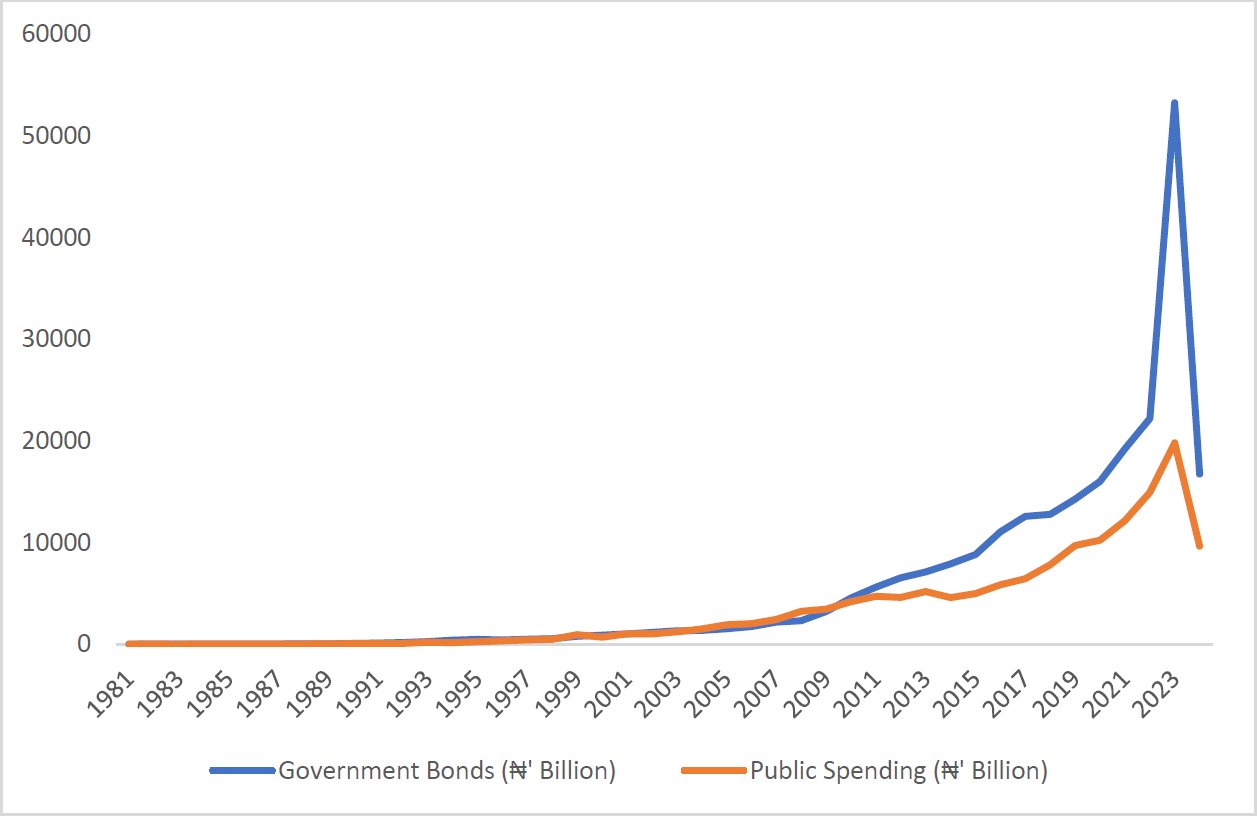
Fig. (1). Government bonds and public spending in Nigeria (1981-2024).
In the 1980s, Nigeria’s government spending and public sector investment were moderate. While government expenditure increased from ₦11.19 billion in 1981 to ₦84.09 billion in 1990, the country’s public spending increased from ₦11.41 billion to ₦60.27 billion. The era was characterized by efforts geared towards cautious expansion due to the volatility of prices and adjustments. The issuance of bonds at this time was low as the government mostly relied on budgetary allocation and borrowed funds. However, the 1990s experienced a geometric growth rate in government expenditures as well as investment. As of 2000, government spending had grown tremendously reaching ₦701.05 billion. The expenditure growth is attributable to increased revenue generated due to efforts toward investing more in infrastructural development, notwithstanding the fact that initial indicators showed that government over-reliance on borrowing in the past had imposed a debt burden on the economy. Going forward, the issuance of government bonds within the country gained traction as a means of exploring internal debt financing alternatives.
In the first decade of the millennium, precisely from 2001 to 2010, debts financing and management strategies had significantly improved and better structured in Nigeria. The period marked the inception of the creation of the Debt Management Office. Resultantly, the launch of federal government bonds and treasury bills took place during the period. This led to increased spending by the government. Within the space of 10 years duration, government spending rose from ₦1.01 trillion to ₦4.55 trillion. Among other usage, the bond generated funds were used to introduce and establish capital market development in Nigeria, leading to a reduction in the country’s external borrowing. In the following decade, the improvement in Nigeria’s capital market led to a rapid increase in government fiscal activities. The country experienced a sharp increase in expenditure from ₦5.62 trillion to ₦16.02 trillion by 2020, culminating into a corresponding growth of between ₦4.71 trillion and ₦10.23 trillion, from 2011 to 2020.
However, it is imperative to note that in spite of the earlier positive role of bonds in economic space of the country, Nigeria currently experience fiscal challenges. This shows in the later part of the study period, precisely from 2021 to 2024. Spending climaxed at ₦53.26 trillion in 2023 after which it drastically fell to about ₦16.74 trillion in 2024. It would not be out of place to attribute the burden of past borrowing to the challenge. As at 2024, the surge in domestic debt service costs had reached almost ₦2 trillion. This caused the government to respond by front-loading debt repayments and exploring alternative financing mechanisms, to include the Sukuk and green bonds.
1.2.2. Bond Revenue and Public Spending
Public expenditure is a tool used most successfully by the government to determine the way an economy develops and to access social outcomes (You, 2024). It can, for all intents and purposes, be employed to cater for various public needs. The underlying theory of public expenditure lies in the concept of providing certain services that benefit the whole of society, with its significance deriving as being sources of economic activation and social stabilization (Eniola, 2024). Public expenditures create economic demand, generate employment, and imbue growth, while also serving as an avenue to reduce inequalities among people of a nation. Its focus, are therefore, basically, towards securing quality of life for the public (Sama et al., 2025). However, the impact is usually subject to the nature of the expenditure. In spite of the role of public spending in a country’s growth and development, many developing countries, Nigeria inclusive, public expenditure are characterized by ineffectiveness, corruption, and improper fund allocation. Expenditure in the nature of infrastructural development may be misappropriated in the form of recurrent expenditure or in the form of fund-lost, resulting from public sector failure. Around the globe, however, the experience considerably varies. In developed parts of the world, public expenditure on financial resources is dictated by existence of strong financial frameworks.
In Nigeria, such failure is exacerbated by huge and growing debt profile, with the attendant unsustainable debt servicing drawn from government revenue (Olaoye & Alabadan, 2024). This likens with the Greece’s financial crisis which resulted from unchecked rising public expenditure supported by unaffordable borrowing (Nitsi & Ioannidis, 2025). On the contrary, there are nations that conducted virtuous financial practices of public expenditure beneficial for the economic development of the state. The Nigerian context showed that borrowing and subsequent spending were driven by political cycles, with emphasis on spending related to those expenditures that yield observable developmental success, thereby increasing political support ratings of political leaders (Egiyi, 2024). While this may hold true, to a certain threshold, the secret here remains the efficiency with which policies are implemented. This, again, reveals an extreme underlining need for financial prudence, measurable public expenditure that is finely balanced between current necessity and long-term financial obligations.
Governments’ outlay on education sector is one of the important investments towards securing the future of a nation. Beyond social services, education is the cornerstone of human capital formation and development. It is, as such, essential in ensuring the provision of means of learning to everybody in society. Expenditure by governments in the sector therefore indicate the laying of groundwork for the growth of intellectual abilities of the people, and by extension, the nation (Tarigan & Saharuddin, 2025). Thus, the significance of education spending reflects in its transformational abilities on the national economy. To this end, expenditure in the education sector in Nigeria has proved important in expanding the elementary education sector, the primary, the secondary, and tertiary infrastructures within the country (Olaoye & Alabadan, 2024). Hence, education expenses promise massive future returns, at the economic front. Noted in many world economies, states investing significantly in education have registered greater rates of growth with improved competitiveness. Investment in educational systems enables people to acquire necessary skills that lead to discovery of new industries. This substantiates investment in education by the Nigerian government in addressing unemployment while also building capacity to meet the needs in emerging sectors such as information and communication technologies, healthcare, and manufacturing industries (Eniola, 2024). However, education spending largely depends on fund availability, its allocation and utilization. The major challenge confronted by the sector is that the sector suffers less capital prioritization, with funds been rarely apportioned for infrastructure development, innovations, research and many more. Systemic corruption and inefficiencies in money management also plagues the sector, limiting its performance (Danlami et al., 2025).
Globally, the experiences with expenditure on education are disparate. Many developed countries have shown the impact that proper expenditure in education holds the key to change a country’s dynamics and creating a well-skilled people and innovative economies. On the other hand, countries with poorly aimed fiscal responsibility, instability, and lack of prudent education spending are known for negative impact culminating in low literacy levels and inadequate human capital. Nigeria’s case fits the middle ground where the government is aware that education expenditure is important, but still hinder the sector through fund deprivation (Isma et al., 2025). Nigeria, in addition denying its education sector the required fund, also politicizes budgetary allocation to education sector such that funded educational projects are situated where they are not or rarely needed just to score political points. Such projects become redundant at the expense of locations where such projects are highly needed. This has resulted in gross under-performance, inefficiency and waste of scarce resources (Othman et al., 2024).
2. LITERATURE REVIEW
2.1. Theoretical Review
Peacock and Wiseman Hypothesis of Public Expenditure: The Peacock and Wiseman hypothesis, formulated by Alan Peacock and Jack Wiseman in the 1960s, identifies existing linkage among public expenditure, economic growth, and changing societal requirements. The theory asserts that increase in public spending does not occur as a result of smooth trajectory, rather it rises through discrete structural shifts often triggered by crisis. In effect, institutional upheavals, infrastructure deficits, and other socio-economic crises affecting education growth and development pressurizes the governments to rapidly increase education sector capacity. The swiftness with which government response is required necessitates the usage of debt instruments, such as bonds, to instantly mobilize capital. This is because alternative tax revenues take more time to be raised to cater for such emergency. Bonds is therefore the financial wheel operationalizing the displacement effect of non-tax revenue provision to cater for educational spending. Thereafter, spending on the education sector will never return to its pre-crises level, rather it will keep rising as money made from government bond gets deployed into the sector’s infrastructure spending. This brings about a new equilibrium but then gets affected by a new social disturbance, thus forming a cycle of displacement effects (Magazzino et al., 2015).
Here, debt financing through government bonds is a structural mechanism that leads expenditure to a higher and permanent threshold following a systemic demand period, referred to as the inspection effect. This is often associated with by the concentration effect which illustrates the faster rate of growth of the central government’s spending beyond activities within the states (Peacock & Wiseman, 1961). The model yields two testable and directly mapped expectations towards the study’s empirical position. A path dependency and expenditure resulting from displacement and inspection effects, leads to the lag in education spending with a high positive coefficient. This is a reflection of the continuous higher spending once it is initiated. Also, government bond issuance is seen here as an immediate enabler for capital expansion, signaling expected positive association between education spending and government bonds.
Musgrave Theory of Public Expenditure Growth: The theory of public expenditure, propounded by Musgrave links growth in government expenditure to structural changes across different stages of development. The theory asserts that the responsiveness of demand for public goods varies with change in per capita income. Nigeria, being in its middle-income developmental stage, demand in the country tends to gradually transition from basic survival needs to more of sophisticated capital-intensive goods, with education infrastructure as one of the most important (Sparks, 1964). In order to match the increasing need for this human capital infrastructure heavy initial capital outlay, which cannot be accommodated by the country’s tax base revenue, is often required. Thus, bond issuance serves as a bridge in the revenue gap to facilitate upfront financing of the needed educational infrastructure, while providing space to spread the fiscal load over time (Aggarwal, 2017; Arif et al</.=”#em”>em>., 2026). The other important angle of Musgrave’s theory involves the consideration of social welfare and equity, laying emphasis on a balanced expenditure between efficient service delivery and equitable public goods’ accessibility.
Within this context, bond-financing tends to enable the expansion of education to people with less access to such public goods. By implication, leveraging bond markets, ensures the security of long-term human capital investments. This in turn enhances the nation’s workforce productivity, driving output growth over time (Bandyopadhyay & Singh, 2023; Usman et al., 2026). The theory’s developmental framework provides a testable expectation for education financing-bond relation. As the economy grows, there is an increase in demand for secondary and tertiary education, substantiating a positive relationship between economic output and education spending. Further, Second, given that changes in public service demand require instruments that generate fund, bond issuance tends to assist spending on education. This highlights the relevance of the debt markets in funding public infrastructure (Suriadi et al., 2023).
2.2. Excerpt of Empirical Review
Government bonds, being offered debt securities by governments to acquire fund in covering expenses that exceed their budget, has application in financing government expenditures. This includes its usage in covering expenses related to social activities (Antolin-Diaz, 2025). However, the relationship of government bonds with respect to public spending in Nigeria, has been controversial in terms of credibility (Egiyi, 2024).
In the empirical research by (Abdul-kemi, 2014), where annual time series were analysed to study bond-economic growth relationship, it was discovered that government bonds have positive but insignificant contribution to economic growth. The study asserts that the impact of bonds in offering growth in the economy is related to efficiency in the use of funds. (Akhanolu et al., 2018) pointed out the danger of the possible growth damage that could result from excessive borrowing. The study cautioned that over-reliance on the issuance of bonds and foreign borrowing has the tendency to cause ‘overhang effect’, which could drive away investment from the real sectors of the economy.
In the study by (Petlele & Buthelezi, 2025) where bond yield shocks in South Africa was analyzed using secondary data, it was found that a wave or shock in the bond market directly relates with economic growth. Bond-financed spending resulted in financial instability and overloading interest rates. A set of macroeconomic determinants of bond yields, such as inflationary level, investors’ trust and monetary policies, that relates to emerging economies were identified by (Koroleva & Kopeykin, 2022). Given the effect of both internal and external factors on bond attractiveness in Nigeria, such determinants prove to also be applicable to the context of the Nigerian economy.
Given that inflation has the tendencies to raise borrowing rates, it may impact the capacity of Government to spend on basic services. A good borrowing opportunity through bond issuance at low rates of interest may enable the Government to spend more on public goods (Iqra et al., 2025). The ability to understand these relationships is crucial to the development of policies for sustainable economic growth that is poised, especially given serious challenges related to high unemployment levels and inadequate public infrastructure.
Literature further considers expenditure policies to be homogeneous rather than focusing on the various fields benefited by the government bonds investments. As a result, it was established that there was information gap concerning the effectiveness of the investments that were put in place. An investigation into the allocation may provide valuable information regarding the importance of sectors that were given priority, as well as the impact of such priority in ensuring its effectiveness in heralding the expected economic growth. (Akhanolu et al., 2018) noted the role played by capital expenditure in improving economic development. However, the study did not bring to fore the sectors that benefitted from the expenditure. The clarification was necessary because while investment in infrastructure sector tends to lead to immediate benefits such as job creation and increased productivity, improved education spending, in turn, provides long-term benefits to investments through the training of enhanced human capital. Analyzing the allocation of funds from issued bonds to necessary sectors of the economy, provides explanation for its effects on the economy.
2.3. Study Gap
Sectoral oversight has long remained a lacuna in the government bond spending. Reviewed work has sufficiently showed that empirical literature generally considered government expenditure, being a fiscal policy measure in Nigeria, as an aggregate macroeconomic variable, where overall public investments and economic growth are collectively considered. Notable research works on sovereign debt had thoroughly evaluated bond issuance and debt overhang (Akhanolu et al., 2018; Abdul-kemi, 2014). The studies however failed to separate how bond-financed proceeds actually impacted sectoral allocations such as education spending. General consensus concluded that capital expenditure drives economic development while leaving an information caveat on the explicit transmission pathway that links government bond to critical social sectors, most notably expenditure on education. Further, previous works had regularly overlooked the inherent complex endogeneity in fiscal policy implementation and its analysis. There has been failure to account for existing reverse causality between public expenditure streams and governments’ borrowing alternative choices, in the past literature. Also, path dependency of previous budget allocations in the country was not taken into consideration, and this, by no means, is an important shortcoming of earlier empirical works. This is because the treatment of public expenditure without dynamic time-path components not only ignores the financial tightening caused by macroeconomic instability but also erodes the real value of government capital investment.
Methodologically, the study provides a bridge to a major analytical gap by fitting a System Generalized Method of Moments estimation regression which takes into accounts the influence of past education spending through lagged variables, controls for unobserved variation, and also adjust for reverse endogenous causality between debt issuance and government expenditure. Through this, the study delivers a superior and more robust evaluation of bond market proceeds on sustainable education funding in Nigeria.
3. METHODS
3.1. Type, Source of Data and Method of Analysis
The study analyzed secondary data to explain the relationship between government bonds and government spending in Nigeria, between 1981 to 2024. The period is largely covered by military regimes precipitated with economic recessions while transiting to democracy periods. During the period, the country also experienced changing fiscal policies. The series were extracted from relevant publications of Central Bank of Nigeria Statistical Bulletin.
In the research, the features of the series are described after which their levels of stationarity were tested using the ADF and Phillips-Perron tests. This study utilizes a system Generalized method of moments estimation technique given its strength to account for the existing reverse causality endogeneity between borrowing and spending. This is supported by its accountability of variable lag effect, hence ensuring reliability and validity of the study results (Gujarati, 2004).
3.2. Model Specification
The research models relevant studies in its model specification, taking into account the importance of some critical macroeconomic variables. For instance, public expenditure being a function of gross domestic product (Jibir & Aluthge, 2019; Mohsen, 2022; Adegboye & Akinyele, 2022; Horobeț et al., 2023), government bonds (Abdul-kemi, 2014; Omodero & Alege, 2022), inflation rate (Mohsen, 2022; Gina et al., 2023).
gset = f(gdpt, gbt irt & ift) (1)
Where; Government spending on Education (N’billion); Gross Domestic Product (N’billion); Government bonds (N’billion); Inflation rate (%); Interest rate (N’billion)
The linear form of equation one above is giving as;
gset = β0 + β1gdpt + β2gbt + β3ift + β4irt + tεt (2)
The specific model to achieve the study objective to determine the effect of government bonds generated proceeds on government spending on education in Nigeria is thereafter adapted from equation 2 above.
lngset = β0 + β1lngset-1+ β2lngdpt + β3lngbt + β4ift + β5irt + εt (3)
3.2.1. Dependent Variable
lngset = Natural log of government Spending on Education in current period t
3.2.2. Explanatory Variables
lngdpt = Natural log of Gross Domestic Product
lngbt = Natural log of Government Bonds
ift = Inflation Rate
irt = Interest rate
3.2.3. Lagged Variable/GMM Instrument
lngset-1 = A period lag of Government education spending (used to control for
reverse causality and endogeneity in the GMM estimation)
εt = Error term for unobserved shocks
4. RESULTS PRESENTATION
4.1. Descriptive Analysis
The features of the analyzed series are described and presented as shown in the Table 1.
Table 1. Descriptive analysis result.
| – | gse | gdp | gb | if | ir |
| Mean | 4.55 | 9.04 | 6.83 | 19.40 | 17.25 |
| Median | 4.25 | 9.43 | 7.13 | 13.13 | 16.92 |
| Maximum | 6.62 | 12.53 | 10.88 | 72.84 | 31.65 |
| Minimum | 3.37 | 4.94 | 2.42 | 5.39 | 8.92 |
| Std. Dev | 1.25 | 2.52 | 2.36 | 16.23 | 4.73 |
| Skewness | 0.41 | -0.32 | -0.30 | 1.80 | 0.40 |
| Kurtosis | 1.54 | 1.69 | 1.95 | 5.28 | 3.78 |
| JarqueBera | 5.14 | 3.92 | 2.70 | 33.14 | 2.12 |
| Probability | 0.08 | 0.14 | 0.26 | 0.00 | 0.35 |
| Sum | 200.32 | 397.76 | 301.11 | 853.66 | 758.98 |
| Observation | 44 | 44 | 44 | 44 | 44 |
Source: Author’s computation, 2026.
Table 1 showed that across the sample period the mean estimates of government education spending is 4.55 while that of GDP is 9.04. While the mean estimate of government bond is 6.83, the average inflation and interest rates are 19.40 and 17.25, respectively. The result revealed close median values of the series to their respective means, thus confirming the absence of notable asymmetry. Government bonds and spending on education have standard deviations that are moderately dispersed around their mean estimates. However, GDP, interest rate and inflation rates have respective standard deviations of 2.52, 4.73 and 16.23 which shows wider variability, thus reflecting a much higher fluctuation. A negative skewness of -0.32 was reported for GDP, while a right-skewness was shown by the inflation series, which is in consistence with the reported maximum value relative to its mean. Interest and inflation rates are leptokurtic with estimates of 3.72 and 5.28, respectively. GDP. Government bonds and interest were found to be normally distributed given the probability values of their respective Jarque-Bera statistics.
As reported in Table 2 above, all variables were not of order I(0) across both the ADF and Phillip-perron tests. After differencing the variables became integrated of order I(1), hence the null hypothesis of presence of unit root is rejected, in both tests. They therefore exhibit first order integration properties. The system of generalized method of moment, GMM, is employed as it allows for dynamic specification and maintains consistency even when series are of any order of integration. It is also suitable for estimating the model with lag instruments in order to account for inherent dynamics among variables.
Table 2. Unit root test result table.
| Variable | Order | ADF Test | PP Test |
| lngse | Level | 0.85(0.99) | 0.54(0.99) |
| First Diff. | -8.94(0.00)*** | -8.87(0.00)*** | |
| lngdp | Level | -1.38 (0.58) | -1.11 (0.70) |
| First Diff. | -3.59 (0.01)** | -3.52 (0.01)** | |
| lngb | Level | -1.97 (0.30) | -2.31 (0.17) |
| First Diff. | -6.98(0.00)*** | -7.03(0.00)*** | |
| ir | Level | -2.55 (0.11) | -2.56 (0.11) |
| First Diff. | -6.96(0.00)*** | -6.97(0.00)*** | |
| if | Level | 1.73 (0.11) | -2.72 (0.15) |
| First Diff. | -6.71(0.00)*** | -10.43(0.00)*** |
Note: *** p < 0.01, ** p < 0.05, * p < 0.1
Source: Author’s computation, 2026.
4.2. The GMM Regression
Result of the estimated system Generalized method of moments (GMM) regression is presented and discussed below.
In Table 3 above, the results of the effect of government bonds generated fund on government spending on education in Nigeria, is presented. The results show that lag of government spending on education, government bonds and inflation rate are statistically significant in determining current government spending on education. While effect of lag of government spending on education and government bonds are statistically significant, the effect of GDP on education spending is not significant at any statistical level. Inflation and interest rates have negative and influence on government spending on education in Nigeria. While the effect of inflation rate is significant at 1 percent level, the effect of interest rate is not significant. The positive coefficient of the lag of education spending indicates that past allocations to education strongly predict current allocations. The positive and statistically significant coefficient of government bonds implies that greater government bond issuance or bond-financed resources are associated with higher government spending on education. Bonds appear to be, at least partly, used to finance education outlays, capital projects such as school construction, over and above its usage for recurrent costs. Given that the coefficient is modest, bond financing is likely a complementary financing source rather than a dominant driver of education spending. These are in line with studies that aligned with the proposition that domestic borrowing and bond markets helps to finance public sector investments, including human-capital enhancing sectors like education (Jibir & Aluthge, 2019; Mohsen, 2022).
Table 3. GMM regression output.
| Variable | Coefficient | Std. Error | P-value |
| 0.83 (0.00)*** | 0.105 | 0.000 | |
| 0.08 (0.30) | 0.072 | 0.304 | |
| 0.02 (0.00)*** | 0.002 | 0.006 | |
| -0.01 (0.33) | 0.008 | 0.334 | |
| -0.01 (0.00)*** | 0.001 | 0.000 | |
| cons_ | 0.22 (0.75) | 0.705 | 0.753 |
| – | |||
| R-square | 0.98 | – | – |
| Adjusted R-square | 0.97 | – | – |
| Durbin-Watson Stat. | 2.31 | – | – |
| J-stat. | 0.000 | – | – |
Note: *** p < 0.01, ** p < 0.05, * p < 0.1
Dependent Variable:
Source: Author’s computation, 2026.
The negative and significant coefficient of inflation suggests that higher inflation reduces money value, thus adversely affecting education spending. This may necessitate budget line indexation or incorporation of contingency adjustments into the nation’s multi-year budgets, in order to protect education spending.
4.3. Post Estimation Test
Results of the post-estimation diagnostic check, evaluating the robustness and reliability of the fitted econometric model in the study, is presented in Table 4 below.
Table 4. Post-estimation test results.
| Serial Correlation | |
| Test | Bonds & Education |
| Arellano-Bond test for AR(1) | -2.09 |
| (0.137) | |
| Arellano-Bond test for AR(2) | -0.79 |
| (0.432) | |
| Restriction over-identification | |
| Test | Bonds & Education |
| Sargan test of overid. | 256.97 |
| Restr | (0.7684) |
| Hansen test of overid. | 8.35 |
| Restr | (1.000) |
Note: *** p < 0.01, ** p < 0.05, * p < 0.1
Source: Author’s computation, 2026.
The test results show that education spending has Arellano-Bond AR(1) test statistics of -2.09, with a probability value of 0.137 suggesting the absence of first-order autocorrelation. Same result is also reported for AR(2) test with estimated statistic of 0.79 and probability value of 0.432 indicating that the model is free of autocorrelation. The respective outputs of Sargan test (256.97, p = 0.7684) and Hansen test (8.35, p = 1.000) clearly supports the validity of the instruments. This ascertains the model reliability. In the overall, the results of the analysis of effect of funds from government-issued bond on education spending in Nigeria using the GMM is valid and robust.
5. DISCUSSION
Education spending demonstrates persistence, with past allocations strongly influencing current spending. This is a reflection of multi-year budgeting ongoing programs which include continuous upward salary review of resource persons, provision of educational capital projects, and so forth. This finding matches the public expenditure literature that documents the importance of past spending in explaining current outlays (Ukwueze, 2015; Jibir & Aluthge, 2019). Government bonds have a positive and significant effect on public spending on education. The positive effect is an indication that expansion of the country’s fiscal space through bond issuances provides higher budgetary allocations to education sector financing.
However, the effect is relatively modest, suggesting bonds complement rather than dominate education financing. The positive effect of government bonds resonates with findings that domestic borrowing supports investment in human-capital sectors (Ahwireng-Obeng & Ahwireng-Obeng, 2020). Inflation exerts a negative and significant effect on education spending. This highlights the need for inflation-indexed budgeting or macroeconomic stability to protect education spending. The noted adverse impact of inflation is a confirmation of prior evidence that undermines service provision and growth (Castelló Climent, 2010; Ahuja & Pandit, 2020). Macroeconomic stability that keeps inflation low supports the real value and effectiveness of education allocations. Matches theoretical and empirical work showing inflation erodes the real value of public spending and can harm provision of public services.
The positive role of government bonds is further established by (Abdul-kemi, 2014; and Omodero & Alege, 2022), who argued that bond financing augments public service investment. However, both interest rates and inflation have negative and significant effects on education debt financing. This substantiates evidence that macroeconomic instability constrains social sector spending (Azmi, 2013; Asogwa & Ezema, 2005; Castelló Climent, 2010).
LIMITATIONS AND FUTURE DIRECTION
The study provided a robust insight into the dynamics of government bond financing and education spending in Nigeria. However, the reliance on aggregated macro-level national data does not allow for proper disaggregation of education spending into capital and recurrent outlays. Variance in regional and state-level allocation and utilization of bond proceeds are also needed to be looked into by future studies.
While the system of Generalized Method of Moments (GMM) dynamic model controls for endogeneity, lag effects and reverse causality, affecting external shocks are not fully captured by the adopted control variables. Lastly, the linear form of the dynamic regression model specified and estimated in the study assumes a uniform and continuous relationship over time. This may not adequately reflect potential non-linearities, threshold effects, or structural breaks inherent in the bond market and public expenditure patterns, in Nigeria.
CONCLUSION
The study draws that, with appropriate fund channeling and utilization, deepening domestic government bond markets has potentials to mobilize resources towards the growth of education sector, even as price level undermines real spending. The benefits depend on prudent debt management and maintenance of low borrowing costs and price stability.
Domestic government bonds needed to be complementarily leveraged to broaden the country’s fiscal space such that educational funding will have a good representation in the nation’s annual budgetary allocation that capitalize on the strong. This will serve as blocks upon which subsequent spending rests, given the positive persistence of past education allocations to the sector. It is equally necessary to prioritize macroeconomic policies that keep inflation low and stable. There should be maintenance of a credible inflation-targeting framework, tighten monetary stance when necessary, and use fiscal prudence to avoid demand-driven inflation spikes that erode real public expenditures.
ABBREVIATION
GMM | = | Generalized Method of Moments |
AUTHORS’ CONTRIBUTIONS
N.O.B. has contributed to the conceptualization and design of the study, data analysis and interpretation of the findings, and preparation and writing of the manuscript. H.O.O. has contributed to data collection, manuscript writing, proofreading, and reference compilation and formatting. Both authors reviewed and approved the final version of the manuscript.
ETHICAL APPROVAL & INFORMED CONSENT
Not applicable.
AVAILABILITY OF DATA AND MATERIALS
The data will be made available on reasonable request by contacting the corresponding author [N.O.B.].
FUNDING
None.
CONFLICT OF INTEREST
The authors declare that there is no conflict of interest regarding the publication of this article.
ACKNOWLEDGEMENTS
Declared none.
DECLARATION OF AI
In preparing this manuscript, the authors used ChatGPT as a language-editing and refinement tool. All AI-assisted content was subsequently reviewed and, where necessary, revised by the author. The author retains full responsibility for the content, accuracy, and final version of the manuscript.
REFERENCES
Abbasov, R. (2025). Government budgeting and expenditure: A multifaceted analysis of economic growth, fiscal sustainability, and social impact. iBusiness, 17, 32–55.
https://doi.org/10.4236/ib.2025.171002
Abdul-Kemi, I. Z. (2014). Government bonds and economic growth and development in Nigeria: An empirical study. American Open Economics Journal, 2(3), 1–15. Available from: https://www.researchgate.net/profile/Abdul-Zubair-2/publication/352374581_Government_Bonds_and_Economic_Growth_and_Development_in_Nigeria_An_Empirical_Study/links/60e1f05692851ca944a79e52/Government-Bonds-and-Economic-Growth-and-Development-in-Nigeria-An-Empirical-Study.pdf
Adegboye, A., & Akinyele, O. D. (2022). Assessing the determinants of government spending efficiency in Africa. Future Business Journal, 8, 47.
https://doi.org/10.1186/s43093-022-00142-8
Aggarwal, R. (2017). Growth of public expenditure. Pacific Business Review International, 9(9), 122–128.
https://www.pbr.co.in/2017/2017_month/March/14.pdf
Ahuja, D., & Pandit, D. (2020). Public expenditure and economic growth: Evidence from the developing countries. FIIB Business Review, 9(3), 228–236.
https://doi.org/10.1177/2319714520938901
Ahwireng-Obeng, A. S., & Ahwireng-Obeng, F. (2020). Macroeconomic determinants of sovereign bond market development in African emerging economies. International Journal of Emerging Markets, 15(4), 651–669.
https://doi.org/10.1108/IJOEM-07-2018-0400
Akhanolu, I. A., Babajide, A. A., Akinjare, V., Oladeji, T., & Osuma, G. (2018). The effect of public debt on economic growth in Nigeria: An empirical investigation. International Business Management, 12(6), 436–441. Available from: https://www.researchgate.net/publication/327731901_The_Effect_of_Public_Debt_on_Economic_Growth_in_Nigeria_An_Empirical_Investigation
Amadi, U. V., & Nwogu, U. J. (2023). The impact of funding on educational development in Nigeria. Journal of Education in Developing Areas, 31(3), 61-82. Available from: https://journals.journalsplace.org/index.php/JEDA/article/viewFile/383/304
Antolin-Diaz, J. (2025). How did government bonds become safe? [Working paper]. London Business School.
https://www.juanantolindiaz.com/docs/HowDidBondsBecomeSafe.pdf
Arif, T., Munir, Y., Azeem, S., Khan, M. B., Zafar, H., & Sarwar, U. (2026). Nexus between business incubators, commercialization and innovation: Does absorptive capacity act as a mediator? Journal of Asian Development Studies, 15(1), 1–14.
https://doi.org/10.62345/jads.2026.15.1.1
Asogwa, R. C., & Ezema, C. C. (2005). Domestic government debt structure, risk characteristics and monetary policy conduct: Evidence from Nigeria [Research report]. International Research Project on Macroeconomic Policy Challenges for Low-Income Countries. Available from: https://www.imf.org/external/np/res/seminars/2005/macro/pdf/asogwa.pdf
Azmi, F. (2013). An empirical analysis of the relationship between GDP and unemployment, interest rate and government spending [Working paper]. SSRN.
https://doi.org/10.2139/ssrn.2276817
Bandyopadhyay, S., & Singh, H. (2023). Foundations of public expenditure management: Theories and concepts. In K. D. Dzigbede & W. B. Hildreth (Eds.), Research handbook on public financial management (pp. 238–257). Edward Elgar Publishing.
https://doi.org/10.4337/9781800379718.00026
Castelló-Climent, A. (2010). Inequality and growth in advanced economies: An empirical investigation. The Journal of Economic Inequality, 8(3), 293–321.
https://doi.org/10.1007/s10888-010-9133-4
Danlami, D., Muhammad, H., & Ramatu, I. B. (2025). Effect of public education spending on pupils’ enrolment in Nigeria (1980–2024). Abuja International Journal of Education, 12(1), 411–419. Available from: https://www.researchgate.net/publication/400707929_Effect_of_Public_Education_Spending_on_Pupils’_Enrolment_in_Nigeria_1980-2024
Egiyi, M. A. (2024). The politics of borrowing in Nigeria: Balancing short-term gains and long-term risks. International Journal of Financial Economics and Accounting, 4(1), 1–10.
https://doi.org/10.5281/zenodo.14773885
Ejedegba, R. U. (2022). Macroeconomic instability, policy uncertainty, and investment performance: The case of Nigeria. International Review of Economics & Finance, 83, 1–17. Available from: https://www.researchgate.net/publication/370875494_Macroeconomic_Instability_Policy_Uncertainty_and_Investment_Performance_The_case_of_Nigeria
Eniola, A. B. (2024). The impact of government spending (2008–2024) and the 14th five-year plan (2021–2025) on the economic growth of the People’s Republic of China [Master’s thesis, Selinus University]. Selinus University.
https://uniselinus.education/sites/default/files/2025-03/ADEBAYO%20BUSOLA%20ENIOLA.pdf
Ezeudu, T. S., & Fadeyi, T. J. (2024a). Examining the influence of infrastructure deficit on economic activities, education, and healthcare in rural areas of Nigeria. Nnamdi Azikiwe Journal of Political Science, 9(1), 155-176. Available from: https://najops.org.ng/index.php/najops/article/view/229
Ezeudu, T. S., & Fadeyi, T. J. (2024b). The politics of government budgeting and its implications for development in Nigeria. Journal of Public Administration, 6(1), 20–33.
https://doi.org/10.22259/2642-8318.0601003
Gina, O. O., Ogbeide, O. C., & Ofuebe, K. C. (2023). Determinants of public expenditure on government expenditure in Nigeria. Journal of the Management Sciences, 60(4), 144–158. Available from: https://journals.unizik.edu.ng/jfms/article/view/3644
Gujarati, D. N. (2004). Basic econometrics (4th ed.). The McGraw-Hill Companies. Available from: https://faculty.ksu.edu.sa/sites/default/files/gujarati_d._2004_basic_econometrics_1.pdf
Horobeț, A. L., Mnohoghitnei, I., Zlatea, E. M. L., & Smedoiu-Popoviciu, A. (2023). Determinants of e-government use in the European Union: An empirical analysis. Societies, 13(6), 150.
https://doi.org/10.3390/soc13060150
Iqra, Shafqat, M. M., Munir, Y., & Sarwar, U. (2025). Impact of ICT diffusion on economic growth: Exploring the moderating role of financial inclusion in E7 countries. Journal of Asian Development Studies, 14(3), 1339–1354.
https://doi.org/10.62345/jads.2025.14.3.108
Isma, F. H., Fitrawaty, F., & Rahmadana, M. F. (2025). The effect of government expenditure in the field of education, health and per capita expenditure on the Human Development Index in the districts/cities of North Sumatra Province. Indonesian Interdisciplinary Journal of Sharia Economics, 8(3), 11997–11210. Available from: https://www.researchgate.net/publication/402165380_The_Effect_of_Government_Expenditure_in_the_Field_of_Education_Health_and_Per_Capita_Expenditure_on_the_Human_Development_Index_in_the_DistrictsCities_of_North_Sumatra_Province
Jibir, A., & Aluthge, C. (2019). Modelling the determinants of government expenditure in Nigeria. Cogent Economics & Finance, 7(1), 1620154.
https://doi.org/10.1080/23322039.2019.1620154
Koroleva, E., & Kopeykin, M. (2022). Understanding of macro factors that affect yield of government bonds. Risks, 10(8), 166.
https://doi.org/10.3390/risks10080166
Magazzino, C., Giolli, L., & Mele, M. (2015). Wagner’s Law and Peacock and Wiseman’s displacement effect in European Union countries: A panel data study. International Journal of Economics and Financial Issues, 5(3), 812–819. Available from: https://www.researchgate.net/publication/280221932_Wagner’s_Law_and_Peacock_and_Wiseman’s_Displacement_Effect_in_European_Union_Countries_A_Panel_Data_Study
Mohsen, A. S. (2022). The main determinants of the government expenditure: A case study of Côte d’Ivoire. Timisoara Journal of Economics and Business, 15(2), 151–166.
https://doi.org/10.2478/tjeb-2022-0009
Nitsi, E. I., & Ioannidis, Y. (2025). State budget, public debt, fiscal outlook. Greek Economic Outlook, 56, 36–43. Available from: https://www.kepe.gr/wp-content/uploads/2025/04/2.pdf
Olaoye, F. O., & Alabadan, D. N. (2024). Effect of debt burden on public revenue and budget performance in Nigeria. African Banking and Finance Review Journal, 13(13), 63–80. Available from: https://www.abfrjournal.com/index.php/abfr/article/view/207
Omodero, C. O., & Alege, P. O. (2022). Public-sector bonds and economic growth in Nigeria. Montenegrin Journal of Economics, 18(2), 95–103.
https://doi.org/10.14254/1800-5845/2022.18-2.9
Onabote, A. A., Ohwofasa, B. O., & Ogunjumo, R. A. (2023). Government sectoral spending and human development in Nigeria: Is there a link? Heliyon, 9(7), e17545.
https://doi.org/10.1016/j.heliyon.2023.e17545
Othman, N., Abdul Kapar, N. I. J., Wahab, S. N., & Rizkalla, N. (2024). Assessing the role of government spending in education and economic growth in Malaysia. Advances in Social Sciences Research Journal, 11(2.2), 537–550. Available from: https://www.researchgate.net/publication/378789234_Assessing_the_Role_of_Government_Spending_in_Education_and_Economic_Growth_in_Malaysia
Peacock, A. T., & Wiseman, J. (1961). The growth of public expenditure in the United Kingdom. Princeton University Press. Available from: https://www.nber.org/books-and-chapters/growth-public-expenditure-united-kingdom
Petlele, O., & Buthelezi, E. M. (2025). Shocks of government bonds and yield impact economic growth in South Africa. Cogent Economics & Finance, 13(1), 2448219.
https://doi.org/10.1080/23322039.2024.2448219
Sama, M. C., Oumar, S. B., & Ndam, N. L. (2025). Public spending and sustainable economic development. Studies in Economics and Finance, 42(2), 218–239.
https://doi.org/10.1108/SEF-02-2024-0095
Sparks, G. R. (1964). Professor Musgrave’s theory of public expenditures. Canadian Journal of Economics and Political Science/Revue canadienne de economiques et science politique, 30(4), 591–594.
https://doi.org/10.2307/139520
Suriadi, I., Sriningsih, S., & Fatimah, S. (2023). Government expenditure according to functions and economic growth in Indonesia. East Asian Journal of Multidisciplinary Research, 2(5), 1933–1956.
https://doi.org/10.55927/eajmr.v2i5.3957
Tarigan, R. A. B. R., & Saharuddin, S. (2025). The influence of government expenditure in the education, health, and infrastructure sectors on the human development index in Aceh Province, 2018–2024. Journal of Malikussaleh Public Economics, 8(1), 34–47.
https://doi.org/10.29103/jompe.v8i1.22437
Ukwueze, E. R. (2015). Determinants of the size of public expenditure in Nigeria. SAGE Open, 5(4), 1–8.
https://doi.org/10.1177/2158244015621346
Usman, M., Sarwar, U., & Azeem, S. (2026). Entrepreneurial tax compliance in an emerging economy: The role of audits, penalties, and patriotic values in Pakistan. Journal of Entrepreneurship and Business Venturing, 6(1), 43–59.
https://doi.org/10.56536/jebv.v6i1.226
You, K. (2024, December). Government spending the biggest contributor to economic growth. Institute of Public Affairs.
https://ipa.org.au/wp-content/uploads/IPA-Research-Note-December-2024-Government-fuelled-economic-growth-FINAL.pdf