1. INTRODUCTION
In many real-world situations, when two or more random variables are observed and show some degree of dependence, the joint behavior of such variables is not described using univariate probability distributions alone. On the other hand, bivariate probability distributions give a mathematical way of studying the joint distribution of two or more random variables. Bivariate probability distributions have many applications in various fields such as economics, engineering, reliability theory, biomedical sciences, and environmental sciences.
The bivariate probability distribution gives the probability distribution of two random variables through their joint probability density function or mass function. It takes into account not only the probability distributions of the variables individually but also their association. There are many features of the distribution that can be derived from the joint probability distribution including the correlation coefficient, marginal distributions, conditional distributions, among others. Several bivariate probability distributions have been developed to model the joint behavior of two random variables i.e., Yoo et al. [1], Herr et al. [2], Olkin et al. [3], Yue et al. [4], Burgazzi et al. [5], Kocherlakota et al. [6], Yue [7], Li et al. [8], Yue et al. [9], Xie et al. [10], Nadarajah [11], Kim et al. [12], Lai et al. [13], Dehghani et al. [14], Filus et al. [15], Castillo et al. [16], Alaya et al. [17], Erdem et al. [18], Wang et al. [19], Onyancha et al. [20], Jacobs [21], Lee et al. [22], Poonia et al. [23], Patra et al. [24] and Ding [25] among others.
There exist various methods to create bivariate probability distribution in the literature, and copula is one of them. Nelsen [26] describes the copula as a function which joins the bivariate distribution functions having uniform marginals on the range [0,1]. The dependence relationship between random variables can be labeled by a copula using their quantile behavior. By combining univariate marginal distributions with an appropriate copula to construct bivariate probability distributions. There are numerous types of copulas including Clayton copula, Gumbel copula, t copula, Gaussian copula, Farlie-Gumbel-Morgenstern (FGM) copula, Archimedean copula and Frank copula. Among the various copulas, the Farlie-Gumbel-Morgenstern (FGM) copula is widely used for constructing bivariate probability distribution. For example, Shih et al. [27], Cuadras et al. [28], Husseiny et al. [29], El-Sherpieny et al. [30], Suzuki et al. [31], Louzada et al. [32], Abd Elgawad et al. [33], Qura et al. [34], Ghosh [35], El-Sherpieny et al. [36], Barakat et al. [37], Javed et al. [38], Ahmed et al. [39], Cuadras et al. [40], Hassan et al. [41] and Muhammed et al. [42] among others.
Although several bivariate lifetime distributions have been proposed in the literature, many of them suffer from one or more limitations. Some models have complicated joint structures that make parameter estimation computationally demanding, while others lack analytical tractability for deriving important reliability measures. Additionally, very few research articles have attempted to construct bivariate distributions using the Generalized Inverse Weibull distribution under the assumption of copula theory, specifically the Farlie–Gumbel–Morgenstern (FGM) copula. The reason is that the FGM copula offers an easy way to model weakly correlated variables. Hence, there exists a need for a flexible yet tractable bivariate Generalized Inverse Weibull distribution that can handle dependent lifetime data.
In this paper, we propose a new bivariate probability distribution, termed the FGM bivariate Generalized Inverse Weibull (FGM-GIW) distribution, constructed using the Farlie Gumbel Morgenstern (FGM) copula to link two Generalized Inverse Weibull marginal distributions. The proposed model is motivated by the need for a joint distributional framework that combines the flexible marginal behavior of the GIW distribution with an explicit dependence structure for modeling paired positive-valued data. By integrating these components, the model provides a framework for investigating the joint characteristics of two dependent random variables while retaining the individual properties of the GIW marginals. The statistical properties of the proposed distribution are investigated, including conditional distributions, conditional expectations, product moments, moment-generating functions, and reliability functions. Parameter estimation is performed using Maximum Likelihood Estimation (MLE), the Inference Functions for Margins (IFM) method, and Bayesian estimation. The performance of the proposed model is evaluated through numerical simulations and applications to real datasets, demonstrating its potential utility in the analysis of dependent economic and environmental observations.
The FGM copula was considered because it is an easy-to-work-with structure that allows one to construct bivariate distributions while preserving all the properties of the marginal distributions of the Generalized Inverse Weibull distribution. The advantage of the mathematical simplicity of this model is that various theoretical characteristics of the distribution can be obtained in an explicit form, including conditional distributions, moments, reliability functions, and estimation methods for parameters of the distribution. However, it should be emphasized that the dependence range of the FGM copula is quite narrow and it is impossible to model strong dependence or tail dependence with the help of this structure. Therefore, the suggested FGM-GIW distribution is well suited for problems related to modeling weak to moderate dependence structures.
The remainder of the paper is organized as follows. In Section 2, the proposed bivariate FGM Generalized Inverse Weibull (GIW) distribution is introduced. Section 3 presents its statistical properties, while Sections 4 and 5 discuss reliability measures and parameter estimation methods, respectively. Section 6 provides the results of simulation studies, Section 7 illustrates applications to real datasets, and Section 8 concludes the paper.
2. MODEL DESCRIPTION
The Probability Density Function (PDF) and Cumulative Distribution Function (CDF) for the univariate Generalized Inverse Weibull distribution is given as Eq: (2.1).



 Article DOI
10.67887/PD2601208009
Article DOI
10.67887/PD2601208009


 are the scale parameters and
  is the shape parameter.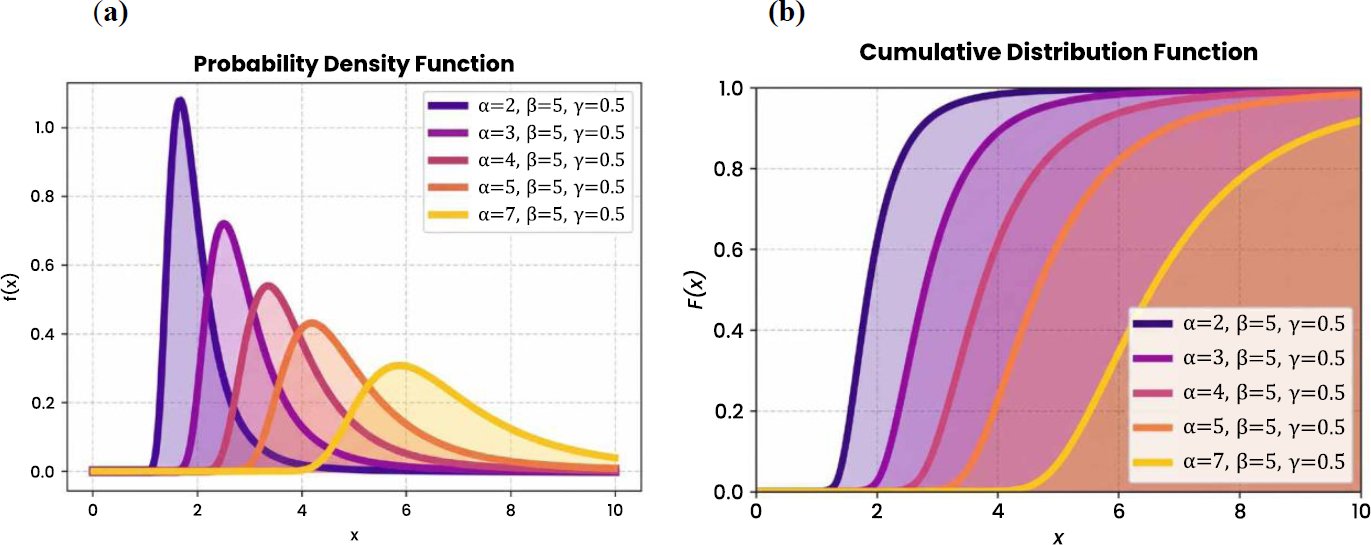
 and
and  with marginal cumulative distribution functions
  and
and  respectively. Then Sklar [43] presents the joint PDF and CDF based on copula theory Eq: (2.3).



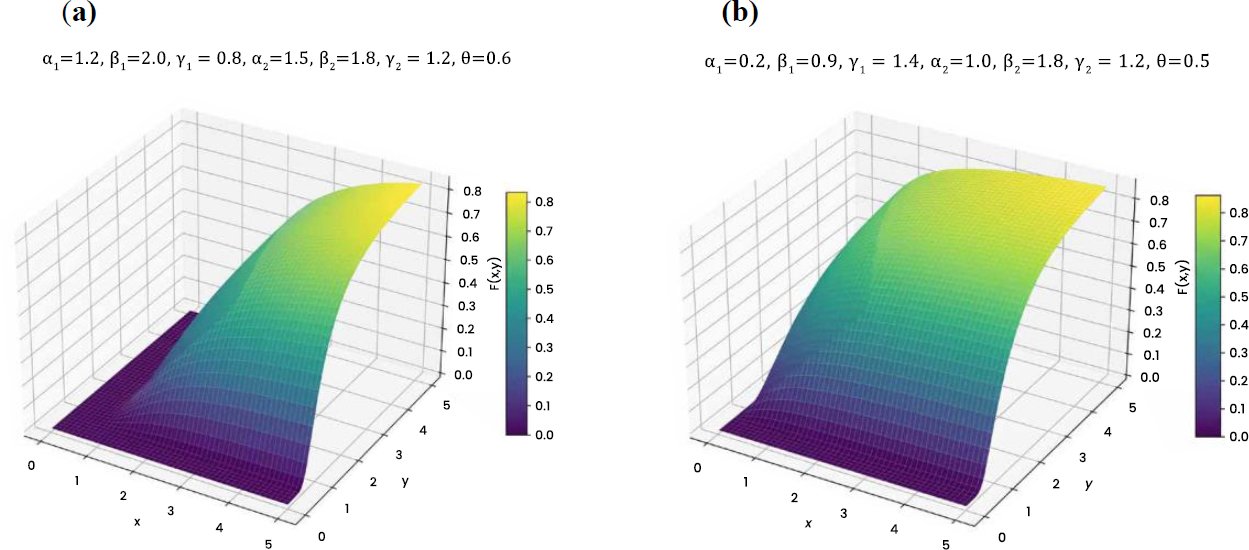
 . The CDF of bivariate FGM Generalized Inverse Weibull (GIW) distribution is given as Eq: (2.7).
 ,
,  . The corresponding joint PDF is Eq: (2.8).
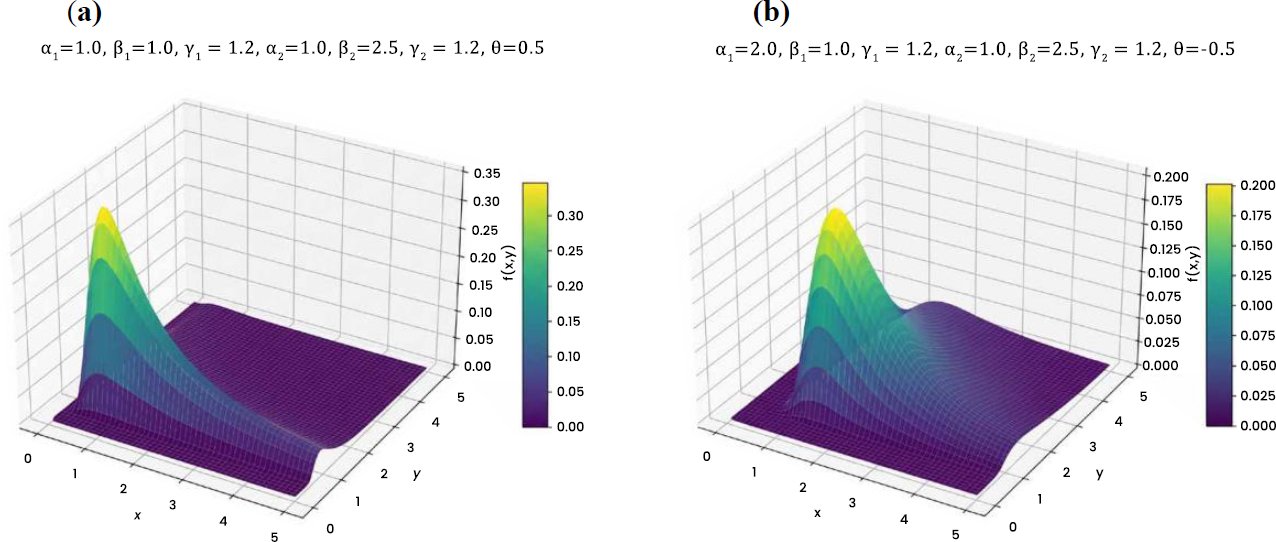

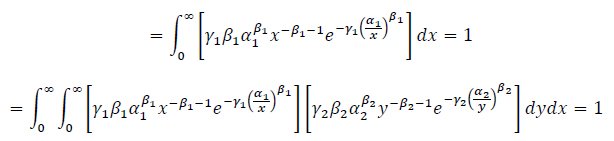
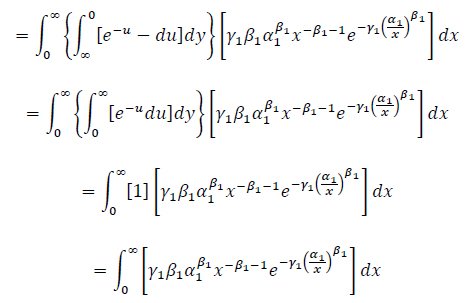
 . To conform this property, we integrate equation (2.8) as follow: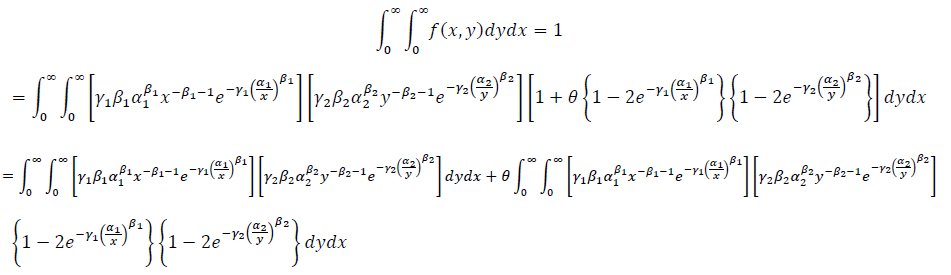
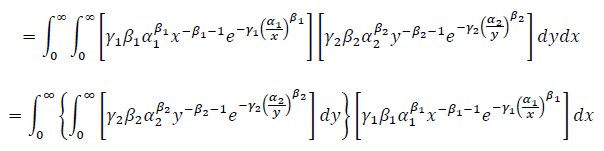

 .
.
 .
.